Page 270 of 400
8-32
nTires
WARNING
Never tow a trailer when the temporary spare tire is used. The temporary spare tire is not designed to sustain the towing load.
Use of the temporary spare tire when towing can result in failureof the spare tire and/or less stability of the vehicle.
Make sure that all the tires on your vehicle are properly inflated.
The recommended cold tire pressure under trailer towing conditions
is indicated on the tire placard located under the door striker on the
driver’ s side. Adjust the rear tire pressure to the recommended pres-
sure shown on the tire placard when the tires are cold. Normal pres-
sure should be maintained in the front tires.
Trailer tire condition, size, load rating and proper inflation pressure
should be in accordance with the trailer manufacturer ’s specifications.
In the event your vehicle gets a flat tire when towing a trailer, ask a
commercial road service to repair the flat tire.
If you carry a regular size spare tire in your vehicle or trailer as a pre-
caution against getting a flat tire, be sure that the spare tire is firmly
secured. Trailer towing tips CAUTION
Never exceed 45 mph (72 km/h) when towing a trailer in hilly
country on hot days. When towing a trailer, steering, stability, stopping distance and
braking performance will be different from normal operation. For
safety’ s sake, you should employ extra caution when towing a
trailer and you should never speed. You should also keep the fol-lowing tips in mind:
Page 272 of 400

8-34
trailer, causing sway. Crosswinds can be due to weather conditions or
the passing of large trucks or buses. If swaying occurs, firmly grip the
steering wheel and slow down immediately but gradually.When passing other vehicles, considerable distance is required
because of the added weight and length caused by attaching the
trailer to your vehicle. Backing up with a trailer is difficult and takes practice. When back-
ing up with a trailer, never accelerate or steer rapidly. When turning
back, grip the bottom of the steering wheel with one hand and turn it
to the left for a left turn, and turn it to the right for a right turn.
Left turn Right turn
OM-H2791
If the ABS warning light illuminates while the vehicle is in motion,
stop towing the trailer and have repairs performed immediately by the
nearest SUBARU dealer. n Driving on grades
Before going down a steep hill, slow down and shift into lower gear
(if necessary, use 1st gear) in order to utilize the engine braking effect
and prevent overheating of your vehicle ’s brakes. Do not make sud-
den downshifts. When driving uphill in hot weather, the air conditioner may turn off
automatically to protect the engine from overheating. When driving uphill in hot weather, pay attention to the water tem-
perature gauge pointer (for all vehicles) and AT OIL TEMP warning
light (for AT vehicles) since the engine and transmission are relatively
prone to overheating under these conditions. If the water temperature
Page 273 of 400

Driving tips8-35
–
CONTINUED –
gauge pointer approaches the OVERHEAT zone or the AT OIL TEMP
warning light illuminates, immediately switch off the air conditioner
and stop the vehicle at the nearest safe place. Refer to the “Engine
overheat” section in Chapter 9, and “Warning and indicator lights ”
section in Chapter 3. If your vehicle has an automatic transmission, avoid using the
accelerator pedal to stay stationary on an uphill slope instead of usingthe parking brake or foot brake. That may cause the transmission fluidto overheat. Also, if your vehicle is equipped with an automatic trans-mission, avoid driving with the gear selector lever in “D” when towing
a heavy trailer to prevent fluid overheating. A lower gear should beused. n Parking on a grade
Always block the wheels under both vehicle and trailer when parking.
Apply the parking brake firmly. You should not park on a hill or slope.But if parking on a hill or slope cannot be avoided, you should takethe following steps:
1. Apply the brakes and hold the pedal down.
2. Have someone place wheel blocks under both the vehicle and
trailer wheels.
3. When the wheel blocks are in place, release the regular brakes
slowly until the blocks absorb the load.
4. Apply the regular brakes and then apply the parking brake; slowly
release the regular brakes.
5. Shift into 1st or reverse gear (manual transmission) or “P” (auto-
matic transmission) and shut off the engine.
Page 276 of 400
9-2
If you park your vehicle in an emergency
HB8002BA
The hazard warning flasher should be used in day or night to warn other
drivers when you have to park your vehicle under emergency conditions.
Avoid stopping on the road. It is best to safely pull off the road if a prob-lem occurs.
The hazard warning flasher can be activated regardless of the ignition switch position.
Turn on the hazard warning by pushing the hazard warning flasher
switch. Turn it off by pushing the switch again. NOTE When the hazard warning flasher is on, the turn signals do not work.
Page 282 of 400
9-8
HB9056AA
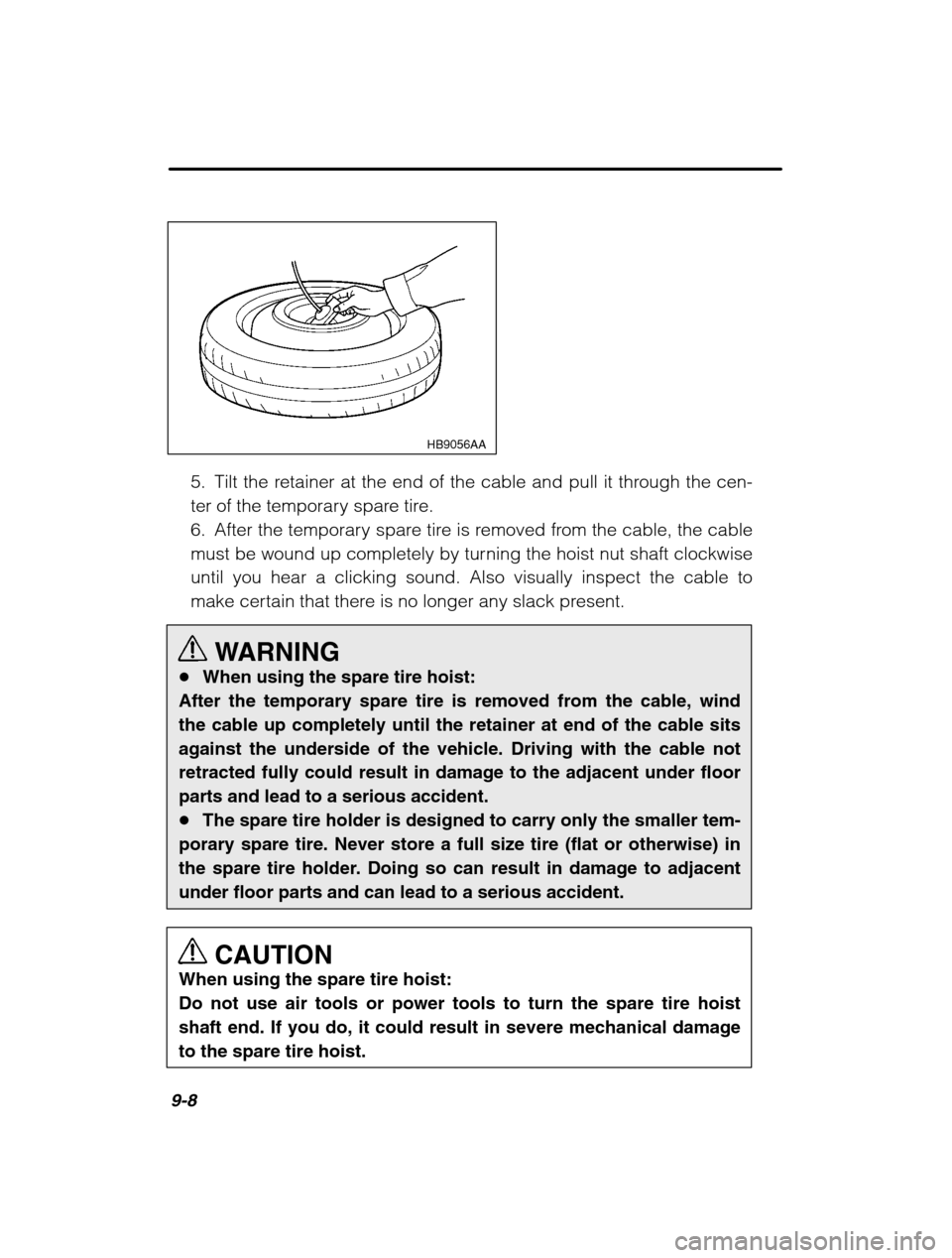
5. Tilt the retainer at the end of the cable and pull it through the cen-
ter of the temporary spare tire.
6. After the temporary spare tire is removed from the cable, the cable
must be wound up completely by turning the hoist nut shaft clockwise
until you hear a clicking sound. Also visually inspect the cable to
make certain that there is no longer any slack present.WARNING
When using the spare tire hoist:
After the temporary spare tire is removed from the cable, wind
the cable up completely until the retainer at end of the cable sitsagainst the underside of the vehicle. Driving with the cable notretracted fully could result in damage to the adjacent under floorparts and lead to a serious accident. The spare tire holder is designed to carry only the smaller tem-
porary spare tire. Never store a full size tire (flat or otherwise) in
the spare tire holder. Doing so can result in damage to adjacentunder floor parts and can lead to a serious accident.
CAUTION
When using the spare tire hoist:Do not use air tools or power tools to turn the spare tire hoist
shaft end. If you do, it could result in severe mechanical damageto the spare tire hoist.
Page 283 of 400
In case of emergency9-9
–
CONTINUED –
Re-storage of spare tire
1. Turn the spare tire hoist shaft end counterclockwise with the wheel
nut wrench to loosen the cable sufficiently enough to allow the cable
end retainer go through center hole of the temporary spare tire.
2. Insert the retainer through the center hole of the temporary tire
(with the outside of the tire facing up).
3. Turn the hoist shaft end clockwise with the wheel nut wrench towind the cable up completely until you hear a few clicking sounds.
Confirm that the temporary spare tire holding cable has been wound
up completely by shaking the temporary tire.
CAUTION
If the temporary spare tire is not stored securely, it could damage
adjacent areas of the vehicle and make an abnormal noise.
4. Put the rubber cap on the hoist shaft end hole.
5. Place the wheel nut wrench back into the tool bag and store thejack and tool bag in their storage locations.
Temporary spare tire Using the temporary spare tire
WARNING
Never tow a trailer when the temporary spare tire is used. The temporary spare tire is not designed to sustain the towing load.
Use of the temporary spare tire when towing can result in failureof the spare tire and/or less stability of the vehicle and may leadto an accident.
CAUTION
Never use any temporary spare tire other than the original. Usingother sizes may result in severe mechanical damage to the drivetrain of your vehicle.
Page 284 of 400

9-10
The temporary spare tire is smaller and lighter than a conventional tire
and is designed for emergency use only. Remove the temporary spare
tire and re-install the conventional tire as soon as possible because the
spare tire is designed only for temporary use.
Check the inflation pressure of the temporary spare tire periodically to
keep the tire ready for use. The correct pressure is 60 psi (420 kPa, 4.2
kg/cm 2
).
When using the temporary spare tire, note the following: Do not exceed 50 mph (80 km/h).
Do not put a tire chain on the temporary spare tire. Because of the
smaller tire size, a tire chain will not fit properly. Do not use two or more temporary spare tires at the same time.
Do not drive over obstacles. This tire has a smaller diameter, so
road clearance is reduced. When the wear indicator appears on the tread, replace the tire.
HB8003BB
HG0106
Indicator location mark
Tread wear indicator bar
NOTE [Automatic transmission vehicle] Before driving your vehicle with the temporary spare tire, put a spare fuse inside the FWD connectorlocated in the engine compartment and confirm that the Front-wheeldrive warning light comes on. The all wheel drive capability of the
vehicle has now been deactivated. After re-installing the convention-al tire, remove the spare fuse from the FWD connector in order to
reactivate all wheel drive.
Page 285 of 400
In case of emergency9-11
–
CONTINUED –
Flat tires
If you get a flat tire while driving, never brake suddenly; keep driving
straight ahead while gradually reducing speed. Then slowly pull off the
road to a safe place. Changing a flat tire
WARNING
Do not jack up the vehicle on an incline or a loose road sur-
face. The jack can come out of the jacking point or sink into the ground and this can result in a serious accident. Use only the jack provided with your vehicle. The jack sup-
plied with the vehicle is designed only for changing a tire. Neverget under the vehicle while supporting the vehicle with this jack. Always turn the engine off before raising the flat tire off the
ground using the jack. Never swing or push the vehicle sup-ported with the jack. The jack can come out of the jacking pointdue to a jolt and this can result in a serious accident. Never place a tire or tire changing tools in the passenger
compartment after changing wheels. In a sudden stop or colli-
sion, loose equipment could strike occupants and cause injury.Store the tire and all tools in the proper place.
1. Park on a hard, level surface, whenever possible, then stop the en-gine.
2. Set the parking brake securely and shift a manual transmission ve-
hicle into reverse or an automatic transmission vehicle into the “P” (Park)
position.
3. Turn on the hazard warning flasher and have everyone get out of thevehicle.