2003 SKODA SUPERB steering
[x] Cancel search: steeringPage 133 of 259

Communicating and Navigating
132
CD-player
– You can select the titles forward or back by pressing the button (positions
and ).
Radio data system (RDS)*
You can select the recorded radio traffic messages by moving forward or
back in stages by pressing the button (positions
and ).
On the version fitted with mobile phone, you must press button in the
position MODE in order to switch over to the radio mode.
Operating mobile phone
– You can operate the mobile phone with buttons , and
⇒page 130, fig. 115 .
– You can switch over from the radio mode to the phone mode (or back again) by pressing the button in the position
MODE .
– You can accept or end a telephone call or select from the tele- phone book by briefly pressing the button in the position
.
– You can refuse a telephone call by pressing the button in the position
for more than 2 seconds.
– You can make the volume of the telephone call louder or softer by pressing the button in the positions VOL+ and VOL- .
– You can scroll alphabetically upwa rd (A to Z) or downward (Z
to A) within the telephone memory by pressing the button
in the positions
and . Note
The operation of the mobile phone fitted with multifunction steering wheel
is only possible on certain models of mobile phone. More detailed infor-
mation is available from your Škoda Dealer.
Mobile phone, two-wa
y radio system and
navigation system
Universal telephone connectio n at the front* (GSM II)
A telephone mount is factory-fitted. The mount is attached to the
centre console. Adapter (Cullmann) and mobile phone are not
factory-fitted by Škoda Auto.
A4
A4
A2
A2A3A4
A2
A2
A2
A3
A4
Fig. 117 Universal tele-
phone connection at
the front
Page 140 of 259

Seat belts139
Using the systemSafetyDriving TipsGeneral MaintenanceBreakdown assistanceTechnical Data
The physical principle of a frontal
collision
The physical principle of a frontal accident can be explained quite simply: As soon as the vehicle is moving, so-called kinetic energy (the energy of
motion) is produced both in terms of the car as well as in terms of the
occupants. The magnitude of this kinetic energy depends essentially on
the speed at which the vehicle is travelling and on the weight of the vehicle
and the occupants. The greater the speed and weight increase, the
greater the amount of energy which has to be absorbed in the event of an
accident.
The speed of the vehicle is, nevertheless, the most important factor.
Doubling the speed of the vehicle from 25 km/h up to 50 km/hour
increases the kinetic energy four times.
The common opinion that it is possible to support your body in a minor
accident with your hands, is incorrect. Even in a collision at only a low
speed, the forces acting on the body are such that it is no longer possible
to support your body.
Even if you only drive at a speed within the range from 30 km/hour to 50
km/hour, the forces which are produced on your body in the event of an
accident can easily exceed 10,000 N (Newton). This equals a weight of
one tonne (1 000 kg).
In the event of a frontal collision, occupants of the car not wearing a seat
belt, are thrown forward and strike in an uncontrolled way parts of the inte-
rior of the car, such as steering wheel, dash panel, windscreen,
⇒fig. 121 .
The occupants of a vehicle who have not fastened their seat belts may
even be thrown out of the vehicle. This can result in fatal injuries.
It is also important that rear seat passengers fasten their seat belts as they
will otherwise be thrown through the vehicle in an uncontrolled manner in
the event of an accident A rear seat passenger who has not fastened the
seat belt is a danger not only to himself but also for those seated at the
front ⇒fig. 122 .
Fig. 121 The driver is
thrown forward if not
wearing a belt
Fig. 122 The rear seat
occupant is thrown
forward if not wearing a
belt
Page 148 of 259
Airbag system147
Using the systemSafetyDriving TipsGeneral MaintenanceBreakdown assistanceTechnical Data
Front airbags
Description of the front airbags
The airbag system is not a substitute for the seat belt!
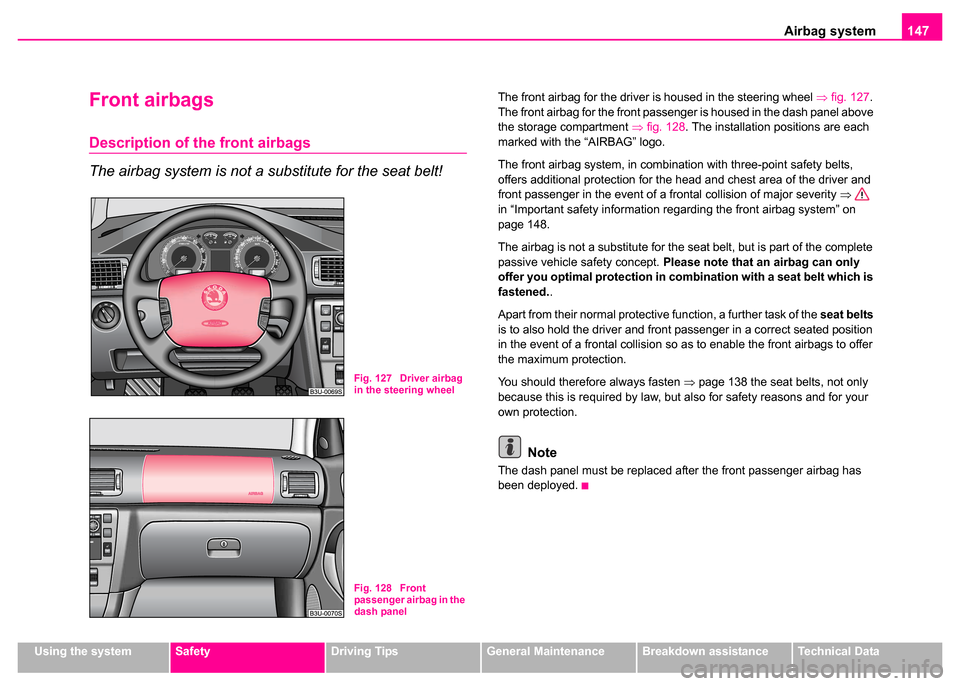
The front airbag for the driver is housed in the steering wheel ⇒fig. 127 .
The front airbag for the front passenger is housed in the dash panel above
the storage compartment ⇒fig. 128 . The installation positions are each
marked with the “AIRBAG” logo.
The front airbag system, in combination with three-point safety belts,
offers additional protection for the head and chest area of the driver and
front passenger in the event of a frontal collision of major severity ⇒
in “Important safety information regarding the front airbag system” on
page 148.
The airbag is not a substitute for the seat belt, but is part of the complete
passive vehicle safety concept. Please note that an airbag can only
offer you optimal protection in combination with a seat belt which is
fastened. .
Apart from their normal protective function, a further task of the seat belts
is to also hold the driver and front passenger in a correct seated position
in the event of a frontal collision so as to enable the front airbags to offer
the maximum protection.
You should therefore always fasten ⇒page 138 the seat belts, not only
because this is required by law, but also for safety reasons and for your
own protection.
Note
The dash panel must be replaced after the front passenger airbag has
been deployed.
Fig. 127 Driver airbag
in the steering wheel
Fig. 128 Front
passenger airbag in the
dash panel
Page 149 of 259

Airbag system
148
Function of the front airbags
Risk of injury to the head and chest area is reduced by fully
inflated airbags.
The airbag system is designed in such a way that the driver and front
passenger airbag are deployed in the event of a frontal collision of major
severity.
In certain accident situations both the front airbags as well as the head
and side airbags may be deployed together.
If the airbags are deployed, the airbags are filled with a propellant gas and
inflated in front of the driver and front passenger ⇒fig. 129 . The airbags
inflate in fractions of a second and at a high speed in order to be able to
offer that additional protection in the event of an accident. The forward
movement of the driver and of the front passenger is cushioned when they
make contact with the fully inflated airbag and the risk of injury to head and
chest is thus reduced.
The specially developed airbag allows the gas to flow out of the inflated
airbag in a controlled manner (depending on the load of the particular car occupant) in order to cushion head and chest areas. The airbag then
deflates subsequently to such an extent, after an accident, to again
provide a clear view forward.
A fine dust is produced when airbag inflated. This is perfectly normal and
is not an indication of a fire in the vehicle.
The airbag develops enormous forces when triggered, which can lead to
injuries if the sitting position or seated position is not correct
⇒ in
“Important safety information regarding the front airbag system”.
Important safety informati on regarding the front
airbag system
Correct use of the airbag system considerably reduces the
risk of injury!
Fig. 129 Inflated
airbags
Fig. 130 Safe distance
to steering wheel
Page 150 of 259

Airbag system149
Using the systemSafetyDriving TipsGeneral MaintenanceBreakdown assistanceTechnical Data
Side airbags
Description of side airbags
The side airbag together with the head airbag offers
enhanced occupant protection in the event of a side colli-
sion.
WARNING
•Never transport children on the front seat of a vehicle without
using a proper restraint system. If airbags are deployed in the
event of an accident, the child might suffer severe or even fatal
injuries.
•For the driver and front passenger it is important to maintain a
distance of at least 25 cm from the steering wheel or dash panel
⇒ page 148, fig. 130 . Not maintaining this minimum distance will
mean that the airbag system will not be able to properly protect you
- hazard! The front seats and the head restraints must always also
be correctly adjusted to match the body size of the occupant.
•It is essential to always switch off ⇒page 154 the front
passenger airbag when attaching a child safety seat on the front
passenger seat where the child is seated with its back facing in
direction of travel (in some countri es also when the child is facing
the direction of travel). If this is not done, there is a risk of the child
suffering severe or even fatal injuries if the front passenger airbag
is deployed. In certain countries national legal provisions also
require that the side or head passenger airbags be deactivated.
When transporting a child on the front passenger seat, please
comply with the appropriate nation al regulations regarding the use
of child safety seats.
•There must not by any further persons, animals or objects posi-
tioned between the front seated occupants and the deployment
area of the airbag.
•The steering wheel and the surface of the airbag module in the
dash panel on the passenger side must not be stuck onto, covered
or modified in any other way. These parts should only be cleaned
with a dry cloth or a cloth moistened with water. No objects such
as cup holders, mobile phone mounts, etc. may be attached to the
covers of the airbag modules or be located within the immediate
area.
WARNING (continued)
•No modifications of any kind may be made to parts of the airbag
system. Any work on the airbag system including installing and
removing system components because of other repair work (e.g.
removing the steering wheel) must only be carried out by a Škoda
dealer.
•Never place any objects on the surface of the front passenger
airbag in the dash panel.
Fig. 131 Installation
position of side airbag
in driver seat
Page 155 of 259

Airbag system
154
Deactivating an airbag
Deactivating airbags
If any airbags have been deactivated, switch them on
again as soon as possible so that they are able to again
provide their proper protection.
There is the technical means installed within your vehicle to switch off the
front, side or head airbag (take out of commission).
This is why you should have the deactivation of the airbags carried out by
a Škoda dealer. On vehicles equipped with the switch for deactivation of the airbags, you
can deactivate the front and side passenger airbag by means of this
switch
⇒page 155.
Deactivation of airbags is envisaged only for particular instances,
such as if
•Yo u m u s t i n exceptional cases use a child seat on the front
passenger seat where the child is seated with its back to the direction of
travel (in some countries this must be in the direction of travel due to other
legal regulations applying) ⇒page 157.
•You are not able to maintain the distance of at least 25 cm between
middle of steering wheel and chest, despite the driver seat being correctly
adjusted.
•Special attachments are required in the area of the steering wheel
because of a physical disability.
•You have installed other seats (e.g. orthopaedic seats without side
airbags).
Monitoring the airbag system
The functionality of the airbag system is monitored electronically, also
when the airbags have been switched off
An airbag which has been switched off by a Skoda dealer using the
vehicle system tester:
•The warning light for the airbag system lights up for 3 seconds after
switching on the ignition and then flashes for 12 seconds afterwards in 2
second intervals.
Front passenger airbags switched off using the switch for front
passenger airbags* in stowage compartment on the front passenger
side:
•The airbag indicator light in the instrument cluster comes on for about
3 seconds each time the ignition is switched on.
WARNING (continued)
•The sun visors must not be swivelled to the side windows into
the deployment area of the head airbags if any objects, such as
ball-point pens etc. are attached to them. This might result in inju-
ries to the occupants if the head airbag is deployed.
•Installing accessories in the area of the head airbag may
considerably impair the protection offered by the head airbag in
the event of it being deployed. When the deployed head airbag is
inflated, parts of the accessories fitted may in certain circum-
stances be thrown into the interior of the car and cause injuries to
the occupants.
•Any work on the head airbag system including installing and
removing system components because of other repair work (e.g.
removing headliner) must only be carried out by a Škoda Dealer.
Page 170 of 259

Intelligent Technology169
Using the systemSafetyDriving TipsGeneral MaintenanceBreakdown assistanceTechnical Data
Driving Tips
Intelligent Technology
Electronic stability programme (ESP)*
General
General
The ESP aids you maintain control of your vehicle in situations in border-
line driving situations such as when negotiating a curve too fast. The risk
of skidding is reduced and your car thus offers greater driving stability
depending on the conditions of the road surface. This occurs at all speeds.
The following systems are integrated into the electronic stability
programme:
•Electronic Differential Lock (EDL)
•Traction control system (TCS)
•Antilock brake system ABS
•Brake Assist
Operating principle
The ESP switches on automatically when the engine is started and then
conducts a self-test. The ESP control unit processes data from the indi-
vidual systems. It also processes additional measurement data which are
supplied by highly sensitive sensors: the rotational velocity of the vehicle
about its vertical axis, the lateral acceleration of the vehicle, the braking
pressure and the steering angle.
The direction which the driver wishes to take is determined based on the
steering angle and the speed of the vehicle and is constantly compared
with the actual behaviour of the vehicle. If differences exist, such as the
car beginning to skid, the ESP will automatically brake the appropriate
wheel and reduce the engine speed.
The car is stabilised again by the forces which take effect when the wheel
is braked. Intervention into the brake system takes place primarily on the
outer front wheel of a vehicle which tends to oversteer (tendency for the
rear of the vehicle to break away) while occurs this is on the inner rear
wheel of a vehicle which tends to understeer (tendency to shift out of the
curve). This braking control cycle is accompanied by noises.
The ESP operates in combination with the ABS ⇒page 173. If there is a
fault in the ABS system, the ESP also does not operate.
Fig. 145 ESP switch
Page 174 of 259

Intelligent Technology173
Using the systemSafetyDriving TipsGeneral MaintenanceBreakdown assistanceTechnical Data
fied. Drive at a reduced speed while on your way to the dealer and adapt
your style of driving to the higher brake pedal pressure required.
Low brake fluid level
An insufficient level of brake fluid may result in problems in the brake
system. The level of the brake fluid is monitored electronically
⇒page 35.
Caution
•Never allow the brakes to rub by applying slight pressure if you do not
wish to brake the vehicle. This causes the brakes to overheat and can also
result in a longer braking distance and excessive wear.
•Before negotiating a steep downhill section, please reduce your
speed, shift down into the next lower gear (manual gearbox) or select a
lower driving stage (automatic gearbox). This enables you to make full use
of the braking power of the vehicle and reduces the strain on the brakes.
Any additional braking should be done intermittently, not continuously.
Antiblock brake system (ABS)
ABS prevents the wheels locking when braking.
General
The ABS contributes significantly to enhancing the active safety of your
vehicle. Compared to a car not fitted with the ABS brake system, you are
able to retain optimal steering ability even during a full brake application
on a slippery road surface because the wheels do not lock up.
You must not expect, however, that the braking distance will be shorter
under all circumstances as a result of the ABS The braking distance for
example on gravel and fresh snow, when you should anyway be driving
slowly and cautiously, will be longer.
Operating principle
As soon as the vehicle speed has increased to about 6 km/hour an auto-
matic test procedure is conducted during which you will be able to hear a
pumping noise for about 1 second.
The brake pressure will be reduced on a wheel which is rotating at a speed
which is too low for the speed of the vehicle and tending to lock. This
control cycle is noticeable from a pulsating movement of the brake
pedal which is accompanied by noises. This is consciously intended to
provide the driver with the information that the wheels are tending to lock
(ABS control range). You must always keep the brake pedal depressed to
enable the ABS to optimally control the brake application in this braking
range. Never interrupt the application of the brakes!
WARNING
•Only apply the brakes for the purpose of drying and cleaning
the brake discs if the traffic conditions permit this. Do not place
any other road users in jeopardy.
•When retrospectively mounting a front spoiler, solid wheel
hubs etc. one must ensure that the air supply to the front wheel
brakes is not reduced otherwise the braking system could run too
hot.
•Allow for the fact that new brake pads do not achieve their full
braking efficiency until approximately 200 kilometres. New brake
pads must be first “run in” before they develop their optimal fric-
tion force. You can, however, compensate for this slightly reduced
braking force by increasing the pressure on the brake pedal. This
guideline also applies to any new brake pads installed at a future
date.