2003 SKODA SUPERB belt
[x] Cancel search: beltPage 142 of 259

Seat belts141
Using the systemSafetyDriving TipsGeneral MaintenanceBreakdown assistanceTechnical Data
How are seat belts correctly fastened?
Fastening a three-point seat belt
Fasten your seat belt before starting!
– Correctly adjust the front seat and the head restraint before
fastening your seat belt ⇒page 69, “Front seats”.
– Slowly pull the belt webbing at the tongue of the lock over your chest and pelvis ⇒.
– Insert the tongue of the lock into the seat belt buckle belonging to the seat until it is heard to lock in place.
– Pull on the belt to check that it has also reliably engaged in the lock.
Each three-point seat belt is equipped with an inertia reel. This inertia reel
offers you complete freedom of movement if the belt is unreeled slowly. If
the brakes are applied suddenly, the inertia reel will block. It also blocks
the belts when the car accelerates, when driving uphill and when
cornering.
Expectant mothers must also wear the seat belt ⇒.
Fig. 123 Routing of
webbing over the
shoulders and the lap
belt
Fig. 124 Routing of
belt webbing for an
expectant mother
WARNING
•The shoulder part of the seat belt must never run across your
neck but must run approximately over the middle of the shoulder
and fit snugly against the chest. The lap part of the belt must run
across the hip and must never be routed across the stomach. It
must always fit snugly ⇒fig. 123. Adjust the belt webbing as
required.
•The lap part of the belt should be positioned as low as possible
at the pelvis of an expectant mother in order to avoid exerting any
pressure on the lower abdomen.
•Always ensure that the webbing of the seat belts is properly
routed. Seat belts which are not correctly adjusted can themselves
cause injuries even in minor accidents.
Page 143 of 259

Seat belts
142
Seat belt height adjuster
The seat belt height adjuster makes it possible for you to adapt
the routing of the three-point seat belt in the area of the shoulder
to match your body size.
– Move the height adjuster in the desired direction up or down
⇒fig. 125 . – Then pull firmly on the belt to ensure that the seat belt height
adjuster has correctly locked in place.
Note
It is also possible to adapt the routing of the belt webbing at the front seats
by adjusting the height of the seat.
Taking seat belts off
WARNING (continued)
•A seat belt which is hanging too lo ose can result in injuries as
your body is moved forward by the kinetic energy produced in an
accident and is then suddenly held firm by the belt.
•Only insert the lock tongue into the lock which is the correct
one for your seat. This will affect the protection which the belt
offers and increase the risk of an injury.
Fig. 125 Front seat:
Seat belt height
adjuster
WARNING
Adjust the height of the belt in such a way that the shoulder part of
the belt is positioned approximately across the middle of your
shoulder - on no account across your neck.
Fig. 126 Releasing
lock tongue from belt
lock
Page 144 of 259

Seat belts143
Using the systemSafetyDriving TipsGeneral MaintenanceBreakdown assistanceTechnical Data
– Press the red button in the belt lock ⇒fig. 126. The spring
force causes the tongue of the lock to jump out.
– Guide the belt back with your hand to enable the inertia reel to wind up the belt webbing more easily.
A plastic knob in the belt webbing holds the belt tongue in a position which
is easy to get hold of.
Three-point safety belt for the middle rear seat
Your car is equipped as standard with the three-point seat belt in the
middle rear seat. It is used in the same way as the three-point seat belts
on the left and right (at front and rear). The three-point seat belt for the rear
middle seat must be put on first to allow the pelvic part of the belt to run
between the belt lock for the right three-point seat belt and the backrest,
while avoiding crossing the belt webbing of the right and middle seat
belts.
Blocking seat belts
The three-point seat belts for the front passenger and for the rear seats
can be blocked for attaching a child safety seat ⇒page 164, “Attaching
child safety seat”. Blocking the belt in this way ensures that the child seat
is held firmly in position in the car.
Belt tensioners
Safety for the driver and passengers wearing their seat belts, is
enhanced by the belt tensioners fitted to the inertia reels of the front and
rear side three-point seat belts, in addition to the protection afforded by
the airbag system.
The fastened three-point seat belts are automatically tensioned in the
event of a frontal collision of a certain severity. The rear outside belt
tensioners are also deployed if the seat belt is not fastened.
The belt tensioner is deployed in the event of a frontal collision of major
severity. A powder charge is ignited in the inertia reels during deployment.
The belt webbing is pulled into the inertia reels by a mechanical system
and the belt is tensioned.
Belt tensioners are not activated in the event of minor frontal collisions,
side and rear-end collisions, in the case of a rollover and also not in acci-
dents in which no major forces are produced from the front.
WARNING
Never attach a child safety seat on the front passenger seat if the
child is seated with its back facing in direction of travel when the
front passenger airbag is still activated ⇒page 158, “Use of child
safety seats on the front passenger seat”. Risk of severe or even
fatal injuries!
Page 145 of 259

Seat belts
144
Note
•Smoke is generated when the belt tensioners are deployed. This is not
an indication of a fire in the vehicle.
•It is essential to pay attention to relevant safety regulations if the
vehicle or individual parts of the system are scrapped. Škoda dealers are
familiar with these regulations and will be able to provide you with detailed
information in this respect.
•When disposing of vehicle or parts of the system, it is important to
comply with the national legal requirements.
WARNING
•The service life of seat belts and belt tensioners is 15 years from
the date of manufacture of the vehicle. It is then necessary to have
the seat belts replaced by a Škoda dealer.
•Any work on the system including removal and installation of
system components because of other repair work, must only be
carried out by Škoda Dealer.
•The protective function of the system is only adequate for a
single accident. If the belt tensioners have been deployed, it is then
necessary to replace the entire system.
•The Owner's Manual must also be handed over to the new
owner if the vehicle is sold.
Page 146 of 259

Airbag system145
Using the systemSafetyDriving TipsGeneral MaintenanceBreakdown assistanceTechnical Data
Airbag system
Description of the airbag system
General information on the airbag system
The front airbag system is complementary to the three-point seat belts
and offers additional protection for the head and chest area of the driver
and passenger in the event of a frontal collision.
In the case of a violent side crash, the side and head airbags reduce the
risk of injuries to the occupants on the part of the body facing the side of
the accident ⇒.
The airbag system is only functional after the ignition has been switched
on.
The operational readiness of the airbag system is monitored electroni-
cally. The airbag warning light comes on for a few seconds each time the
ignition is switched on.
The airbag system (according to vehicle equipment) essentially
consists of:
•an electronic control unit
•the two front airbags
•the side airbags
•Head airbags*
•an airbag warning light in the instrument cluster
•a front passenger airbag switch* ⇒page 155
•an indicator light showing a switched-off front passenger airbag* in the
middle of the dash panel ⇒page 155 A fault in the airbag system exists if:
•the airbag indicator light does not light up when the ignition is switched
on
•the warning light does not go out after about 3 seconds after the igni-
tion is switched on
•the airbag indicator light goes out and comes on again after the ignition
is switched on
•the airbag indicator light comes on or flickers when driving
•an airbag indicator light showing a switched-off front passenger
airbag* in the middle of the dash panel flashes
WARNING
•To enable the occupants of a car to be protected with the
greatest possible effect when the airbag is deployed, the front
seats must be ⇒page 69, “Front seats”correctly adjusted to
match the body size of the occupant.
•If you do not fasten the seat belts when driving, lean too far
forward or adopt an incorrect seated position, you are exposing
yourself to increased risk of injury in the event of an accident.
•Have the airbag system checked immediately by a Škoda Dealer
if a fault exists. Otherwise, there is a risk of the airbag not being
activated in the event of an accident.
•No modifications of any kind may be made to parts of the airbag
system.
•It is prohibited to manipulate individual parts of the airbag
system as this might result in the airbag being deployed.
Page 148 of 259
Airbag system147
Using the systemSafetyDriving TipsGeneral MaintenanceBreakdown assistanceTechnical Data
Front airbags
Description of the front airbags
The airbag system is not a substitute for the seat belt!
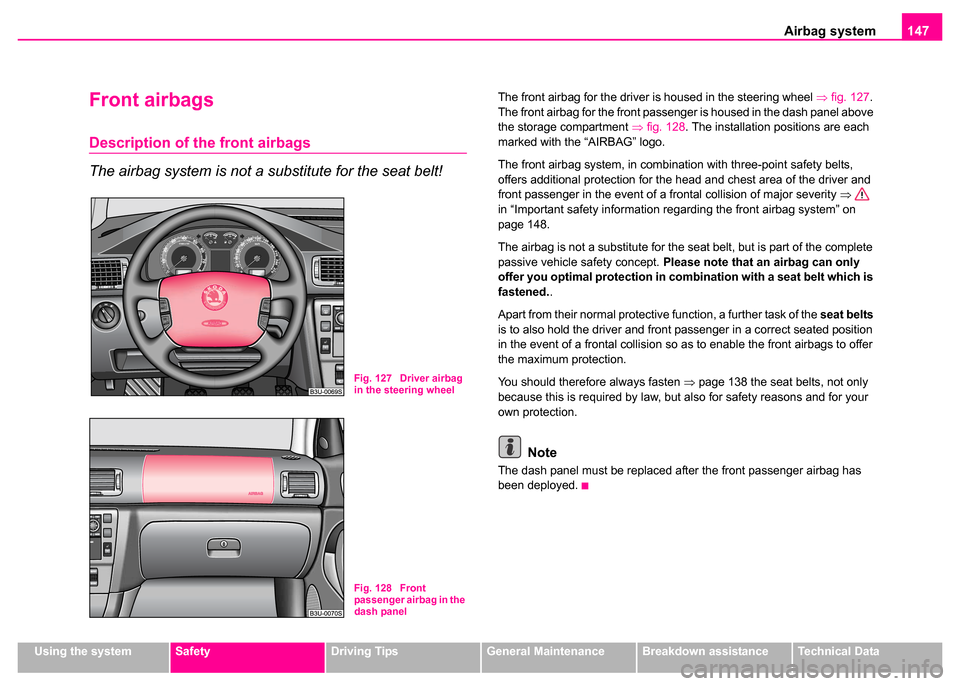
The front airbag for the driver is housed in the steering wheel ⇒fig. 127 .
The front airbag for the front passenger is housed in the dash panel above
the storage compartment ⇒fig. 128 . The installation positions are each
marked with the “AIRBAG” logo.
The front airbag system, in combination with three-point safety belts,
offers additional protection for the head and chest area of the driver and
front passenger in the event of a frontal collision of major severity ⇒
in “Important safety information regarding the front airbag system” on
page 148.
The airbag is not a substitute for the seat belt, but is part of the complete
passive vehicle safety concept. Please note that an airbag can only
offer you optimal protection in combination with a seat belt which is
fastened. .
Apart from their normal protective function, a further task of the seat belts
is to also hold the driver and front passenger in a correct seated position
in the event of a frontal collision so as to enable the front airbags to offer
the maximum protection.
You should therefore always fasten ⇒page 138 the seat belts, not only
because this is required by law, but also for safety reasons and for your
own protection.
Note
The dash panel must be replaced after the front passenger airbag has
been deployed.
Fig. 127 Driver airbag
in the steering wheel
Fig. 128 Front
passenger airbag in the
dash panel
Page 151 of 259

Airbag system
150
The side airbags are housed in the upholstery of the backrests of the front
seats ⇒page 149, fig. 131 .
The side airbag system in combination with the three-point seat belts,
offers additional protection for the upper area of the body (chest, stomach
and pelvis) of the occupants of the car in the event of a side collision of
major severity ⇒ in “Important safety information on the side airbag”
on page 151.
Apart from their normal protective function, a further task of the seat belts
is to also hold the driver and front passenger in a correct seated position
in the event of a side collision so as to enable the side airbags to offer the
maximum protection.
You should therefore always fasten ⇒page 138 the seat belts, not only
because this is required by law, but also for safety reasons and for your
own protection.
Each time the side airbags are deployed, the head airbag* on the relevant
side is automatically deployed at the same time in order to provide the
occupant with enhanced protection ⇒page 152.Function of the side airbags
Risk of injury to the upper part of the body is reduced by
fully inflated side airbags.
In case of violent side collision the side airbag on the side of the vehicle
on which the collision takes place, is also deployed ⇒ fig. 132.
In certain accident situations both the front airbags as well as the head
and side airbags may be deployed together.
If an airbag is deployed, the airbag is filled with propellant gas. The
airbags inflate in fractions of a second and at a high speed in order to be
able to offer that additional protection in the event of an accident.
A fine dust is produced when airbag inflated. This is perfectly normal and
is not an indication of a fire in the vehicle.
The load of the occupants is cushioned when plunging into the fully
inflated airbag and the risk of injury to the entire upper body (chest,
stomach and pelvis) is reduced on the side facing the door.
Fig. 132 Inflated side
airbag
Page 153 of 259

Airbag system
152
Head airbags*
Description of the head airbags
The head airbag together with the side airbag offers
enhanced occupant protection in the event of a side colli-
sion.
The head airbags are positioned above the doors on both sides in the inte-
rior of the car ⇒ fig. 133. The installation positions are each marked with
the “AIRBAG” logo.
The head airbag together with the three-point seat belts and the side
airbags, offers additional protection for the head and neck area of the
occupants in the event of a side collision of major severity ⇒ in “Impor-
tant safety information on the head airbag” on page 153.
Apart from their normal protective function, a further task of the seat belts
is to also hold the driver and the occupants in a correct seated position in the event of a side collision so as to enable the head airbags to offer the
maximum protection.
You should therefore always fasten
⇒page 138 the seat belts, not only
because this is required by law, but also for safety reasons and for your
own protection.
Together with other elements (such as cross bars in the seats, stable
vehicle structure) the head airbags are the consequent further develop-
ment of occupant protection in the case of side collisions.
Function of the head airbags
The risk of injury to the head and neck area is reduced in
the event of a side collision by fully inflated head airbags.
In the case of a side collision the head airbag is deployed together with
the relevant side airbag on the side of the car on which the accident occurs
⇒ fig. 134 .
Fig. 133 Installation
position of the head
airbags above the door,
shown inflated, and
Airbag logo on the
pillar cover panel
Fig. 134 Inflated head
airbag