2003 SKODA SUPERB coolant temperature
[x] Cancel search: coolant temperaturePage 118 of 259

Starting-off and Driving117
Using the systemSafetyDriving TipsGeneral MaintenanceBreakdown assistanceTechnical Data
You should not switch on any major electrical components during
the heating period otherwise the ve
hicle battery will be drained
unnecessarily.
•You should start the engine immediately after the glow plug warning
light has gone out.
•The glow plug warning light will come on for about one second if the
engine is at a normal operating temperature or if the outside temperature
is above +5°C. This means that you can start the engine right away.
•Interrupt the attempt at starting after 10 seconds if the engine does not
start right awayand wait for about 30 seconds before repeating the
attempt.
•It is possible that the fuse on the diesel preglow system is defect if the
engine still does not start ⇒page 241.
•Contact the nearest Škoda dealer to obtain professional assistance.
Starting the engine after the fuel tank has run dry
It may take longer than normal to start the engine after refuelling if the fuel
tank has run completely dry - up to one minute. This is because the fuel
system must first of all be filled while the attempting to start the engine.
Switching the engine off
– Turn the ignition key into position ⇒page 114.
Caution
you should not switch the engine off right away at the end of your journey
after the engine has been operated for a lengthy period at high loads but
should be allowed it to run at idling speed for about 2 minutes. This
prevents any accumulation of heat when the engine is switched off.
Note
•The radiator fan may continue running for a further 10 minutes or so
after the engine and the ignition have been switched off. The coolant fan
may, however, also switch on again after some time if the coolant temper-
ature rises because of an accumulation of heat in the engine or if the
engine is warm and the engine compartment is additionally heated by
strong sunlight.
•This is why particular care is required when carrying out any work in
the engine compartment ⇒page 203.
A1
Page 186 of 259

Towing a trailer185
Using the systemSafetyDriving TipsGeneral MaintenanceBreakdown assistanceTechnical Data
Tyre inflation pressure
Select the tyre inflation pressure on your vehicle for that of “fully laden”,
⇒
page 220. The inflation pressure of the tyres fitted to the trailer adjust
in accordance with the manufacturer's recommendation.
Exterior mirrors
You have to have additional exterior mirrors fitted if you are not able to see
the traffic behind the trailer with the standard rear-view mirrors. Both exte-
rior mirrors should be attached to folding arms. Adjust the mirrors so that
they provide you with an adequate field of view to the rear.
Headlights
Before starting off with a hitched trailer, also check the setting of the head-
lights. Alter the setting as necessary with the aid of the headlight beam
adjuster ⇒page 58.
Detachable ball head
The ball rod is detachable on vehicles which feature a factory-fitted towing
device. It is stowed together with separate fitting instructions in the spare
wheel well in the luggage compartment of the vehicle.
Further information on the towing device ⇒page 186.
Note
•We recommend that you also have your vehicle inspected between
service intervals if you tow a trailer frequently.
•The handbrake on the towing vehicle must be put on when coupling
and decoupling the trailer.
Driving Tips
Particular caution is required when towing a trailer.
– Do not, as far as possible, drive with your vehicle unladen and the trailer laden.
– Do not make full use of the legal maximum speeds. This applies in particular to downhill sections.
– Apply the brakes in good time.
– Keep a check on the coolant temperature gauge if the outside temperature is high.
Distribution of weight
The distribution of the weight is very poor if your vehicle is unladen and
the trailer is laden. Maintain a particularly low speed if you cannot avoid
driving with this combination.
Driving speed
Do not drive faster than 80 km/hour for safety reasons. This also applies
for countries in which higher speeds are allowed.
The fact that the driving stability of the vehicle + trailer combination
reduces with increasing speed means that the legally allowed speed
should not be used when there are unfavourable road, weather or wind
conditions, particularly near accident black spots.
You must always reduce your speed immediately as soon as you detect
even just the slightest swaying of the trailer. On no account attempt to
stop the trailer from “swaying” by accelerating.
Apply the brakes in good time! If the trailer is fitted with a trailer brake,
apply the brakes gently at first, then brake firmly. This will avoid brake jolts
resulting from the trailer wheels locking. Shift down gears in good time
Page 187 of 259

Towing a trailer
186
before negotiating a downhill section to allow the engine to also act as a
brake.
Engine overheating
Please keep a check on the coolant temperature gauge if you have to
negotiate a lengthy downhill stretch in a low gear at a high engine speed
when the outside temperature is very high ⇒page 14. If the needle of the
coolant temperature gauge moves into the right-hand area or even the red
area of the scale, reduce your speed immediately. Stop and switch off the
engine if the warning light
in the instrument cluster begins flashing.
Wait a few minutes and check the level of coolant in the coolant expansion
bottle ⇒page 208.
Please refer to the following guidelines ⇒page 31.
The coolant temperature can be reduced by switching on the heating.
Any increase in the cooling effect of the coolant fan through shifting down
a gear and increasing the engine speed is not possible since the fan
speed is independent of the engine speed. One should also not drop a
gear for this reason when towing a trailer as long as the engine can
manage the slope without any drop in speed.
Detachable towing device*
The detachable ball head of the towing device is stowed in the spare
wheel well in the luggage compartment.
An instruction for correct installation and removal of the ball head of the
towing device is supplied with the ball head
Note
•Do not carry out any modifications or repairs to the ball head or to any
other components on the towing device.
WARNING
•Do not use any aids or tools for installing or removing the ball
head. This might result in damage to the locking mechanism to the
extent that the safety of the towing device is no longer assured -
risk of an accident.
Fig. 150 Detachable
ball head
Page 211 of 259
Inspecting and Replenishing
210
For the sake of the environment
Do not re-use coolant if it is necessary to drain the coolant in the system.
It should be collected and disposed of in compliance with environmental
protection regulations.
The radiator fan
The radiator fan may switch on suddenly.
The radiator fan is driven by an electric motor and controlled by a thermo-
stat according to the coolant temperature.
After the engine is switched off, the radiator fan may continue running for
up to 10 minutes - even if the ignition is also off. It may also switch on
suddenly after a certain time, if
•the coolant temperature has risen because of an accumulation of heat
or
•the warm engine compartment is heated up additionally by strong
sunlight.
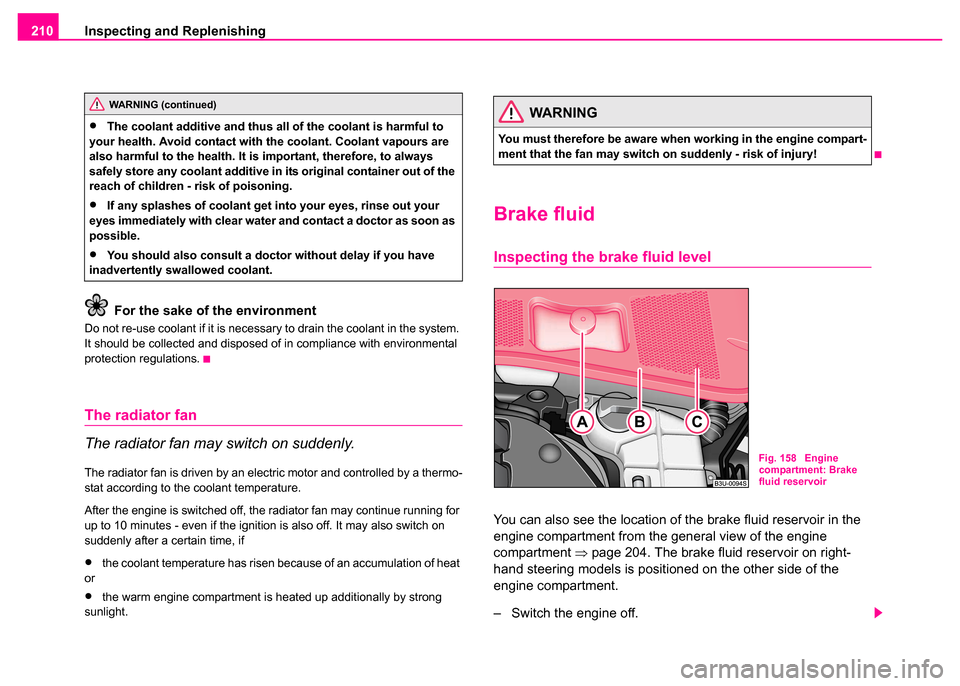
Brake fluid
Inspecting the brake fluid level
You can also see the location of the brake fluid reservoir in the
engine compartment from the general view of the engine
compartment ⇒page 204. The brake fluid reservoir on right-
hand steering models is positioned on the other side of the
engine compartment.
– Switch the engine off.
WARNING (continued)
•The coolant additive and thus all of the coolant is harmful to
your health. Avoid contact with the coolant. Coolant vapours are
also harmful to the health. It is important, therefore, to always
safely store any coolant additive in its original container out of the
reach of children - risk of poisoning.
•If any splashes of coolant get into your eyes, rinse out your
eyes immediately with clear water and contact a doctor as soon as
possible.
•You should also consult a doctor without delay if you have
inadvertently swallowed coolant.
WARNING
You must therefore be aware when working in the engine compart-
ment that the fan may switch on suddenly - risk of injury!
Fig. 158 Engine
compartment: Brake
fluid reservoir
Page 253 of 259

Index
252
Child seat . . . . . . . . . . . . . . . . . . . . . . . . . . 161
Attaching . . . . . . . . . . . . . . . . . . . . . . . . 164
Child seat protection . . . . . . . . . . . . . . . 164
Classification into groups . . . . . . . . . . . 161
on the front passenger seat . . . . . . . . . 158
Safety instructions . . . . . . . . . . . . . . . . . 157
Use of child seats . . . . . . . . . . . . . . . . . 161
Cigarette lighter . . . . . . . . . . . . . . . . . . . . . . 93
Cleaning . . . . . . . . . . . . . . . . . . . . . . . . . . . 189
Climatronic Air outlet vents . . . . . . . . . . . . . . . . . . . 112
Blower . . . . . . . . . . . . . . . . . . . . . . . . . . 111
Defrosting windows . . . . . . . . . . . . . . . . 108
economic use . . . . . . . . . . . . . . . . . . . . 108
Keeping windows demisted . . . . . . . . . . 109
Operational problems . . . . . . . . . . . . . . 108
Recirculated air mode . . . . . . . . . . . . . . 110
Setting temperature . . . . . . . . . . . . . . . . 111
Climatronic (automatic air conditioning) . . . 107
Clothes hooks . . . . . . . . . . . . . . . . . . . . . . . 101
Cockpit An overview . . . . . . . . . . . . . . . . . . . . . . . 11
Coming Home . . . . . . . . . . . . . . . . . . . . . . . . 60
Compartments . . . . . . . . . . . . . . . . . . . . . . . 95
Convenience operation . . . . . . . . . . . . . . . . . 51
Converting/masking over headlights . . . . . . 178
Cool box . . . . . . . . . . . . . . . . . . . . . . . . . . . . 82
Coolant . . . . . . . . . . . . . . . . . . . . . . . . . 31, 208 replenishing . . . . . . . . . . . . . . . . . . . . . . 209
Coolant temperature gauge . . . . . . . . . . . . . 14 Coolant temperature/coolant level
Warning light . . . . . . . . . . . . . . . . . . . . . . 31
Counter for distance driven . . . . . . . . . . . . . . 16
Cruise control . . . . . . . . . . . . . . . . . . . . . . . 120
Cruise control system . . . . . . . . . . . . . . . . . 120
D
Deactivating an airbag . . . . . . . . . . . . . . . . 154
Defrosting windows The air conditioning system . . . . . . . . . . 104
De-icing windows . . . . . . . . . . . . . . . . . . . . 192
Detachable towing device . . . . . . . . . . . . . . 186
Diesel . . . . . . . . . . . . . . . . . . . . . . . . . . . . . 198
Digital clock . . . . . . . . . . . . . . . . . . . . . . . . . . 15
Dipstick . . . . . . . . . . . . . . . . . . . . . . . . . . . . 206
Direction indicators . . . . . . . . . . . . . . . . . . . . 59 Warning light . . . . . . . . . . . . . . . . . . . . . . 29
Doors Child safety locks . . . . . . . . . . . . . . . . . . . 45
Drinks can holder at the front . . . . . . . . . . . . . . . . . . . . . . . . 90
at the rear . . . . . . . . . . . . . . . . . . . . . . . . 90
Driving economically . . . . . . . . . . . . . . . . . . 179
Dynamo Warning light . . . . . . . . . . . . . . . . . . . . . . 36
E
EDLSee Electronic Differential Lock . . . . . . . . 34 Electric sliding/tilting roof . . . . . . . . . . . . . . . . 52
Electronic Differential Lock
Operating principle . . . . . . . . . . . . . . . . . 171
Warning light . . . . . . . . . . . . . . . . . . . . . . 34
Electronic stability programme Operating principle . . . . . . . . . . . . . . . . . 169
Electronic stability programme (ESP) Warning light . . . . . . . . . . . . . . . . . . . . . . 34
Emergency key . . . . . . . . . . . . . . . . . . . . . . . 37
Emergency operation Fuel filler flap . . . . . . . . . . . . . . . . . . . . . 201
Engine compartment Safety instructions . . . . . . . . . . . . . . . . . 203
Engine electronics EPC warning light . . . . . . . . . . . . . . . . . . 31
Engine oil . . . . . . . . . . . . . . . . . . . . . . . . . . . 205 changing . . . . . . . . . . . . . . . . . . . . . . . . 207
replenishing . . . . . . . . . . . . . . . . . . . . . . 207
Engine revolutions counter . . . . . . . . . . . . . . 14
Environmental compatibility . . . . . . . . . 179, 183
Exterior mirrors . . . . . . . . . . . . . . . . . . . . . . . 67
F
First-aid box . . . . . . . . . . . . . . . . . . . . . . . . . 227
Fog lights . . . . . . . . . . . . . . . . . . . . . . . . . . . . 57 Warning light . . . . . . . . . . . . . . . . . . . 30, 31
For the first 1 500 kilometres . . . . . . . . . . . . 176
Front airbags . . . . . . . . . . . . . . . . . . . . . . . . 147
Front armrest . . . . . . . . . . . . . . . . . . . . . . . . 100