2003 SAAB 9-3 winter tires
[x] Cancel search: winter tiresPage 4 of 256

4ExteriorBody __________________ 219
Touching up paintwork ____ 219
Anti-corrosion treatment ___ 220
Service program _________ 230
Sunroof ________________ 102
Washing _______________ 218
Waxing and polishing _____ 219Taillights _______________ 194
Brake lights _____________ 194
Changing bulbs __________ 188
Light switches ___________ 72Towing _________________ 164
Towing hook eyes ________ 164
Towing a trailer __________ 157Trunk __________________ 116
Lighting ________________ 194
Folding down the rear seat _ 116
Load-through hatch _______ 117
Spare wheel ____________ 119
Tools __________________ 119
Maximum loads _______________ 236
Mounting holes for roof carriers ___ 161
Roof load ____________________ 161
Hood _______________________ 172
Washing the engine bay_________ 218
Trunk lock ______________ 41
Central locking __________ 38
Lock buttons ____________ 38
Child safety locks ________ 42Front lights _____________ 190
Direction indicators_______ 75
Changing bulbs _________ 188
Headlight levelling (Bi-
Xenon) _______________ 73
Dipswitch ______________ 72
Headlight switches _______ 72
Headlight washers _______ 186Fuel grade _____________ 240
Fuel gauge _____________ 61
Economical motoring _____ 153
Fuel filler door __________ 128
Refueling ______________ 128
Braking _____________________ 141
Tires _______________________ 206
Tire pressure ________________ 245
Tire pressure monitor __________ 207
Wheels _____________________ 243
Changing wheels ______________ 214
Spare wheel _________________ 212
Winter driving ________________ 155
ProCarManuals.com
Page 153 of 256

153 Starting and driving
Economical drivingFactors affecting fuel consumptionThe fuel consumption of a car is greatly
affected by driving conditions, climate, road
conditions, speed, driving technique, and
so on.Breaking-inFuel consumption may be somewhat
higher during the break-in period (the
first 3,000–4,000 miles (5,000–7,000 km)).Weather conditionsSummer temperatures give better fuel
economy than winter ones. The difference
can be as much as about 10%. Consump-
tion increases in cold weather because the
engine takes longer to reach its normal
operating temperature. The transmission
and wheel bearings also take longer to
warm up. Even distance affects consump-
tion: short journeys of 3–5 miles (5–8 km)
do not give the engine enough time to
reach its optimum temperature. Wind con-
ditions also have a marked effect on fuel
consumption.How to read the diagram:
If fuel consumption with the engine at
normal temperature is 28 mpg (10 l/
100 km), the actual fuel consumption
3 miles (5 km) after the engine has started
from cold will be:
– 23.5 mpg (12 l/100 km) at outside temp.
of 68°F (+20°C) (increase of 20%).
– 17.7 mpg (16 l/100 km) at outside temp.
of 32°F (0°C) (increase of 60%).
– 14 mpg (20 l/100 km) at outside temp.
of –4°F (–20°C) (increase of 100%).
It is clear from the diagram that both dis-
tance driven and outside temperature have
a significant impact on fuel consumption,
after a cold start.
If the car is normally driven on short jour-
neys, 3–5 miles (5–8 km), for example to
and from work, the average consumption
will be 60–80% above the normal level.
Driving techniques To obtain the best running economy, with
regard to fuel consumption and general
wear, the car must be serviced regularly.
High speed, unnecessary acceleration,
frequent braking and much changing
down all give higher fuel consumption.
Frequent gear changing in traffic, starting
in cold weather, the use of studded tires
and roof racks, and towing a caravan all
increase fuel consumption.
Do not warm up the engine while the car
is stationary.
If idling, the engine will take much longer
to reach its optimum temperature, and Percentage increase in fuel consumption
of engine starting from cold compared to
engine at normal temperature.
ProCarManuals.com
Page 155 of 256

155 Starting and driving
Driving in cold weatherIn cold weather, special attention should be
paid to the following:
Before driving off, make sure that the
wiper blades have not frozen to the wind-
shield.
Remove any snow from the heating
system air intakes between the hood and
the windshield.
If necessary, inject oil into the locks to
prevent them from freezing. Use molyb-
denum-sulphide oil (MoS
2). If the locks
freeze, exercise care when unlocking the
car (manual unlocking) to avoid breaking
the key. Warm up the key or use a de-icer.
It is particularly important when the roads
are slippery that the brakes and tires are
in good condition.
For how to check the level of antifreeze in
the engine coolant, see page 179. Add gasoline anti-freeze when refueling
several times before the onset of winter.
This will prevent condensation water in
the fuel tank from freezing and causing
interruptions in the fuel supply. The likeli-
hood of condensation is lowest when the
fuel tank is full.
If the car is parked outside and the
temperature is below zero, carburettor
spirit is of little use as it cannot remove
water that has already frozen. Park the
car in a warm place so that any ice that
may have built up melts, then add carbu-
rettor spirit when refueling.
Condensation is caused by temperature
fluctuations, either in the outside temper-
ature alone or when the car is alternately
parked outdoors and in a garage.
The car is equipped with tires designed to
provide optimum grip on both wet and dry
roads, although this has been achieved at
the expense of somewhat reduced grip on
snow and ice. For regular driving on snow
and ice, we therefore recommend that
winter (snow) tires be fitted.Winter tires, particularly studded tires,
generally make driving safer on snow and
ice.
Acquaint yourself with the legal provi-
sions governing the use of different
types of winter tires and snow chains.
Studded tires are not allowed in some
countries. If winter tires are fitted, the same
type must be fitted to all four wheels. Your
Saab dealer will be pleased to advise you on
the best tires for your car.
Remember that tires age: it may therefore
be necessary to change winter tires before
they reach the legal wear limit, as they grad-
ually lose their friction properties with age.
If you get into a front wheel skid and the car
has a manual transmission, the best
response is to freewheel, which means
declutching so that the wheels neither drive
nor brake, and to cautiously steer in the
desired direction.
If the car has automatic transmission, ease
off the accelerator slightly and steer cau-
tiously in the desired direction.
If you get into a rear wheel skid, steer in the
same direction as the movement of the rear
of the car.
ProCarManuals.com
Page 209 of 256

209 Car care
Malfunction
The message shown above will be dis-
played on the SID if:
a wheel without pressure sensor is fitted
(e.g. spare wheel)
one, two or three pressure sensors are
broken or missing
two or more detectors are missing or
broken
the receiver malfunctions
a fault arises in the system.
The message shown above is not displayed
if none of the wheels have sensors, such as
if winter wheels without sensors are fitted.
Shifting the wheelsBecause of front wheel drive, the front tires
tend to wear faster than the rear ones. New
tires should always be fitted in pairs, so that
tires on the same axle have the same
amount of tread.
The wheels should be marked, L (left) and
R (right), when changing between summer
and winter (snow) tires. This ensures that
the direction of rotation of the wheels is the
same when they are refitted. Fit the tires in
best condition to the rear wheels.
Store wheels lying flat or hanging – never
standing upright.
Tire markingsAn example of the meaning of the different
markings in a tire size is given below for a
tire size of 195/65 R15 91H: Tire pressure
system failure.
Contact Saab dealer.
WARNING
When fitting just one new pair of tires,
these should be fitted to the rear wheels,
as these are more critical to the direc-
tional stability of the car (e.g. on braking
or in a skid). The existing rear wheels
should therefore be moved to the front.
Always move rear left to front left and rear
right to front right, so that the direction of
rotation remains the same.
195 Tire section width, mm
65 Aspect ratio, i.e. the section height
as a percentage of the section
width
R Radial ply
15 Wheel rim diameter 15 in at bead
seats
91 Tire load index
H Speed rating
Tire load indices
91 Tire approved for max. 1355 lbs.
(615 kg)
93 Max. 1433 lbs. (650 kg)
94 Max. 1477 lbs. (670 kg)
Speed ratings
S Tire approved for speeds up to
110 mph (180 km/h)
T Max. 118 mph (190 km/h)
H Max. 130 mph (210 km/h)
V Max. 149 mph (240 km/h)
W Max. 168 mph (270 km/h)
Y Max. 186 mph (300 km/h)
ProCarManuals.com
Page 210 of 256

210 Car careWinter tiresWinter (snow) tires are recommended for
winter climates where the majority of your
driving will be done on snow and ice. Winter
tires should be fitted to all four wheels to
maintain a proper balance. Your Saab
dealer can advise you of to the correct size
tire for your car (if different from the original
size) and also supply Saab approved winter
tires pre-mounted on steel or alloy rims.Tire quality grading (cars sold in
U.S.)New tires must be graded and labeled in
accordance with new Federal regulations.
Standard tests are conducted to measure
performance in the areas of traction and
temperature resistance. Refer to the tire
sidewall for the specific quality grades of the
tires provided on your new Saab. Compact
spare tires are exempt.
DOT QUALITY GRADES
Treadwear.
Traction AA, A, B, C.
Temperature A, B, C.
All passenger car tires must conform to Fed-
eral safety requirements in addition to these
grades.
Uniform Tire Quality Grading (US)Quality grades can be found where applica-
ble on the tire sidewall between tread shoul-
der and maximum section width. For exam-
ple:
Treadwear 200 Traction AA
Temperature ATreadwearThe treadwear grade is a comparative
rating based on the wear rate of the tire
when tested under controlled conditions on
a specified government test course. For
example, a tire graded 150 would wear one
and one half (1 1/2) times as well on the gov-
ernment course as a tire graded 100. The
relative performance of tires depends upon
the actual conditions of their use, however,
and may depart significantly from the norm
due to variations in driving habits, service
practices and differences in road character-
istics and climate.
TractionThe traction grades, from highest to lowest,
are AA, A, B and C. These grades represent
the tire’s ability to stop on wet pavement as
measured under controlled conditions on
specified government test surfaces of
asphalt and concrete. A tire marked C may
have poor traction performance.
WARNING
The traction grade assigned to a tire is
based on straight-ahead braking, traction
test and does not include acceleration,
cornering, hydroplaning or peak traction
characteristics.
ProCarManuals.com
Page 211 of 256

211 Car care
TemperatureThe temperature grades are A (the highest),
B, and C, representing the tire’s resistance
to the generation of heat and its ability to dis-
sipate heat when tested under controlled
conditions on a specified indoor laboratory
test wheel. Sustained high temperature can
cause the material of the tire to degenerate
and reduce tire life. Excessive temperature
can lead to sudden tire failure. The grade C
corresponds to a level of performance
which all passenger car tires must meet
under the Federal Motor Vehicle Safety
Standard No. 109.
Grades B and A represent higher levels of
performance on the laboratory test wheel
than the minimum required by law.
Wear indicatorsThe tires incorporate wear indicators in the
form of smooth, treadless strips across the
width, which become visible when only 2/
32" (1.6 mm) of tread remains. As soon as
the indicators become visible, new tires
should be fitted without delay.
Make sure you are familiar with the legal
limit for minimum tread depth in your
country and also any regulations gov-
erning the use of winter (snow) tires.
WARNING
The temperature grade for a tire is estab-
lished for a tire that is properly inflated
and not overloaded. Excessive speed,
underinflation, or excessive loading,
either separately or in combination, can
cause heat buildup and possible tire fail-
ure.
Wear indicator
ProCarManuals.com
Page 212 of 256
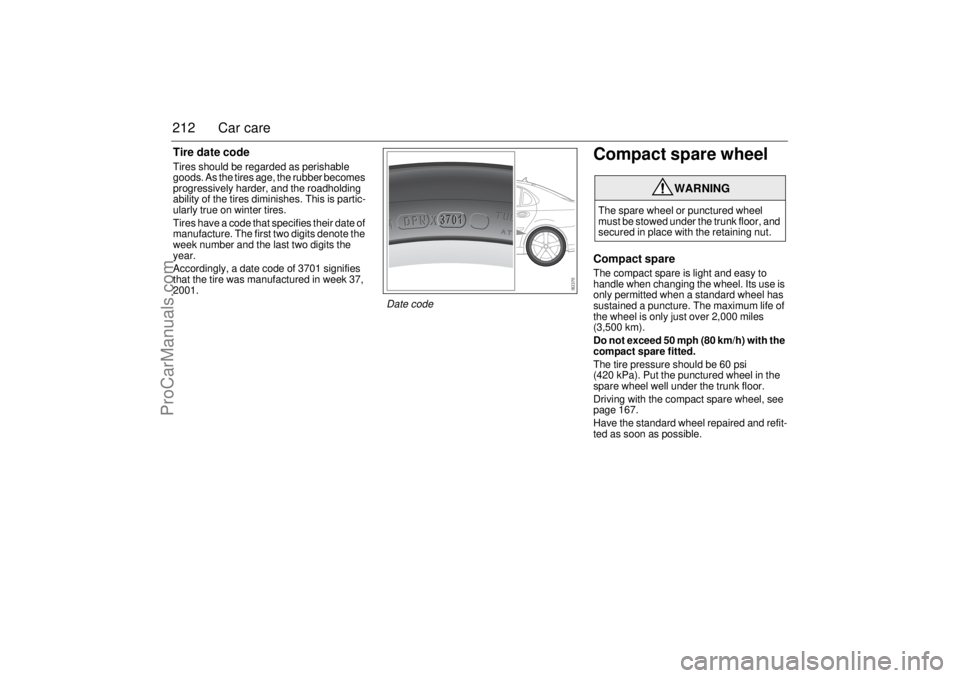
212 Car careTire date codeTires should be regarded as perishable
goods. As the tires age, the rubber becomes
progressively harder, and the roadholding
ability of the tires diminishes. This is partic-
ularly true on winter tires.
Tires have a code that specifies their date of
manufacture. The first two digits denote the
week number and the last two digits the
year.
Accordingly, a date code of 3701 signifies
that the tire was manufactured in week 37,
2001.
Compact spare wheelCompact spareThe compact spare is light and easy to
handle when changing the wheel. Its use is
only permitted when a standard wheel has
sustained a puncture. The maximum life of
the wheel is only just over 2,000 miles
(3,500 km).
Do not exceed 50 mph (80 km/h) with the
compact spare fitted.
The tire pressure should be 60 psi
(420 kPa). Put the punctured wheel in the
spare wheel well under the trunk floor.
Driving with the compact spare wheel, see
page 167.
Have the standard wheel repaired and refit-
ted as soon as possible.
WARNING
The spare wheel or punctured wheel
must be stowed under the trunk floor, and
secured in place with the retaining nut.
Date code
ProCarManuals.com
Page 243 of 256

243 Technical data
Wheels and tires Summer tires
6.5 x 15" _________________________ 215/60R15 94 H
6.5 x 16" _________________________ 215/55R16 93 H
7 x 17"___________________________ 215/50R17 91 W or
225/45R17 91 W
7.5 x 18" (accessory) _______________ 225/45 R18 91 W
Always contact a Saab dealer if you plan to fit other wheels or
tires than those fitted as standard.
Winter (snow) tires:
6.5 x 15" wheel ____________________ 195/65 R15 91 Q
M+S
6.5 x 16" wheel ____________________ 205/55 R16 91 Q
M+S or
215/55 R16 93 Q
M+S
7 x 17" wheel _____________________ 205/50 R17 93 Q RF
M+S
Compact spare:
Wheel ___________________________ 4 x 16"
Tire _____________________________ 125/80 R16 97 M or
125/85 R16 97 M
Pressure _________________________ 4.2 bar (60 psi)
Maximum life______________________ 2200 miles
(3500 km)
Maximum speed ___________________ 50 mph (80 km/h)
NOTICEContact your Saab dealer regarding suitable snow chains.
Max. permissible speed with snow chains fitted is 30 mph
(50 km/h).
Snow chains must not be fitted to wheels larger than 17".
Snow chains must not be used on the rear wheels.NOTICEWheels larger than 18" must not be fitted.
Exercise care when driving on uneven roads or against the curb
if the car is heavily laden. This particularly applies to cars with
18" wheels.
Permitted wheel offset is 41 mm.
ProCarManuals.com