Page 5 of 256

5
InteriorAirbag _________________ 26
Steering wheel adjustment _ 98
Steering _______________ 242
Interior rearview mirror _________ 111
Vanity mirror _________________ 106
Door mirrors__________________ 110
Airbag_________________ 26
Child seats _____________ 21
Safety belts ____________ 11
Safety belt care _________ 217
Child safety locks ________ 42Glove compartment ______ 109
Storage compartments____ 109Automatic transmission ___ 134
Manual transmission _____ 133
Changing gears _________ 133
Rear seat _________________ 116
Child seats ________________ 21
Safety belts ________________ 11
Folding down the rear seat ____ 116
Upholstery care ____________ 217
Seat adjustment ____________ 16
Seat heating _______________ 83, 92
Interior lighting: changing bulbs ___ 197
Interior light switches ___________ 105
Sunroof _____________________ 102
Break-In Period _______________ 132
Driving in hot/cold climates ______ 155
Parking _____________________ 148
Starting the engine ____________ 123
Ignition switch ________________ 122
Parking brake_________________ 148
Ashtray and cigarette lighter _____ 108
Fuses _________________ 199Electric windows _________ 99
ProCarManuals.com
Page 10 of 256
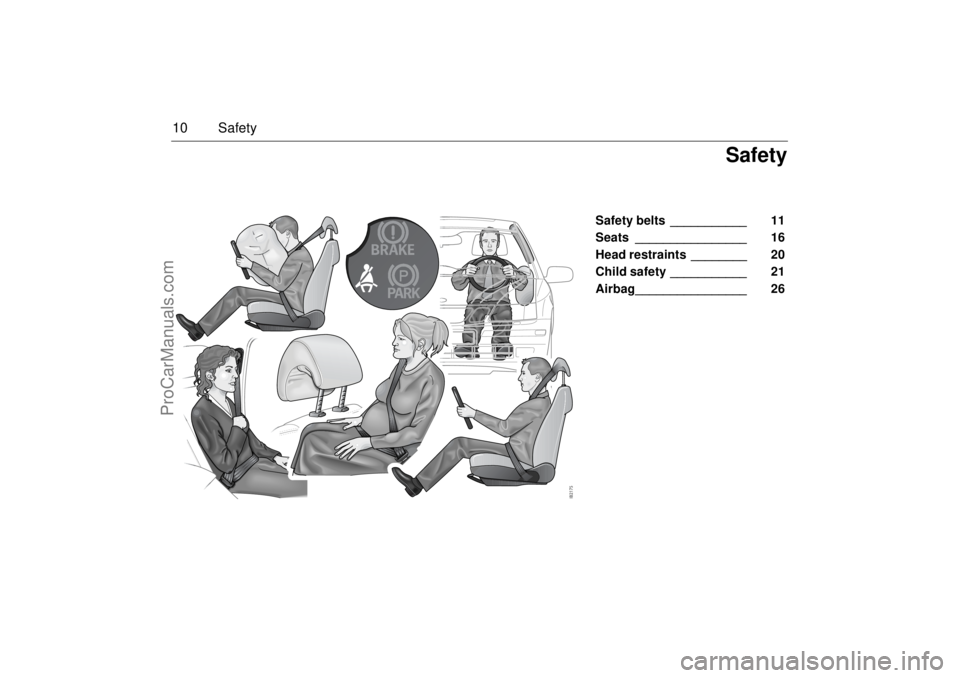
10 Safety
Safety belts ___________ 11
Seats ________________ 16
Head restraints ________ 20
Child safety ___________ 21
Airbag________________ 26
Safety
ProCarManuals.com
Page 11 of 256

11 Safety
Safety belts
Three-point inertia-reel safety belts are
provided for all seats.
The results of studies show that it is equally
important to wear safety belts in the rear
seat as in the front seats.Safety belt reminderWhen the ignition is switched on, the safety
belt reminder in the main instrument panel
will come on if the driver has not buckled up.
In addition an audible signal sounds for 4–
8 seconds, or until the driver fastens his
belt.
The front seat passenger is reminded to
buckle up by the Saab Information Display
(SID).
WARNING
Buckle up and adjust your safety belt
before driving off so that you can pay
full attention to the traffic.
Safety belts must be worn at all times
by all occupants.
Child safety, see page 21.
Check that the locking tongue is prop-
erly locked in the belt lock.
In the event of a crash, a rear-seat
passengers not wearing a safetybelt
will be thrown forward against the
front-seat backrests. The stresses
imposed on the front seat passengers
and belts are multiplied and can result
in needless injury or even death for all
car occupants.
Use your seatbelt.
Driver seat safety belt reminder
ProCarManuals.com
Page 13 of 256

13 Safety
Front safety beltsFasten the belt by pulling the belt and insert-
ing the tongue in the buckle. Check that it is
securely fastened.
Position the lap part low across the hips.
Grasp the shoulder belt close to the buckle
and pull the belt towards the shoulder to
tighten the lap belt part.The belt must be as far in on the shoulder as
possible.
Press the red button on the belt buckle to
release the belt.
The front safety belts have their lower
anchorage points on the seats. The safety
belts follow the seats when the legroom is
adjusted.
Refer to page 217 for how to check the func-
tion of the safety belts, cleaning, etc.
Belt height adjustmentThe belt guide on the door pillar for the front
safety belts can be set at different heights.
Adjust the belt so that it is as high up as pos-
sible without rubbing against the neck. To
avoid chafing in the case of a short person,
the guide can be lowered until the belt
comes about an inch (a few centimetres)
from the throat but still provides safe
restraint.
Raise the belt guide by pushing it upwards
to the desired position. To lower it, depress
the catch release button while lowering the
guide. Check that the guide locks in its new
position.
To fasten the belt Press the red button to release the belt
The belt guide on door pillar
ProCarManuals.com
Page 14 of 256

14 SafetySafety belt use during pregnancyPregnant women must always wear a
safety belt to protect both themselves and
the unborn child.
The lap belt should be placed low, across
the hips and over the upper thighs.
Safety belt pretensioners
The belts of the front seats are fitted with
automatic pretensioners and force limiters.
The pretensioners are activated in the event
of a violent frontal or side-on crash. The
pretensioners are only activated if the safety
belt in question is in use.
The safety belt pretensioners are not acti-
vated if the car rolls over.
The safety belt pretensioners serve to
reduce the forward movement of the body
by tensioning the belt. The force limiters
reduce belt loads on the body by "slacken-
ing" the safety belt slightly to absorb the
body’s kinetic energy as gradually as possi-
ble.
WARNING
If the car is involved in a crash, the safety
belts, belt pretensioners and other
components must be inspected by an
authorized Saab dealer and replaced as
necessary.
Never make any alterations or repairs to
the safety belt yourself. Visit an autho-
rized Saab dealer for any necessary
repairs.
ProCarManuals.com
Page 15 of 256

15 Safety
Safety belts, rear seatThe three rear seats all have three-point
safety belts with inertia reels.
Fasten the belts by pulling the belt across
you and inserting the tongue into the buckle.
Check that it is securely fastened.
Grasp the shoulder belt close to the buckle
and pull the belt towards the shoulder to
tighten the lap belt part.
The belt must be as far in on the shoulder as
possible.
Press the red button on the buckle to
release the belt.See page 217 for the checking of belt func-
tion, cleaning, etc.
WARNING
Make sure that the belt does not
become trapped when the backrest is
folded down or raised (see page 116).
If a cargo has to be placed on a seat,
it must be properly secured with the
safety belt. This reduces the risk of the
cargo being thrown about during hard
braking or a crash, which could cause
personal injury.
Check that the belt is not twisted or
lying against sharp edges.
Make sure you use the correct safety
belt buckle. The buckles for the center
and left-hand rear seats are close
together.
Rear safety belts
Securing an item on the rear seat
ProCarManuals.com
Page 16 of 256

16 SafetySeatsManually adjusted front seatsThe following seat adjustments can be
made to achieve a comfortable driving
position:
Height (driver’s seat)
Legroom
Backrest rake angle
Lumbar support (driver’s seat)
Head-restraint height
We recommend that adjustments to the
driver’s seat be performed in the following
order:
1 Height
2 Legroom
3 Backrest rake angle
4 Head restraint height
Lastly, adjust the position of the steering
wheel (see page 98).Electrically adjustable front seatsSee page 18.Electric heating, front seats (option)See pages 83 and 92.
Height adjustment, driver’s seatLift the lever to raise the seat. The lever is
spring-loaded to return to its neutral posi-
tion. Repeated lifting of the lever will
increase the height in steps.
Press down the lever to lower the seat.
Repeated downward presses of the lever
will lower the seat in steps.
Legroom adjustmentLift the lever under the front of the seat and
slide the seat to the desired position.
WARNING
Never adjust the driver’s seat except
when the car is stationary.
WARNING
Check that the seat is locked in the new
position. If not, it may move while the car
is being driven and it could result in injury
to the occupant in the event of a crash.
ProCarManuals.com
Page 18 of 256

18 SafetyElectrically adjustable front seats
(option)With the doors closed the seats can only be
adjusted when the ignition is ON.
However, there are two exceptions:
To facilitate getting into the car, both seats
can be adjusted when either of the front
doors is open.
The seats can be adjusted up to
20 seconds after both doors have been
closed (applicable only to cars without
window and sunroof pinch protection).
Height adjustment and seat angleAdjust the height of the seat with the rear
section of the front lever.
Adjust the angle of the seat with the front
section of the front lever.
Legroom adjustmentAdjust the legroom with the front lever.
WARNING
The seats are actuated by powerful
motors. Bear this in mind when adjust-
ing the seat, and make sure that noth-
ing gets caught and damaged. Ensure
that nothing can be trapped behind the
seat when adjusting it.
Bear in mind that children can be
injured if they play with the electrically-
operated seats.
Always remove the remote control
when you leave the car to prevent
personal injury caused by the electri-
cally adjustable seats, for example,
due to children playing.
ProCarManuals.com