Page 76 of 256

76 Instruments and controlsBack-Up The back-up lights come on automatically
when reverse gear is engaged or selected
with the ignition switched on.
Wipers and washersWindshield wipersPosition 1 is a spring-loaded position that
will produce a single sweep of the wipers.
In position 2 you can set the delay period for
intermittent wiping using the thumbwheel on
the stalk switch. There are 5 delay periods
from which to choose, ranging from 2 to
15 seconds.
The wipers always return to their home posi-
tion when the ignition is turned off.
To leave the wipers positioned vertically on
the windshield, proceed as follows:
1 Switch off the engine and remove the
remote control.
2 Activate the wipers within the next
16 seconds by pressing the stalk switch
down.
When the ignition is next switched on the
wipers will return to their home position.
WashersActivate the washers by pulling the stalk
switch towards the steering wheel.
When the washers are operated, the wipers
will make 3, 4 or 5 sweeps, depending on
how long the washers were kept on. If
the speed of the car is less than 12 mph
(20 km/h), the wipers will make an addi-
tional sweep after roughly 8 seconds.Windshield wipers0OFF
1 Single sweep
2 Intermittent wiping
3 Low speed
4 High speed
5 Windshield and headlight washing
ProCarManuals.com
Page 77 of 256

77 Instruments and controls
When the washer fluid level drops below
1 quart (1 litre), the headlight washers are
deactivated. This is in order to prioritize the
windshield. The following message is
displayed on the SID:
Headlight washers (certain variants
only)The headlights are washed at the same time
as the windshield if the h eadlights are on.
The headlights are washed every fifth time
the windshield washers are used or if two
(2) minutes have elapsed since the wind-
shield was last washed.
The headlight washers are not activated at
speeds in excess of 125 mph (200 km/h).
Rain sensor (option)The rain sensor automatically controls the
windshield wipers. The sensor is located on
the windshield beside the rearview mirror.
The system varies the frequency of wiping
between single sweeps and continuous
wiping, depending on the amount of pre-
cipitation.
Washer fluid level low.
Refill.
WARNING
Turn the rain sensor off if the ignition is
ON to avoid personal injury when clearing
snow and ice from the windshield.NOTICETurn the rain sensor off before washing
the car in an automatic carwash, to avoid
damaging the windshield wipers.
Control for setting wiper delay
ProCarManuals.com
Page 78 of 256

78 Instruments and controlsActivate the rain sensor by lifting the stalk
switch to the AUTO position. The wipers
make one sweep for reference to see how
much water is on the windshield. In the
future, the sensor compares the amount of
water on the windshield with this reference
value.
If the system malfunctions, the wipers will
operate at low speed when the stalk switch
is set to the AUTO position.Adjusting sensitivity
The sensitivity of the rain sensor can be
adjusted under Profiler. If you increase the
sensitivity, the wipers will make one sweep
for reference.
1 Press the CUSTOMIZE button to go to
Profiler.
2 Select Rain Sensor using the INFO dial.
3 Press in the INFO dial.
4 Select the sensitivity by turning the dial.
5 Confirm this selection by pressing the
INFO dial.
The sensitivity of the sensor is also affected
by the amount of daylight. The sensor is
somewhat more sensitive at night. This
adjustment is automatic.Explanation of sensor sensitivity.
Rain Sensor
HighMediumLow
High
The sensor is set to high sensitivity.
The wipers start when there is only
a small amount of water on
the windshield.
Medium
The sensor is set to normal sensitivity.
This is one of the Default Settings.
Low
The sensor is set to low sensitivity (wip-
ers operate only with a large amount of
water on the windshield, i.e., down-
pour).
Windshield wipers with rain sensor0OFF
1 Single sweep
2 AUTO - rain sensor engaged
3 Low speed
4 High speed
5 Washers
ProCarManuals.com
Page 79 of 256

79 Instruments and controls
Manual climate-control
systemFresh air for the cabin is drawn in through an
inlet grille at the bottom edge of the wind-
shield. It passes through a filter before
reaching the climate control system and
delivery into the cabin. The air is evacuated
via openings in the parcel shelf. It is then led
through outlets on either side of the car
behind the rear bumper.
The incoming air is treated in three stages:
first it passes through a filter; it is then dehu-
midified and cooled; and finally, if required,
it is heated.
To optimize the performance of the A/C sys-
tem, all windows and the sunroof should be
shut.
To reduce potential misting on the insides of
the windows, the glass should be cleaned
with a quality glass cleaner. How often this
will need to be done depends on how clean
the air is - if there are smokers in the car, the
windows will need to be cleaned more fre-
quently.
The output of air is controlled by the fan
speed.
Temperature controlThe temperature of the incoming air can
be infinitely varied using the temperature
control.
Fan
Control panel: manual climate control1 Temperature
2 Fan speed
3 Air distribution
4 Seat heating, front right seat
5 Recirculation6 Rear window/door mirror heating
7 Hazard warning lights
8 Air conditioning (A/C)
9 Seat heating, front left seat
ProCarManuals.com
Page 84 of 256
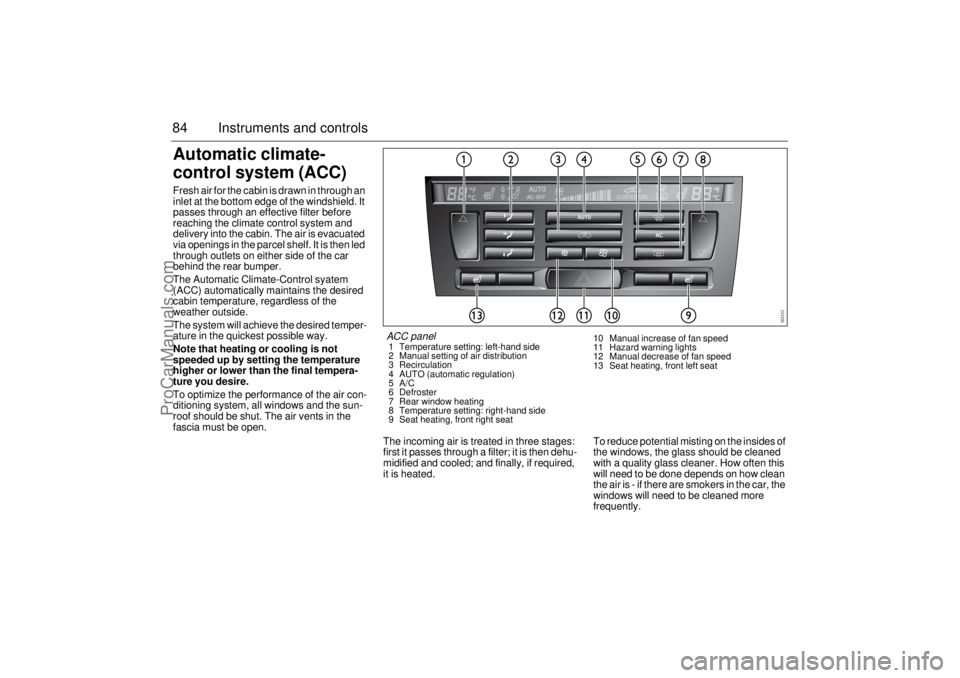
84 Instruments and controlsAutomatic climate-
control system (ACC)Fresh air for the cabin is drawn in through an
inlet at the bottom edge of the windshield. It
passes through an effective filter before
reaching the climate control system and
delivery into the cabin. The air is evacuated
via openings in the parcel shelf. It is then led
through outlets on either side of the car
behind the rear bumper.
The Automatic Climate-Control syatem
(ACC) automatically maintains the desired
cabin temperature, regardless of the
weather outside.
The system will achieve the desired temper-
ature in the quickest possible way.
Note that heating or cooling is not
speeded up by setting the temperature
higher or lower than the final tempera-
ture you desire.
To optimize the performance of the air con-
ditioning system, all windows and the sun-
roof should be shut. The air vents in the
fascia must be open.
The incoming air is treated in three stages:
first it passes through a filter; it is then dehu-
midified and cooled; and finally, if required,
it is heated.To reduce potential misting on the insides of
the windows, the glass should be cleaned
with a quality glass cleaner. How often this
will need to be done depends on how clean
the air is - if there are smokers in the car, the
windows will need to be cleaned more
frequently.
ACC panel1 Temperature setting: left-hand side
2 Manual setting of air distribution
3 Recirculation
4 AUTO (automatic regulation)
5A/C
6 Defroster
7 Rear window heating
8 Temperature setting: right-hand side
9 Seat heating, front right seat10 Manual increase of fan speed
11 Hazard warning lights
12 Manual decrease of fan speed
13 Seat heating, front left seat
ProCarManuals.com
Page 89 of 256

89 Instruments and controls
Recirculation is controlled manually.
Recirculation is not selected when the engine is
started (fresh air mode).
To prevent the smell of washer fluid from entering
the car, recirculation can be activated temporarily
while washing the windshield. The recirculation
symbol will however not light up. This function can
be programmed; contact a Saab dealer.
Press or to increase or decrease the fan
speed. This sets the fan speed (fan speed shown on
display).
Refer also to Profiler regarding the possibility to
increase/decrease the automatic fan speed.
Air distribution
When defroster is chosen, all the front windows are
demisted:
High fan speedThe air is directed to the defroster ventsNormal temperature controlRecirculation OFFRear window and door mirror heating ON
.
The system will remain in defroster mode until the
or button is pressed.
The following three buttons for air distribution can be selected indi-
vidually or in combination. Press the button or selection of buttons
to produce the airflow you desire. Pressing the same button twice
will return the system to AUTO. You can also select automatic air
distribution by pressing the AUTO button.
Initial air distribution to take effect on starting the engine can be set
under Profiler (see page 93).
Airflow to windshield vents.
Airflow to facia air vents.
Airflow to floor vents.
ProCarManuals.com
Page 94 of 256

94 Instruments and controlsExplanation of how the ACC system can be
customized under Profiler.
Rear Defroster
Auto:
The rear window and door mirror
heating is controlled automatically.
This is one of the Default Settings.
Manual:
The rear window and door mirror
heating is switched on with
the button on ACC panel.
Heated Seats
Auto:
The front seat heating is controlled
automatically.
Select the level by repeatedly
pressing the appropriate button on
the ACC panel: 2 arrows on symbol
= standard; 3 arrows = high; 1 arrow
= low. The selected heating setting
is saved when the engine is
switched off. Note: The symbol on
the ACC panel goes out if the heat-
ing is turned off automatically by the
system.
Manual:
See Electric heating, front seats
(option) on page 92
.
This is one of the Default Settings.
Fan Settings
High speed:
This selection give a slightly higher
fan speed than Medium speed
though with continued automatic
regulation.
Medium speed:
Normal automatic fan speed. This is
one of the Default Settings.
Low speed:
This selection give a slightly lower
fan speed than Medium speed
though with continued automatic
regulation.
Air Distribution
Auto:
The ACC system adapts air tem-
perature and distribution to the pre-
vailing conditions. This is one of the
Default Settings
.
Manual:
Windshield:
The ACC system directs almost
all air to the windshield.
Panel:
The ACC system directs almost
all air to air vents in the fascia.
Floor:
The ACC system directs almost
all air to the floor.
ProCarManuals.com
Page 97 of 256
97 Interior equipment
Steering wheel
adjustment _________ 98
Electric windows ______ 99
Sunroof _____________ 102
Interior lighting _______ 105
Cup holder ___________ 107
Ashtray______________ 108
Storage compartments _ 109
Rearview mirrors______ 110
Trunk _______________ 116
Interior equipment
ProCarManuals.com
