Page 85 of 256

85 Instruments and controls
Temperature controlThe cabin is divided into two temperature
zones:
1 Driver’s zone.
2 Passenger zone.
The temperature in the rear seat will be a
mixture of the two zones.
If you choose the single zone setting, the
entire cabin is treated as one zone. If you
choose the dual zone setting, settings can
be made separately for the driver’s zone
and passenger zone.
Select between single and dual zone set-
tings under Profiler (see page 93).
The cabin temperature can be set to
between 58–82°F (15–27°C). In addition, HI
(maximum heating and high fan speed) and
LO (maximum cooling and maximum fan
speed) can be selected. HI and LO can only
be selected for the passenger zone if the
driver has selected the same setting.The displayed temperature is not the actual
air temperature but corresponds to the
comfort level normally experienced at that
temperature after allowance has been
made for the airflow, relative humidity, solar
radiation, and so on, currently prevailing
inside the car.
The most usual temperature setting is
between 66–74°F (19–23°C), depending
on personal preference and what clothing
is worn.
Change the temperature setting in 2°F
(1°C) steps.
Make sure the air vents are open when
cooling the cabin in warm weather.
Settings when HI is selected:
Maximum heat
Air distribution to windshield and floor
High fan speed (6 bars on the fan display).
Settings when LO is selected:
Maximum cooling
Air distribution to air vents in fascia
Maximum fan speed (8 bars on the fan
display).
Recirculation ON (depending on outside
temperature).
Air ventsThe air vents swivel universally, so that air
can be directed as desired. In winter, for
instance, the outer vents can be directed
onto the door windows for enhanced
demisting.
The amount of air can be individually con-
trolled by the regulator on each vent. If you
wish to reduce the airflow, start by half-
shutting the vent in question.Panel vent
ProCarManuals.com
Page 86 of 256
86 Instruments and controlsThe system uses four sensors:
Outside air temperature sensor
Cabin air temperature sensor
Sun sensor
Blended air temperature sensors (located
in the heater unit and the outer panel vent
duct).
The sun sensor is located centrally on the
top of the fascia.
Note:
If the sun sensor is covered, the ACC
system will not be able to regulate the cabin
climate as intended, especially in strong
sunshine.
Condensation waterWhen the A/C compressor is on, the incom-
ing air is dehumidified. The resulting con-
densation water is drained away through an
outlet under the car.
It is therefore perfectly normal for water to
be seen dripping from this outlet when the
car is parked. The warmer the ambient air
and the higher the humidity, the more con-
densation will form.
1 Sun sensor
2 Cabin temperature sensor
ProCarManuals.com
Page 90 of 256
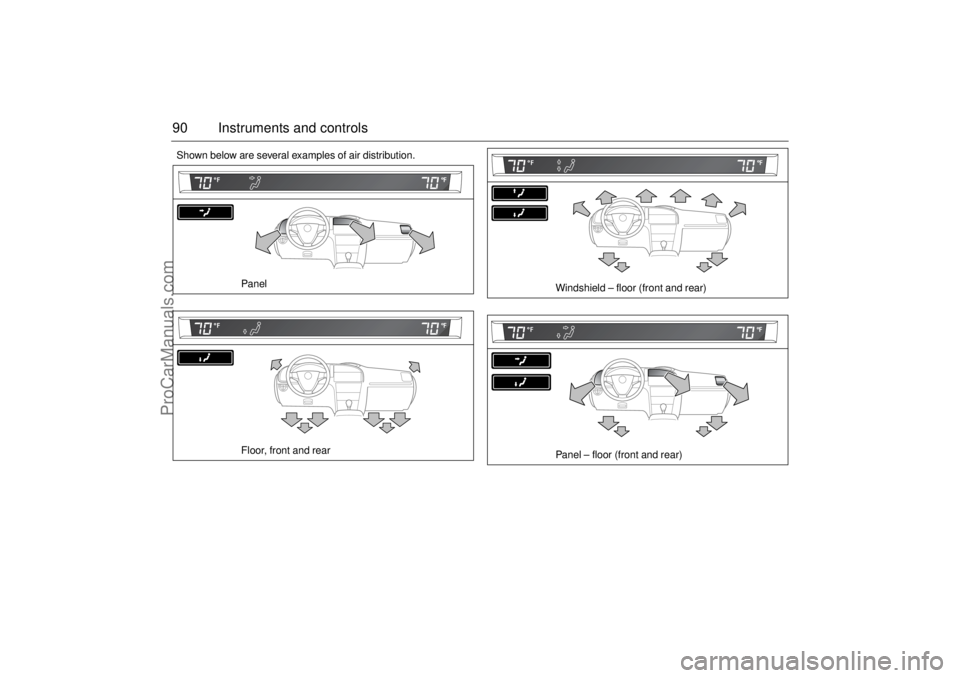
90 Instruments and controlsShown below are several examples of air distribution.
Panel
Floor, front and rear
Windshield – floor (front and rear)
Panel – floor (front and rear)
ProCarManuals.com
Page 91 of 256
91 Instruments and controls
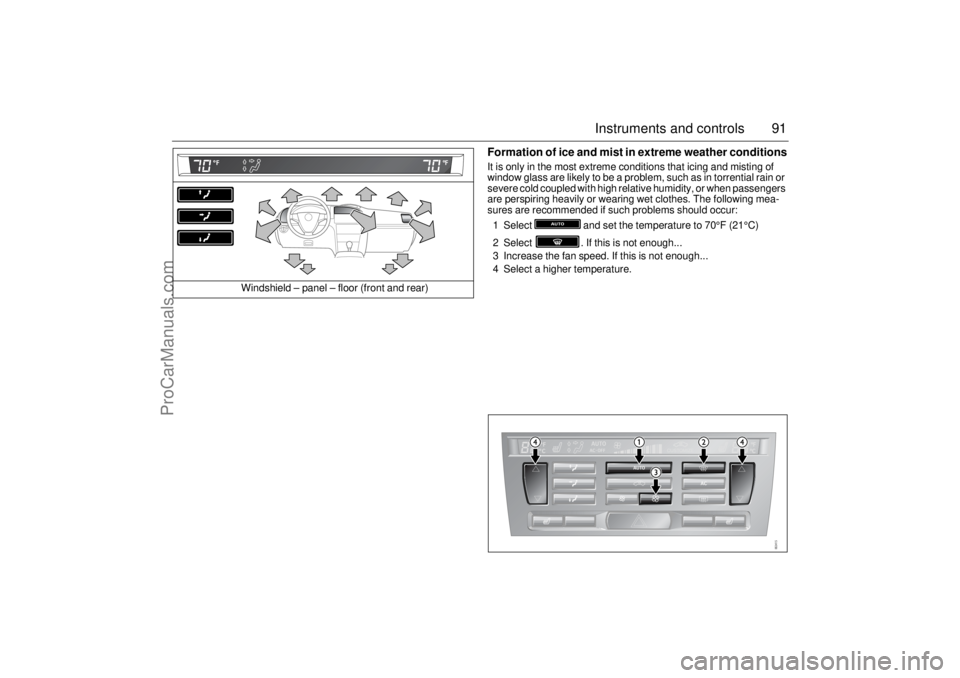
Formation of ice and mist in extreme weather conditionsIt is only in the most extreme conditions that icing and misting of
window glass are likely to be a problem, such as in torrential rain or
severe cold coupled with high relative humidity, or when passengers
are perspiring heavily or wearing wet clothes. The following mea-
sures are recommended if such problems should occur:
1 Select and set the temperature to 70°F (21°C)
2 Select . If this is not enough...
3 Increase the fan speed. If this is not enough...
4 Select a higher temperature.
Windshield – panel – floor (front and rear)
ProCarManuals.com
Page 93 of 256
93 Instruments and controls
ProfilerSome of the functions of the ACC system
can be customized.
1 Press the CUSTOMIZE button to go to
Profiler.
2 Select Climate System using the
INFO dial.
3 Press in the INFO dial.
4 Select Rear Defroster, Heated Seats,
Fan Settings, Air Distribution, A/C
Mode, Dual/Single Zone or Default
Settings by turning the dial.
5 Confirm this selection by pressing the
INFO dial.
Once you have adjusted the ACC system
settings under Profiler, CUSTOMIZE will
appear on the ACC display.
Climate System
Rear Defroster
AutoManual
Heated Seats
AutoManual
Fan Settings
High speedMedium speedLow speed
Air Distribution
AutoManual
WindshieldPanelFloor
A/C Mode
AutoA/C off
Dual/Single Zone
Dual zoneSingle zone
Default Settings
Are you sure?Ye s N o
ProCarManuals.com
Page 94 of 256

94 Instruments and controlsExplanation of how the ACC system can be
customized under Profiler.
Rear Defroster
Auto:
The rear window and door mirror
heating is controlled automatically.
This is one of the Default Settings.
Manual:
The rear window and door mirror
heating is switched on with
the button on ACC panel.
Heated Seats
Auto:
The front seat heating is controlled
automatically.
Select the level by repeatedly
pressing the appropriate button on
the ACC panel: 2 arrows on symbol
= standard; 3 arrows = high; 1 arrow
= low. The selected heating setting
is saved when the engine is
switched off. Note: The symbol on
the ACC panel goes out if the heat-
ing is turned off automatically by the
system.
Manual:
See Electric heating, front seats
(option) on page 92
.
This is one of the Default Settings.
Fan Settings
High speed:
This selection give a slightly higher
fan speed than Medium speed
though with continued automatic
regulation.
Medium speed:
Normal automatic fan speed. This is
one of the Default Settings.
Low speed:
This selection give a slightly lower
fan speed than Medium speed
though with continued automatic
regulation.
Air Distribution
Auto:
The ACC system adapts air tem-
perature and distribution to the pre-
vailing conditions. This is one of the
Default Settings
.
Manual:
Windshield:
The ACC system directs almost
all air to the windshield.
Panel:
The ACC system directs almost
all air to air vents in the fascia.
Floor:
The ACC system directs almost
all air to the floor.
ProCarManuals.com
Page 122 of 256

122 Starting and drivingIgnition switchThe ignition switch is located on the center
console between the front seats. In cars
with automatic transmission, the remote
control can only be removed when the
selector lever is in position P.NOTICETake care not to spill drinks or to drop
crumbs over the ignition switch. If dirt or
liquid gets into it, the switch may not
operate properly.
WARNING
• Always remove the remote control
before leaving children unattended in
the car.
Apply the parking brake before remov-
ing the remote control.
Never remove the remote control
while the car is moving. This will acti-
vate the steering wheel lock and make
it impossible to steer the car.
LOCK position
The position lights, hazard warning lights and interior lighting can be
turned on.
Cars with automatic transmission: Move the gear lever to P.
The gear lever is locked in position. This is the only position in which the
remote control can be removed.
Cars with manual transmission: The remote control can be removed
regardless of the position of the gear lever.
OFF position
Parts of the electrical system are operative.
Do not leave the remote control in the OFF position with the engine
not running as this could cause the battery to run flat in a matter of
hours.
Cars with automatic transmission: The gear lever is not locked. See
also page 135.
ON position
The entire electrical system is operative.
Do not leave the remote control in the ON position when the engine
is not running.
Turn the remote control to the OFF position to disconnect the electrical
system.
When you turn the remote control to ON, some indicator and warning lights
will come on in the main instrument panel. These should go out after about
3 seconds.
ST - starter position
The starter motor operates (automatic transmission: selector lever must
be in P or N) when the remote control is turned to this position. When
released, the remote control will spring back to the ON position.
The car has an electronic restart lock. If the engine fails to start, the remote
control must first be turned back to a position between OFF and LOCK
before the starter motor can be operated again.
ProCarManuals.com
Page 126 of 256

126 Starting and drivingLimp-homeThe engine management system has a
diagnostic feature that checks a number of
internal functions. If a fault is detected in the
throttle valve, the engine management
system will set the throttle system to the
limp-home mode. This means:
idling control will be poor (uneven idling
since regulated by ignition and fuel
supply)
engine performance will be reduced
the cruise control will not function
the capacity of the A/C compressor will be
limited.If the diagnosis function detects a fault in the
engine management system, the light
"Engine malfunction (CHECK ENGINE)" in
the instrument panel will come on (see page
55). Have the car checked at a Saab dealer
as soon as possible.
The following message is shown on the SID:
Important considarations with
catalytic convertersThe catalytic converter is an emission con-
trol device incorporated in the car’s exhaust
system. It consists of a metal canister with a
honeycomb insert, the cells of which have
walls coated in a catalytic layer (precious
metal alloy).
To ensure that the catalytic converter con-
tinues to function properly, and also to avoid
damage to the converter and its associated
components, the following points must be
observed:
NOTICE If the engine sounds strange there is a
malfunction. Contact a Saab dealer
immediately.
The use of fuel with too low an octane
rating can cause serious engine
damage.
Reduced engine power.
Contact Saab dealer.
NOTICEIf "Engine malfunction (CHECK
ENGINE)" warning light starts to flash
(indicating that the engine is misfiring and
the catalytic converter can be damaged),
ease off the accelerator slightly. The light
should go out or start to shine constantly.
If the light continues to flash despite
easing off the accelerator, you may
continue to drive the car but at the mini-
mum throttle permitted by the current traf-
fic situation. Have the car checked as
soon as possible at a Saab dealer.
NOTICEUse only unleaded gasoline. Leaded
gasoline is detrimental to the catalyst and
oxygen sensor and will seriously impair
the function of the catalytic converter.
ProCarManuals.com