2003 SAAB 9-3 roof
[x] Cancel search: roofPage 153 of 256

153 Starting and driving
Economical drivingFactors affecting fuel consumptionThe fuel consumption of a car is greatly
affected by driving conditions, climate, road
conditions, speed, driving technique, and
so on.Breaking-inFuel consumption may be somewhat
higher during the break-in period (the
first 3,000–4,000 miles (5,000–7,000 km)).Weather conditionsSummer temperatures give better fuel
economy than winter ones. The difference
can be as much as about 10%. Consump-
tion increases in cold weather because the
engine takes longer to reach its normal
operating temperature. The transmission
and wheel bearings also take longer to
warm up. Even distance affects consump-
tion: short journeys of 3–5 miles (5–8 km)
do not give the engine enough time to
reach its optimum temperature. Wind con-
ditions also have a marked effect on fuel
consumption.How to read the diagram:
If fuel consumption with the engine at
normal temperature is 28 mpg (10 l/
100 km), the actual fuel consumption
3 miles (5 km) after the engine has started
from cold will be:
– 23.5 mpg (12 l/100 km) at outside temp.
of 68°F (+20°C) (increase of 20%).
– 17.7 mpg (16 l/100 km) at outside temp.
of 32°F (0°C) (increase of 60%).
– 14 mpg (20 l/100 km) at outside temp.
of –4°F (–20°C) (increase of 100%).
It is clear from the diagram that both dis-
tance driven and outside temperature have
a significant impact on fuel consumption,
after a cold start.
If the car is normally driven on short jour-
neys, 3–5 miles (5–8 km), for example to
and from work, the average consumption
will be 60–80% above the normal level.
Driving techniques To obtain the best running economy, with
regard to fuel consumption and general
wear, the car must be serviced regularly.
High speed, unnecessary acceleration,
frequent braking and much changing
down all give higher fuel consumption.
Frequent gear changing in traffic, starting
in cold weather, the use of studded tires
and roof racks, and towing a caravan all
increase fuel consumption.
Do not warm up the engine while the car
is stationary.
If idling, the engine will take much longer
to reach its optimum temperature, and Percentage increase in fuel consumption
of engine starting from cold compared to
engine at normal temperature.
ProCarManuals.com
Page 161 of 256
161 Starting and driving
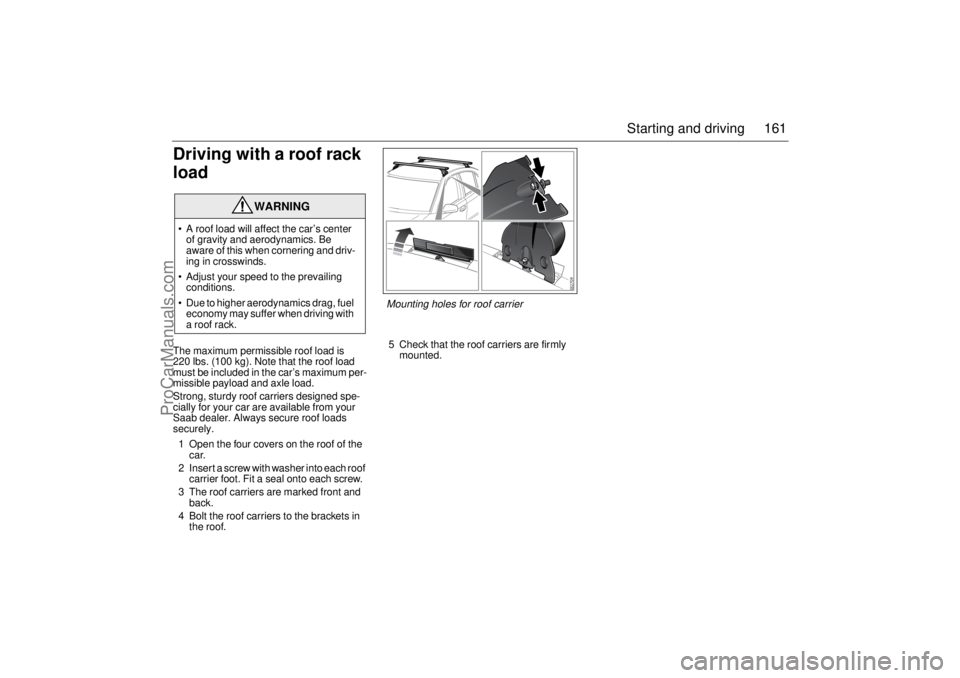
Driving with a roof rack
loadThe maximum permissible roof load is
220 lbs. (100 kg). Note that the roof load
must be included in the car’s maximum per-
missible payload and axle load.
Strong, sturdy roof carriers designed spe-
cially for your car are available from your
Saab dealer. Always secure roof loads
securely.
1 Open the four covers on the roof of the
car.
2 Insert a screw with washer into each roof
carrier foot. Fit a seal onto each screw.
3 The roof carriers are marked front and
back.
4 Bolt the roof carriers to the brackets in
the roof.5 Check that the roof carriers are firmly
mounted.
WARNING
A roof load will affect the car’s center
of gravity and aerodynamics. Be
aware of this when cornering and driv-
ing in crosswinds.
Adjust your speed to the prevailing
conditions.
Due to higher aerodynamics drag, fuel
economy may suffer when driving with
a roof rack.
Mounting holes for roof carrier
ProCarManuals.com
Page 162 of 256

162 Starting and drivingDriving with a loadThe handling characteristics are affected by
how the car is loaded.
Place the heaviest load as far forward and
as low as possible in the trunk.
Secure the load to the lashing eyes (see
page 118).
Heavy loads mean that the car’s center of
gravity is further back. As a result, the car
will sway more during evasive steering.
Never exceed the permissible load of the
roof box, even if there is room for more.
Ensure that the tire pressure is correct –
slight overinflation is preferable to under-
inflation.
The braking distance of a loaded car is
always greater. Keep your distance from
the vehicle in front.
Do not exceed the car’s permissible
gross vehicle weight or axle load (see
page 236).
Roof loads can negatively affect telecom-
munication.
TiresNote: Low tire pressure also causes prema-
ture tire wear and increased fuel consump-
tion.
Tire pressure should match the current load
and speed of the car (see page 245).
The tire pressures given apply to cold tires,
that is tires that are the same temperature
as the outside air temperature.
The tire pressure increases approximately
4 psi/27 kPa as the tires become warm (e.g.
during highway driving). When the temper-
ature of the tires changes by 50°F (10°C),
the tire pressure will change 2 psi/13 kPa.Never reduce the pressure of a hot tire. If the
tires are hot when you check them, only
increase the pressure, if necessary.
Underinflated tires wear more quickly than
slightly overinflated tires.
If a valve is leaking, simply unscrew it and fit
a new one.
Note: Remember to adjust the tire pres-
sures if you change the load in the car sig-
nificantly or intend to drive at substantially
lower or higher speeds than normal.
Automatic tire pressure monitoring, see
page 207.
WARNING
Check the tire pressure at least once a
month and before long journeys. Under-
inflation can result in:
punctures
separation of the tire and tread
damage to the sidewalls
damage to the rims on poor roads
poor handling characteristics
premature tire wear
increased fuel consumption.
ProCarManuals.com
Page 163 of 256

163 Starting and driving
Driving with the trunk lid
openAvoid driving with the trunk lid partly or fully
open, since exhaust fumes can be drawn
into the cabin.
If you must drive with the trunk lid open,
close all windows and the sunroof (if fitted)
and set the cabin fan to its highest speed
setting.
Driving in deep water Driving at night
Bear in mind the following points, especially
when driving at night:
Nighttime driving requires your full
concentration
Do not rush. Count on your journey taking
slightly longer.
The number of drivers under the influence
of drugs is likely to be greater at night than
during the day.
Do not stare at the headlights of oncom-
ing vehicles.
Avoid driving at night if you have poor
eyesight. Night vision deteriorates with
age.
Keep your car’s headlights, windows and
mirrors clean. Also, if you wear glasses,
make sure they are clean.
Make sure you are well rested before
starting a long journey. Take a break
every other hour.
Only eat light meals. Heavy meals have a
tendency to induce tiredness.
Wild animals prefer to move at dusk and
dawn.
Check the headlight levelling setting (see
page 73).
NOTICEDo not drive in puddles or water deeper
than 7 in. (20 cm) and do not drive faster
than at idling speed. Water can otherwise
be sucked into the engine. The engine will
be damaged if water enters the intake
system.
ProCarManuals.com
Page 202 of 256

202 Car careTrunk fuse panel, left-hand sideNo. Amp. Function
1–5 MAXI -
6 30 Control module in left rear door
7 30 Control module in right rear door
820Trailer
9--
10 30 Left-hand brake light; rear right turn signal; right tail
light; right reversing light; high-mounted brake light;
trailer lights
11 - -
12 - -
13 - -
14 - -
15 15 Seat heating, left seat
16 15 Seat heating, right seat
17 7.5 Autodimming rearview mirror; rain sensor; tire
pressure monitoring
18 15 Sunroof
19 7.5 Telematics (OnStar)
20 7.5 DVD player (navigation system)
21 7.5 Saab Parking Assistance (SPA); control module in
rear doors
22 30 Amplifier, sound system III
23 - -
24 10 Movement sensor; CD changer in trunk (accessory)
25 30 Electrically adjustable driver’s seat with memory
26 30 Right-hand stop light; rear left turn signal; left tail
light; rear fog light; left reversing light; license plate
lighting; trunk lighting; trailer lights
27 - -
28 - -
29 - -
ProCarManuals.com
Page 220 of 256

220 Car careTwo-coat enamelAs the name implies, two-coat enamel is
applied in two operations. The first coat, the
base color, contains the pigment, metal
flakes and binder. The second coat consists
of a clear enamel, which provides the final
gloss for the paintwork and protects the
base from moisture and environmental con-
taminants.
Touch-up stone-chip damage as follows:
1 Thoroughly clean the damaged area.
2 Then apply the primer, base colour and
finally, the clear enamel. To achieve the
best finish, apply two or three coats of
primer.
Anti-corrosion
treatmentThe entire car undergoes a series of anti-
corrosion processes during production.
These include electrophoretic priming,
polyester-based coating to protect against
stone chip damage and corrosion, and
treatment of body cavities and members
with thin, penetrating rustproofing oil.
In addition, most body panels, such as the
hood, doors and floor pan are galvanized.
The anti-corrosion treatment on some parts
of the car is constantly exposed to wear and
prone to damage. This applies particularly
to the underside of the car and inside the
wheel arches, where grit, road salt and the
like that are thrown up can give rise to cor-
rosion where the underseal has worn away.
The extent of this obviously depends on the
conditions in which the car is used.
Accordingly, make it a habit to hose the
underside of the car often and to inspect the
condition of the underseal. The anti-corro-
sion warranty does not relieve the car owner
of the need to carry out normal maintenance
to the rustproofing and to make good any
damage.
Surface treatment composition1 Body panel
2 Zinc (certain components only) 7.5 µm
3 Phosphate coating 3 –5 µm
4 Cathodic ED 30 µm
5 Intermediate coat 40 –45 µm
6 Metallic base/solid base 13 µm
7 Clear enamel 45 µm
ProCarManuals.com
Page 221 of 256

221 Car care
Use a hose to clean the underside of the car
thoroughly. After it has dried, use a brush or
spray to apply a viscous anti-corrosion
agent to any worn or damaged areas, to
prevent the onset of corrosion.
Even after the anti-corrosion warranty has
expired, it makes good sense to continue to
maintain the rustproofing.
Seams in the body, especially those in the
doors and trunk lid, are particularly vulnera-
ble to corrosion from the outside, caused by
grit and salt thrown up from the road, and to
corrosion from the inside, largely as a result
of condensation. Keep the seams clean and
at the first sign of any rust, apply a thin, pen-
etrating, anti-corrosion oil. Your Saab
dealer will be pleased to give you further
advice.
What causes rust?Steel body panels of automobiles are sub-
ject to rusting whenever air and moisture
manage to penetrate the protective finish.
Body panels may rust through if the process
is unchecked. Rusting can occur wherever
water is trapped or where the car’s panels
are continuously damp.
Damage to paint and undercoating by
stones, gravel and minor crashes immedi-
ately exposes metal to air and moisture.
Road salts used for de-icing will collect on
the bottom of the car and promote rusting.
Areas of the country with high humidity have
a greater potential for rust problems, espe-
cially where salt is used on roads or there is
moist sea air. Industrial pollution (fallout)
may also damage paint and promote rust-
ing.
Preventive maintenanceThe following procedures are necessary to
help protect against rusting. Refer also to
the terms and conditions of the Performa-
tion Limited Warranty described in the war-
ranty booklet.
1Wash the car frequently, and wax at
least twice a year. Under adverse
conditions, where there is a rapid
buildup of dirt, sand or road salt, wash
your car at least once a week. After
extreme exposure to salted snow or
slush, evidenced by a white film on the
car, wash the car immediately. Frequent
washing will prevent paint damage from
acid rain and other airborne contami-
nants such as tree sap and bird drop-
pings. If any of these contaminants are
noticed on the car the finish should be
washed immediately.
Begin washing by rinsing the entire car
with water to loosen and flush off heavy
concentrations of dirt (include the
underbody).
Sponge the car with a solution of either
a good quality car soap or mild general
purpose (dish washing) detergent and
water.
Rinse car thoroughly with clean water.
After washing, check and clear all
drains in doors and body panels.
Wipe the car dry, preferably using a
chamois.
ProCarManuals.com
Page 237 of 256

237 Technical data
Curb weight
(i.e. with full fuel tank, full washer fluid res-
ervoir, standard tools and spare wheel) _3174–3461 lbs.
(1440–1570 kg)
Gross vehicle weight (GVW) ___________ 4343–4453 lbs.
(1970–2020 kg)
Maximum axle load:
Front ____________________________ 248 lbs. (1125 kg)
Rear ____________________________ 2226 lbs. (1010 kg)
Weight distribution:
Curb weight + driver (154 lbs. (70 kg)),
front/rear _________________________ approx. 60/40 %
GVW, front/rear ____________________ approx. 50/50 %
Maximum roof load _________________ 220 lbs. (100 kg)
Maximun load in trunk ______________ 175 lbs. (80 kg)
WARNING
The GVW and maximum axle loads must not be exceeded.
Note that if some accessories (e.g. towbar, CD changer) are
fitted, the available load capacity is reduced by the weight of
these.
When carrying a load in the trunk, make sure that it is lashed
down securely, particularly when part or all of the rear seat is
folded down.
Trailer:
Trailer with brakes ___________________ Max. 3500 lbs.
(1588 kg)
Trailer without brakes ________________ Max. 1000 lbs.
(450 kg)
Recommended towball load ___________ 110–165 lbs.
(50–75 kg)
Maximum theoretical towing speed, trailer
with brakes _______________________ 60 mph (100 km/h)
When towing a trailer, increase the pressure
of the rear tires by 0.2 bar (3 psi).
The above speed and weight restrictions are those specified by
Saab Automobile AB.
Note that national restrictions may apply to trailer speeds and
weights (see page 157).
ProCarManuals.com