2003 SAAB 9-3 oil
[x] Cancel search: oilPage 178 of 256

178 Car careChanging filter
1 Unscrew the oil filter cap.
Lift the cap slightly and carefully pry
apart the cap and the filter housing.
Remove the filter cap.
2 Remove the filter. Have paper towelling
or a rag at hand to catch the oil that
escapes from the filter.
3 Fit a new filter.
4 Check the seal in the cap. Apply a small
amount of new engine oil to the O-ring.
5 Screw on the cap. The correct tightening
torque is 25 Nm (18 lbf ft).
Air filter
Transmission fluidManual transmissionCheck and top up the oil in accordance with
the service program.Automatic transmissionCheck and top up the oil in accordance with
the service program.
WARNING
To ensure reliable operation, only use
an air filter recommended by Saab
Automobile AB.
Oil filter
ProCarManuals.com
Page 179 of 256

179 Car care
CoolantIf the coolant level drops too low, the follow-
ing message appears on the SID:The properties of the coolant are retained
for the entire service life of the car. There-
fore, it is not necessary to change the cool-
ant.
The coolant contains 50 % antifreeze and
anti-corrosion fluid. This ratio gives the best
cooling effect. Lower concentrations should
be avoided, in view of the corrosion risk.
Other makes of antifreeze can damage the
engine and cooling system.The expansion tank is transparent to facili-
tate checking the coolant level.
When the engine is cold, the coolant must
not lie above the KALT/COLD mark on the
expansion tank (boundary between the
upper and lower sections of the tank, see
illustration).
Top up with a mixture of equal parts of
Saab-approved antifreeze and clean water.
If the expansion tank is empty when coolant
is added, run the engine to normal temper-
ature and top up again, as necessary.
WARNING
Proceed with caution if the radiator is
boiling when you open the hood.
Never remove the expansion-tank
filler cap when the radiator is boiling.
The cooling system is pressurized –
hot coolant and vapor can escape
when the filler cap is released. These
can cause injury to your eyes and
burns. Loosen the cap carefully, and
let the engine cool before removing
the cap.
Exercise care when adding coolant.
Coolant on hot surfaces constitutes a
fire risk.
Coolant level low.
Refill.
Coolant expansion tank
ProCarManuals.com
Page 181 of 256

181 Car care
The foot brake and parking brake are self-
adjusting.
It is not possible to detect, through abnormal
pedal or parking brake lever travel, whether
the brake pads are worn and need replac-
ing. It is therefore essential that brake pads
be checked regularly, as specified in the
service program.
Brake pads should only be changed at a
Saab dealer. To ensure optimum brake
performance, use only Saab genuine
brake pads.
Power steeringCheck the level of the power steering fluid in
the reservoir regularly, in accordance with
the service program.
The wheels should point directly forwards
during this check.
Clean round the cap before unscrewing it.
Wipe the dipstick. To check the level, screw
down the cap completely and then remove
it again.
The oil level should lie between the MAX
and MIN marks when the oil temperature is
about 68°F (+20°C). If the oil is colder, the
level will be lower, and at a higher tempera-
tures the level will be higher, both of which
are acceptable.
Top up with "CHF 11S power steering fluid".
NOTICEAvoid spilling brake fluid onto paintwork,
since it can cause the paint to bubble and
lift. If any brake fluid is spilled, the area
should be flushed with large quantities of
water as quickly as possible.
WARNING
Power steering fluid on hot engine
components constitutes a fire risk.
Power steering fluid reservoir
ProCarManuals.com
Page 217 of 256

217 Car care
Flat spottingAll tires get hot, especially on long journeys
or when the car is driven hard. After the car
has been parked with hot tires and the tires
have cooled down, a flat spot can form in the
tire, where it is in contact with the ground.
The same can occur if the car has not been
moved for a long time.
Flat spots can cause vibration that can be
felt through the steering wheel, similar to
that experienced when the wheels need bal-
ancing.
Flat spots of this type disappear once the
tires get hot again, usually after 10–15 miles
(20–25 km) of driving at cruising speed.
Safety beltsCheck the function of the safety belts regu-
larly as follows:
Hold the diagonal strap and pull it sharply.
The safety belt should lock and it should
not be possible to withdraw it further.
Check the anchorage points in the floor.
They must not have suffered rust damage.
If a belt is worn or has any fraying edges, it
should be replaced.
Safety belts must not come into contact with
substances such as polishes, oil or chemi-
cals. If the belts get dirty, wash them with
warm water and a detergent or have them
replaced.
Upholstery and trimTo remove fluff and hairs from the seats,
door armrests and headlining, use a
vacuum cleaner, a moist lint-free cloth, or a
clothes brush. Remove spots and dirt using
a cloth moistened with lukewarm soapy
water.
When using a stain remover, always work
from the outside towards the centre to avoid
leaving a ring. If a soiled ring or spot should
remain, it can usually be removed using
lukewarm soapy water or water alone.
Spots left by liquids, such as soft drinks or
thin oil, must be removed at once with an
absorbent material, such as kitchen towel-
ling. Then clean with a stain remover.
White spirit is recommended for removing
grease and oil stains. A medium stiff brush
may also be used.
WARNING
If the car is involved in a crash, the safety
belts, belt pretensioners and other asso-
ciated components must be inspected at
a Saab dealer.
Never make any alterations or repairs to
the safetybelts yourself but visit a Saab
dealer.
ProCarManuals.com
Page 220 of 256

220 Car careTwo-coat enamelAs the name implies, two-coat enamel is
applied in two operations. The first coat, the
base color, contains the pigment, metal
flakes and binder. The second coat consists
of a clear enamel, which provides the final
gloss for the paintwork and protects the
base from moisture and environmental con-
taminants.
Touch-up stone-chip damage as follows:
1 Thoroughly clean the damaged area.
2 Then apply the primer, base colour and
finally, the clear enamel. To achieve the
best finish, apply two or three coats of
primer.
Anti-corrosion
treatmentThe entire car undergoes a series of anti-
corrosion processes during production.
These include electrophoretic priming,
polyester-based coating to protect against
stone chip damage and corrosion, and
treatment of body cavities and members
with thin, penetrating rustproofing oil.
In addition, most body panels, such as the
hood, doors and floor pan are galvanized.
The anti-corrosion treatment on some parts
of the car is constantly exposed to wear and
prone to damage. This applies particularly
to the underside of the car and inside the
wheel arches, where grit, road salt and the
like that are thrown up can give rise to cor-
rosion where the underseal has worn away.
The extent of this obviously depends on the
conditions in which the car is used.
Accordingly, make it a habit to hose the
underside of the car often and to inspect the
condition of the underseal. The anti-corro-
sion warranty does not relieve the car owner
of the need to carry out normal maintenance
to the rustproofing and to make good any
damage.
Surface treatment composition1 Body panel
2 Zinc (certain components only) 7.5 µm
3 Phosphate coating 3 –5 µm
4 Cathodic ED 30 µm
5 Intermediate coat 40 –45 µm
6 Metallic base/solid base 13 µm
7 Clear enamel 45 µm
ProCarManuals.com
Page 221 of 256

221 Car care
Use a hose to clean the underside of the car
thoroughly. After it has dried, use a brush or
spray to apply a viscous anti-corrosion
agent to any worn or damaged areas, to
prevent the onset of corrosion.
Even after the anti-corrosion warranty has
expired, it makes good sense to continue to
maintain the rustproofing.
Seams in the body, especially those in the
doors and trunk lid, are particularly vulnera-
ble to corrosion from the outside, caused by
grit and salt thrown up from the road, and to
corrosion from the inside, largely as a result
of condensation. Keep the seams clean and
at the first sign of any rust, apply a thin, pen-
etrating, anti-corrosion oil. Your Saab
dealer will be pleased to give you further
advice.
What causes rust?Steel body panels of automobiles are sub-
ject to rusting whenever air and moisture
manage to penetrate the protective finish.
Body panels may rust through if the process
is unchecked. Rusting can occur wherever
water is trapped or where the car’s panels
are continuously damp.
Damage to paint and undercoating by
stones, gravel and minor crashes immedi-
ately exposes metal to air and moisture.
Road salts used for de-icing will collect on
the bottom of the car and promote rusting.
Areas of the country with high humidity have
a greater potential for rust problems, espe-
cially where salt is used on roads or there is
moist sea air. Industrial pollution (fallout)
may also damage paint and promote rust-
ing.
Preventive maintenanceThe following procedures are necessary to
help protect against rusting. Refer also to
the terms and conditions of the Performa-
tion Limited Warranty described in the war-
ranty booklet.
1Wash the car frequently, and wax at
least twice a year. Under adverse
conditions, where there is a rapid
buildup of dirt, sand or road salt, wash
your car at least once a week. After
extreme exposure to salted snow or
slush, evidenced by a white film on the
car, wash the car immediately. Frequent
washing will prevent paint damage from
acid rain and other airborne contami-
nants such as tree sap and bird drop-
pings. If any of these contaminants are
noticed on the car the finish should be
washed immediately.
Begin washing by rinsing the entire car
with water to loosen and flush off heavy
concentrations of dirt (include the
underbody).
Sponge the car with a solution of either
a good quality car soap or mild general
purpose (dish washing) detergent and
water.
Rinse car thoroughly with clean water.
After washing, check and clear all
drains in doors and body panels.
Wipe the car dry, preferably using a
chamois.
ProCarManuals.com
Page 223 of 256
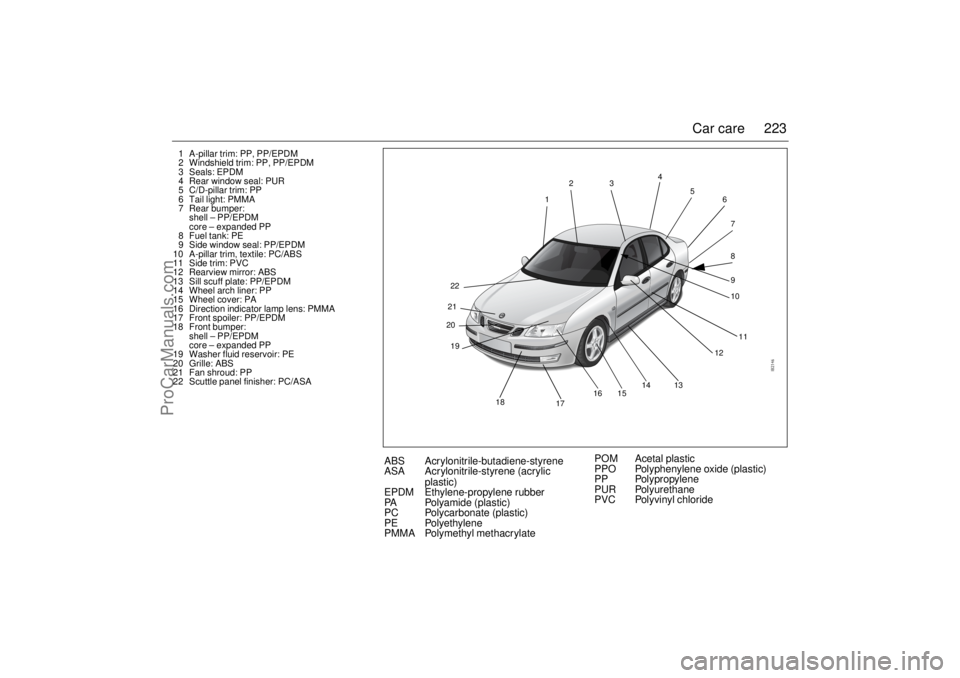
223 Car care
1 A-pillar trim: PP, PP/EPDM
2 Windshield trim: PP, PP/EPDM
3 Seals: EPDM
4 Rear window seal: PUR
5 C/D-pillar trim: PP
6 Tail light: PMMA
7 Rear bumper:
shell – PP/EPDM
core – expanded PP
8 Fuel tank: PE
9 Side window seal: PP/EPDM
10 A-pillar trim, textile: PC/ABS
11 Side trim: PVC
12 Rearview mirror: ABS
13 Sill scuff plate: PP/EPDM
14 Wheel arch liner: PP
15 Wheel cover: PA
16 Direction indicator lamp lens: PMMA
17 Front spoiler: PP/EPDM
18 Front bumper:
shell – PP/EPDM
core – expanded PP
19 Washer fluid reservoir: PE
20 Grille: ABS
21 Fan shroud: PP
22 Scuttle panel finisher: PC/ASA
19 2022
211234
18
1716 151412
1311 7
10 9 8 6 5
ABS Acr ylonitrile-butadiene-styrene
ASA Acrylonitrile-styrene (acrylic
plastic)
EPDM Ethylene-propylene rubber
PA Polyamide (plastic)
PC Polycarbonate (plastic)
PE Polyethylene
PMMA Polymethyl methacrylatePOM Acetal plastic
PPO Polyphenylene oxide (plastic)
PP Polypropylene
PUR Polyurethane
PVC Polyvinyl chloride
ProCarManuals.com
Page 225 of 256

225 Car care
Maintenance The compressor drive belt should be
inspected under the regular service
program.
Clean away dirt and insects from the
condenser and radiator to prevent clog-
ging. When washing the car, use the hose
to spray the radiator and condenser
(located in front of the radiator) from both
sides (both from the front of the car and
from inside the engine bay). Do not use a
pressure washer.
Caution: Do not hose down the radia-
tor and condenser while the engine is
hot.Other than in extremely cold weather, do not
screen the radiator, e.g. with netting, as this
will greatly diminish its cooling capacity.
Applicable to the manual climate control
system - During cold months the air condi-
tioning should be switched on once or
twice a month and run for 5–10 minutes
during highway driving once the engine is
warm.
This action saves the gaskets in the
compressor from being spoiled. The
compressor uses a lubricant that circu-
lates with the coolant.
Note:
The A/C system cannot be switched on
when the outside temperature is below 32°F
(0°C). Turn on the A/C system when the car
is standing in a warm place. Simplest is to
always have the A/C button pressed in. The
A/C system will then cut in automatically
when the outside temperature is high
enough.NOTICEDo not use a pressure washer when
cleaning the condenser or radiator due to
the risk of damage.
ProCarManuals.com