Page 215 of 256

215 Car care
When the car has to be lifted, the jack must
be positioned at one of the four jacking
points (front or rear) under the sill members.
If a floor jack is used, the lifting plate must
be positioned under the normal jacking
points. If the car is equipped with a towbar,
the jack can also be placed under this.
1 Apply the parking brake and engage 1st
or reverse gear (automatic transmis-
sion: select P).
2 Wind the jack up to a suitable height
before placing it under the jacking point.
Each jacking point is indicated by an arrow on the sill (see illustration).
Make sure that the jack fully engages
the jacking point in the underside of the
sill member and that the entire foot of the
jack is steady and flat on the ground.
The jack must not stand on snow, ice or
similar.
Wind up the jack until it just begins to lift
the car.
3 It is not necessary to remove the wheel
cover.
If, none the less, you wish to remove the
wheel cover, take hold of the outer edge
and pull it straight out.
Loosen the wheel bolts half a turn.
4 Wind the jack to raise the wheel clear of
the ground. Remove the wheel bolts and
lift off the wheel.5 Clean any rust or dirt from the contact
surfaces between the wheel and brake
disc. Do not wipe away the grease in the
wheel hub.
6 Fit the wheel and screw in the bolts in the
sequence shown on the following page
(opposite pairs).
Tighten the bolts enough for the bolts
and wheel to be seated correctly.
7 Lower the car and tighten the wheel
bolts to torque in sequence as shown on
the following page.
Tightening torque:
Light-alloy wheels: 110 Nm.
Steel wheels: 110 Nm.NOTICEApply the jack only to the jacking points
indicated on the body.
Jacking points
Marking of jacking points
Clean any rust or dirt from the contact sur-
faces between the wheel and brake disc.
ProCarManuals.com
Page 216 of 256
216 Car care8 Retighten the wheel bolts after twenty or
so miles.
Tightening torque:
Light-alloy wheels: 110 Nm.
Steel wheels: 110 Nm.We advise against using wheels with large
ventilation slots in winter, as the brake com-
ponents are then more exposed to slush,
road salt and grit.
If you fit wheels of a different dimension, the
speedometer can be reprogrammed to
ensure it is as accurate as possible. Contact
a Saab dealer.
Driving with tire chains, see
page 156 NOTICE
Do not overtighten the bolts using a
impact wrench: not only can this
damage the wheels but it can also
make it impossible to undo the bolts
using the wheel wrench in the car’s
toolkit.
When refitting a wheel cover, make
sure that the valve protrudes through
the marked recess in the wheel cover.
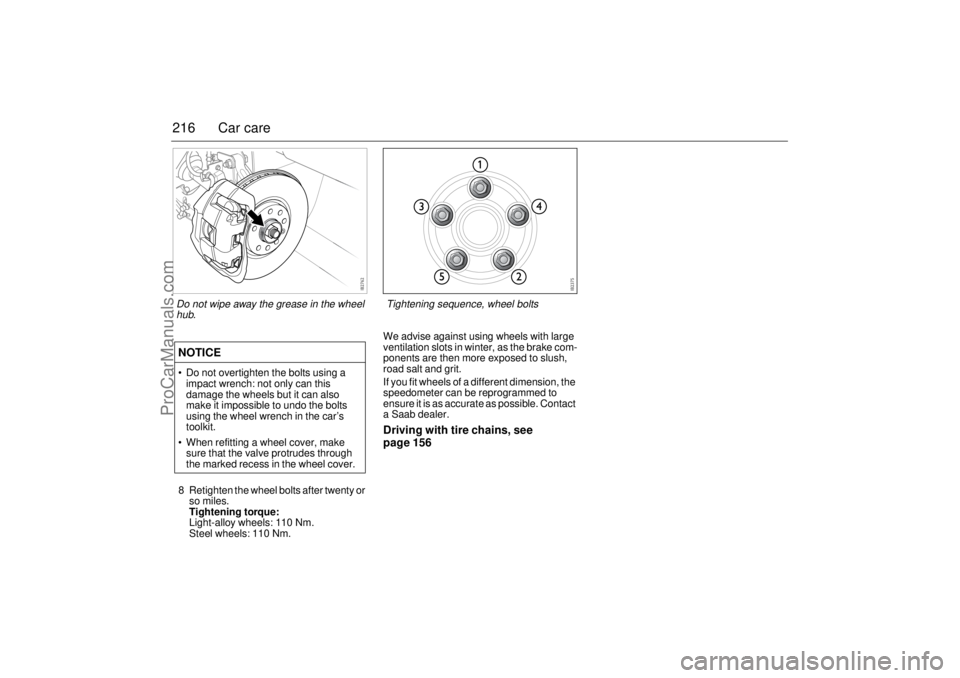
Tightening sequence, wheel bolts
Do not wipe away the grease in the wheel
hub.
ProCarManuals.com
Page 240 of 256

240 Technical dataFuel
EnginesElectrical system
Drive belt
Fuel tank capacity ___________________ 16.3 U.S. gal. (62 l)
For optimum performance
Saab recommends:
2.0t (175 hp) ______________________ Unleaded 90 AON
2.0 Turbo (210 hp) _________________ Unleaded 93 AON2.0t EcopowerRating, EEC at 5500 rpm ____________ 175 hp (129 kW)
Maximum torque, EEC at 2500 rpm ____ 195 ft.lb. (265 Nm)
Compression ratio__________________ 9.5:12.0 Turbo EcopowerRating, EEC at 5500 rpm ____________ 210 hp (147 kW)
Maximum torque, EEC at 2500 rpm ____ 221 ft.lb. (300 Nm)
Compression ratio__________________ 9.5:1Voltage ___________________________ 12 V
Battery capacity ____________________ 60 or 70 Ah
Starter motor_______________________ 1.8 kW
Alternator rating: ____________________ 140 A/14 V
Firing order ________________________ 1-3-4-2
Spark plugs________________________ NGK PFR6T-10G
Electrode gap ______________________ 0.9–1.0 mm
Outside length______________________ 40.472'' (1028 mm)
Drive belt
ProCarManuals.com
Page 241 of 256
241 Technical data
Manual transmission Automatic transmissionType _____________________________ Fully synchronized
with final drive gear
and differential
Oil type (for topping up) _______________ Saab MTF 0063
Oil capacity ________________________ 2.0 qts. (1.9 l)
Speed (mph/km/h) at 1000 rpm in highest
gear (5th gear):
1.8t and 2.0t ______________________ 27–30/43–45Type _____________________________ Electronically-
controlled, 5-speed,
fully-automatic with
hydraulic torque
converter, planetary
gears and integral
final drive.
Lock-up function in
selector positions 3,
4 and 5.
Selector lever positions _______________ P, R, N, D, M
Oil capacity, total ____________________ 7.6 qts. (7.2 litres)
Oil type ___________________________ Saab 3309
Clutch type ________________________ Hydraulic plate
clutches, brake
bands and one-way
couplings
Speed (mph/km/h) at 1000 rpm in top gear:
1.8t, 2.0t and 2.0T _________________ 28–30/46–49
ProCarManuals.com
Page 254 of 256

254 IndexRemote control
_________________ 38
Remote locking malfunction
_______ 40
Reporting safety defects
_________ 233
Rev counter
___________________ 59
Reversing lights ________________ 76
Roof lighting
__________________ 105
Roof lighting, changing
__________ 196
Running-in
___________________ 132
SSAHR, head restraint
____________ 20
SID
__________________________ 64
SPA _________________________ 151
Saab Information Display
_________ 64
Saab Parking Assistance ________ 151
Saab Trionic engine
management system
__________ 174
Safety belts
____________________ 11
Seatbelts
______________________ 11
Seatbelts, care
________________ 217
Seatbelts, checking
_____________ 217
Seats
_________________________ 16
Securing a load
________________ 118
Sentronic, manual gear selection
__ 139
Service costs
_________________ 232
Service information
_____________ 232
Service intervals
_______________ 230
Service record retention
_________ 231
Shifting the wheels
_____________ 209
Signalling, horn
_________________ 98Ski hatch
_____________________ 117
Spare wheel __________________ 212
Speed ratings, tyres
____________ 209
Speedometer
__________________ 60
Starting the engine
_____________ 123
Steering wheel adjustment
________ 98
Steering wheel lock
_____________ 123
Storage compartments __________ 109
Sun visor
_____________________ 106
Sunroof
______________________ 102
Switches ______________________ 72
TTCS
_________________________ 144
Technical data
_________________ 236
Textile carpeting, cleaning
_______ 218
Tightening torque, wheels ________ 216
Tools and spare wheel
__________ 212
Touching up paintwork __________ 219
Towbar
______________________ 157
Towbar load
__________________ 159
Towing
______________________ 164
Towing a trailer
________________ 157
Towing the car ________________ 165
Traction Control System (TCS)
____ 144
Transmission oil, checking
_______ 178
Transmission oil, grade
__________ 241
Transmission, automatic _________ 134
Transmission, manual
___________ 133
Transporting the car
____________ 166Trip computer
__________________ 65
Trip meter
_____________________ 59
Trolley jack ___________________ 215
Troubleshooting, A/C and ACC
____ 224
Turbo gauge
___________________ 61
Tyre date code ________________ 212
Tyre markings
_________________ 209
Tyre pressure _________________ 207
Tyre pressure monitoring, automatic
207
Tyre sizes
____________________ 243
Tyres
________________________ 206
UUpholstery care
________________ 217
Upholstery, cleaning
____________ 217
Useful tips on night driving
_______ 163
Useful tips on starting petrol engines
125
VVanity mirror
__________________ 106
Vehicle identification number
_____ 246
Vehicle recovery
_______________ 166
WWarning labels
___________________ 7
Warning lights __________________ 54
Warning triangle ________________ 76
ProCarManuals.com