Page 170 of 256
170 Starting and drivingFor long tripsBefore starting off on a long journey, it is
advisable to have your car inspected by
your Saab dealer.
Obtain a few important items to take along
on your journey, such as spare bulbs, wiper
blades, fuses, a drive belt (poly-V-belt) and
the like.
You can check some points yourself before-
hand:
Check that no oil or fuel leaks out of the
engine or gearbox/transmission.
Check the coolant and power steering
fluid levels. Check also for leaks.
Inspect the drive belt (poly-V-belt) and
replace if it shows any signs of wear.
Check the battery charge.
Check the tires for tread pattern and air
pressure, including the compact spare
wheel.
Take an extra remote control and keep it
separate.
Check the brakes.
Check all bulbs.
Check for the presence of the tool kit and
jack in the car.
ProCarManuals.com
Page 171 of 256
171 Car care
Hood ________________ 172
Engine ______________ 173
Engine bay ___________ 175
Engine oil ____________ 176
Air filter______________ 178
Transmission fluid ____ 178
Coolant ______________ 179
Brake/clutch fluid and
brake pads__________ 180
Power steering________ 181
Battery ______________ 182
Drive belt ____________ 185
Wipers and washers ___ 186
Wiper blades _________ 186
Changing bulbs _______ 188 Fuses ________________ 199
Wheels _______________ 206
Compact spare wheel ___ 212
Changing a wheel ______ 214
Safety belts ___________ 217
Upholstery and trim ____ 217
Textile carpeting _______ 218
Engine bay ____________ 218
Washing ______________ 218
Waxing and polishing ___ 219
Touching up the paint___ 219
Anti-corrosion treatment 220
Recovery and/or
recycling of automotive
materials ____________ 222
Air conditioning (A/C) ___ 224
Car care
ProCarManuals.com
Page 208 of 256

208 Car careThe receiver is located in the trunk. Tire
pressure information is sent wirelessly to
the receiver.
The system checks the tire pressure when
the car is travelling over 18 mph (30 km/h).
The system is "self-learning", which means
that the position of the wheels can be
changed without requiring adjustments to
the monitoring system. The spare wheel
does not have a sensor.
The sensor batteries have an average life of
10 years. The batteries cannot be changed
but require the sensor units to be replaced.
The system does not warn if a tire is overin-
flated.
If the tire pressure drops
If the tire pressure drops 0.3 bar (4 psi)
below the recommended pressure, the SID
will issue a warning as to which tire is
affected.
Adjust the tire pressure as soon as possible.If the tire pressure continues to drop, the
SID will issue a warning alarm when the
pressure is 0.6 bar (9 psi) below the recom-
mended value.
Reduce speed (avoid heavy braking and
violent steering wheel movements) and
stop the car as soon as it is safe to do so.
Change the wheel. Tire pressure low,
front left.
Check tires.
Flat tire front left.
Make a safe stop.
Valve with sensor Valve without sensor
ProCarManuals.com
Page 209 of 256

209 Car care
Malfunction
The message shown above will be dis-
played on the SID if:
a wheel without pressure sensor is fitted
(e.g. spare wheel)
one, two or three pressure sensors are
broken or missing
two or more detectors are missing or
broken
the receiver malfunctions
a fault arises in the system.
The message shown above is not displayed
if none of the wheels have sensors, such as
if winter wheels without sensors are fitted.
Shifting the wheelsBecause of front wheel drive, the front tires
tend to wear faster than the rear ones. New
tires should always be fitted in pairs, so that
tires on the same axle have the same
amount of tread.
The wheels should be marked, L (left) and
R (right), when changing between summer
and winter (snow) tires. This ensures that
the direction of rotation of the wheels is the
same when they are refitted. Fit the tires in
best condition to the rear wheels.
Store wheels lying flat or hanging – never
standing upright.
Tire markingsAn example of the meaning of the different
markings in a tire size is given below for a
tire size of 195/65 R15 91H: Tire pressure
system failure.
Contact Saab dealer.
WARNING
When fitting just one new pair of tires,
these should be fitted to the rear wheels,
as these are more critical to the direc-
tional stability of the car (e.g. on braking
or in a skid). The existing rear wheels
should therefore be moved to the front.
Always move rear left to front left and rear
right to front right, so that the direction of
rotation remains the same.
195 Tire section width, mm
65 Aspect ratio, i.e. the section height
as a percentage of the section
width
R Radial ply
15 Wheel rim diameter 15 in at bead
seats
91 Tire load index
H Speed rating
Tire load indices
91 Tire approved for max. 1355 lbs.
(615 kg)
93 Max. 1433 lbs. (650 kg)
94 Max. 1477 lbs. (670 kg)
Speed ratings
S Tire approved for speeds up to
110 mph (180 km/h)
T Max. 118 mph (190 km/h)
H Max. 130 mph (210 km/h)
V Max. 149 mph (240 km/h)
W Max. 168 mph (270 km/h)
Y Max. 186 mph (300 km/h)
ProCarManuals.com
Page 210 of 256

210 Car careWinter tiresWinter (snow) tires are recommended for
winter climates where the majority of your
driving will be done on snow and ice. Winter
tires should be fitted to all four wheels to
maintain a proper balance. Your Saab
dealer can advise you of to the correct size
tire for your car (if different from the original
size) and also supply Saab approved winter
tires pre-mounted on steel or alloy rims.Tire quality grading (cars sold in
U.S.)New tires must be graded and labeled in
accordance with new Federal regulations.
Standard tests are conducted to measure
performance in the areas of traction and
temperature resistance. Refer to the tire
sidewall for the specific quality grades of the
tires provided on your new Saab. Compact
spare tires are exempt.
DOT QUALITY GRADES
Treadwear.
Traction AA, A, B, C.
Temperature A, B, C.
All passenger car tires must conform to Fed-
eral safety requirements in addition to these
grades.
Uniform Tire Quality Grading (US)Quality grades can be found where applica-
ble on the tire sidewall between tread shoul-
der and maximum section width. For exam-
ple:
Treadwear 200 Traction AA
Temperature ATreadwearThe treadwear grade is a comparative
rating based on the wear rate of the tire
when tested under controlled conditions on
a specified government test course. For
example, a tire graded 150 would wear one
and one half (1 1/2) times as well on the gov-
ernment course as a tire graded 100. The
relative performance of tires depends upon
the actual conditions of their use, however,
and may depart significantly from the norm
due to variations in driving habits, service
practices and differences in road character-
istics and climate.
TractionThe traction grades, from highest to lowest,
are AA, A, B and C. These grades represent
the tire’s ability to stop on wet pavement as
measured under controlled conditions on
specified government test surfaces of
asphalt and concrete. A tire marked C may
have poor traction performance.
WARNING
The traction grade assigned to a tire is
based on straight-ahead braking, traction
test and does not include acceleration,
cornering, hydroplaning or peak traction
characteristics.
ProCarManuals.com
Page 212 of 256
212 Car careTire date codeTires should be regarded as perishable
goods. As the tires age, the rubber becomes
progressively harder, and the roadholding
ability of the tires diminishes. This is partic-
ularly true on winter tires.
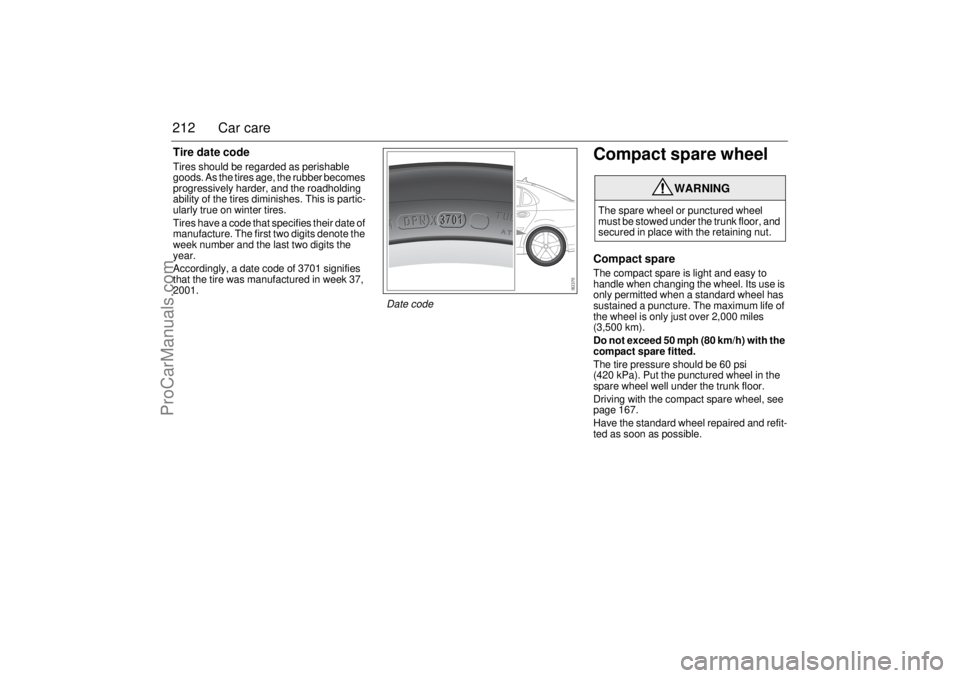
Tires have a code that specifies their date of
manufacture. The first two digits denote the
week number and the last two digits the
year.
Accordingly, a date code of 3701 signifies
that the tire was manufactured in week 37,
2001.
Compact spare wheelCompact spareThe compact spare is light and easy to
handle when changing the wheel. Its use is
only permitted when a standard wheel has
sustained a puncture. The maximum life of
the wheel is only just over 2,000 miles
(3,500 km).
Do not exceed 50 mph (80 km/h) with the
compact spare fitted.
The tire pressure should be 60 psi
(420 kPa). Put the punctured wheel in the
spare wheel well under the trunk floor.
Driving with the compact spare wheel, see
page 167.
Have the standard wheel repaired and refit-
ted as soon as possible.
WARNING
The spare wheel or punctured wheel
must be stowed under the trunk floor, and
secured in place with the retaining nut.
Date code
ProCarManuals.com
Page 213 of 256
213 Car care
The spare wheel, the tools and the jack with
its crank are carried under a panel in the
trunk.
Fold the carpeting forward to ease access to
the tools and spare wheel.
The screwdriver handle has a "button" for
removing plastic rivets. This type of rivet
must be removed when changing the light
bulb in the trunk lid (see page 195).Your Saab is equipped with a trip computer
and you can use its "Speed warning" func-
tion, to monitor driving speed since you
must not exceed 50 mph (80 km/h).
NOTICETo avoid damaging an alloy wheel with a
flat tire, this can be placed outside up in
the spare-wheel well but only while driv-
ing to the closest workshop.
A general rule is that all heavy loads must
be well secured in the luggage compart-
ment (see page 118).
Spare wheel (under trunk floor)
ProCarManuals.com
Page 237 of 256

237 Technical data
Curb weight
(i.e. with full fuel tank, full washer fluid res-
ervoir, standard tools and spare wheel) _3174–3461 lbs.
(1440–1570 kg)
Gross vehicle weight (GVW) ___________ 4343–4453 lbs.
(1970–2020 kg)
Maximum axle load:
Front ____________________________ 248 lbs. (1125 kg)
Rear ____________________________ 2226 lbs. (1010 kg)
Weight distribution:
Curb weight + driver (154 lbs. (70 kg)),
front/rear _________________________ approx. 60/40 %
GVW, front/rear ____________________ approx. 50/50 %
Maximum roof load _________________ 220 lbs. (100 kg)
Maximun load in trunk ______________ 175 lbs. (80 kg)
WARNING
The GVW and maximum axle loads must not be exceeded.
Note that if some accessories (e.g. towbar, CD changer) are
fitted, the available load capacity is reduced by the weight of
these.
When carrying a load in the trunk, make sure that it is lashed
down securely, particularly when part or all of the rear seat is
folded down.
Trailer:
Trailer with brakes ___________________ Max. 3500 lbs.
(1588 kg)
Trailer without brakes ________________ Max. 1000 lbs.
(450 kg)
Recommended towball load ___________ 110–165 lbs.
(50–75 kg)
Maximum theoretical towing speed, trailer
with brakes _______________________ 60 mph (100 km/h)
When towing a trailer, increase the pressure
of the rear tires by 0.2 bar (3 psi).
The above speed and weight restrictions are those specified by
Saab Automobile AB.
Note that national restrictions may apply to trailer speeds and
weights (see page 157).
ProCarManuals.com


