2003 SAAB 9-3 brakes
[x] Cancel search: brakesPage 142 of 256

142 Starting and driving
ABS brakesThe Antilock Braking System (ABS) modu-
lates the brake pressure to each wheel. The
pressure is automatically reduced just
before the wheel locks up and then
increases again to the point at which the
wheel is just about to lock. The wheel sen-
sors send information to the brake system’s
electronic control module for every 4 or so
inches (decimetre) that the car rolls. This
information is processed continuously to
ensure that the adjustment of the brake
pressure will be as exact as possible.
Adjustment takes place up to 12 times per
second.The brake system provides Electronic
Brakeforce Distribution (EBD). This distri-
butes the brake pressure between the front
and rear wheels, in such a way as to achieve
optimum braking performance irrespective
of the car’s speed or load.
The ABS has a built-in diagnostics function
which will switch on the ABS warning light
if a fault is detected in the system (see
page 54).
The following message will appear on the
SID (and corresponding symbol on main
instrument unit) if a fault is detected:
WARNING
It is prudent to try your brakes from
time to time, especially when driving in
heavy rain, through water collected on
the road, in snow, on a wet road
surface or in salty slush. In such condi-
tions, the brakes may take longer than
normal to take effect. To rectify this,
touch the brake pedal periodically to
dry the brakes out.
The same applies after the car has
been washed or when the weather is
very humid.
Avoid parking the car with wet brakes.
Before parking, and if the traffic condi-
tions allow, brake quite heavily so that
the brake discs and pads warm up and
dry.
The brakes are power assisted and it
should be kept in mind that the servo
unit only provides the power assis-
tance when the engine is running.
The brake pressure required when the
engine is off,(e.g. when the car is
being towed) is roughly four times the
normal pedal force required. The
pedal also feels hard and unrespon-
sive.
Overheating can cause the brakes to
fade!
WARNING
The additional safety afforded by the
ABS system is not designed to allow
drivers to drive faster but to make
normal driving safer.
To stop as quickly as possible, without
loss of directional stability, whether
the road surface is dry, wet or slippery,
press the brake pedal down hard
without letting up (do not pump the
pedal), declutching simulta-
neously, and steer the car to safety.
Antilock brake malfunction.
Contact Saab dealer.
ProCarManuals.com
Page 143 of 256
143 Starting and driving
The ABS system will not reduce the braking
distance on loose gravel, snow or ice but,
because the wheels cannot lock up, steer-
ing control is retained.
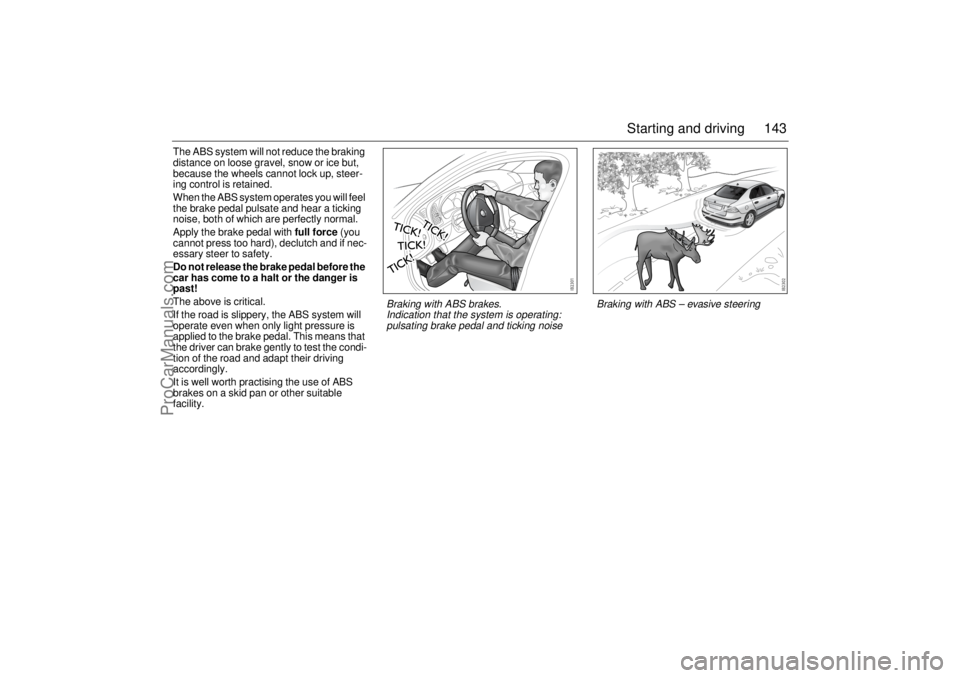
When the ABS system operates you will feel
the brake pedal pulsate and hear a ticking
noise, both of which are perfectly normal.
Apply the brake pedal with full force (you
cannot press too hard), declutch and if nec-
essary steer to safety.
Do not release the brake pedal before the
car has come to a halt or the danger is
past!
The above is critical.
If the road is slippery, the ABS system will
operate even when only light pressure is
applied to the brake pedal. This means that
the driver can brake gently to test the condi-
tion of the road and adapt their driving
accordingly.
It is well worth practising the use of ABS
brakes on a skid pan or other suitable
facility.
Braking with ABS – evasive steering
Braking with ABS brakes.
Indication that the system is operating:
pulsating brake pedal and ticking noise
ProCarManuals.com
Page 146 of 256

146 Starting and drivingElectronic Stability
Program (ESP)Anti-skid systemThe Electronic Stability Program employs
both the antilock braking system (ABS) and
the traction control system (TCS). It is a
safety system that helps the driver to stabi-
lize the car in unusual circumstances that
can otherwise be difficult to handle.
How the ESP system worksThe Electronic Stability Program can help to
prevent the car from skidding by braking
one or several wheels independently of the
driver. The engine output is then also
reduced to prevent the driving wheels from
spinning. The car has sensors that measure
wheel speed, yaw rate, lateral acceleration,
steering wheel position and braking pres-
sure. The values provided by these sensors
are used to calculate the actual direction of
the car, the intentions of the driver and
whether the ESP should be engaged.
If this direction does not agree with that
intended by the driver, calculated from the
steering wheel position, the ESP is
engaged.
The ESP improves the driver’s chances
of retaining control over the car in critical
situations.
WARNING
When driving normally, the ESP system
helps to improve the car’s directional
stability. The ESP must not be regarded
as a system to enable the driver to main-
tain higher speeds. The same precau-
tions must be adopted as normal for safe
cornering and driving on slippery roads
must be adopted.
Illustration of how the system applies the
brakes on one or several wheels to avoid
a skid
ProCarManuals.com
Page 150 of 256

150 Starting and drivingLong-term parkingIf the car is not going to be used for some
time, e.g. three to four months, the following
steps are recommended:
Drain the washer fluid reservoir and
hoses.
Wash and wax the car. Clean the rubber
seals on the hood, trunk lid and doors,
and lubricate them with glycerol
(glycerine).
After washing the car, dry the brake discs
to avoid corrosion by taking the car out on
the road and applying the brakes a few
times.
Fill the fuel tank to prevent condensation
forming in it.
Top up the coolant and check the anti-
freeze before the onset of winter. Park the car in a dry, covered and well-
ventilated building. Leave the parking
brake OFF!
If necessary, use wheel chocks.
Disconnect the negative (–) battery lead.
If frost is likely to occur during the storage
period, remove the battery and store it in
a frost-free place.
If it is not possible to stand the car on axle
stands, increase the tire pressure to
43 psi (3 bar).
Leave all the door windows open a crack
and cover the car with a non-plastic
tarpaulin – not one made of plastic which will
not breath.
ProCarManuals.com
Page 154 of 256

154 Starting and drivingengine wear is at its greatest during this
period. Drive off as soon as possible after
starting the engine and avoid high engine
speeds.
Drive as smoothly and thoughtfully as
possible. Match your driving to the
prevailing traffic conditions.
Driving in a low gear gives rise to higher
fuel consumption than driving in a high
gear because of the higher engine speed
for any given road speed. Always shift up
as soon as traffic conditions allow and
drive in the highest gear as much as
possible.
Check the tire pressure once a month.
Incorrect tire pressure increases tire
wear. It is preferable for the tire pressure
to be slightly high than too low. Under-
pressure increases fuel consumption. Check the fuel consumption regularly.
Increased fuel consumption can indicate
that something is wrong and that the car
needs to be checked at a Saab dealer.
Practical road tests have demonstrated that
substantial savings in fuel consumption can
be made if the above advice is followed.
Road conditionsWet roads increase fuel consumption, as do
unpaved roads and driving in hilly country
(the amount of fuel saved driving downhill is
less than the additional amount required to
climb the hill).
Engine block heater (standard
equipment in Canada, accessory in
U.S.)The following are just some of the benefits
to the car and the environment of using an
engine block heater:
Lower fuel consumption.
Reduced wear on the engine.
Inside of car warms up faster.
Exhaust emissions substantially reduced
over short runs.
The engine heater is effective at outside
temperatures up to 60–70°F (+15–+20°C).
The warmer it is outside, the shorter the time
the engine heater needs to be connected.
Longer than 1.5 hours is unnecessary.
If the car is equipped with a removable,
electric cabin heater that is not in use, store
this in the trunk.
WARNING
Never switch off the engine while driving
as the effect of the brakes and power
steering will be greatly reduced.
ProCarManuals.com
Page 155 of 256

155 Starting and driving
Driving in cold weatherIn cold weather, special attention should be
paid to the following:
Before driving off, make sure that the
wiper blades have not frozen to the wind-
shield.
Remove any snow from the heating
system air intakes between the hood and
the windshield.
If necessary, inject oil into the locks to
prevent them from freezing. Use molyb-
denum-sulphide oil (MoS
2). If the locks
freeze, exercise care when unlocking the
car (manual unlocking) to avoid breaking
the key. Warm up the key or use a de-icer.
It is particularly important when the roads
are slippery that the brakes and tires are
in good condition.
For how to check the level of antifreeze in
the engine coolant, see page 179. Add gasoline anti-freeze when refueling
several times before the onset of winter.
This will prevent condensation water in
the fuel tank from freezing and causing
interruptions in the fuel supply. The likeli-
hood of condensation is lowest when the
fuel tank is full.
If the car is parked outside and the
temperature is below zero, carburettor
spirit is of little use as it cannot remove
water that has already frozen. Park the
car in a warm place so that any ice that
may have built up melts, then add carbu-
rettor spirit when refueling.
Condensation is caused by temperature
fluctuations, either in the outside temper-
ature alone or when the car is alternately
parked outdoors and in a garage.
The car is equipped with tires designed to
provide optimum grip on both wet and dry
roads, although this has been achieved at
the expense of somewhat reduced grip on
snow and ice. For regular driving on snow
and ice, we therefore recommend that
winter (snow) tires be fitted.Winter tires, particularly studded tires,
generally make driving safer on snow and
ice.
Acquaint yourself with the legal provi-
sions governing the use of different
types of winter tires and snow chains.
Studded tires are not allowed in some
countries. If winter tires are fitted, the same
type must be fitted to all four wheels. Your
Saab dealer will be pleased to advise you on
the best tires for your car.
Remember that tires age: it may therefore
be necessary to change winter tires before
they reach the legal wear limit, as they grad-
ually lose their friction properties with age.
If you get into a front wheel skid and the car
has a manual transmission, the best
response is to freewheel, which means
declutching so that the wheels neither drive
nor brake, and to cautiously steer in the
desired direction.
If the car has automatic transmission, ease
off the accelerator slightly and steer cau-
tiously in the desired direction.
If you get into a rear wheel skid, steer in the
same direction as the movement of the rear
of the car.
ProCarManuals.com
Page 157 of 256

157 Starting and driving
Towing a trailerMake sure you are familiar with the legal
requirements regarding speed limits for
towing, maximum trailer weights, trailer
braking requirements, and also any spe-
cial driving licence provisions.
Trailer hitch attachmentTrailer hitch attachments are available as
accessories. These are designed for a max-
imum trailer weight of 3500 lbs (1588 kg),
with trailer brakes.
An electrical socket is provided for connect-
ing the trailer electrics. This is located under
the floor trim by the left-hand tail light.
The Saab genuine electrical socket enables
the battery in the trailer on tow to be charged
during while driving. Also, if the car has
SPA, this is deactivated automatically if a
trailer is hitched up and correctly connected
to the Saab genuine trailer socket.
Saab recommendations:
Use a genuine Saab towbar that is
designed and tested for your Saab.
Contact your Saab dealer for advice on
which towbar is designed for your car.
WARNING
Do not drive with a trailer on inclines
steeper than 15 %. The load on the
drive (front) wheels will be so low that
the wheels can start to spin and
prevent further progress.
In addition, the car’s parking brake
may not always be sufficient to hold
the car and trailer securely, as the
wheels may start to slide.
Always apply the trailer’s parking
brake when unhitching it. There is
otherwise a risk of personal injury or
damage to the bumper should the
trailer start to roll.
When you hitch up the trailer be sure
to attach its safety chains to the holes
by the hitch attachment.
NOTICE Use only a genuine Saab trailer hitch,
since other models can damage the
car’s bodywork and electrical system.
Consult a Saab dealer for guidance on
how to connect a trailer hitch.
Exercise care when driving on uneven
roads or against the curb if the car is
heavily laden. This particularly applies
to cars with 18" wheels.
ProCarManuals.com
Page 159 of 256

159 Starting and driving
Recommendations for cars with
manual transmissionRises in coolant temperature are indicated
by the temperature gauge in the main instru-
ment panel.
When the needle is just outside the red
zone, the A/C compressor will be switched
off and, on certain engine variants, the max-
imum engine torque will be limited.
When continuing your journey, select a low
gear in which the engine speed is about
3,500 rpm until the incline eases.
Trailer hitch loadThe weight distribution on the trailer makes
a lot of difference to the handling properties
of the car and trailer combination. As
regards two-wheel trailer, concentrate the
load over the wheels and keep it as low as
possible.
The trailer should be loaded so that the load
on the towball is 110–165 lbs. (50–75 kg).
Note that this load must be included in the
total load for the car. If this now exceeds the
specified load capacity, the load in the trunk
may have to be reduced by the correspond-
ing amount.
WARNING
Remember to use engine-braking (selec-
tor position 1, 2, or 3) to spare the brakes
when you are driving on a long or steep
downhill slope.
Overheating can cause the brakes to
fade!
Distribution of load in traileraLight
b Moderate
cHeavy
ProCarManuals.com