2003 SAAB 9-3 light
[x] Cancel search: lightPage 215 of 256

215 Car care
When the car has to be lifted, the jack must
be positioned at one of the four jacking
points (front or rear) under the sill members.
If a floor jack is used, the lifting plate must
be positioned under the normal jacking
points. If the car is equipped with a towbar,
the jack can also be placed under this.
1 Apply the parking brake and engage 1st
or reverse gear (automatic transmis-
sion: select P).
2 Wind the jack up to a suitable height
before placing it under the jacking point.
Each jacking point is indicated by an arrow on the sill (see illustration).
Make sure that the jack fully engages
the jacking point in the underside of the
sill member and that the entire foot of the
jack is steady and flat on the ground.
The jack must not stand on snow, ice or
similar.
Wind up the jack until it just begins to lift
the car.
3 It is not necessary to remove the wheel
cover.
If, none the less, you wish to remove the
wheel cover, take hold of the outer edge
and pull it straight out.
Loosen the wheel bolts half a turn.
4 Wind the jack to raise the wheel clear of
the ground. Remove the wheel bolts and
lift off the wheel.5 Clean any rust or dirt from the contact
surfaces between the wheel and brake
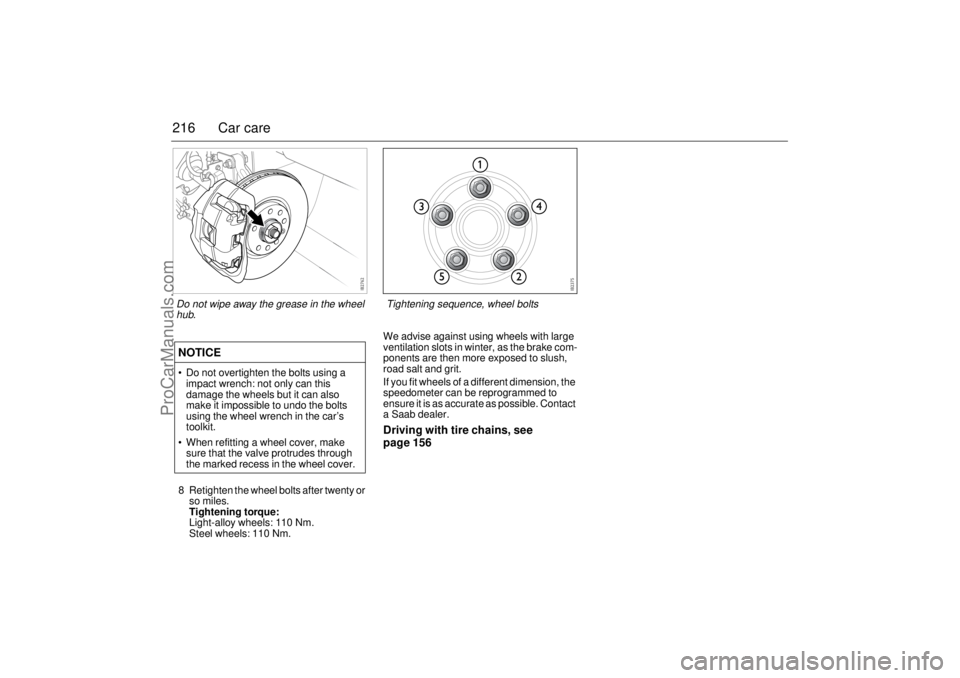
disc. Do not wipe away the grease in the
wheel hub.
6 Fit the wheel and screw in the bolts in the
sequence shown on the following page
(opposite pairs).
Tighten the bolts enough for the bolts
and wheel to be seated correctly.
7 Lower the car and tighten the wheel
bolts to torque in sequence as shown on
the following page.
Tightening torque:
Light-alloy wheels: 110 Nm.
Steel wheels: 110 Nm.NOTICEApply the jack only to the jacking points
indicated on the body.
Jacking points
Marking of jacking points
Clean any rust or dirt from the contact sur-
faces between the wheel and brake disc.
ProCarManuals.com
Page 216 of 256
216 Car care8 Retighten the wheel bolts after twenty or
so miles.
Tightening torque:
Light-alloy wheels: 110 Nm.
Steel wheels: 110 Nm.We advise against using wheels with large
ventilation slots in winter, as the brake com-
ponents are then more exposed to slush,
road salt and grit.
If you fit wheels of a different dimension, the
speedometer can be reprogrammed to
ensure it is as accurate as possible. Contact
a Saab dealer.
Driving with tire chains, see
page 156 NOTICE
Do not overtighten the bolts using a
impact wrench: not only can this
damage the wheels but it can also
make it impossible to undo the bolts
using the wheel wrench in the car’s
toolkit.
When refitting a wheel cover, make
sure that the valve protrudes through
the marked recess in the wheel cover.
Tightening sequence, wheel bolts
Do not wipe away the grease in the wheel
hub.
ProCarManuals.com
Page 218 of 256

218 Car careCleaning and caring for leather
upholsteryThe principal reason for treating leather
upholstery is to maintain its elegant appear-
ance and to provide it with a protective film.
Discolouration caused by dust and wear
mainly affects the lighter shades, although
this is not detrimental to the leather, indeed,
the patina resulting from use is often consid-
ered desirable in leather. But if the leather is
allowed to become too grubby, it can start to
look shabby.
The leather upholstery should be cleaned
and reconditioned twice a year in conjunc-
tion with spring and autumn inspections. In
very warm, dry climates the leather may
need more regular reconditioning. Recom-
mended conditioner – Saab Leather Care
Lotion.
Do not use unknown harsh polishing
agents, cleaning agents, sprays, coarse
soap or hot water.
Textile carpetingTextile carpeting should be vacuum
cleaned regularly. Carpeting can also be
cleaned using a brush or sponge and carpet
shampoo.
For safety reasons, vacuum cleaners that
are not earthed (grounded) must not be
used out of doors.Engine bayThe engine bay should be cleaned with an
engine degreasant and rinsed with hot
water. The headlights must be covered
over. Do not use a pressure washer.
Do not use petrol as a cleaning agent or sol-
vent when carrying out repairs or mainte-
nance. Saab recommends the use of envi-
ronmentally-friendly degreasants.
WashingThe bodywork must be washed frequently.
When the car is new, the body should be
washed by hand using plain cold water and
a clean, soft brush through which the water
flows. Automatic carwashes should be
avoided when the car is new.
After 5–6 months the paintwork will have
hardened. To facilitate cleaning, a suitable
detergent can be added to the water, which
should be lukewarm.
Remove any bird droppings without delay,
as these can discolour the paintwork and
prove difficult to polish out. Lay a wad of wet
paper on the patch of dirt and leave it for a
minute or so. It will then be easy to wash off
the dirt.
Use a soft cloth moistened with white spirit
to remove splashes of tar or asphalt. Do not
use strong cleaners, as these can dry out
the paintwork.
The underside of the car also needs wash-
ing regularly, and this should be done extra NOTICEDo not use alcohol-based cleaners on the
plastic lenses of the front or rear lights, as
these can cause a crackling effect on the
lenses.
The door mirrors should be folded in
before the car enters an automatic car
wash.
ProCarManuals.com
Page 223 of 256
223 Car care
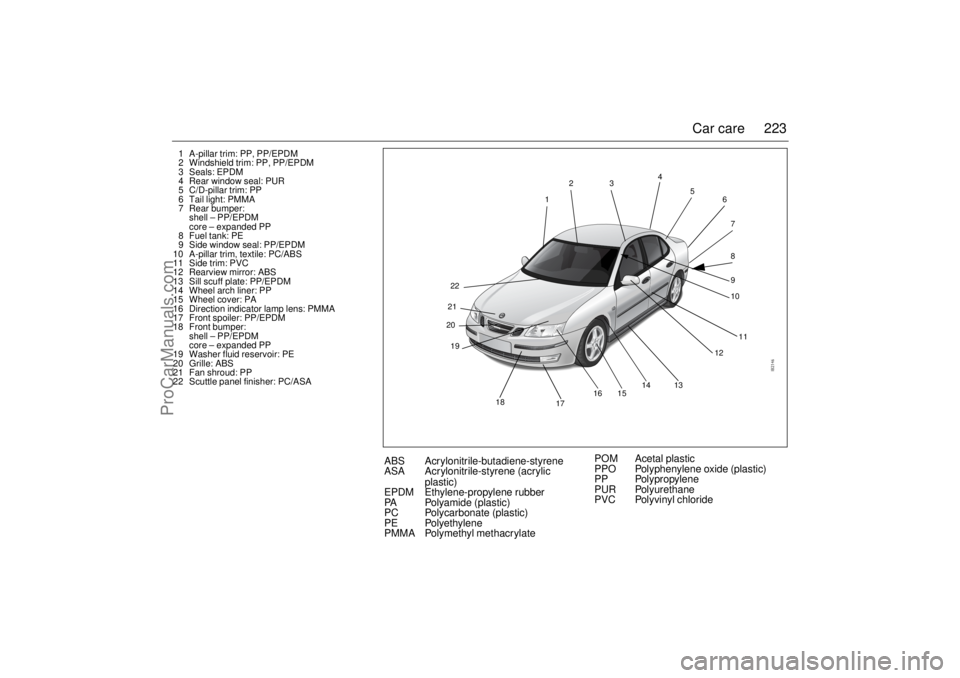
1 A-pillar trim: PP, PP/EPDM
2 Windshield trim: PP, PP/EPDM
3 Seals: EPDM
4 Rear window seal: PUR
5 C/D-pillar trim: PP
6 Tail light: PMMA
7 Rear bumper:
shell – PP/EPDM
core – expanded PP
8 Fuel tank: PE
9 Side window seal: PP/EPDM
10 A-pillar trim, textile: PC/ABS
11 Side trim: PVC
12 Rearview mirror: ABS
13 Sill scuff plate: PP/EPDM
14 Wheel arch liner: PP
15 Wheel cover: PA
16 Direction indicator lamp lens: PMMA
17 Front spoiler: PP/EPDM
18 Front bumper:
shell – PP/EPDM
core – expanded PP
19 Washer fluid reservoir: PE
20 Grille: ABS
21 Fan shroud: PP
22 Scuttle panel finisher: PC/ASA
19 2022
211234
18
1716 151412
1311 7
10 9 8 6 5
ABS Acr ylonitrile-butadiene-styrene
ASA Acrylonitrile-styrene (acrylic
plastic)
EPDM Ethylene-propylene rubber
PA Polyamide (plastic)
PC Polycarbonate (plastic)
PE Polyethylene
PMMA Polymethyl methacrylatePOM Acetal plastic
PPO Polyphenylene oxide (plastic)
PP Polypropylene
PUR Polyurethane
PVC Polyvinyl chloride
ProCarManuals.com
Page 226 of 256

226 Car careHeadlight aimingThe vehicle has a visual optical headlight
aiming system equipped with vertical
aiming device. The aim has been preset at
the factory and should normally not need
further adjustments.
If your headlights are damaged in a crash,
the headlight aim may be affected. If you
believe your headlights need to be re-
aimed, we recommend that you take it to
your Saab dealer for service. However, it is
possible for you to re-aim your headlights as
described in the following procedure.To check the aim, the vehicle should be
properly prepared as follows:
The vehicle shall be placed so that the
headlights are 25 ft (7.6 m) from a light
colored wall or other flat surface. The
aiming area should be darkened, this will
improve your ability to see the beam of the
low beam headlight being aimed.
An optical headlamp aimer can also be
used and will than replace the wall.
The vehicle must have all four wheels on
a perfectly level surface which is level all
the way to the wall or other flat surface.
The vehicle should be placed so it is per-
pendicular to the wall or other flat surface.
The vehicle should be unloaded and fuel
tank full, and one person or 160 lbs.
(75 kg) on the drivers seat. The vehicle should be fully assembled
and all other work stopped while headlight
aiming is being done.
The vehicle should not have any snow, ice
or mud attached to it.
Tires should be inflated to the prescribed
pressure.
Close all doors.
Rock the vehicle to stabilize the suspen-
sion.
Headlight aiming is done with the vehicle
low beam lamps. The high beam lamps will
be correctly aimed if the low beam lamps
are aimed properly.
WARNING
Before checking/adjusting the headlight
aiming, switch off the engine to avoid
danger of fingers and hands being injured
by moving parts.
The radiator fan can start up even when
the engine is switched off.NOTICETo make sure that your headlights are
aimed properly read all instructions
before beginning. Failure to follow these
instructions could cause damage to
headlight parts or a not correctly aimed
headlight.
ProCarManuals.com
Page 227 of 256
227 Car care
If you find that the headlight needs adjust-
ment follow these steps:
1 Open the hood and locate the vertical
aiming devices there are two vertical
aiming devices which shall be turned
simultaneously and the same amount of
turns.
2 Locate the marker on the lens.
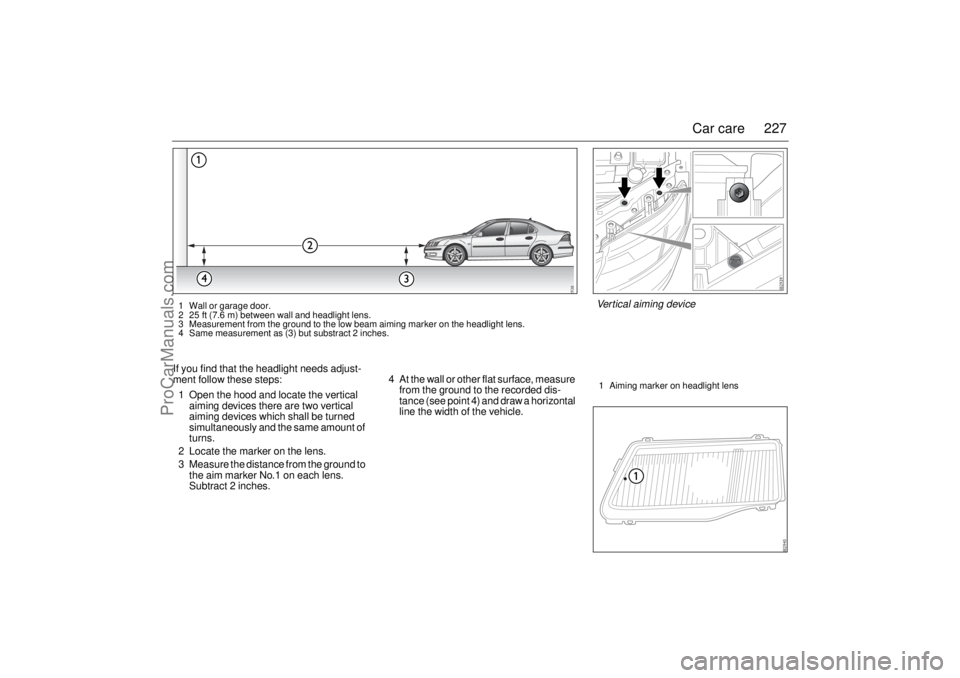
3 Measure the distance from the ground to
the aim marker No.1 on each lens.
Subtract 2 inches.4 At the wall or other flat surface, measure
from the ground to the recorded dis-
tance (see point 4) and draw a horizontal
line the width of the vehicle.1 Wall or garage door.
2 25 ft (7.6 m) between wall and headlight lens.
3 Measurement from the ground to the low beam aiming marker on the headlight lens.
4 Same measurement as (3) but substract 2 inches.
Vertical aiming device1 Aiming marker on headlight lens
ProCarManuals.com
Page 228 of 256

228 Car care5Cars with Bi-Xenon lights:
Bi-Xenon lights with automatic headlight
levelling system must first do a refer-
ence run before aiming: Start the engine
and let the headlights do a reference
run. Turn off the engine but leave the low
beam on.
Cars with halogen lights:
Turn on the low beam headlights.
Both variants:
Place a piece of cardboard or equivalent
(although not directly on the lens) in front
of the headlight not being aimed. This
should allow the beam cut-off of the
headlight being aimed to be seen on the
flat surface.6 Turn the two vertical aiming screws
simultaneously in the same direction
indicated on the headllight until the hori-
zontal cut-off of the headlight is aligned
with the horizontal line on the wall.
7 If an optical headlight aimer device is
used follow point 1 and 2 and center the
lens of the optical headlight aimer
device at the intersection of the two markers on the headlight lens.
Then follow the instructions in the optical
headlight aimer instruction manual and
point 1, 2, 5, and 6 in this instruction.
NOTICEDo not cover a headlight directly on the
lens to improve beam cut-off when aim-
ing. Covering a headlight may cause
excessive heat build-up that may cause
damage to the headlight.Correctly adjusted low beam Horizontal line on wall or other flat surface
ProCarManuals.com
Page 248 of 256

248 Technical dataSeveral of the systems in your Saab
can be customized to better suit
your individual needs. Contact your
Saab dealerCentral locking system
Some functions are governed by legal
requirements and cannot therefore be
reprogrammed.
Consult a Saab dealer for further informa-
tion.
Listed below are a number of examples of
programmable functions.
Audible confirmation of arming/disarming
the car alarm.
Automatic unlocking when car stopped
and remote control removed from the igni-
tion switch.
Trunk lid locked when car driven off or
30 s after being shut.
Length of audible and visual acknowl-
edgements.
Possibility to have the trunk lid unlocked
when doors unlocked, yes/no.
Central locking relocks the car automati-
cally if a door or the trunk lid is not opened,
yes/no. If the car has an alarm, this is
rearmed.Car alarm
Listed below are a number of examples of
programmable functions.
Cabin lighting switched on when the car
alarm is tripped.
Sensitivity of the movement sensor.
Audible signal produced by horn or car
alarm siren.
ProCarManuals.com