Page 176 of 381
4-8
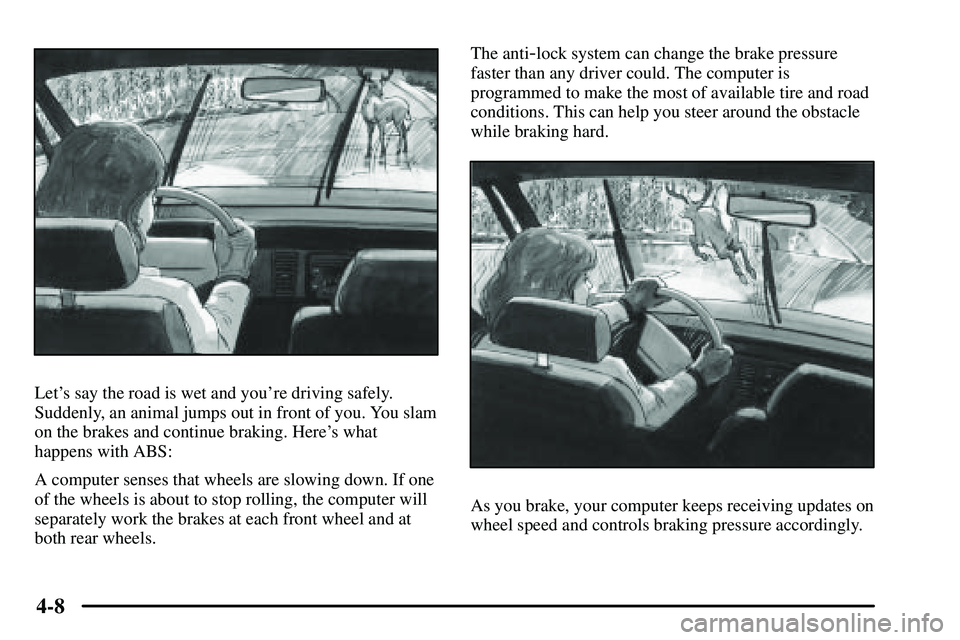
Let's say the road is wet and you're driving safely.
Suddenly, an animal jumps out in front of you. You slam
on the brakes and continue braking. Here's what
happens with ABS:
A computer senses that wheels are slowing down. If one
of the wheels is about to stop rolling, the computer will
separately work the brakes at each front wheel and at
both rear wheels.The anti
-lock system can change the brake pressure
faster than any driver could. The computer is
programmed to make the most of available tire and road
conditions. This can help you steer around the obstacle
while braking hard.
As you brake, your computer keeps receiving updates on
wheel speed and controls braking pressure accordingly.
Page 182 of 381

4-14
Loss of Control
Let's review what driving experts say about what
happens when the three control systems (brakes, steering
and acceleration) don't have enough friction where the
tires meet the road to do what the driver has asked.
In any emergency, don't give up. Keep trying to steer and
constantly seek an escape route or area of less danger.
Skidding
In a skid, a driver can lose control of the vehicle.
Defensive drivers avoid most skids by taking reasonable
care suited to existing conditions, and by not ªoverdrivingº
those conditions. But skids are always possible.
The three types of skids correspond to your vehicle's
three control systems. In the braking skid, your wheels
aren't rolling. In the steering or cornering skid, too
much speed or steering in a curve causes tires to slip and
lose cornering force. And in the acceleration skid, too
much throttle causes the driving wheels to spin.
A cornering skid and an acceleration skid are best
handled by easing your foot off the accelerator pedal.
If your vehicle starts to slide, ease your foot off the
accelerator pedal and quickly steer the way you want the
vehicle to go. If you start steering quickly enough, your
vehicle may straighten out. Always be ready for a
second skid if it occurs.Of course, traction is reduced when water, snow, ice,
gravel or other material is on the road. For safety, you'll
want to slow down and adjust your driving to these
conditions. It is important to slow down on slippery
surfaces because stopping distance will be longer and
vehicle control more limited.
While driving on a surface with reduced traction, try your
best to avoid sudden steering, acceleration or braking
(including engine braking by shifting to a lower gear).
Any sudden changes could cause the tires to slide. You
may not realize the surface is slippery until your vehicle is
skidding. Learn to recognize warning clues
-- such as
enough water, ice or packed snow on the road to make a
ªmirrored surfaceº
-- and slow down when you have
any doubt.
If you have the anti
-lock braking system, remember: It
helps avoid only the braking skid. If you do not have
anti
-lock, then in a braking skid (where the wheels are
no longer rolling), release enough pressure on the brakes
to get the wheels rolling again. This restores steering
control. Push the brake pedal down steadily when you
have to stop suddenly. As long as the wheels are rolling,
you will have steering control.
Page 187 of 381
4-19 Hydroplaning
Hydroplaning is dangerous. So much water can build up
under your tires that they can actually ride on the water.
This can happen if the road is wet enough and you're
going fast enough. When your vehicle is hydroplaning,
it has little or no contact with the road.
Hydroplaning doesn't happen often. But it can if your
tires do not have much tread or if the pressure in one or
more is low. It can happen if a lot of water is standing on
the road. If you can see reflections from trees, telephone
poles or other vehicles, and raindrops ªdimpleº the
water's surface, there could be hydroplaning.
Hydroplaning usually happens at higher speeds. There
just isn't a hard and fast rule about hydroplaning. The
best advice is to slow down when it is raining.
Driving Through Deep Standing Water
NOTICE:
If you drive too quickly through deep puddles or
standing water, water can come in through your
engine's air intake and badly damage your
engine. Never drive through water that is slightly
lower than the underbody of your vehicle. If you
can't avoid deep puddles or standing water, drive
through them very slowly.
Page 191 of 381

4-23
The exit speed is usually posted.
Reduce your speed according to your speedometer, not
to your sense of motion. After driving for any distance
at higher speeds, you may tend to think you are going
slower than you actually are.
Before Leaving on a Long Trip
Make sure you're ready. Try to be well rested. If you
must start when you're not fresh
-- such as after a day's
work
-- don't plan to make too many miles that first part
of the journey. Wear comfortable clothing and shoes you
can easily drive in.
Is your vehicle ready for a long trip? If you keep it
serviced and maintained, it's ready to go. If it needs
service, have it done before starting out. Of course,
you'll find experienced and able service experts in
Pontiac dealerships all across North America. They'll be
ready and willing to help if you need it.Here are some things you can check before a trip:
�Windshield Washer Fluid: Is the reservoir full?
Are all windows clean inside and outside?
�Wiper Blades: Are they in good shape?
�Fuel, Engine Oil, Other Fluids: Have you checked
all levels?
�Lamps: Are they all working? Are the lenses clean?
�Tires: They are vitally important to a safe,
trouble-free trip. Is the tread good enough for
long
-distance driving? Are the tires all inflated to the
recommended pressure?
�Weather Forecasts: What's the weather outlook
along your route? Should you delay your trip a short
time to avoid a major storm system?
�Maps: Do you have up
-to-date maps?
Page 202 of 381
4-34
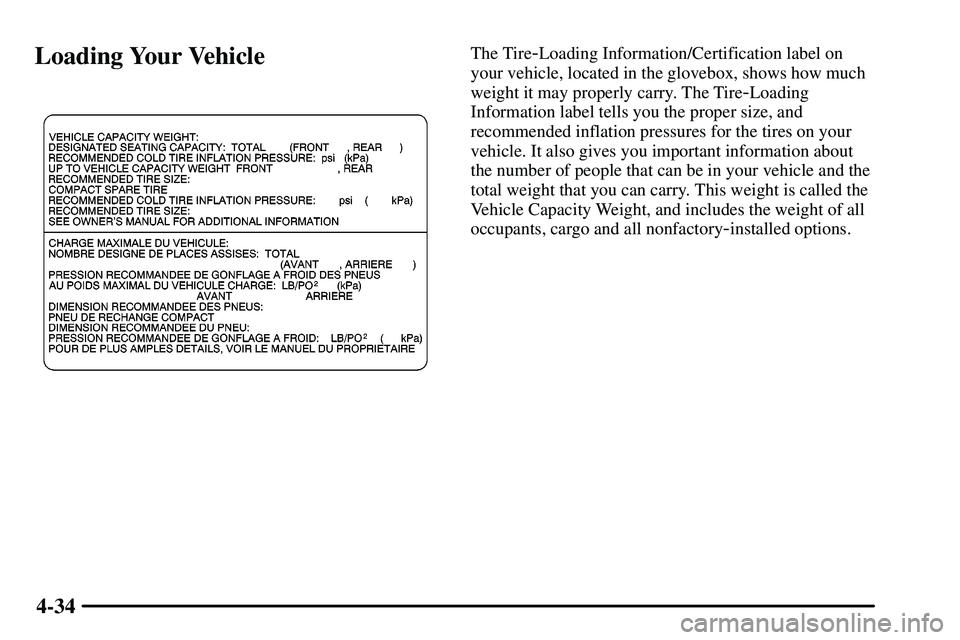
Loading Your VehicleThe Tire-Loading Information/Certification label on
your vehicle, located in the glovebox, shows how much
weight it may properly carry. The Tire
-Loading
Information label tells you the proper size, and
recommended inflation pressures for the tires on your
vehicle. It also gives you important information about
the number of people that can be in your vehicle and the
total weight that you can carry. This weight is called the
Vehicle Capacity Weight, and includes the weight of all
occupants, cargo and all nonfactory
-installed options.
Page 242 of 381
5-31
Compact Spare Tire
Although the compact spare tire was fully inflated
when your vehicle was new, it can lose air after a time.
Check the inflation pressure regularly. It should
be 60 psi (420 kPa).
After installing the compact spare on your vehicle, you
should stop as soon as possible and make sure your
spare tire is correctly inflated. The compact spare is
made to perform well at speeds up to 50 mph (80 km/h)
for distances up to 3,000 miles (5 000 km), so you can
finish your trip and have your full
-size tire repaired or
replaced where you want. Of course, it's best to replace
your spare with a full
-size tire as soon as you can. Your
spare will last longer and be in good shape in case you
need it again.
NOTICE:
When the compact spare is installed, don't take
your vehicle through an automatic car wash with
guide rails. The compact spare can get caught on
the rails. That can damage the tire and wheel,
and maybe other parts of your vehicle.
Don't use your compact spare on other vehicles.
And don't mix your compact spare tire or wheel with
other wheels or tires. They won't fit. Keep your spare
tire and its wheel together.
NOTICE:
Tire chains won't fit your compact spare. Using
them can damage your vehicle and can damage
the chains too. Don't use tire chains on your
compact spare.
Page 246 of 381

6-
6-1
Section 6 Service and Appearance Care
Here you will find information about the care of your vehicle. This section begins with service and fuel information,
and then it shows how to check important fluid and lubricant levels. There is also technical information about your
vehicle, and a part devoted to its appearance care.
6
-2 Service
6
-3 Fuel
6
-6 Fuels in Foreign Countries
6
-6 Filling Your Tank
6
-9 Filling a Portable Fuel Container
6
-10 Checking Things Under the Hood
6
-14 Engine Oil
6
-20 Engine Air Cleaner/Filter
6
-22 Passenger Compartment Air Filter
6
-24 Automatic Transaxle Fluid
6
-28 Manual Transaxle Fluid
6
-29 Hydraulic Clutch
6
-30 All-Wheel Drive (Option)
6
-31 Engine Coolant
6
-34 Radiator Pressure Cap
6
-34 Power Steering Fluid6
-36 Windshield Washer Fluid
6
-37 Brakes
6
-41 Battery
6
-42 Bulb Replacement
6
-49 Windshield Wiper Blade Replacement
6
-50 Tires
6
-61 Appearance Care
6
-61 Cleaning the Inside of Your Vehicle
6
-64 Care of Safety Belts
6
-65 Cleaning the Outside of Your Vehicle
6
-70 Vehicle Identification Number (VIN)
6
-71 Electrical System
6
-76 Replacement Bulbs
6
-76 Capacities and Specifications
6
-78 Normal Maintenance Replacement Parts
Page 295 of 381
6-50
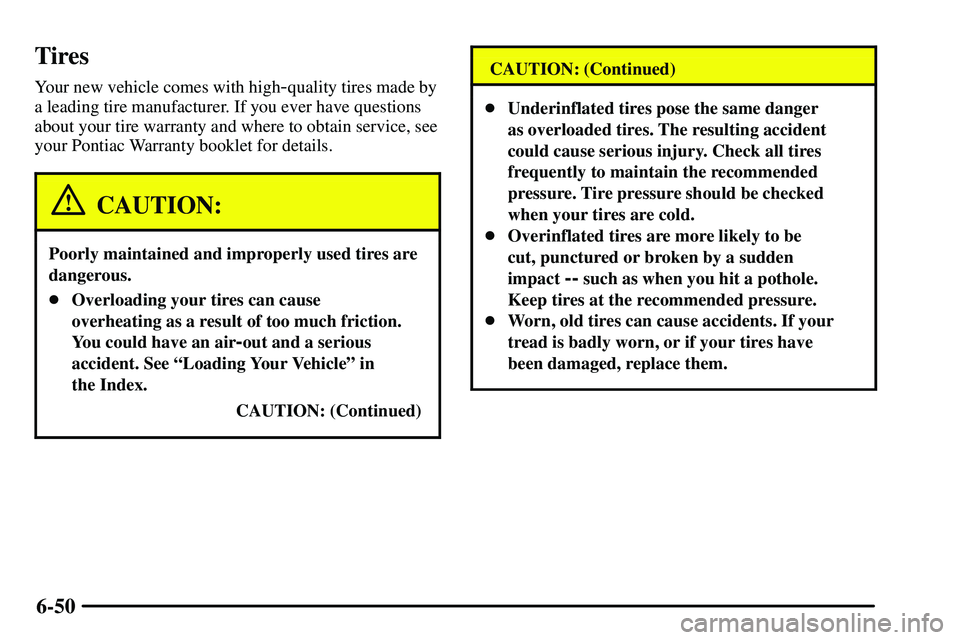
Tires
Your new vehicle comes with high-quality tires made by
a leading tire manufacturer. If you ever have questions
about your tire warranty and where to obtain service, see
your Pontiac Warranty booklet for details.
CAUTION:
Poorly maintained and improperly used tires are
dangerous.
�Overloading your tires can cause
overheating as a result of too much friction.
You could have an air
-out and a serious
accident. See ªLoading Your Vehicleº in
the Index.
CAUTION: (Continued)
CAUTION: (Continued)
�Underinflated tires pose the same danger
as overloaded tires. The resulting accident
could cause serious injury. Check all tires
frequently to maintain the recommended
pressure. Tire pressure should be checked
when your tires are cold.
�Overinflated tires are more likely to be
cut, punctured or broken by a sudden
impact
-- such as when you hit a pothole.
Keep tires at the recommended pressure.
�Worn, old tires can cause accidents. If your
tread is badly worn, or if your tires have
been damaged, replace them.