Page 82 of 381
2-18
Ignition Positions
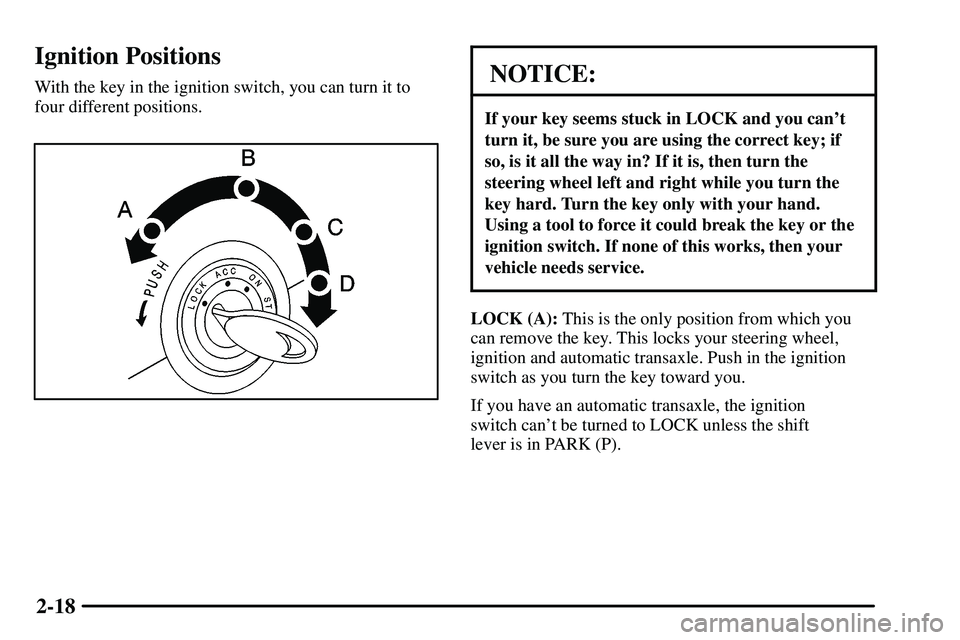
With the key in the ignition switch, you can turn it to
four different positions.NOTICE:
If your key seems stuck in LOCK and you can't
turn it, be sure you are using the correct key; if
so, is it all the way in? If it is, then turn the
steering wheel left and right while you turn the
key hard. Turn the key only with your hand.
Using a tool to force it could break the key or the
ignition switch. If none of this works, then your
vehicle needs service.
LOCK (A): This is the only position from which you
can remove the key. This locks your steering wheel,
ignition and automatic transaxle. Push in the ignition
switch as you turn the key toward you.
If you have an automatic transaxle, the ignition
switch can't be turned to LOCK unless the shift
lever is in PARK (P).
Page 83 of 381

2-19
CAUTION:
On manual transaxle vehicles, turning the key to
LOCK and removing it will lock the steering
column and result in a loss of ability to steer the
vehicle. This could cause a collision. If you need
to turn the engine off while the vehicle is moving,
turn the key only to ACC. Don't push the key in
while the vehicle is moving.
ACC (ACCESSORY) (B): This position operates some
of your electrical accessories (such as the radio, but not
the ventilation fan). It unlocks the steering wheel and
ignition. To move the key from ACC to LOCK, push in
the key and then turn it to LOCK.
ON (C): This is the position the switch returns to after
you start your engine and release the switch. The switch
stays in the ON position when the engine is running.
But even when the ignition is not running, you can use
ON to operate your electrical accessories (including the
ventilation fan and 115 volt power outlet) and to display
some warning and indicator lights.START (D): This position starts the engine. When the
engine starts, release the key. The ignition switch will
return to ON for normal driving.
When the engine is not running, ACC and ON allow you
to operate some of your electrical accessories.
A warning tone will sound if you open the driver's door
when the ignition is still in ACC or LOCK and the key
is in the ignition.
Starting Your Engine
Automatic Transaxle
Move your shift lever to PARK (P) or NEUTRAL (N).
Your engine won't start in any other position
-- that's a
safety feature. To restart when you're already moving,
use NEUTRAL (N) only.
NOTICE:
Don't try to shift to PARK (P) if your vehicle is
moving. If you do, you could damage the
transaxle. Shift to PARK (P) only when your
vehicle is stopped.
Page 99 of 381
2-35
CAUTION:
It can be dangerous to get out of your vehicle if
the shift lever is not fully in PARK (P) with the
parking brake firmly set. Your vehicle can roll.
Don't leave your vehicle when the engine is
running unless you have to. If you've left the
engine running, the vehicle can move suddenly.
You or others could be injured. To be sure your
vehicle won't move, even when you're on fairly
level ground, always set your parking brake and
move the shift lever to PARK (P).
Follow the proper steps to be sure your vehicle won't
move. See ªShifting Into PARK (P)º in the Index.
If you are parking on a hill and if you're pulling a
trailer, also see ªTowing a Trailerº in the Index.
Horn
To sound the horn, press anywhere on the horn pad on
your steering wheel.
Tilt Wheel
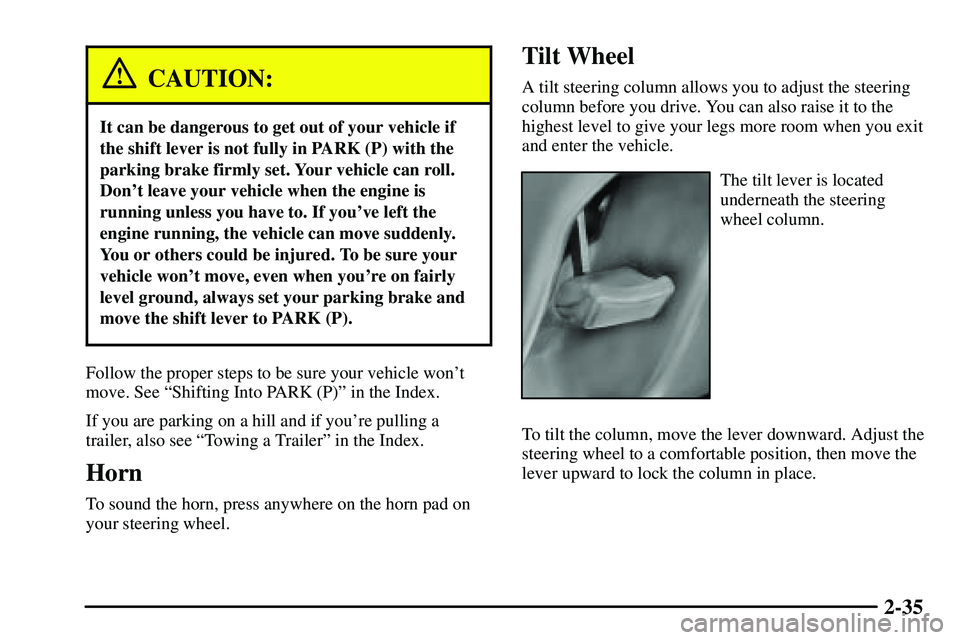
A tilt steering column allows you to adjust the steering
column before you drive. You can also raise it to the
highest level to give your legs more room when you exit
and enter the vehicle.
The tilt lever is located
underneath the steering
wheel column.
To tilt the column, move the lever downward. Adjust the
steering wheel to a comfortable position, then move the
lever upward to lock the column in place.
Page 100 of 381

2-36
Turn Signal/Multifunction Lever
The turn signal/multifunction lever is located on the left
side of the steering column.
This lever operates the following:
�Turn and Lane
-Change Signals
�Headlamp High/Low
-Beam Changer
�Flash
-to-Pass
For more information on the exterior lamps, see
ªExterior Lampsº later in this section.
Turn and Lane-Change Signals
The turn signal has an upward (for right) and a
downward (for left) position. These positions allow you
to signal a turn or a lane change.
To signal a turn, move the lever all the way up or down.
When the turn is finished, the lever will return automatically.
To signal a lane change, raise or lower the lever until the
arrow starts to flash. Hold it there until you complete
your lane change. The lever will return by itself when
you release it.
An arrow on the instrument
panel cluster will flash in
the direction of the turn or
lane change.
If you signal a turn or a lane change and notice the
arrow flashing rapidly, a signal bulb may be burned out
and other drivers won't see your turn signal.
If a bulb is burned out, have it replaced to help avoid an
accident. If the arrows don't go on at all when you
signal a turn, check for burned
-out bulbs and then check
the fuse. See ªFuses and Circuit Breakersº in the Index.
Page 101 of 381

2-37 Headlamp High/Low Beam Changer
The headlamps must be on for this feature to work. For
high beams, push the turn signal lever away from you.
When the high beams
are on, this light on the
instrument panel
cluster also will be on.
It will go off when you switch to the low beams. To
switch back to low beams, pull the lever toward you.
Flash-to-Pass
With the lever in the low-beam position, pull the lever
toward you to momentarily switch to high beams (to
signal that you are going to pass). If you have the
headlamps on when you release the lever, they will
return to the low beams.
Windshield Wipers
The lever on the right side of the steering column
controls the windshield wipers and washer.
The available positions are the following:
OFF: The wipers are off.
INT (Intermittent): Move the lever to INT to choose a
delayed wiping cycle. In light rain or snow, you might
want to use this position rather than continuous wiping.
You can change the time between wipes by turning the
INT TIME band. Turn the band forward or rearward for
longer or shorter delay interval. This position works the
same for the rear wiper.
Page 103 of 381
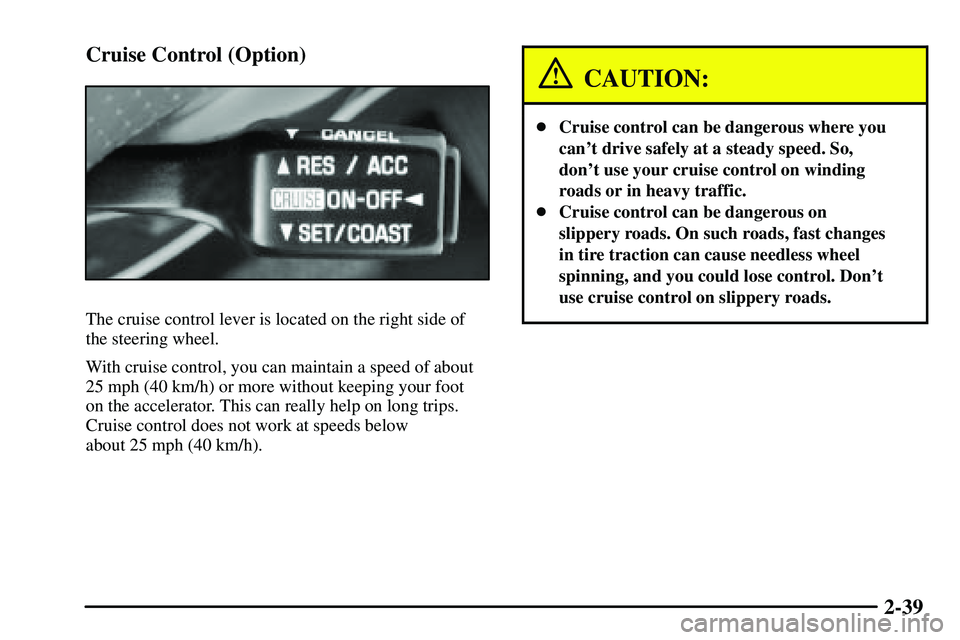
2-39 Cruise Control (Option)
The cruise control lever is located on the right side of
the steering wheel.
With cruise control, you can maintain a speed of about
25 mph (40 km/h) or more without keeping your foot
on the accelerator. This can really help on long trips.
Cruise control does not work at speeds below
about 25 mph (40 km/h).
CAUTION:
�Cruise control can be dangerous where you
can't drive safely at a steady speed. So,
don't use your cruise control on winding
roads or in heavy traffic.
�Cruise control can be dangerous on
slippery roads. On such roads, fast changes
in tire traction can cause needless wheel
spinning, and you could lose control. Don't
use cruise control on slippery roads.
Page 106 of 381
2-42
Exterior Lamps
The lever on the left side of the steering column
operates the exterior lamps.
(Exterior Lamps): Turn the outside part of the
lever with the symbol on it, to operate the lamps.The exterior lamp switch has three positions:
OFF: Turning the switch to this position turns off all
lamps, except the Daytime Running Lamps (DRL).
� (Parking Lamps): Turning the switch to this
position turns on the parking lamps together with the
following:
�Sidemarker Lamps
�Taillamps
�License Plate Lamp
�Instrument Panel Lights
(Headlamps): Turning the switch to this position
turns on the headlamps, together with the previously
listed lamps and lights.
Turn the switch to OFF to turn off the lamps.
(Fog Lamps): You can also use the control lever to
turn on the fog lamps.
Page 108 of 381

2-44
When it begins to get dark, the headlamps will
automatically switch from DRL to the regular
headlamps. See ªAutomatic Light Controlº earlier in
this section.
When you turn the exterior lamp switch off, the regular
lamps will go off and your headlamps will change to the
reduced brightness of DRL provided it is not dark
outside. DRL also comes on if only the parking lamps
are being used.
To idle your vehicle with the DRL off, do the following:
1. Set the parking brake.
2. Turn the ignition off.
3. Turn the ignition back on.
The DRL will stay off until you release the
parking brake.
As with any vehicle, you should turn on the regular
headlamp system when you need it.Interior Lamps
Interior/Instrument Panel Brightness Dial
The interior/instrument
panel brightness dial is
located to the left of the
steering wheel on the
instrument panel.
The brightness of the instrument panel lights will not
decrease when the headlamps are on. It is recommended
that the brightness level is kept at the maximum setting
for all daytime driving to insure proper visibility.