2003 PONTIAC GRAND AM warning
[x] Cancel search: warningPage 263 of 354

BRAKE
United States Canada
When your brake fluid falls to a low level, your brake
warning light will come on. See
Brake System Warning
Light on page
3-26.
What to Add
When you do need brake fluid, use only DOT-3 brake
fluid. Use new brake fluid from a sealed container
only. See
Part D: Recommended Fluids and Lubricants
on page
6- 15.
Always clean the brake fluid reservoir cap and the area
around the cap before removing it. This will help
keep dirt from entering the reservoir.
With the wrong kind of fluid in your brake
system, your brakes may not work well, or
they may not even work at all. This could
cause
a crash. Always use the proper brake
fluid.
Notice:
Using the wrong fluid can badly damage brake
system parts. For example, just
a few drops of
mineral-based oil, such as engine oil, in your
brake system can damage brake system parts
so badly that they’ll have to be replaced.
Don’t let someone put in the wrong kind of fluid.
If you spill brake fluid on your vehicle’s painted
surfaces, the paint finish can be damaged. Be
careful not to spill brake fluid on your vehicle.
If you do, wash it off immediately. See
“Appearance Care” in the Index.
5-40
Page 264 of 354
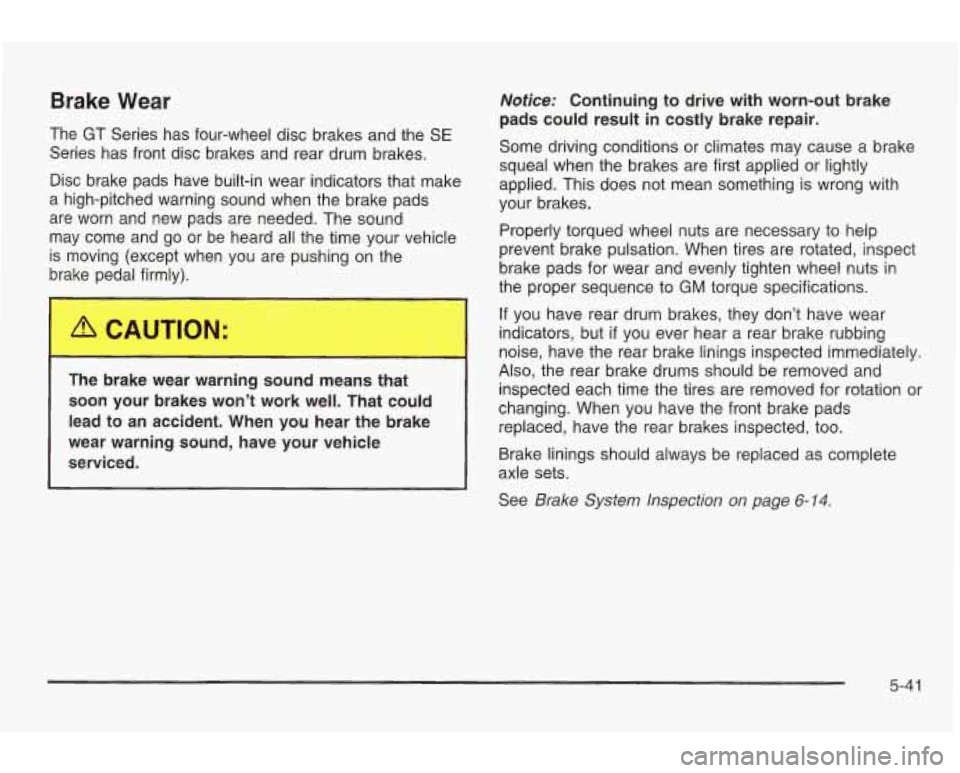
Brake Wear
The GT Series has four-wheel disc brakes and the SE
Series has front disc brakes and rear drum brakes.
Disc brake pads have built-in wear indicators that make
a high-pitched warning sound when the brake pads
are worn and new pads are needed. The sound
may come and go or be heard all the time your vehicle
is moving (except when you are pushing on the
brake pedal firmly).
A CAUTION:
-
The brake wear warning sound means that
soon your brakes won’t work well. That could
lead to an accident. When you hear the brake
wear warning sound, have your vehicle
serviced.
Notice: Continuing to drive with worn-out brake
pads could result in costly brake repair.
Some driving conditions or climates may cause a brake
squeal when the brakes are first applied or lightly
applied. This does not mean something is wrong with
your brakes.
Properly torqued wheel nuts are necessary to help
prevent brake pulsation. When tires are rotated, inspect
brake pads for wear and evenly tighten wheel nuts in
the proper sequence to
GM torque specifications.
If you have rear drum brakes, they don’t have wear
indicators, but
if you ever hear a rear brake rubbing
noise, have the rear brake linings inspected immediately.
Also, the rear brake drums should be removed and
inspected each time the tires are removed for rotation or
changing. When you have the front brake pads
replaced, have the rear brakes inspected, too.
Brake linings should always be replaced as complete
axle sets.
See
Brake System Inspection on page 6-14.
5-4 1
Page 265 of 354

Brake Pedal Travel
See your dealer if the brake pedal does not return to
normal height, or if there is a rapid increase in
pedal travel. This could be a sign
of brake trouble.
Brake Adjustment
Every time you make a moderate brake stop, your
disc brakes adjust for wear.
If you rarely make a
moderate or heavier stop, then your brakes might not
adjust correctly. If you drive in that way, then
- very
carefully
- make a few moderate brake stops about
every
1,000 miles (1 600 km), so your brakes will adjust
properly.
Replacing Brake System Parts
The braking system on a vehicle is complex. Its many
parts have
to be of top quality and work well together if
the vehicle is to have really good braking. Your
vehicle was designed and tested with top-quality
GM
brake parts. When you replace parts of your braking
system
- for example, when your brake linings
wear down and you need new ones put in
- be sure you
get new approved replacement parts. If you don’t,
your brakes may no longer work properly. For example,
if someone puts in brake linings that are wrong for
your vehicle, the balance between your front and rear
brakes can change
- for the worse. The braking
performance you’ve come
to expect can change in many
other ways
if someone puts in the wrong replacement
brake parts.
Battery
Your new vehicle comes with a maintenance free
ACDelco@ battery. When it’s time for a new battery, get
one that has the replacement number shown
on the
original battery’s label. We recommend an ACDelco@
battery. See
Engine Compartment Overview on
page
5- 12 for battery location.
Warning: Battery posts, terminals and related
accessories contain lead and lead compounds,
chemicals known
to the State of California to cause
cancer and reproductive harm. Wash hands after
handling.
5-42
Page 281 of 354

Treadwear Temperature - A, B, C
The
treadwear grade is a comparative rating based on
the wear rate of the tire when tested under controlled
conditions on a specified government test course.
For example, a tire graded
150 would wear one and
a half
(1.5) times as well on the government course as
a tire graded 100. The relative performance of tires
depends upon the actual conditions of their use,
however, and may depart significantly from the norm
due
to variations in driving habits, service practices and
differences in road characteristics and climate.
Traction - AA, A, B, C
The traction grades, from highest to lowest, are AA, A,
B, and C. Those grades represent the tire’s ability
to stop on wet pavement as measured under controlled
conditions on specified government test surfaces of
asphalt and concrete.
A tire marked C may have poor
traction performance. Warning: The traction grade
assigned to this tire is based on straight-ahead braking
traction tests, and does not include acceleration,
cornering, hydroplaning, or peak traction characteristics. The
temperature grades are
A (the highest), B, and C,
representing the tire’s resistance to the generation
of heat and its ability
to dissipate heat when tested
under controlled conditions on a specified indoor
laboratory test wheel. Sustained high temperature can
cause the material of the tire
to degenerate and
reduce tire life, and excessive temperature can lead to
sudden tire failure. The grade
C corresponds to a
level of performance which all passenger car tires must
meet under the Federal Motor Vehicle Safety Standard
No. 109. Grades B and A represent higher levels of
performance
on the laboratory test wheel than the
minimum required by law.
Warning: The temperature grade for this tire is
established for a tire that is properly inflated and not
overloaded. Excessive speed, underinflation, or
excessive loading, either separately or in combination,
can cause heat buildup and possible tire failure.
5-58
Page 285 of 354

Changing a Flat Tire
If a tire goes flat, avoid further tire and wheel damage
by driving slowly to
a level place. Turn on your
hazard warning flashers.
Changing a tire can cause an injury. The
vehicle can slip
off the jack and roll over you
or other people. You and they could be badly
injured. Find a level place to change your tire.
To help prevent the vehicle from moving:
1. Set the parking brake firmly.
2. Put an automatic transaxle shift lever in
PARK (P), or shift a manual transaxle to
FIRST
(1) or REVERSE (R).
3. Turn off the engine.
To be even more certain the vehicle won’t move, you can put blocks at
the front and
rear
of the tire farthest away from the one
being changed. That would be the tire on other side of the vehicle, at the The following steps
will tell you how to use the jack and
change a tire.
5-62
Page 295 of 354

Appearance Care
Remember, cleaning products can be hazardous. Some
are toxic. Others can burst into flames
if you strike a
match or get them on a hot part of the vehicle. Some are
dangerous
if you breathe their fumes in a closed
space. When you use anything from a container to clean
your vehicle, be sure
to follow the manufacturer’s
warnings and instructions. And always open your doors
or windows when you’re cleaning the inside.
Never use these to clean your vehicle:
Gasoline
Benzene
Naphtha
Carbon Tetrachloride
Acetone
Paint Thinner
Turpentine Lacquer Thinner
Nail Polish Remover They can all
be hazardous
- some more than
others -and they can all damage your vehicle, too.
Don’t use any of these unless this manual says you can.
In many uses, these will damage your vehicle:
0 Alcohol
Laundry Soap
0 Bleach
Reducing Agents
Cleaning the Inside of Your Vehicle
Use a vacuum cleaner often to get rid of dust and
loose dirt. Wipe vinyl, leather, plastic and painted
surfaces with a clean, damp cloth.
FabriclCarpet
Your dealer has cleaners for the cleaning of fabric
and carpet. They will clean normal
spots and stains
very well.
You can get
GM - approved cleaning products from
your dealer. See
GM Vehicle Care/Appearance
Materials on page
5-78.
5-72
Page 340 of 354

A
Adding Washer Fluid ....................................... 5-37
Additional Program Information
........................... 7-8
Additives, Fuel
................................................. 5-6
Add-On Electrical Equipment
............................ 5-81
Adjusting the Speakers
(Balance/Fade)
............................ 3-41 ~ 3-48, 3-59
Air Bag
Readiness Light
.......................................... 3-25
Air Bag System, Supplemental Restraint
System (SRS)
............................................. 1-53
Air CleanedFilter, Engine ................................. 5-21
All Overseas Locations ...................................... 7-4
Aluminum Wheels
........................................... 5-77
Antenna, Fixed Mast
....................................... 3-72
Antenna, XMTM Satellite Radio System
............... 3-72
Anti-lock Brake System (ABS)
............................ 4-7
Anti-Lock Brake, System Warning Light
.............. 3-28
Appearance Care
............................................ 5-72
Care
of Safety Belts .................................... 5-75
Cleaning the Inside
of Your Vehicle ................ 5-72
Finish Damage
............................................ 5-77
AM
............................................................... 3-70
ChPMim! Psi nt SFQttinCJ ............................... 5-78
Cleaning the Outside
of Your Vehicle .............. 5-75
GM Vehicle Care/Appearance Materials
.......... 5-78
Sheet Metal Damage
................................... 5-77
Underbody MaiGtenanee
............................... 5-78
Weatherstrips .............................................. 5-75 Ashtrays
........................................................ 3-17
Audio System(s)
............................................. 3-38
Audio Systems
Audio Steering Wheel Controls
...................... 3-69
Care
of Your Cassette Tape Player ................ 3-70
Care of Your CD Player
............................... 3-72
Care of Your CDs
........................................ 3-71
Chime Level Adjustment
............................... 3-72
DAB Radio Antenna System
.......................... 3-72
Fixed Mast Antenna
..................................... 3-72
Radio with Cassette and CD
......................... 3-55
Radio with CD
.................................... 3-39, 3-43
Setting the Time for Radios with Radio
Data Systems (RDS)
................................ 3-39
Setting the Time for Radios without Radio
Data Systems (RDS)
................................ 3-38
Theft-Deterrent Feature
................................ 3-68
Understanding Radio Reception
..................... 3-70
XMTM Satellite Radio Antenna System
............ 3-72
Automatic Headlamp System
............................ 3-14
Automatic Transaxle
........................................ 2-19
Fluid
.......................................................... 5-22
Automatic Transaxle Check
.............................. 6-10
Automatic Transaxle Shift Lock Control
System Check
............................................. 6-11
Annrqtinn vy- IULIVII 1 L-r r) r)A ...................................................
1
Page 341 of 354

Backing Up .................................................... 4-41
Battery
.......................................................... 5-42
Battery Replacement
......................................... 2-6
Battery Run-Down Protection
............................ 3-1 7
Before Leaving on a Long Trip
......................... 4-23
Body Lubrication Service
.................................. 6-10
Brake Parking
...................................................... 2-29
System Inspection
....................................... 6-1 4
System Warning Light
.................................. 3-26
Brake Adjustment
............................................ 5-42
Brake Fluid
.................................................... 5-39
Brake Pedal Travel
......................................... 5-42
Brake System Warning Light
............................ 3-26
Brake Wear
................................................... 5-41
Brakes .......................................................... 5-39
Braking
........................................................... 4-6
Braking in Emergencies
..................................... 4-9
Break-in, New Vehicle
..................................... 2-18
Bulb Replacement
........................................... 5-49
Center High-Mounted Stoplamp (CHMSL)
........ 5-50
Front Turn Signal and Parking Lamps
............. 5-50
Halogen Bulbs ............................................ 5-49
Replacement Bulbs ...................................... 5-51
Buying New Tires
........................................... 5-56
Headlamps
................................................. 5-49
Taillamps, Turn Signal, and Stoplamps
............ 5-51
C
California Fuel .................................................. 5-6
Canada
........................................................... 7-4
Canadian Owners
................................................ ii
Canadian Roadside Assistance ........................... 7-6
Capacities and Specifications
............................ 5-86
Carbon Monoxide
........................... 4-26, 4-37, 4-33
Care of Safety Belts
........................................ 5-75
Care of Your
Cassette Tape Player
................................... 3-70
CDS
.......................................................... 3-71
Cassette Deck Service ...................................... 6-9
Cassette Tape Messages
................................. 3-65
Center Console Storage Area
........................... 2-37
Center High-Mounted Stoplamp (CHMSL)
........... 5-50
Center Rear Passenger Position, Safety Belts
..... 1-27
Chains, Tires
.................................................. 5-60
Charging System Light
.................................... 3-26
Check
Checking Coolant
............................................ 5-25
Checking Engine Oil ........................................ 5-15
Checking Things Under the Hood
...................... 5-10
Checking Your Restraint Systems ...................... 1-60
Chemical Paint Spotting
................................... 5-78
CD Player
.................................................. 3-72
CD Adapter Kits
............................................. 3-66
Engine Light
............................................... 3-31
2