Page 122 of 180
05-05-2003
YOUR BOXER IN DETAIL119
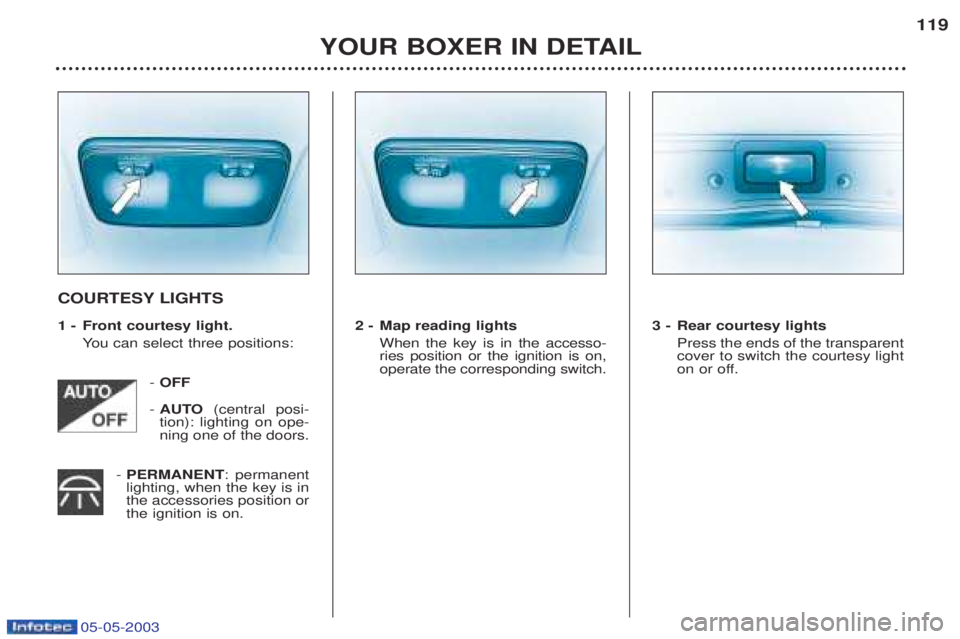
COURTESY LIGHTS
1 - Front courtesy light.
You can select three positions:
- OFF
- AUTO (central posi-
tion): lighting on ope- ning one of the doors.
- PERMANENT : permanent
lighting, when the key is inthe accessories position orthe ignition is on. 2 - Map reading lights
When the key is in the accesso-ries position or the ignition is on,operate the corresponding switch. 3 - Rear courtesy lights
Press the ends of the transparentcover to switch the courtesy light
on or off.
Page 132 of 180
05-05-2003
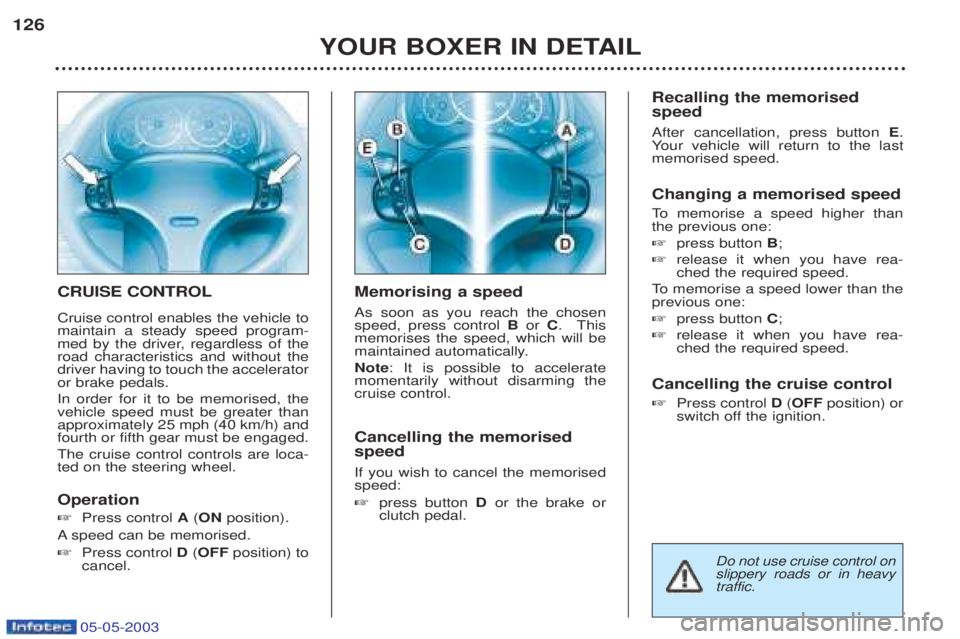
CRUISE CONTROL Cruise control enables the vehicle to maintain a steady speed program-
med by the driver, regardless of theroad characteristics and without thedriver having to touch the acceleratoror brake pedals. In order for it to be memorised, the vehicle speed must be greater thanapproximately 25 mph (40 km/h) andfourth or fifth gear must be engaged. The cruise control controls are loca- ted on the steering wheel. Operation ☞Press control A(ON position).
A speed can be memorised.
☞ Press control D(OFF position) to
cancel. Memorising a speed As soon as you reach the chosen speed, press control
Bor C. This
memorises the speed, which will be
maintained automatically. Note : It is possible to accelerate
momentarily without disarming the cruise control. Cancelling the memorised speed If you wish to cancel the memorised speed: ☞ press button Dor the brake or
clutch pedal. Recalling the memorised speed After cancellation, press button
E.
Y our vehicle will return to the last
memorised speed. Changing a memorised speed
To memorise a speed higher than
the previous one: ☞ press button B;
☞ release it when you have rea- ched the required speed.
To memorise a speed lower than the
previous one: ☞ press button C;
☞ release it when you have rea- ched the required speed.
Cancelling the cruise control ☞ Press control D (OFF position) or
switch off the ignition.
YOUR BOXER IN DETAIL
126
Do not use cruise control on slippery roads or in heavytraffic.
Page 134 of 180
05-05-2003
YOUR BOXER IN DETAIL
128
AIR BAGS The air bags have been designed to maximise the safety of the occupantsin the event of serious collisions.They work in conjunction with theseat belts. The electronic detectors register and analyse any abrupt deceleration ofthe vehicle: if the triggering thresholdis reached, the air bags inflate ins-tantly and protect the occupants ofthe vehicle. Immediately after the impact, the air bags deflate rapidly so that they donot hinder the visibility of the occu-pants nor their exit if necessary fromthe vehicle. The air bags are not deployed in the case of collisions which are notserious, for which the seat belt is suf-ficient to ensure maximum protec-
tion. The seriousness of a collisiondepends on the nature of the obs-tacle and the speed of the vehicle atthe moment of the collision. Air bags only operate when the ignition is switched on. Note:
the gas escaping from the air
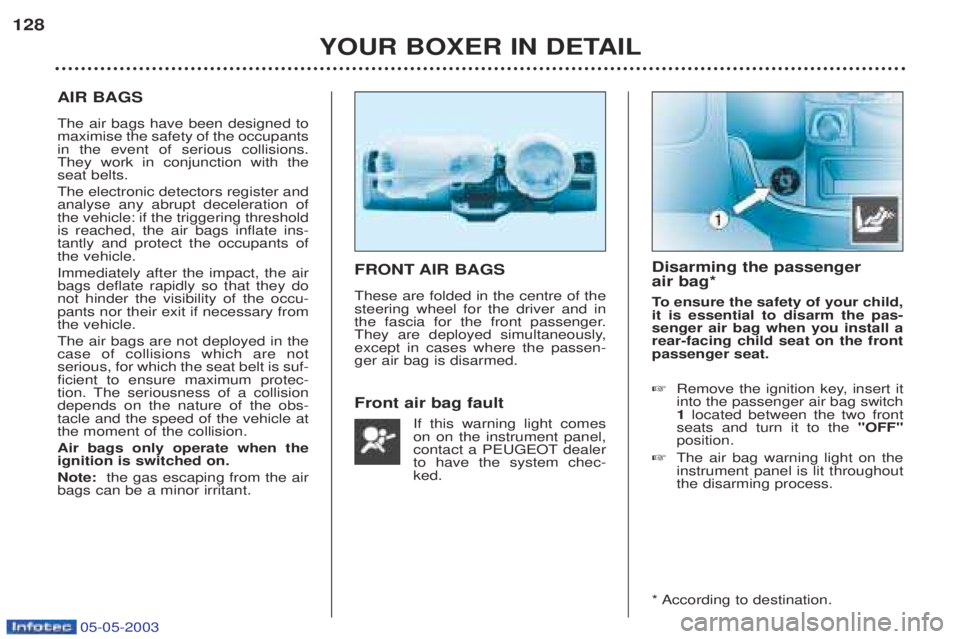
bags can be a minor irritant. FRONT AIR BAGS These are folded in the centre of the steering wheel for the driver and in
the fascia for the front passenger.
They are deployed simultaneously,except in cases where the passen-ger air bag is disarmed. Front air bag fault
If this warning light comes on on the instrument panel,
contact a PEUGEOT dealerto have the system chec-ked. Disarming the passenger air bag*
To
ensure the safety of your child,
it is essential to disarm the pas- senger air bag when you install arear-facing child seat on the frontpassenger seat. ☞ Remove the ignition key, insert it into the passenger air bag switch1located between the two front
seats and turn it to the "OFF"
position.
☞ The air bag warning light on theinstrument panel is lit throughoutthe disarming process.
* According to destination.
Page 135 of 180
05-05-2003
YOUR BOXER IN DETAIL129
In the
"OFF" position, the passenger
air bag will not be triggered in the event of an impact. As soon as you remove the rear- facing child seat from the front pas-senger seat, turn the air bag switchto the "ON"position, to arm the air
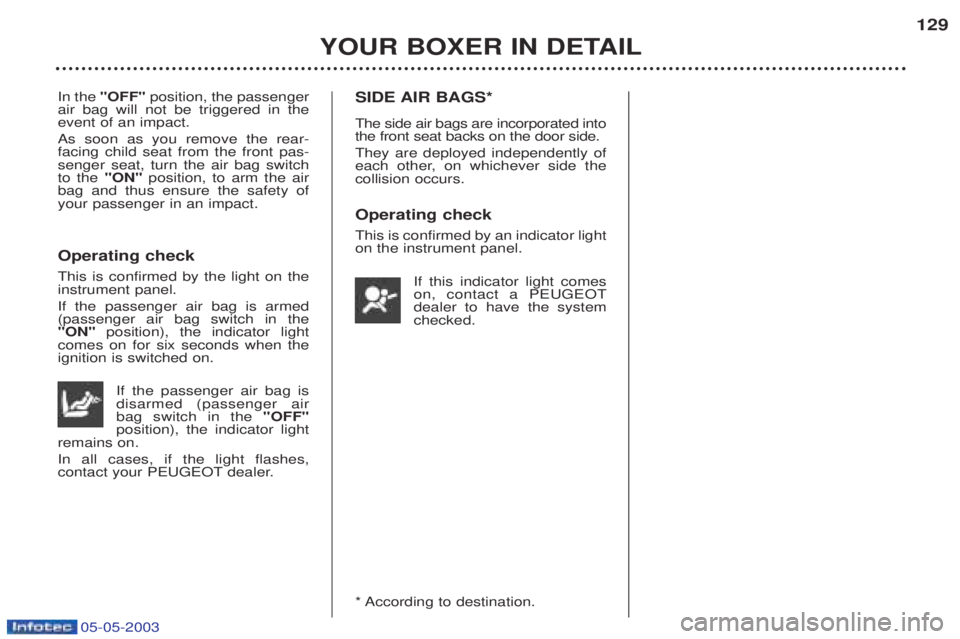
bag and thus ensure the safety ofyour passenger in an impact. Operating check This is confirmed by the light on the instrument panel. If the passenger air bag is armed (passenger air bag switch in the"ON" position), the indicator light
comes on for six seconds when theignition is switched on.
If the passenger air bag isdisarmed (passenger airbag switch in the "OFF"
position), the indicator light
remains on. In all cases, if the light flashes,
contact your PEUGEOT dealer. SIDE AIR BAGS* The side air bags are incorporated into the front seat backs on the door side. They are deployed independently of
each other, on whichever side thecollision occurs. Operating check This is confirmed by an indicator light on the instrument panel.
If this indicator light comeson, contact a PEUGEOTdealer to have the systemchecked.
* According to destination.
Page 137 of 180
05-05-2003
YOUR BOXER IN DETAIL129
In the
"OFF" position, the passenger
air bag will not be triggered in the event of an impact. As soon as you remove the rear- facing child seat from the front pas-senger seat, turn the air bag switchto the "ON"position, to arm the air
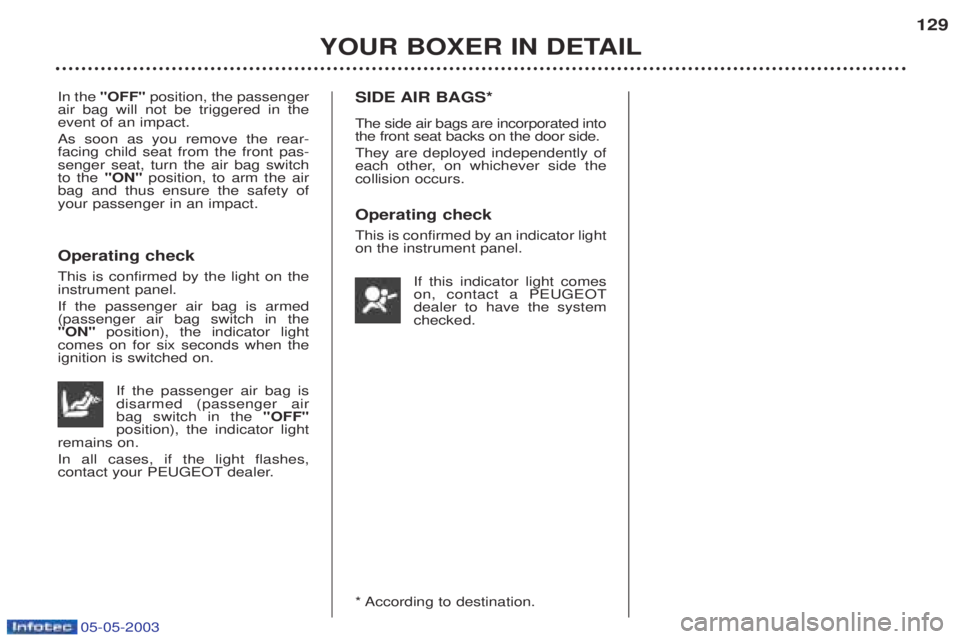
bag and thus ensure the safety ofyour passenger in an impact. Operating check This is confirmed by the light on the instrument panel. If the passenger air bag is armed (passenger air bag switch in the"ON" position), the indicator light
comes on for six seconds when theignition is switched on.
If the passenger air bag isdisarmed (passenger airbag switch in the "OFF"
position), the indicator light
remains on. In all cases, if the light flashes,
contact your PEUGEOT dealer. SIDE AIR BAGS* The side air bags are incorporated into the front seat backs on the door side. They are deployed independently of
each other, on whichever side thecollision occurs. Operating check This is confirmed by an indicator light on the instrument panel.
If this indicator light comeson, contact a PEUGEOTdealer to have the systemchecked.
* According to destination.
Page 142 of 180
05-05-2003
PRACTICAL INFORMATION
134
CHECKING THE LEVELS Oil level ☞Check the level regularly and top
up between changes. The maxi-mum consumption is 0.5 l per600 miles (1000 km). Check the level with the vehicle level, engine cold, using the oillevel gauge on the instrumentpanel or the dipstick.
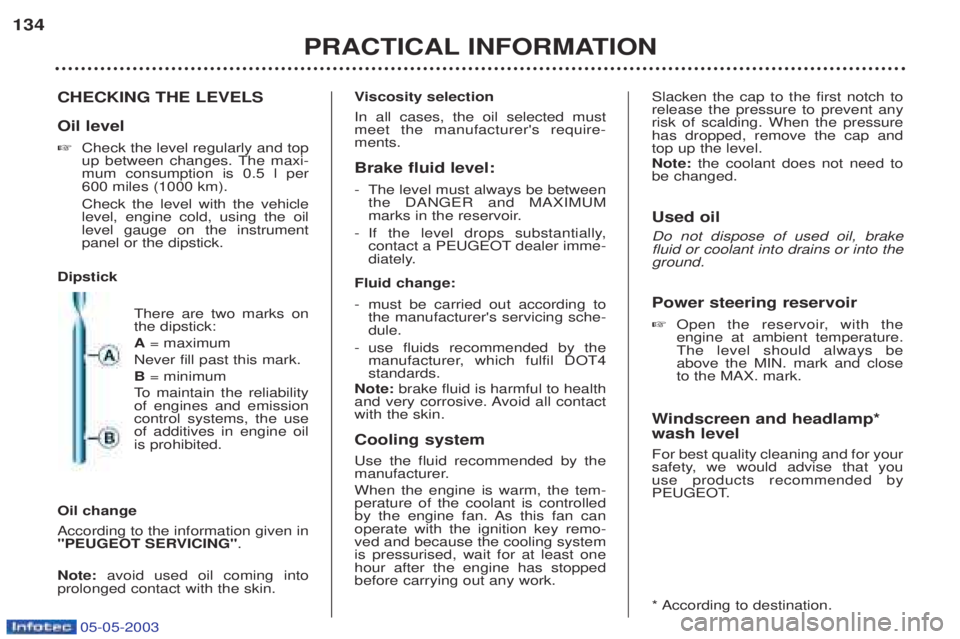
Dipstick
There are two marks onthe dipstick: A= maximum
Never fill past this mark.B = minimum
To maintain the reliability
of engines and emission control systems, the useof additives in engine oilis prohibited.
Oil change According to the information given in
"PEUGEOT SERVICING" .
Note: avoid used oil coming into
prolonged contact with the skin.
V iscosity selection
In all cases, the oil selected must meet the manufacturer's require-ments. Brake fluid level: - The level must always be between the DANGER and MAXIMUM
marks in the reservoir.
- If the level drops substantially,
contact a PEUGEOT dealer imme-
diately.
Fluid change: - must be carried out according to the manufacturer's servicing sche-dule.
- use fluids recommended by the
manufacturer, which fulfil DOT4standards.
Note: brake fluid is harmful to health
and very corrosive. Avoid all contactwith the skin. Cooling system Use the fluid recommended by the
manufacturer. When the engine is warm, the tem- perature of the coolant is controlled
by the engine fan. As this fan canoperate with the ignition key remo-ved and because the cooling systemis pressurised, wait for at least onehour after the engine has stoppedbefore carrying out any work. Slacken the cap to the first notch torelease the pressure to prevent anyrisk of scalding. When the pressurehas dropped, remove the cap andtop up the level. Note:
the coolant does not need to
be changed. Used oil Do not dispose of used oil, brake fluid or coolant into drains or into theground. Power steering reservoir ☞ Open the reservoir, with the engine at ambient temperature.The level should always beabove the MIN. mark and closeto the MAX. mark.
W indscreen and headlamp*
wash level For best quality cleaning and for your
safety, we would advise that you use products recommended by
PEUGEOT.
* According to destination.
Page 144 of 180
05-05-2003
PRACTICAL INFORMATION
136
CHANGING A WHEEL Parking the vehicle ☞
Whenever possible, park the vehicle on level, stable and non-slippery ground.
☞ Apply the handbrake, switch offthe ignition and engage first orreverse gear (position Pfor the
automatic gearbox).
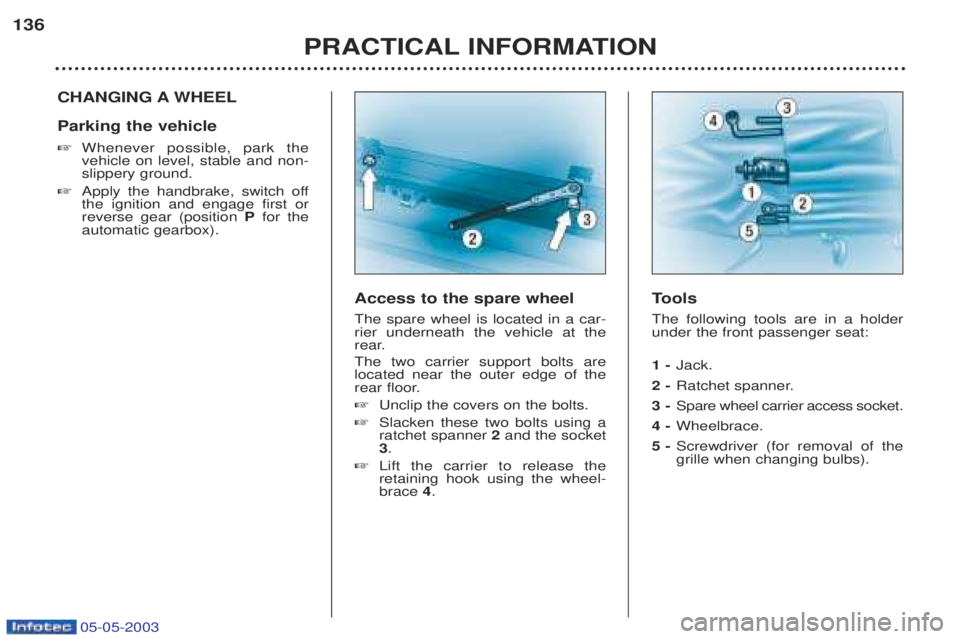
Tools
The following tools are in a holderunder the front passenger seat: 1 - Jack.
2 - Ratchet spanner.
3 - Spare wheel carrier access socket.
4 - Wheelbrace.
5 - Screwdriver (for removal of the grille when changing bulbs).
Access to the spare wheel The spare wheel is located in a car- rier underneath the vehicle at the
rear. The two carrier support bolts are located near the outer edge of the
rear floor. ☞
Unclip the covers on the bolts.
☞ Slacken these two bolts using a ratchet spanner 2and the socket
3 .
☞ Lift the carrier to release theretaining hook using the wheel-brace 4.
Page 145 of 180
05-05-2003
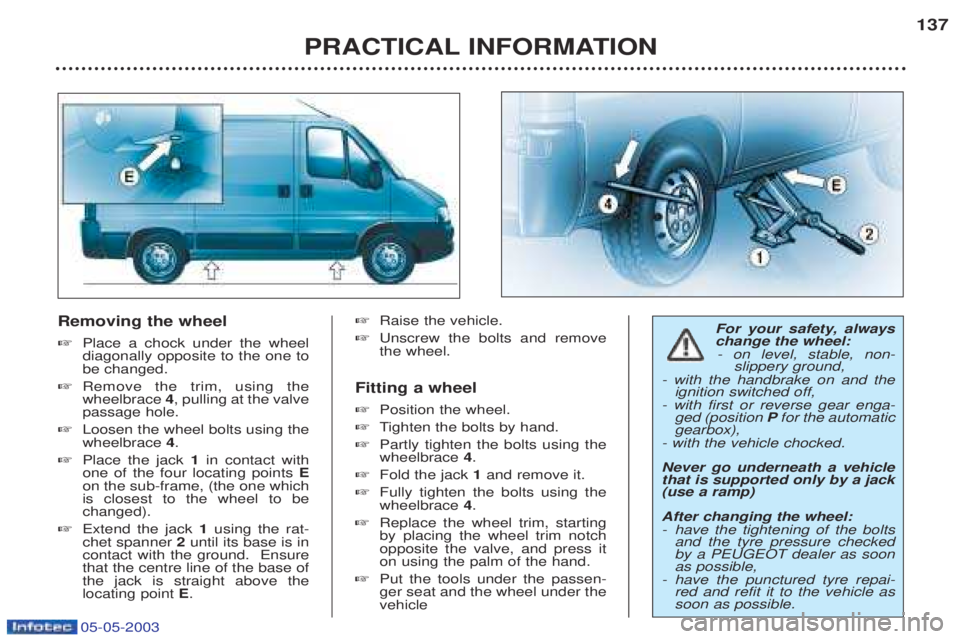
Removing the wheel ☞Place a chock under the wheel diagonally opposite to the one tobe changed.
☞ Remove the trim, using thewheelbrace 4, pulling at the valve
passage hole.
☞ Loosen the wheel bolts using thewheelbrace 4.
☞ Place the jack 1in contact with
one of the four locating points E
on the sub-frame, (the one whichis closest to the wheel to bechanged).
☞ Extend the jack 1using the rat-
chet spanner 2until its base is in
contact with the ground. Ensurethat the centre line of the base ofthe jack is straight above thelocating point E. ☞
Raise the vehicle.
☞ Unscrew the bolts and removethe wheel.
Fitting a wheel ☞ Position the wheel.
☞ Tighten the bolts by hand.
☞ Partly tighten the bolts using the wheelbrace 4.
☞ Fold the jack 1and remove it.
☞ Fully tighten the bolts using thewheelbrace 4.
☞ Replace the wheel trim, startingby placing the wheel trim notchopposite the valve, and press iton using the palm of the hand.
☞ Put the tools under the passen-ger seat and the wheel under thevehicle For your safety, always change the wheel:
- on level, stable, non- slippery ground,
- with the handbrake on and the ignition switched off,
- with first or reverse gear enga- ged (position Pfor the automatic
gearbox),
- with the vehicle chocked. Never go underneath a vehicle that is supported only by a jack(use a ramp) After changing the wheel: - have the tightening of the bolts and the tyre pressure checkedby a PEUGEOT dealer as soonas possible,
- have the punctured tyre repai- red and refit it to the vehicle assoon as possible.
PRACTICAL INFORMATION 137