Page 156 of 183
10-02-2003
PRACTICAL INFORMATION145
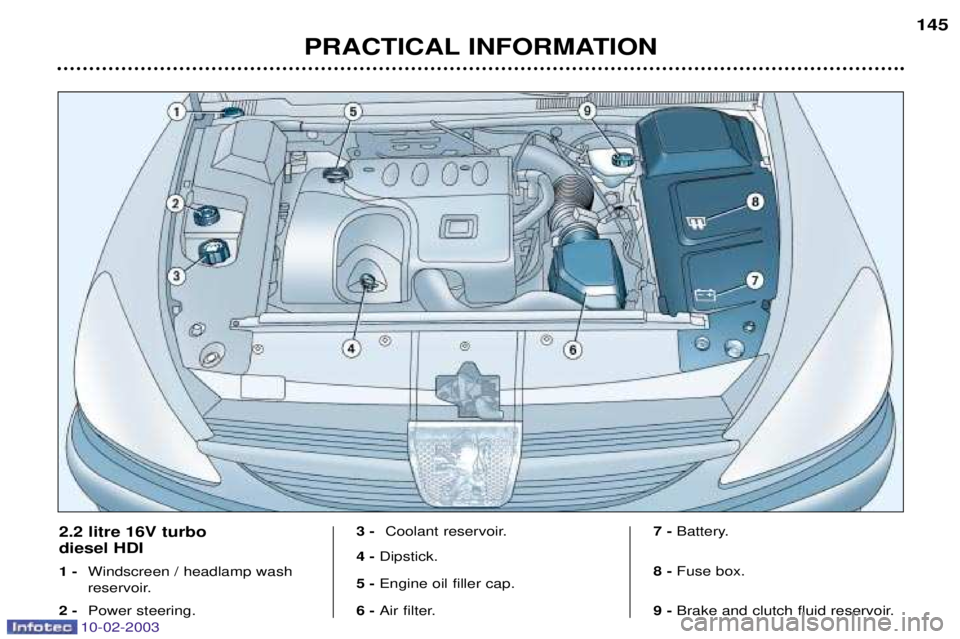
2.2 litre 16V turbo diesel HDI 1 -
Windscreen / headlamp wash
reservoir.
2 - Power steering. 3 -
Coolant reservoir.
4 - Dipstick.
5 - Engine oil filler cap.
6 - Air filter. 7 -
Battery.
8 - Fuse box.
9 - Brake and clutch fluid reservoir.
Page 157 of 183

10-02-2003
CHECKING THE LEVELS Oil level� Check the level regularly and top up between changes. Maximumconsumption is 0.5 l per 600 miles(1000 km). Carry out this check with the vehicle level, engine cold, usingthe oil level gauge on the instru-ment panel or the dipstick.
Dipstick There are two markson the dipstick: A= maximum
Never fill past this mark. B = minimum
To maintain the reliabi- lity of engines andemission control sys-tems, the use of addi-tives in engine oil isprohibited.
Oil change According to the information given in
'PEUGEOT SERVICING'.
PRACTICAL INFORMATION
146
Viscosity selection In all cases, the oil selected must meet the manufacturer's require-ments. Brake and clutch fluid level:
Ð The level must always be between
the DANGER and MAXIMUM
marks in the reservoir.
Ð If the level drops substantially, contact a PEUGEOT dealer imme-
diately.
Fluid change:
Ð must be carried out according to the manufacturer's servicing schedule,
Ð use fluids approved by the manu- facturer, which fulfil DOT4 stan- dards.
WARNING: brake and clutch fluid is
harmful to health and very corrosive. Used oil Prevent used oil from coming into prolonged contact with the skin. Do not dispose of used oil, brake and clutch fluid or coolant into drains oronto the ground. Power steering reservoir
� Open the reservoir, with the engi-
ne cold. The level should alwaysbe above the MINI mark and closeto the MAXI mark.
Windscreen and headlamp wash reservoir For best quality cleaning and for your
safety, we recommend that you useproducts approved by PEUGEOT(reservoir capacity 4 litres or 6.5litres with headlamp wash).
Page 158 of 183
10-02-2003
PRACTICAL INFORMATION147
CHECK
...
Battery
At the start of winter, have your bat-
tery checked by a PEUGEOT dealer. Air filter and pollen filter Have the filter elements replaced
regularly. If you drive in dusty con-
ditions, change them twice asoften. Particulate emission filter - Additive reservoir (Dieselmodels) It is essential the particulate emis- sion filter be maintained and theadditive reservoir be filled by a
PEUGEOT dealer, according to themanufacturer's servicing schedule. Brake pads Brake pad wear depends on the style of driving, in particular for vehi-cles which are used in town, overshort distances . It may be neces-
sary to check the thickness of thepads, even between services. Handbrake Where the handbrake travel is too great or there is a reduction in theperformance of the system, thehandbrake should be adjusted, evenbetween services. Have the system
checked by a PEUGEOT dealer. Manual gearbox This does not need an oil change. Check the level, according to themanufacturer's servicing schedule. Automatic gearbox This does not need an oil change. Have the level checked by a
PEUGEOT dealer, according to themanufacturer's servicing schedule. Oil filter
Change the filter regularly, in accor- dance with the servicing schedule.
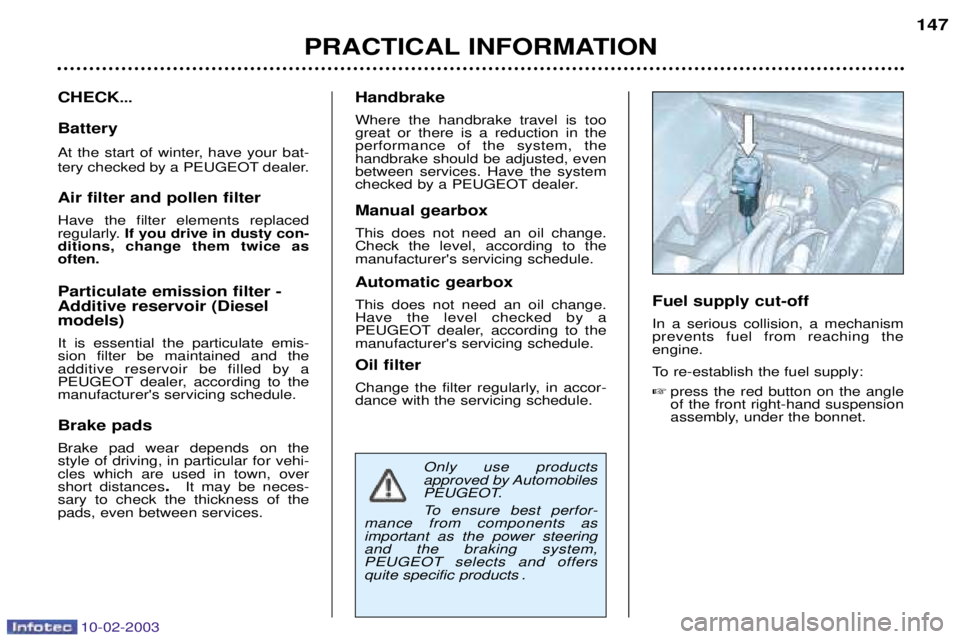
Fuel supply cut-off In a serious collision, a mechanism prevents fuel from reaching theengine.
To re-establish the fuel supply:
� press the red button on the angle of the front right-hand suspension
assembly, under the bonnet.
Only use products
approved by Automobiles
PEUGEOT.
To ensure best perfor-
mance from components as important as the power steeringand the braking system, PEUGEOT selects and offers
quite specific products .
Page 159 of 183
![PEUGEOT 607 2003 Owners Manual 10-02-2003
148TYRE UNDER-INFLATION DETECTION Sensors check the tyre pressure during driving, and trigger a warningin the event of malfunction (speedgreater than 15mph [25 km/h]). Flat tyre When this](/manual-img/29/58352/w960_58352-158.png "PEUGEOT 607 2003 Owners Manual 10-02-2003
148TYRE UNDER-INFLATION DETECTION Sensors check the tyre pressure during driving, and trigger a warningin the event of malfunction (speedgreater than 15mph [25 km/h]). Flat tyre When this")
10-02-2003
148TYRE UNDER-INFLATION DETECTION Sensors check the tyre pressure during driving, and trigger a warningin the event of malfunction (speedgreater than 15mph [25 km/h]). Flat tyre When this warning light comes on, accompanied byan audible signal and themessage 'Tyre pressure
low' on the multi-function
display, have the tyre pressurechecked as soon as possible. Puncture
This warning light, accom- panied by an audible signaland the message 'Punc-
tured tyre(s) detected' on
the multi-function display, is
followed by illumination of the
'STOP' warning light.
Stop immediately, avoiding any sud-den movement of the steering wheeland the brakes.
Change the damaged (punctured orvery deflated) tyre, and have the tyrepresure checked as soon as possible.
Note: if the damaged tyre is tem-
porarily stored in the boot, it willagain emit this message to remindyou of the necessity of having it
repaired. This will prevent anotherwarning of the same type being dis-played. Sensor(s) not detected
This warning light, accom-panied by an audible signaland the message ' X tyre
pressure sensor(s) miss-ing ' on the multi-function
display, indicates that under-inflationdetection is absent from one (or sev-eral) tyre(s).
Contact a PEUGEOT dealer to replace the faulty sensor(s). Note: this message is also displayed
when one of the tyres is away from the vehicle (being repaired) or whena wheel without a sensor is fitted.
PRACTICAL INFORMATION
All repairs and changing of tyres on a wheel fittedwith this system must becarried out by a
PEUGEOT dealer.
The tyre under-inflation detec-tion system is an aid to drivingwhich does not replace theneed for the driver to be vigilant
or to drive responsibly. This system does not remove the necessity for having the tyre pres-sure (including that of the spare
wheel) checked regularly, toensure optimum dynamic perfor-mance of the vehicle and to pre-vent premature wear of the tyres,particularly in the case of arduousdriving conditions (heavy load,high speed). The system may temporarily be disturbed by radio broadcasts ona frequency close to it.
Page 160 of 183
10-02-2003
PRACTICAL INFORMATION149
CHANGING A WHEEL
� Park the vehicle on level, stable and non-slippery ground.
� Apply the handbrake, engage firstor reverse gear (position Pfor the
automatic gearbox) and switch offthe ignition.
Access to the spare wheel and thejack in the boot � Detach the luggage net.
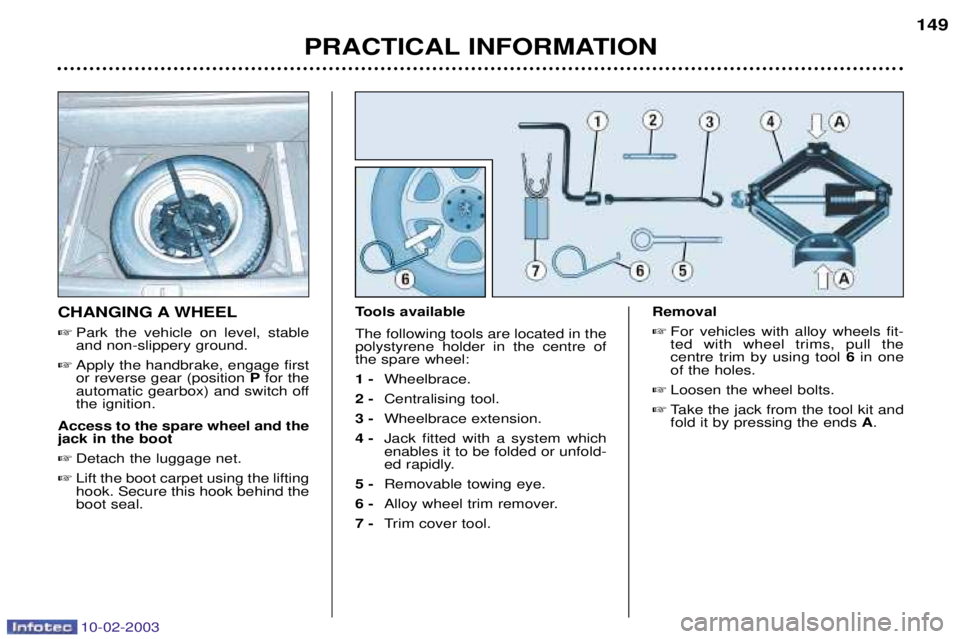
� Lift the boot carpet using the liftinghook. Secure this hook behind theboot seal. Tools available The following tools are located in the polystyrene holder in the centre ofthe spare wheel: 1 -
Wheelbrace.
2 - Centralising tool.
3 - Wheelbrace extension.
4 - Jack fitted with a system which enables it to be folded or unfold-
ed rapidly.
5 - Removable towing eye.
6 - Alloy wheel trim remover.
7 - Trim cover tool. Removal
� For vehicles with alloy wheels fit-ted with wheel trims, pull thecentre trim by using tool 6in one
of the holes.
� Loosen the wheel bolts.
� Take the jack from the tool kit andfold it by pressing the ends A.
Page 161 of 183
10-02-2003
PRACTICAL INFORMATION
150
�
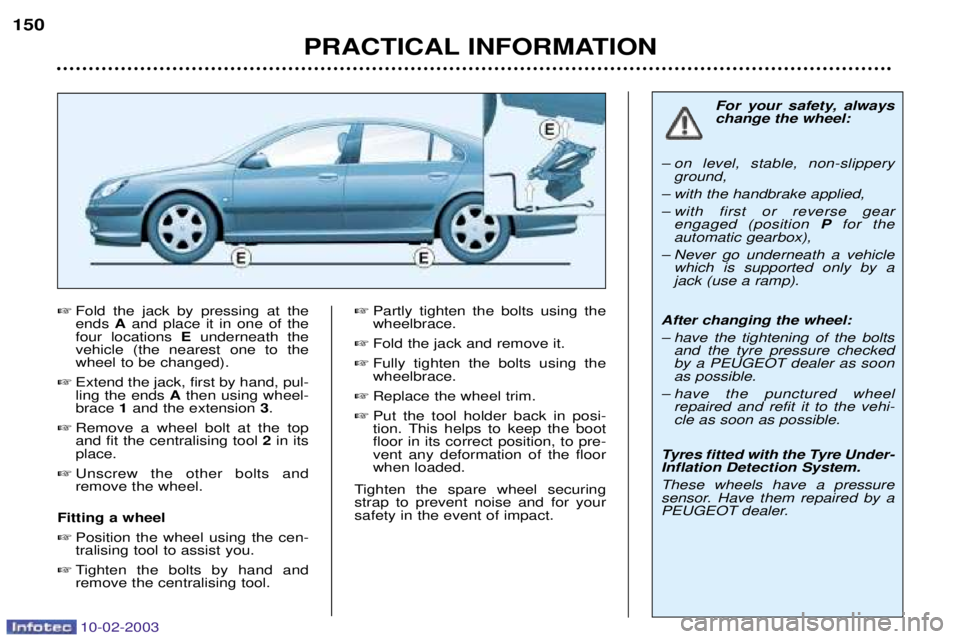
Fold the jack by pressing at the ends Aand place it in one of the
four locations Eunderneath the
vehicle (the nearest one to thewheel to be changed).
� Extend the jack, first by hand, pul-ling the ends Athen using wheel-
brace 1and the extension 3.
� Remove a wheel bolt at the topand fit the centralising tool 2in its
place.
� Unscrew the other bolts andremove the wheel.
Fitting a wheel � Position the wheel using the cen-tralising tool to assist you.
� Tighten the bolts by hand andremove the centralising tool. �
Partly tighten the bolts using thewheelbrace.
� Fold the jack and remove it.
� Fully tighten the bolts using thewheelbrace.
� Replace the wheel trim.
� Put the tool holder back in posi-
tion. This helps to keep the bootfloor in its correct position, to pre-vent any deformation of the floorwhen loaded.
Tighten the spare wheel securingstrap to prevent noise and for yoursafety in the event of impact. For your safety, alwayschange the wheel:
Ð on level, stable, non-slippery ground,
Ð with the handbrake applied,
Ð with first or reverse gear engaged (position Pfor the
automatic gearbox),
Ð Never go underneath a vehicle which is supported only by a jack (use a ramp).
After changing the wheel:
Ð have the tightening of the bolts and the tyre pressure checked by a PEUGEOT dealer as soonas possible.
Ð have the punctured wheel repaired and refit it to the vehi-cle as soon as possible.
Tyres fitted with the Tyre Under-Inflation Detection System. These wheels have a pressure
sensor. Have them repaired by a
PEUGEOT dealer.
Page 164 of 183
10-02-2003
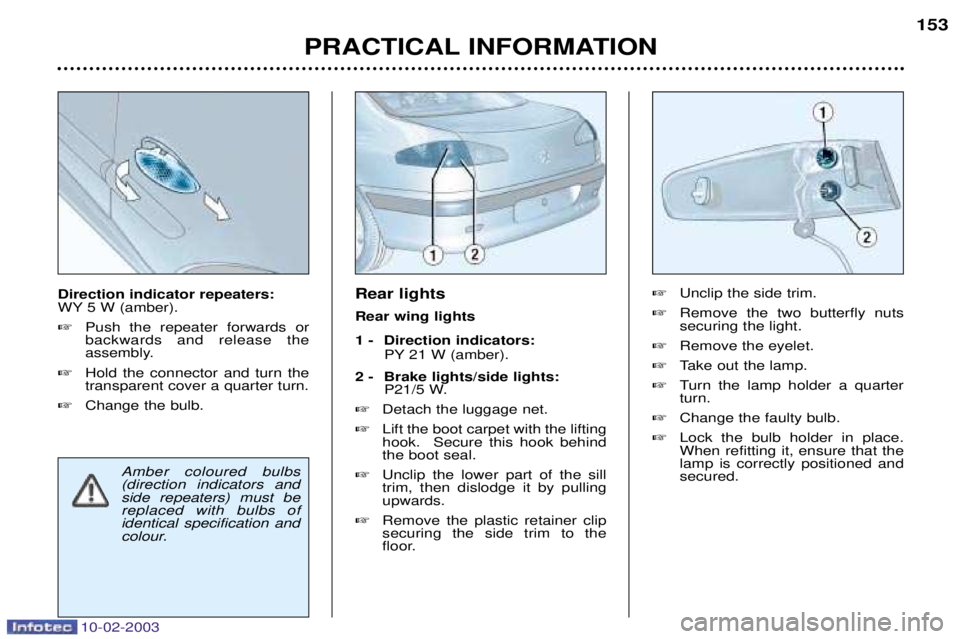
Rear lights Rear wing lights
1 - Direction indicators: PY 21 W (amber).
2 - Brake lights/side lights: P21/5 W.
� Detach the luggage net.
� Lift the boot carpet with the lifting hook. Secure this hook behindthe boot seal.
� Unclip the lower part of the silltrim, then dislodge it by pullingupwards.
� Remove the plastic retainer clipsecuring the side trim to the
floor. �
Unclip the side trim.
� Remove the two butterfly nutssecuring the light.
� Remove the eyelet.
� Take out the lamp.
� Turn the lamp holder a quarterturn.
� Change the faulty bulb.
� Lock the bulb holder in place.When refitting it, ensure that thelamp is correctly positioned andsecured.
PRACTICAL INFORMATION
153Direction indicator repeaters:
WY 5 W (amber).
� Push the repeater forwards orbackwards and release the
assembly.
� Hold the connector and turn thetransparent cover a quarter turn.
� Change the bulb.
Amber coloured bulbs
(direction indicators and side repeaters) must bereplaced with bulbs of
identical specification and
colour.
Page 165 of 183
10-02-2003
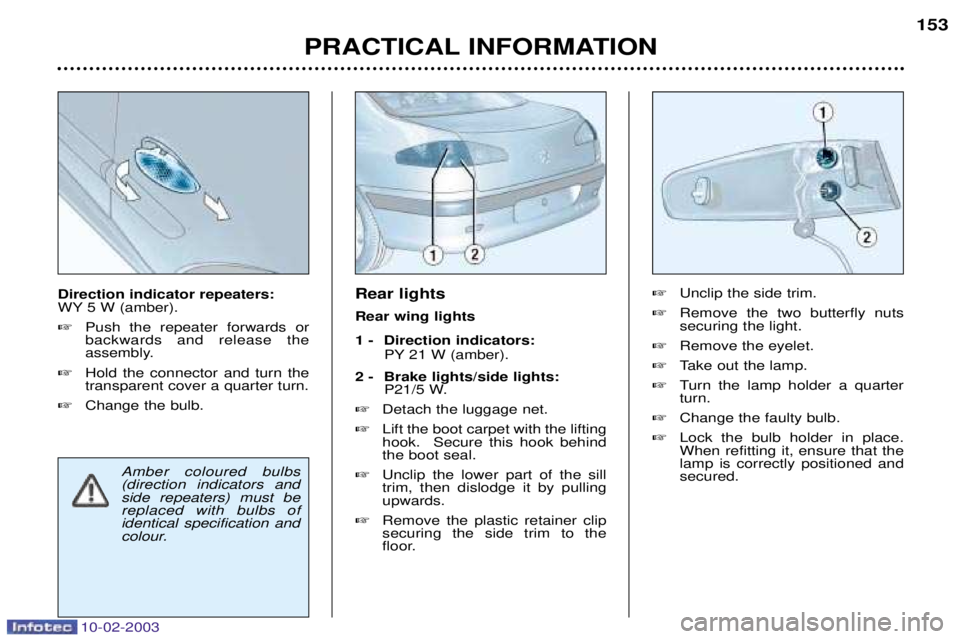
Rear lights Rear wing lights
1 - Direction indicators: PY 21 W (amber).
2 - Brake lights/side lights: P21/5 W.
� Detach the luggage net.
� Lift the boot carpet with the lifting hook. Secure this hook behindthe boot seal.
� Unclip the lower part of the silltrim, then dislodge it by pullingupwards.
� Remove the plastic retainer clipsecuring the side trim to the
floor. �
Unclip the side trim.
� Remove the two butterfly nutssecuring the light.
� Remove the eyelet.
� Take out the lamp.
� Turn the lamp holder a quarterturn.
� Change the faulty bulb.
� Lock the bulb holder in place.When refitting it, ensure that thelamp is correctly positioned andsecured.
PRACTICAL INFORMATION
153Direction indicator repeaters:
WY 5 W (amber).
� Push the repeater forwards orbackwards and release the
assembly.
� Hold the connector and turn thetransparent cover a quarter turn.
� Change the bulb.
Amber coloured bulbs
(direction indicators and side repeaters) must bereplaced with bulbs of
identical specification and
colour.