Page 138 of 183
10-02-2003
YOUR 607 IN DETAIL129
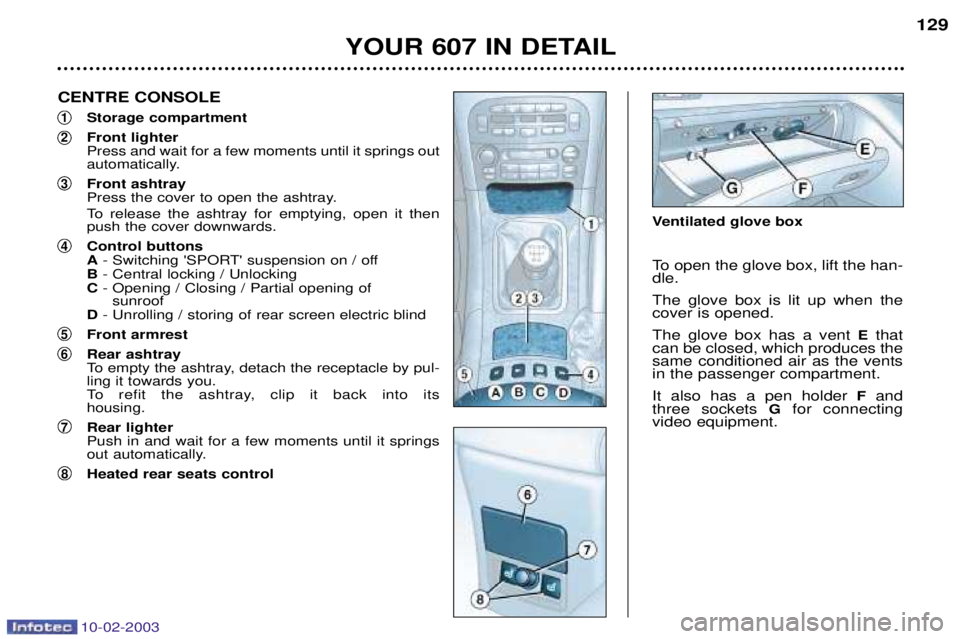
CENTRE CONSOLE
1Storage compartment
2Front lighter Press and wait for a few moments until it springs out
automatically.
3Front ashtray
Press the cover to open the ashtray.
To release the ashtray for emptying, open it then push the cover downwards.
4Control buttons A
- Switching 'SPORT' suspension on / off
B - Central locking / Unlocking
C - Opening / Closing / Partial opening of
sunroof
D - Unrolling / storing of rear screen electric blind
5Front armrest
6Rear ashtray
To empty the ashtray, detach the receptacle by pul- ling it towards you.
To refit the ashtray, clip it back into its housing.
7Rear lighter Push in and wait for a few moments until it springs
out automatically.
8Heated rear seats control
Ventilated glove box
To open the glove box, lift the han- dle. The glove box is lit up when the cover is opened. The glove box has a vent Ethat
can be closed, which produces the same conditioned air as the ventsin the passenger compartment. It also has a pen holder F
and
three sockets Gfor connecting
video equipment.
Page 139 of 183
10-02-2003
Luggage net The stowing rings allow the net to be placed in different positions.
YOUR 607 IN DETAIL
130
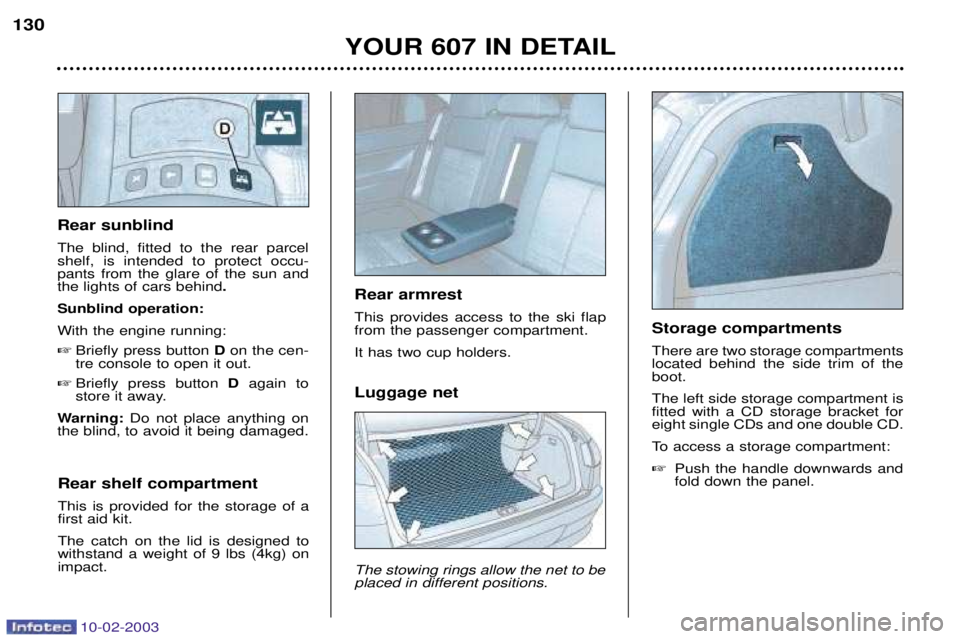
Rear sunblind The blind, fitted to the rear parcel shelf, is intended to protect occu-pants from the glare of the sun andthe lights of cars behind
.
Sunblind operation: With the engine running: � Briefly press button Don the cen-
tre console to open it out.
� Briefly press button Dagain to
store it away.
Warning: Do not place anything on
the blind, to avoid it being damaged. Rear armrest This provides access to the ski flap from the passenger compartment. It has two cup holders.
Storage compartmentsThere are two storage compartments located behind the side trim of theboot. The left side storage compartment is fitted with a CD storage bracket foreight single CDs and one double CD.
To access a storage compartment:�
Push the handle downwards and fold down the panel.
Rear shelf compartment This is provided for the storage of a first aid kit. The catch on the lid is designed to withstand a weight of 9 lbs (4kg) onimpact.
Page 143 of 183
10-02-2003
YOUR 607 IN DETAIL135
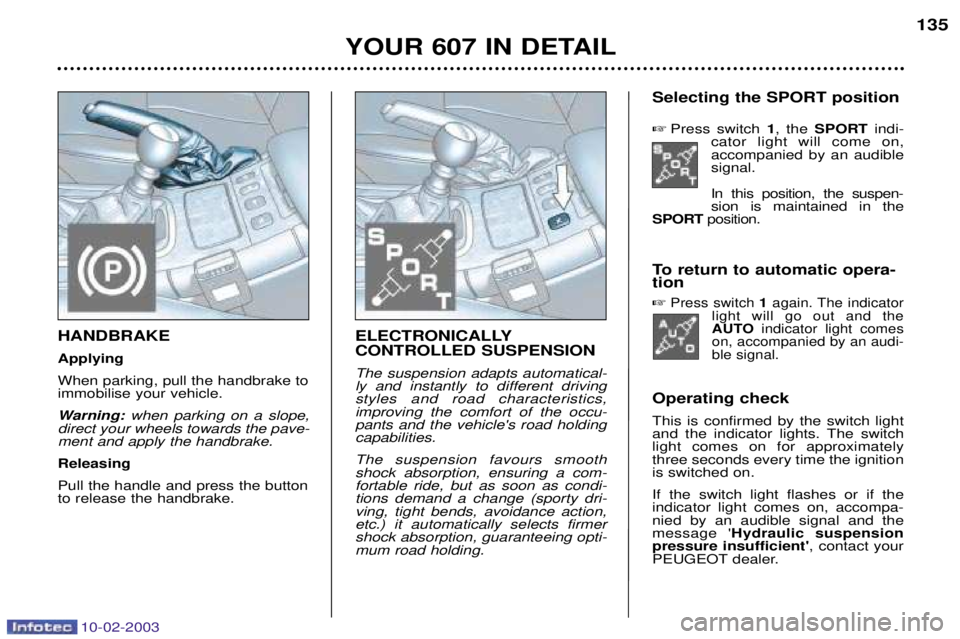
ELECTRONICALLY CONTROLLED SUSPENSION The suspension adapts automatical- ly and instantly to different drivingstyles and road characteristics,improving the comfort of the occu-pants and the vehicle's road holdingcapabilities. The suspension favours smooth shock absorption, ensuring a com-fortable ride, but as soon as condi-tions demand a change (sporty dri-ving, tight bends, avoidance action,etc.) it automatically selects firmershock absorption, guaranteeing opti-mum road holding.Selecting the SPORT position
� Press switch 1, the SPORT indi-
cator light will come on,accompanied by an audiblesignal. In this position, the suspen- sion is maintained in the
SPORT position.
To return to automatic opera-tion
� Press switch 1again. The indicator
light will go out and the
AUTO indicator light comes
on, accompanied by an audi-ble signal.
Operating check This is confirmed by the switch light
and the indicator lights. The switchlight comes on for approximatelythree seconds every time the ignitionis switched on. If the switch light flashes or if the indicator light comes on, accompa-nied by an audible signal and themessage ' Hydraulic suspension
pressure insufficient' , contact your
PEUGEOT dealer.
HANDBRAKE ApplyingWhen parking, pull the handbrake to immobilise your vehicle.
Warning: when parking on a slope,
direct your wheels towards the pave- ment and apply the handbrake. ReleasingPull the handle and press the button to release the handbrake.
Page 145 of 183
10-02-2003
YOUR 607 IN DETAIL
136
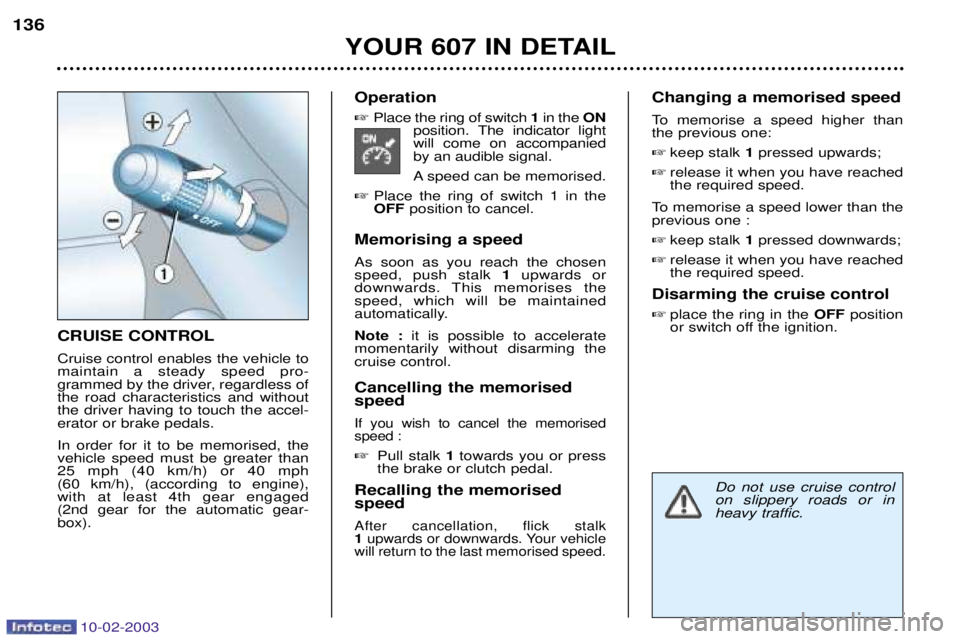
CRUISE CONTROL Cruise control enables the vehicle to maintain a steady speed pro-
grammed by the driver, regardless ofthe road characteristics and withoutthe driver having to touch the accel-erator or brake pedals. In order for it to be memorised, the vehicle speed must be greater than25 mph (40 km/h) or 40 mph
(60 km/h), (according to engine),with at least 4th gear engaged
(2nd gear for the automatic gear-box). Operation
� Place the ring of switch 1in the ON
position. The indicator lightwill come on accompaniedby an audible signal.
A speed can be memorised.
� Place the ring of switch 1 in the OFF position to cancel.
Memorising a speed As soon as you reach the chosen speed, push stalk 1upwards or
downwards. This memorises thespeed, which will be maintained
automatically. Note : it is possible to accelerate
momentarily without disarming the cruise control. Cancelling the memorised speed
If you wish to cancel the memorisedspeed :
� Pull stalk 1towards you or press
the brake or clutch pedal.
Recalling the memorisedspeed
After cancellation, flick stalk 1 upwards or downwards. Your vehicle
will return to the last memorised speed.
Changing a memorised speed
To memorise a speed higher than the previous one:
� keep stalk 1pressed upwards;
� release it when you have reachedthe required speed.
To memorise a speed lower than theprevious one : � keep stalk 1pressed downwards;
� release it when you have reachedthe required speed.
Disarming the cruise control � place the ring in the OFFposition
or switch off the ignition.
Do not use cruise control on slippery roads or inheavy traffic.
Page 146 of 183
10-02-2003
YOUR 607 IN DETAIL137
If there is an operating fault, the audible signal willbe a short bleep followedby a long bleep when
changing to reverse gear.
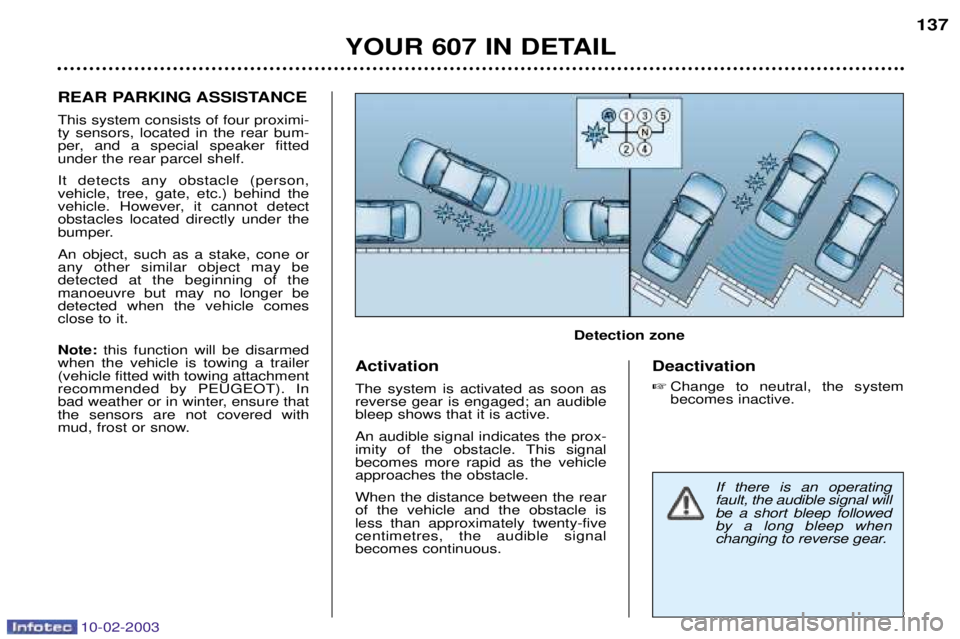
REAR PARKING ASSISTANCE This system consists of four proximi- ty sensors, located in the rear bum-
per, and a special speaker fittedunder the rear parcel shelf. It detects any obstacle (person, vehicle, tree, gate, etc.) behind the
vehicle. However, it cannot detectobstacles located directly under the
bumper. An object, such as a stake, cone or any other similar object may bedetected at the beginning of themanoeuvre but may no longer bedetected when the vehicle comesclose to it. Note:
this function will be disarmed
when the vehicle is towing a trailer (vehicle fitted with towing attachmentrecommended by PEUGEOT). In
bad weather or in winter, ensure thatthe sensors are not covered with
mud, frost or snow. Activation The system is activated as soon as reverse gear is engaged; an audiblebleep shows that it is active. An audible signal indicates the prox-
imity of the obstacle. This signalbecomes more rapid as the vehicleapproaches the obstacle. When the distance between the rear of the vehicle and the obstacle isless than approximately twenty-fivecentimetres, the audible signalbecomes continuous.Deactivation
� Change to neutral, the system
becomes inactive.
Detection zone
Page 158 of 183
10-02-2003
PRACTICAL INFORMATION147
CHECK
...
Battery
At the start of winter, have your bat-
tery checked by a PEUGEOT dealer. Air filter and pollen filter Have the filter elements replaced
regularly. If you drive in dusty con-
ditions, change them twice asoften. Particulate emission filter - Additive reservoir (Dieselmodels) It is essential the particulate emis- sion filter be maintained and theadditive reservoir be filled by a
PEUGEOT dealer, according to themanufacturer's servicing schedule. Brake pads Brake pad wear depends on the style of driving, in particular for vehi-cles which are used in town, overshort distances . It may be neces-
sary to check the thickness of thepads, even between services. Handbrake Where the handbrake travel is too great or there is a reduction in theperformance of the system, thehandbrake should be adjusted, evenbetween services. Have the system
checked by a PEUGEOT dealer. Manual gearbox This does not need an oil change. Check the level, according to themanufacturer's servicing schedule. Automatic gearbox This does not need an oil change. Have the level checked by a
PEUGEOT dealer, according to themanufacturer's servicing schedule. Oil filter
Change the filter regularly, in accor- dance with the servicing schedule.
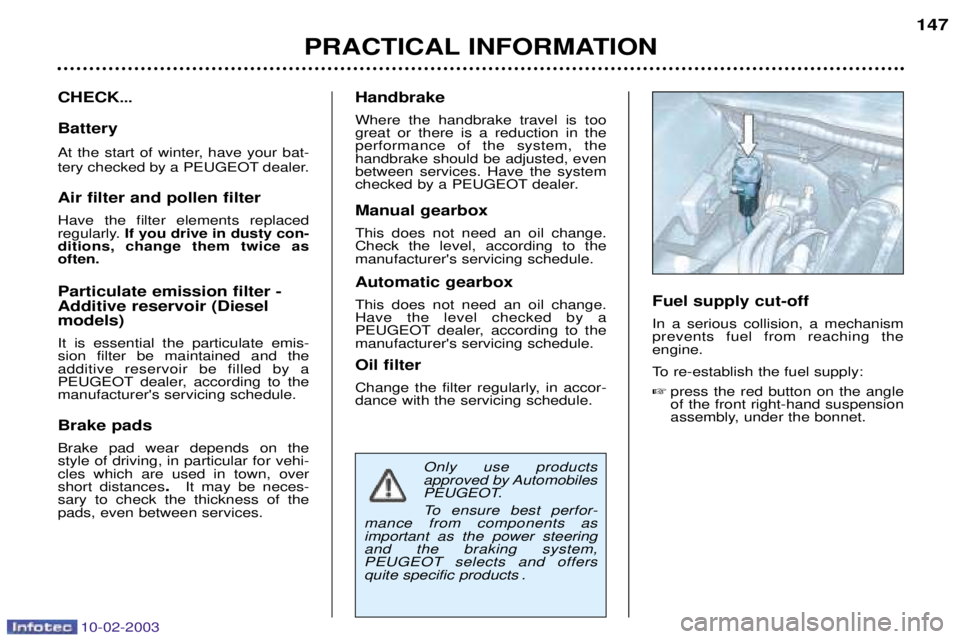
Fuel supply cut-off In a serious collision, a mechanism prevents fuel from reaching theengine.
To re-establish the fuel supply:
� press the red button on the angle of the front right-hand suspension
assembly, under the bonnet.
Only use products
approved by Automobiles
PEUGEOT.
To ensure best perfor-
mance from components as important as the power steeringand the braking system, PEUGEOT selects and offers
quite specific products .
Page 160 of 183
10-02-2003
PRACTICAL INFORMATION149
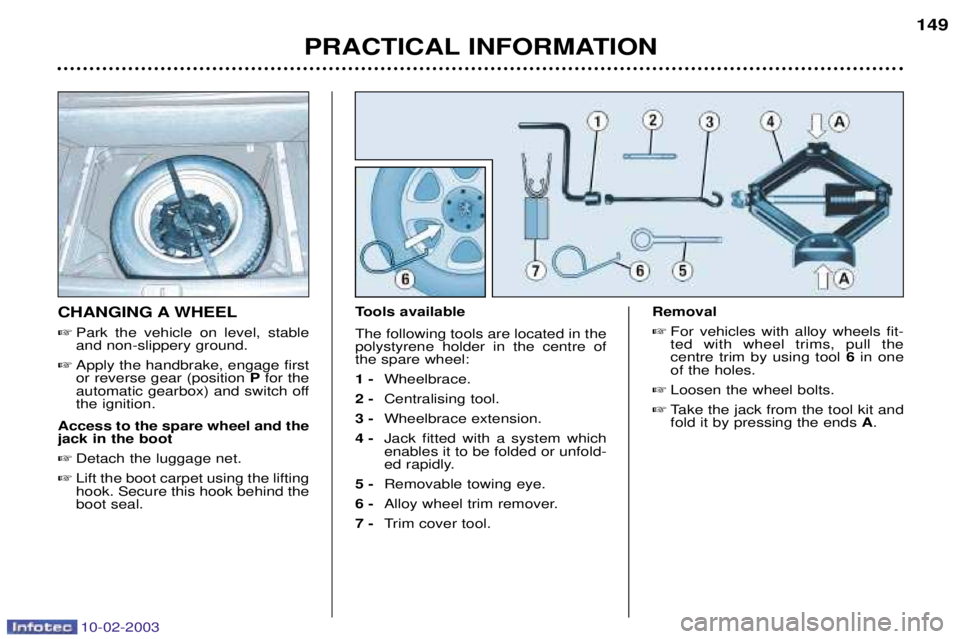
CHANGING A WHEEL
� Park the vehicle on level, stable and non-slippery ground.
� Apply the handbrake, engage firstor reverse gear (position Pfor the
automatic gearbox) and switch offthe ignition.
Access to the spare wheel and thejack in the boot � Detach the luggage net.
� Lift the boot carpet using the liftinghook. Secure this hook behind theboot seal. Tools available The following tools are located in the polystyrene holder in the centre ofthe spare wheel: 1 -
Wheelbrace.
2 - Centralising tool.
3 - Wheelbrace extension.
4 - Jack fitted with a system which enables it to be folded or unfold-
ed rapidly.
5 - Removable towing eye.
6 - Alloy wheel trim remover.
7 - Trim cover tool. Removal
� For vehicles with alloy wheels fit-ted with wheel trims, pull thecentre trim by using tool 6in one
of the holes.
� Loosen the wheel bolts.
� Take the jack from the tool kit andfold it by pressing the ends A.
Page 175 of 183
10-02-2003
PRACTICAL INFORMATION
162
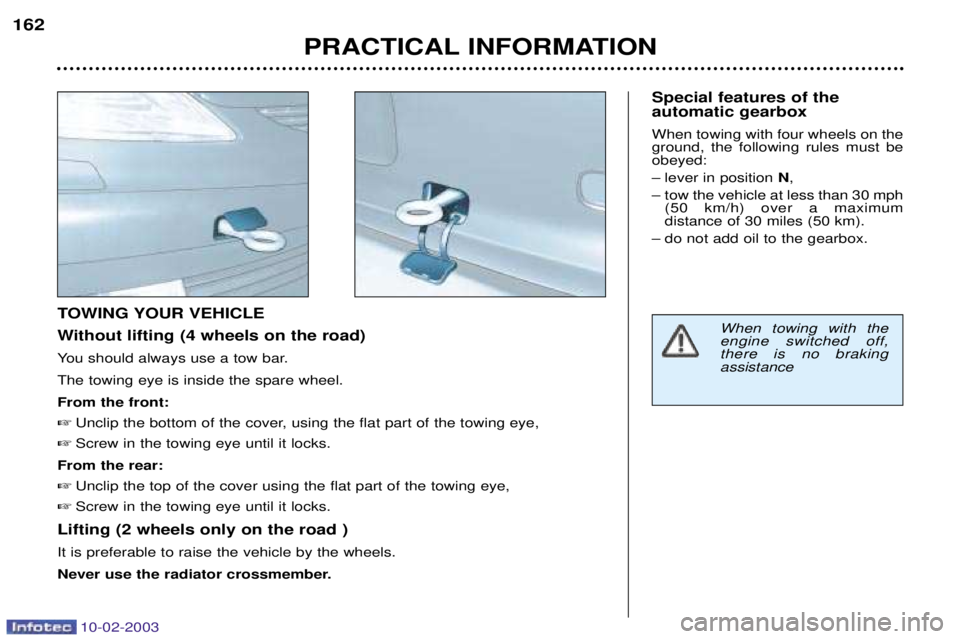
TOWING YOUR VEHICLE
Without lifting (4 wheels on the road)
You should always use a tow bar.The towing eye is inside the spare wheel.From the front:
� Unclip the bottom of the cover, using the flat part of the towing eye,
� Screw in the towing eye until it locks.
From the rear: � Unclip the top of the cover using the flat part of the towing eye,
� Screw in the towing eye until it locks.
Lifting (2 wheels only on the road )It is preferable to raise the vehicle by the wheels.
Never use the radiator crossmember. Special features of the automatic gearbox When towing with four wheels on the ground, the following rules must beobeyed:
Ð lever in position
N,
Ð tow the vehicle at less than 30 mph (50 km/h) over a maximum distance of 30 miles (50 km).
Ð do not add oil to the gearbox.
When towing with theengine switched off,there is no brakingassistance