2003 OLDSMOBILE AURORA belt
[x] Cancel search: beltPage 275 of 387
Replacing Brake System Parts
The braking system on a vehicle is complex. Its many
parts have to be of top quality and work well together
if
the vehicle is to have really good braking. Your
vehicle was designed and tested with top-quality GM
brake parts. When you replace parts of your braking
system
- for example, when your brake linings
wear down and you need new ones put in
- be sure
you get new approved GM replacement parts. If
you don’t, your brakes may no longer work properly. For
example,
if someone puts in brake linings that are
wrong for your vehicle, the balance between your front
and rear brakes can change
- for the worse. The
braking performance you’ve come to expect can change
in many other ways
if someone puts in the wrong
replacement brake parts.
Battery
Your new vehicle comes with a maintenance free
ACDelco@ battery. When it’s time for a new battery, get
one that has the replacement number shown on the
original battery’s label. We recommend an ACDelco
battery.
Warning: Battery posts, terminals and related
accessories contain lead and lead compounds,
chemicals known to the State of California to cause
cancer and reproductive harm. Wash hands after
handling. The
battery is located under the rear seat cushion. To
access the battery, see
Removing the Rear Seat
Cushion on page 5-95. You don’t need to access the
battery to jump start your vehicle. See
Jump Starting on
page 5-44.
- - ~ttery -.~t isn’t properly vented can let
sulfuric acid fumes into the area under the rear
seat cushion. These fumes can damage your
rear seat safety belt systems. You may not be
able to see this damage, and the safety belts
might not provide the protection needed in a
crash. If a replacement battery is ever needed,
it must be vented in the same manner as the
original battery. Always make sure that the
vent hose
is properly reattached before
reinstalling the seat cushion.
5-42
ProCarManuals.com
Page 299 of 387

Buying New Tires
To find out what kind and size of tires you need, look at
the Tire-Loading Information label.
The tires installed on your vehicle when it was new had
a Tire Performance Criteria Specification (TPC Spec)
number on each tire's sidewall. When you get new tires,
get ones with that same TPC Spec number. That way
your vehicle will continue to have tires that are designed
to give proper endurance, handling, speed rating,
traction, ride and other things during normal service on
your vehicle.
If your tires have an all-season tread
design, the TPC number will be followed by an
"MS" (for
mud and snow).
If you ever replace your tires with those not having a
TPC Spec number, make sure they are the same size,
load range, speed rating and construction type (bias,
bias-belted or radial) as your original tires.
IL....; tires could cause yo^ .o lose control
while driving.
If you mix tires of different sizes
or types (radial and bias-belted tires), the
vehicle may not handle properly, and you
could have a crash. Using tires of different
sizes may also cause damage to your vehicle. Be sure to use the same size and type tires on
all wheels.
It's all right to drive with your
compact spare, though.
It was developed for
use on your vehicle.
If you use bias-ply tires
a lr vehicle, the
wheel rim flanges could develop cracks after
many miles
of driving. A tire and/or wheel
could fail suddenly, causing a crash. Use only
radial-ply tires with the wheels on your vehicle.
I
5-66
ProCarManuals.com
Page 317 of 387

Wood Panels
Use a clean cloth moistened in warm, soapy water (use
mild dish washing soap). Dry the wood immediately
with a clean cloth.
Care of Safety Belts
Keep belts clean and dry.
Glass Surfaces
Glass should be cleaned often. GM Glass Cleaner or a
liquid household glass cleaner will remove normal
tobacco smoke and dust films on interior glass. See
GM
Vehicle Care/Appearance Materials on page 5-88.
Notice: Don't use abrasive cleaners on glass,
because they may cause scratches. Avoid placing
decals
on the inside rear window, since they
may have to be scraped
off later. If abrasive cleaners
are used on the inside of the rear window, an
electric defogger element may be damaged. Any
temporary license should not be attached across the defogger grid.
Do not bleach or dye safety belts. If you do, it
may severely weaken them. In a crash, they
might not be able to provide adequate
protection. Clean safety belts only with mild
soap and lukewarm water.
Weatherstrips
Silicone grease on weatherstrips will make them last
longer, seal better, and not stick or squeak. Apply
silicone grease with
a clean cloth at least every six
months. During very cold, damp weather more frequent
application may be required. See
Part D: Recommended
Fluids and Lubricants on page 6- 15.
5-84
ProCarManuals.com
Page 328 of 387
Removing the Rear Seat Cushion
To access the battery and rear compartment fuse
panels, the rear seat cushion
must be removed. This
procedure is somewhat difficult. You may wish to have
your dealer do this for you.
Notice: The battery and main fuse blocks are
located under the rear seat cushion. The battery’s
ground terminal and some relay wires are exposed.
To help avoid damage to the battery and wires,
be careful when removing or reinstalling the seat
cushion.
Do not remove covers from covered parts.
Do not store anything under the seat, as objects
could touch exposed wires and cause a short.
To remove the rear seat cushion, do the following:
1. Pull up on the front of the cushion to release the
2. Pull the cushion up and out toward the front of the
front hooks.
vehicle.
To reinstall the rear seat cushion, do the following: A safety belt that
isn’t properly routed through
the seat cushion or
is twisted won’t provide
the protection needed
in a crash. ld the safety
belt hasn’t been routed through the seat
cushion at all,
it won’t be there to work for the
next passenger. The person sitting
in that
position could be badly injured. After
reinstalling the seat cushion, always check to
be sure that the safety belts are properly
routed and are not twisted.
5-95
ProCarManuals.com
Page 329 of 387
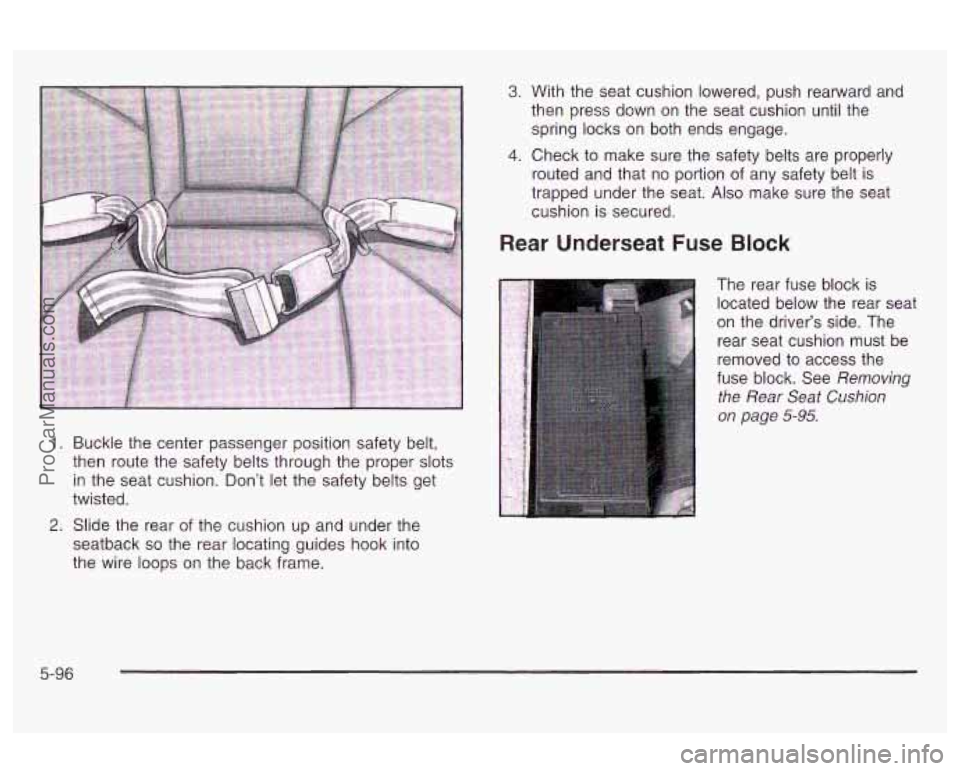
1.
2.
Buckle the center passenger position safety belt,
then route the safety belts through the proper slots
in the seat cushion. Don’t let the safety belts get
twisted.
Slide the rear of the cushion up and under the
seatback
so the rear locating guides hook into
the wire loops on the back frame.
3. With the seat cushion lowered, push rearward and
then press down
on the seat cushion until the
spring locks on both ends engage.
4. Check to make sure the safety belts are properly
routed and that no portion
of any safety belt is
trapped under the seat.
Also make sure the seat
cushion is secured.
Rear Underseat Fuse Block
The rear fuse block is
located below the rear seat
on the driver’s side. The rear seat cushion must be
removed to access the
fuse block. See
Removing
the Rear Seat Cushion
on
page 5-95.
5-96
ProCarManuals.com
Page 343 of 387

90,000 Miles (150 000 km)
0 Inspect throttle body bore and valve plates for
deposits, open the throttle valve and inspect all
surfaces. Clean as required.
An Emission Control
Service. (See footnote
t.)
Control Service.
page
5-63 for proper rotation pattern and additional
information.
(See footnote @.) (See footnote +.)
0 Replace engine air cleaner filter. An Emission
0 Rotate tires. See Tire Inspection and Rotation on
97,500 Miles (162 500 km)
U Rotate tires. See Tire Inspection and Rotation on
page 5-63 for proper rotation pattern and additional
information.
(See footnote @.) (See footnote +.)
100,000 Miles (1 66 000 km)
0 Replace spark plugs. An Emission Control Service.
0 Change automatic transaxle fluid and bottom screens
if the vehicle is mainly driven under one or more of
these conditions:
- In heavy city traffic where the outside
temperature regularly reaches
90°F (32°C) or
higher.
- In hilly or mountainous terrain.
- When doing frequent trailer towing.
0 If you haven’t used your vehicle under severe service
conditions listed previously and therefore, haven’t
changed your automatic transaxle fluid, change both
the fluid and filter.
150,000 Miles (240 000 km)
0 Drain, flush and refill cooling system (or every
60 months since last service, whichever occurs first).
See
Engine Coolant on page 5-24 for what to use.
Inspect hoses. Clean radiator, condenser, pressure
cap and neck. Pressure test the cooling system and pressure cap.
An Emission Control Service.
U Inspect engine accessory drive belt. An Emission
Control Service.
- Uses such as found in taxi, police or delivery
service.
6-8
ProCarManuals.com
Page 345 of 387

At Least Twice a Year
Restraint System Check
Make sure the safety belt reminder light and all your
belts, buckles, latch plates, retractors and anchorages
are working properly. Look for any other loose or
damaged safety belt system parts.
If you see anything
that might keep a safety belt system from doing its
job, have it repaired. Have any torn or frayed safety belts
replaced.
Also look for any opened or broken air bag coverings,
and have them repaired or replaced. (The air bag
system does not need regular maintenance.)
Wiper Blade Check
Inspect wiper blades for wear or cracking. Replace
blade inserts that appear worn or damaged or that
streak or miss areas of the windshield.
Also see
“Windshield Wiper and Wiper Blades” under Cleaning
the Outside
of Your Vehicle on page 5-85.
Weatherstrip Lubrication
Silicone grease on weatherstrips will make them last
longer, seal better, and not stick or squeak. Apply
silicone grease with a clean cloth. During very cold,
damp weather more frequent application may be
required. See
Part D: Recommended Fluids and
Lubricants on page
6- 15.
Automatic Transaxle Check
Check the transaxle fluid level; add if needed. See
Automatic Transaxle Fluid on page 5-22. A fluid loss
may indicate a problem. Check the system and repair if
needed.
At Least Once a Year
Key Lock Cylinders Service
Lubricate the key lock cylinders with the lubricant
specified in Part D.
Body Lubrication Service
Lubricate all body door hinges. Also lubricate all hinges
and latches, including those for the hood, rear
compartment, glove box door, console door and any
folding seat hardware. Part
D tells you what to use. More
frequent lubrication may be required when exposed to
a corrosive environment.
6-1 0
ProCarManuals.com
Page 364 of 387

Accessory Power Outlets ................................. 3-21
Adding Washer Fluid
....................................... 5-38
Additional Program Information
........................... 7-8
Additives, Fuel
................................................. 5-6
Add-on Electrical Equipment
............................ 5-91
Adjusting the Speakers (Balance/Fade)
.............. 3-62
Air Bag
Readiness Light
.......................................... 3-34
Air Bag Systems
............................................. 1-47
How Does an Air Bag Restrain? .................... 1-52
Servicing Your Air Bag-Equipped Vehicle
......... 1-54
What Makes an Air Bag Inflate?
.................... 1-52
What Will You See After an Air Bag Inflates? ...... 1-52
When Should an Air Bag Inflate?
................... 1-51
Where Are the Air Bags?
.............................. 1-49
Air CleanedFilter, Engine
................................. 5-21
All Overseas Locations
...................................... 7-4
Aluminum or Chrome-Plated Wheels
.................. 5-86
Antenna, Diversity
........................................... 3-76
Anti-Lock Brake, System Warning Light
.............. 3-36
Appearance Care
............................................ 5-82
Care
of Safety Belts .................................... 5-84
AM
............................................................... 3-74
r-11 It1-Iucln u1anG \JYQLGI II
uw) f-r A,-.+: I ,.-I, D.-~.I,A C?.,-+A- /A DC A7 ...........................
Appearance Care (cont.)
Chemical Paint Spotting
............................... 5-87
Cleaning the inside of Your Vehicle
................ 5-82
Cleaning the Outside of Your Vehicle
.............. 5-85
Finish Damage
............................................ 5-87
GM Vehicle Care/Appearance Materials
.......... 5-88
Sheet Metal Damage
................................ 5-87
Underbody Maintenance
........ ........ 5-87
Weatherstrips
........................... .... 5-84
Ashtrays
..................................... ........ 3-22
Assist Handles
............................................... 2-45
Audio System(s)
............................................. 3-59
Audio Systems
Audio Steering Wheel Controls
...................... 3-74
Care of Your Cassette Tape Player
................ 3-74
Care of Your CD Player
............................... 3-76
Care of Your CDs
........................................ 3-75
Chime Level Adjustment
............................... 3-76
Diversity Antenna System
............................. 3-76
NavigatiodRadio System
.............................. 3-69
Personal Choice Radio Controls
.................... 3-73
Radio with Cassette and CD
......................... 3-60
~eLlilly LIIt: I It lit3 3-a3
Theft-Deterrent Feature ................................ 3-73
Trunk-Mounted CD Changer
.......................... 3-70
Understanding Radio Reception
..................... 3-74
0 -LA:.- - . &I- - -r:.-- n rn ..........................................
1
ProCarManuals.com