Page 278 of 387
4. Open the hood on the other vehicle and locate the
positive
(+) and the negative (-) terminal locations
on that vehicle.
Open the hood on your vehicle and find the remote
positive
(+) terminal located in the engine
compartment on the passenger side
of the vehicle.
5. To access the remote
positive
(+) terminal,
remove the cover. You will not see the battery
of your vehicle under
the hood. It is located under the rear passenger
seat. You will not need to access the battery
for jump starting. The remote positive
(+) terminal
is for that purpose.
An electric fan can start up even when the
engine
is not running and can injure you. Keep
hands, clothing and tools away from any
underhood electric fan.
I
Your vehicle has a remote negative (-) terminal,
III~IKWJ UIAU, ~utiaiecj rear iile puwer sieering
fluid reservoir.
- ..I. - .I unr. ~n 11 I
See Engine Compartment Overview on page 5-14
for more information on location.
5-45
ProCarManuals.com
Page 279 of 387

Using a match near a battery can cause battery
gas to explode. People have been hurt doing
this, and some have been blinded. Use a
flashlight if you need more light.
Be sure the battery has enough water.
You
don’t need to add water to the ACDelco@
battery installed
in your new vehicle. But if a
battery has filler caps, be sure the right
amount of fluid is there. If
it is low, add water
to take care of that first. If you don’t, explosive
gas could be present.
Battery fluid contains acid that can burn you.
Don’t get
it on you. If you accidentally get it in
your eyes or on your skin, flush the place with
water and get medical help immediately. Fans or other moving engine parts
can injure
you badly. Keep your hands away from moving
parts once the engine
is running.
6. Check that the jumper cables don’t have loose or
missing insulation.
If they do, you could get a
shock. The vehicles could be damaged too.
Before you connect the cables, here are some
basic things you should know. Positive
(+) will go
to positive
(+) or to a remote positive (+) terminal if
the vehicle has one. Negative (-) will go to a
heavy, unpainted metal engine part or to a remote
negative
(-) terminal if the vehicle has one.
Don’t connect positive
(+) to negative (-) or you’ll
get
a short that would damage the battery and
maybe other parts too. And don’t connect the
negative
(-) cable to the negative (-) terminal on
the dead battery because this can cause sparks.
5-46
ProCarManuals.com
Page 280 of 387
7. Connect the red
positive
(+) cable to the
remote positive
(+)
terminal of the
dead battery. Use a
remote positive
(+) terminal if the
vehicle has one.
9. Now connect the black
negative
(-) cable to
the negative
(-)
I terminal of the good
battery. Use a remote
negative
(-) terminal
if the vehicle has one.
8. Don’t let the other end Don’t let
the other end touch anything until the next
touch metal. Connect it step. The other end of the negative (-) cable doesn’t go
to the positive
(+) to the dead battery. It goes to a heavy, unpainted
terminal of the good metal engine part or to a remote negative
(-) terminal
battery. Use a remote on the vehicle with the dead battery.
positive
(+) terminal
if the vehicle has one.
5-47
ProCarManuals.com
Page 281 of 387
10. Connect the other end
of the negative
(-)
cable at least 18 inches
(45 cm) away from
the dead battery, but
not near engine
parts that move.
The electrical connection is just as good there, and the
chance of sparks getting back to the battery is much less.
Use a remote negative
(-) terminal if the vehicle has
one. Your vehicle has a remote negative
(-) terminal
marked
“G N D .”
11. Now start the vehicle with the good battery and run
the engine for
a while.
12. Try to start the vehicle that had the dead battery. If
it won’t start after a few tries, it probably needs
service.
Notice: Damage to your vehicle may result from
electrical shorting
if jumper cables are removed
incorrectly.
To prevent electrical shorting, take care
that the cables don’t touch each other or any
other metal. The repairs wouldn’t be covered by
your warranty.
5-48
ProCarManuals.com
Page 282 of 387
I
Jumper Cable Removal
A. Dead Battery or Remote positive (+) Terminal
B. Good Battery or Remote positive
(+) or Remote
C. Heavy, Unpainted Metal Engine Part or Remote
Negative
(-) Terminals
Negative
(-) Terminal
To disconnect the jumper cables from both vehicles, do
the following:
1. Disconnect the black negative (-) cable from the
2. Disconnect the black negative (-) cable from the
3. Disconnect the red positive (+) cable from the
4. Disconnect the red positive (+) cable from the other
5. Return the positive (+) remote terminal cover to its
vehicle that
had the dead battery.
vehicle with the good battery.
vehicle with the good battery.
vehicle.
original position.
5-49
ProCarManuals.com
Page 325 of 387
Fuses and Circuit Breakers
The wiring circuits in your vehicle are protected from
short circuits by a combination of fuses and circuit
breakers. This greatly reduces the chance of fires
caused by electrical problems.
Look at the silver-colored band inside the fuse.
If the
band is broken or melted, replace the fuse. Be sure you
replace a bad fuse with a new one of the identical
size and rating. If a MaxiFuse@ should blow, see your
dealer for service immediately.
If you ever have a problem on the road and don’t have
a spare fuse, you can “borrow” one that has the
same amperage. Pick some feature of your vehicle that
you can get along without
- like the radio or cigarette
lighter
- and use its fuse, if it is the correct amperage.
Replace it as soon as you can. You will find a fuse puller
clipped in both
of the fuse blocks. Snap the wide end
of the fuse puller at the side indentations and pull
the fuse out.
The MaxiFuses@ are located in two fuse blocks, one
located in the engine compartment and the other under
the rear seat. If a MaxiFuse@ should blow, have your
vehicle serviced by your dealer immediately.
Engine Compartment Fuse Block
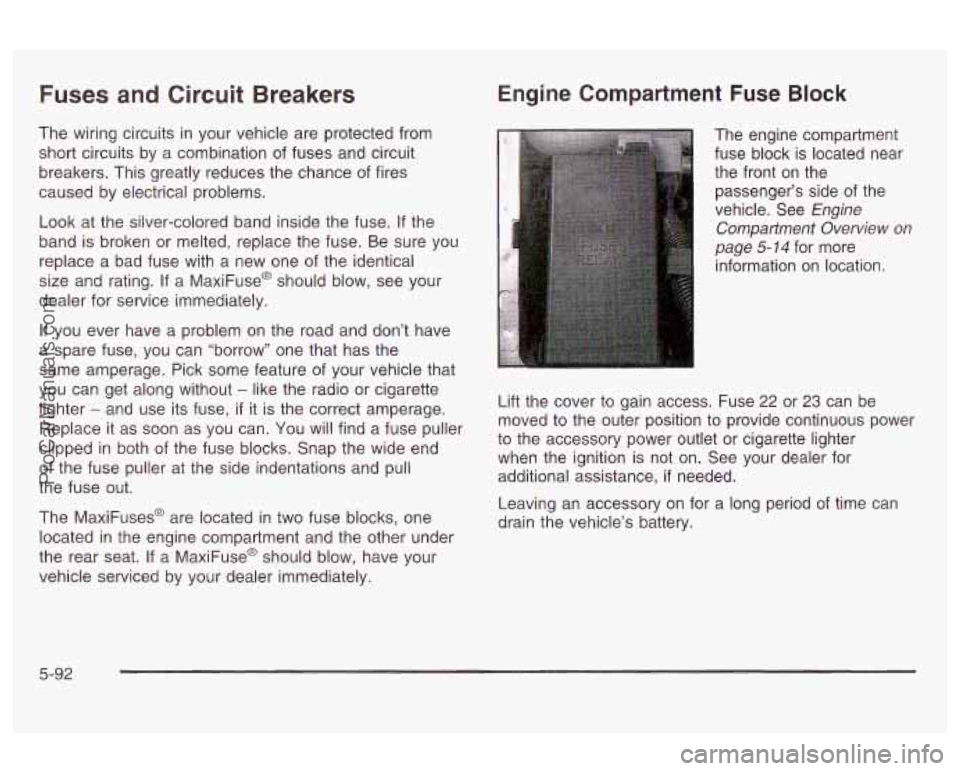
The engine compartment
fuse block is located near
the front on the
Comparfment Oiewiew on
page 5-14 for more
information on location.
Lift the cover to gain access. Fuse
22 or 23 can be
moved
to the outer position to provide continuous power
to the accessory power outlet or cigarette lighter
when the ignition is not on. See your dealer for
additional assistance,
if needed.
Leaving an accessory on for a long period of time can
drain the vehicle’s battery.
5-92
ProCarManuals.com
Page 326 of 387
Fuses
1
2
3
4
5
6 - 1
Usage
Not Used
Accessory
Windshield Wipers
Not Used Left Low-Beam Headlamp
Right Low-Beam Headlamp
Spare Fuses
8
9
10
11
12
13
14
15
16
17
18
19
20 21
22
23
24
25
26
Usage Powertrain Control Module Battery
Right High-Beam Headlamp
Left High-Beam Headlamp
Ignition
1
Not Used
Transaxle Cruise Control Direct Ignition System
Injector Bank #2
Not Used
Not Used
Powertrain Control Module Ignition
Oxygen Sensor
Injector Bank
#I
Auxiliary Power
Cigarette Lighter Fog Lamps/Daytirne Running Lamps
Horn
Air Conditioning Clutch
5-93
ProCarManuals.com
Page 328 of 387
Removing the Rear Seat Cushion
To access the battery and rear compartment fuse
panels, the rear seat cushion
must be removed. This
procedure is somewhat difficult. You may wish to have
your dealer do this for you.
Notice: The battery and main fuse blocks are
located under the rear seat cushion. The battery’s
ground terminal and some relay wires are exposed.
To help avoid damage to the battery and wires,
be careful when removing or reinstalling the seat
cushion.
Do not remove covers from covered parts.
Do not store anything under the seat, as objects
could touch exposed wires and cause a short.
To remove the rear seat cushion, do the following:
1. Pull up on the front of the cushion to release the
2. Pull the cushion up and out toward the front of the
front hooks.
vehicle.
To reinstall the rear seat cushion, do the following: A safety belt that
isn’t properly routed through
the seat cushion or
is twisted won’t provide
the protection needed
in a crash. ld the safety
belt hasn’t been routed through the seat
cushion at all,
it won’t be there to work for the
next passenger. The person sitting
in that
position could be badly injured. After
reinstalling the seat cushion, always check to
be sure that the safety belts are properly
routed and are not twisted.
5-95
ProCarManuals.com


