2003 Oldsmobile Alero check engine
[x] Cancel search: check enginePage 239 of 354
Notice: When adding coolant, it is important that
you use only
DEX-COOL@ (silicate-free) coolant.
If coolant other than DEX-COOL is added to
the system, premature engine, heater core or
radiator corrosion may result. In addition, the engine
coolant will require change sooner
-- at 30,000 miles
(50,000 km) or 24 months, whichever occurs first.
Damage caused by the use of coolant other
than DEX-COOL@
is not covered by your new vehicle
warranty.
What to Use
Use a mixture of one-half clean, drinkable wafer and
one-half
DEX-COOL@ coolant which won’t damage
aluminum parts.
If you use this coolant mixture,
you don’t need to add anything else. Adding only plain water to your cooling
system can be dangerous. Plain
water, or
some other liquid such as alcohol, can boil
before the proper coolant mixture will. Your
vehicle’s coolant warning system is set for the proper coolant mixture.
With plain water or the
wrong mixture, your engine could get too hot
but you wouldn’t get
the overheat warning.
Your engine could catch fire and you or others
could be burned. Use a
50/50 mixture of clean,
drinkable water and DEX-COOL@ coolant.
Notice: If you use an improper coolant mixture,
your engine could overheat and be badly damaged.
The repair cost wouldn’t be covered by your
warranty.
Too much water in the mixture can freeze
and crack the engine, radiator, heater core and
other parts.
If you have to add coolant more than four times a year,
have your dealer check your cooling system.
Notice: If you use the proper coolant, you don’t
have to add extra inhibitors or additives which claim
to improve the system. These can be harmful.
5-24
Page 240 of 354
Checking Coolant
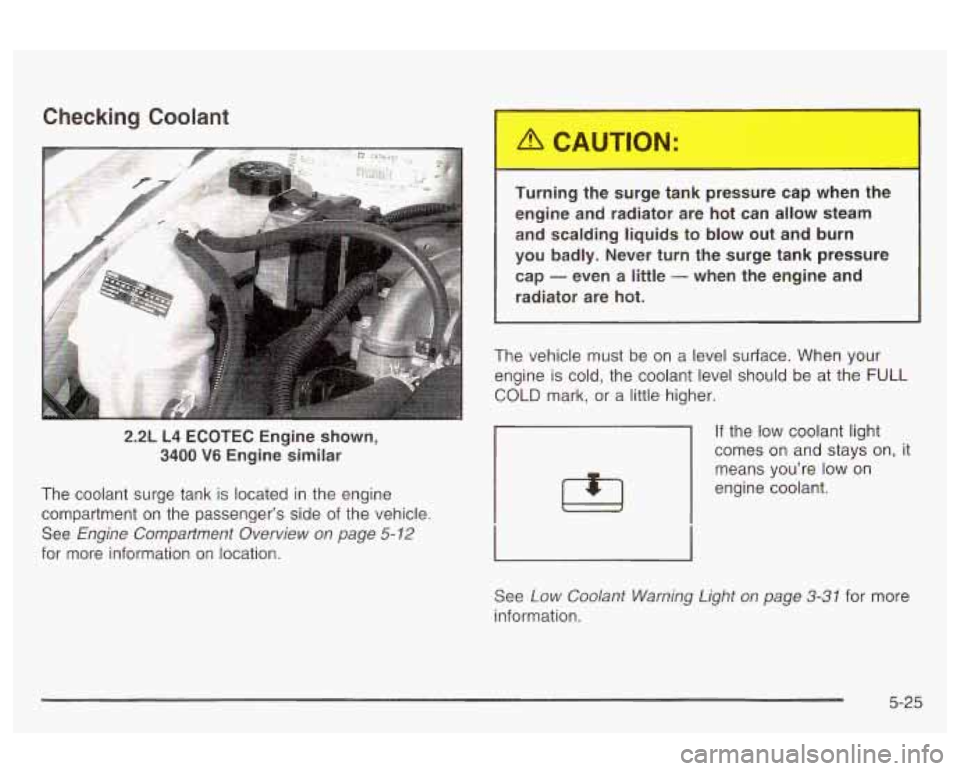
2.2L L4 ECOTEC Engine shown,
3400 V6 Engine similar
The coolant surge tank
is located in the engine
compartment on the passenger’s side of the vehicle.
See
Engine Compartment Overview on page 5-12
for more information on location. Turning
the surge tank pressure cap when the
engine and radiator are hot can allow steam
and scalding liquids to blow out and burn
you badly. Never turn the surge tank pressure
cap
- even a little - when the engine and
radiator are hot.
The vehicle must be on
a level surface. When your
mgine is cold, the coolant level should be at the
FULL
;OLD mark, or a little higher.
If the
low coolant light
comes on and stays on,
it
means you’re low on
engine coolant.
See
Low Coolant Warning Light on page 3-31 for more
nformation.
5-25
Page 245 of 354
Heater a _.__ . -ldiatoL -.oses, and other engine
parts, can be very hot. Don’t touch them. If you
do, you can be burned.
Don’t run the engine if there
is a leak. If you
run the engine, it could lose all coolant. That
could cause an engine fire, and you could be
burned. Get any leak fixed before you drive the
vehicle.
If there seems to be no leak, with the engine on, check
to see if the electric engine cooling fans are running.
If the engine is overheating, both fans should be
running.
If they aren’t, your vehicle needs service.
Notice: Engine damage from running your engine
without coolant isn’t covered by your warranty.
Notice: When adding coolant, it is important that
you use only
DEX-COOL@ (silicate-free) coolant.
If coolant other than DEX-COOL
is added to
the system, premature engine, heater core or
radiator corrosion may result. In addition, the engine
coolant will require change sooner
- at 30,000 miles
(50 000 km) or 24 months, whichever occurs first.
Damage caused by the use of coolant other
than DEX-COOL@ is not covered by your new vehicle
warranty.
How to Add Coolant to the Coolant
Surge Tank
Notice: This vehicle has a specific coolant fill
procedure. Failure to follow this procedure could
cause your engine to overheat and be severely
damaged.
If you haven’t found a problem yet, check to see
if
coolant is visible in the surge tank. If coolant is visible
but the coolant level isn’t at or above the
FULL
COLD mark, add a 50/50 mixture of clean, drinkable
water
and DEX-COOL@ coolant at the coolant
surge tank, but be sure the cooling system, including
the coolant surge tank pressure cap,
is cool before you
do it. See Engine Coolant on page 5-23 for more
information.
5-30
Page 249 of 354
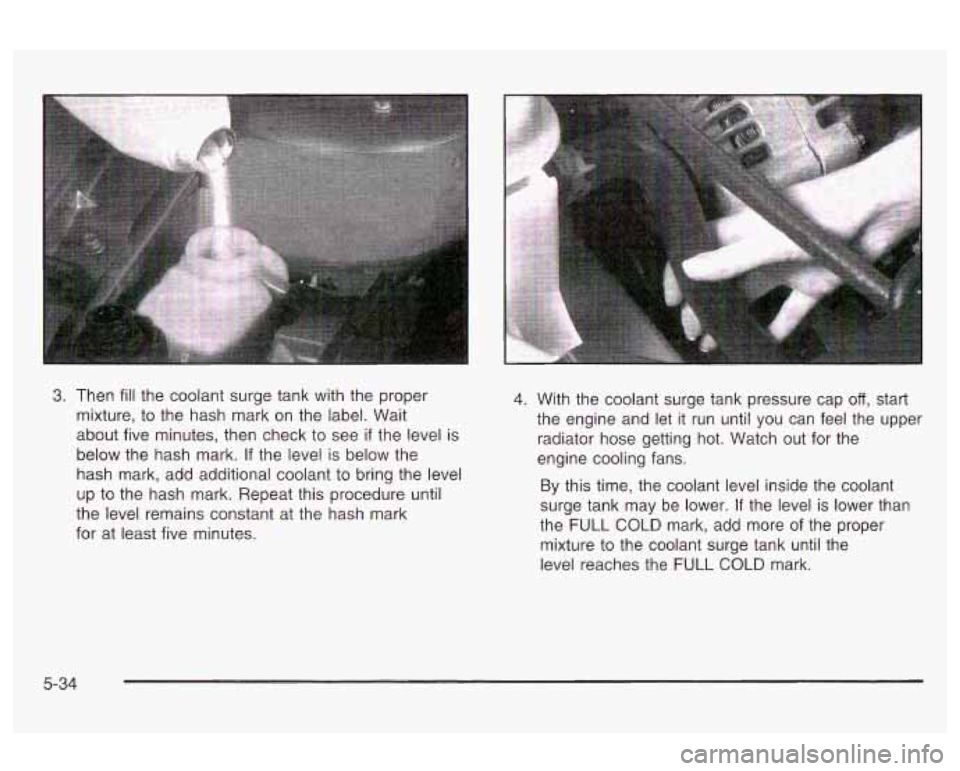
3. Then fill the coolant surge tank with the proper
mixture, to the hash mark on the label. Wait
about five minutes, then check to see
if the level is
below the hash mark.
If the level is below the
hash mark, add additional coolant to bring the level
up to the hash mark. Repeat this procedure until
the level remains constant at the hash mark
for at least five minutes. 4.
With the coolant surge tank pressure cap
off, start
the engine and let it run until you can feel the upper
radiator hose getting hot. Watch out for the
engine cooling fans.
By this time, the coolant level inside the coolant
surge tank may be lower. If the level is lower than
the FULL COLD mark, add more of the proper
mixture to the coolant surge tank until the
level reaches the FULL COLD mark.
5-34
Page 250 of 354
Power Steering Fluid
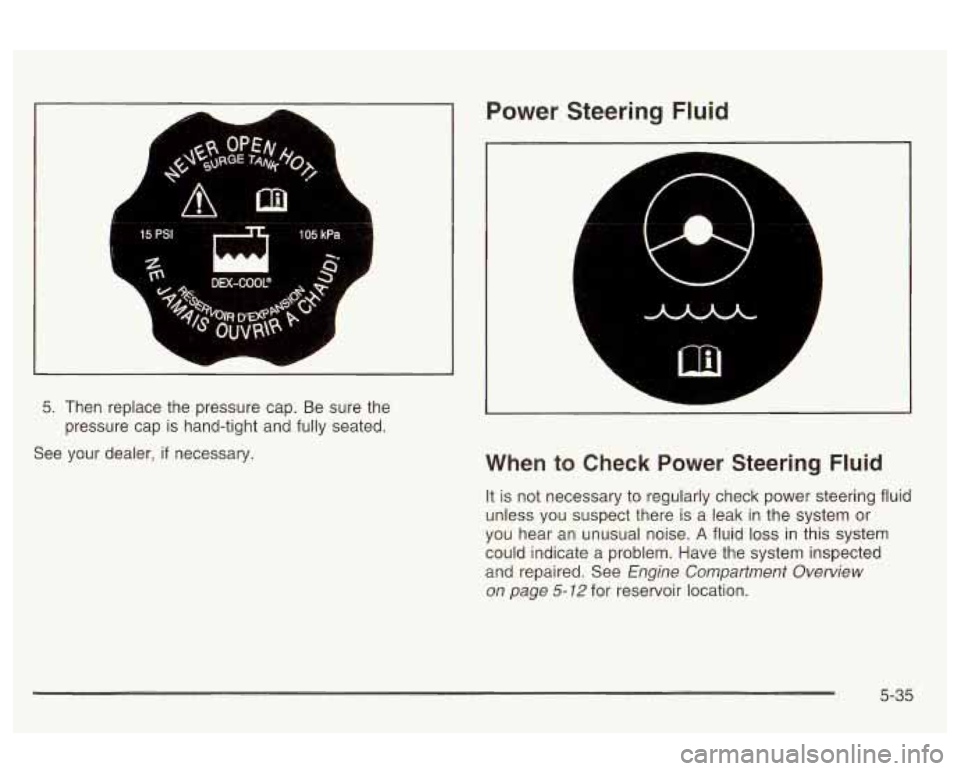
5. Then replace the pressure cap. Be sure the
pressure cap is hand-tight and fully seated.
See your dealer,
if necessary.
A L
L.
When to Check Power Steering Fluid
It is not necessary to regularly check power steering fluid
unless you suspect there is a leak in the system or
you hear an unusual noise.
A fluid loss in this system
could indicate a problem. Have the system inspected
and repaired. See
Engine Compartment Overview
on page
5-72 for reservoir location.
5-35
Page 251 of 354
How to Check Power Steering Fluid
Turn the key off, let the engine compartment cool down,
wipe the cap and the top of the reservoir clean, then
unscrew the cap and wipe the dipstick with a clean rag.
Replace the cap and completely tighten it. Then
remove the cap again and look at the fluid level on the
dipstick.
The level should be at the
FULL COLD mark. If
necessary, add only enough fluid
to bring the level up to
the mark.
What to Use
To determine what kind of fluid to use, see Part Dr
Recommended Fluids and Lubricants on page 6- 15.
Always use the proper fluid. Failure to use the proper
fluid can cause leaks and damage hoses and seals.
Windshield Washer Fluid
What to Use
When you need windshield washer fluid, be sure to read
the manufacturer’s instructions before use.
If you will
be operating your vehicle in an area where the
temperature may fall below freezing, use
a fluid that has
sufficient protection against freezing. See
Engine
Compartment Overview on page
5-12 for reservoir
location.
Adding Washer Fluid
Your vehicle has a low
washer fluid telltale that
will come on in the
WASHER
FLU ID
instrument panel cluster
when the washer fluid
is low.
See
Low Washer Fluid Warning Light on page 3-36 for
more information.
5-36
Page 257 of 354
Jump Starting
If your battery has run down, you may want to use
another vehicle and some jumper cables to start your
vehicle. Be sure to follow the steps below to do it safely.
I- Ba..,ries can hi.- - you. ’_ --?y cal. Je c-.lgerous
because:
They contain acid that can burn you.
They contain gas that can explode or
They contain enough electricity to
ignite.
burn you.
If you don’t follow these steps exactly, some
or all of these things can hurt you.
Notice: Ignoring these steps could result in costly
damage to your vehicle that wouldn’t be covered
by your warranty.
Trying to start your vehicle by pushing or pulling
it
won’t work, and it could damage your vehicle.
1. Check the other vehicle. It must have a 12-volt
battery with a negative ground system.
Notice: If the other system isn’t a 12-volt system
with a negative ground, both vehicles can be
damaged.
2. Get the vehicles close enough so the jumper cables
can reach, but be sure the vehicles aren’t touching
each other.
If they are, it could cause a ground
connection you don’t want.
You wouldn’t be able to
start your vehicle, and the bad grounding could
damage the electrical systems.
To avoid the possibility of the vehicles rolling, set
the parking brake firmly on both vehicles involved in
the jump start procedure. Put an automatic
transaxle in PARK (P) or a manual transaxle in
NEUTRAL before setting the parking brake.
Notice: If you leave your radio on, it could be badly
damaged. The repairs wouldn’t be covered by
your warranty.
3. Turn off the ignition on both vehicles. Unplug
unnecessary accessories plugged into the cigarette
lighter. Turn
off the radio and all lamps that aren’t
needed. This will avoid sparks and help save
both batteries. And it could save your radio!
4. Open the hoods and locate the batteries. Find the
positive
(+) and negative (-) terminal locations on
each vehicle. See
Engine Compartment Overview
on page
5-12 for more information on location.
5-42
Page 258 of 354
An electric fan can start up even wt.-.r the
engine
is not running and can injure you. Keep
hands, clothing and tools away from any
underhood electric fan.
m rn
Using a match near a battery can cause battery
gas to explode. People have been hurt doing
this, and some have been blinded. Use a
flashlight if you need more
light.
Be sure the battery has enough water. You
don’t need to add water tsthe ACDelco@
battery installed
in your new vehicle. But if a
battery has filler caps, be sure the right
amount of fluid
is there. If it is low, add water
to take care of that first. If you don’t, explosive
gas could be present.
CAUTION: (Continued) Battery fluid contains acid that can
burn you.
Don’t get
it on you. If you accidentally get it in
your eyes or on your skin, flush the place with
water and get medical help immediately.
I Fans or other moving el,,,ne parts can ..., ure
you badly. Keep your hands away from moving
parts once the engine
is running.
5. Check that the jumper cables don’t have loose or
missing insulation.
If they do, you could get a
SI Iucln. I I IC VCIIICIIG~ UWUIU UG UCAIIIUY~U CUW. -L--I- TI-- ..-L.:-1-,. mA,,lA Lm An-mmr.P4 tnn
Before you connect the cables, here are some
basic things you should know. Positive
(+) will go to
positive
(+) or to a remote positive (+) terminal if
the vehicle has one. Negative (-) will go to a heavy,
unpainted metal engine part or to a remote
negative
(-) terminal if the vehicle with the dead
battery has one.
5-43