2003 NISSAN X-TRAIL check engine
[x] Cancel search: check enginePage 830 of 3066
BL-86
NATS (NISSAN ANTI-THEFT SYSTEM)
2.CHECK SECURITY INDICATOR LAMP
1. Install 10A fuse.
2. Perform initialization with CONSULT-II.
For initialization, refer to “CONSULT-II Operation Manual NATS”.
3. Turn ignition switch OFF.
4. Start engine and turn ignition switch OFF.
5. Check the security indicator lamp lighting.
Security indicator lamp should be light up.
OK or NG?
OK >> INSPECTION END
NG >> GO TO 3
3.CHECK SECURITY INDICATOR LAMP POWER SUPPLY CIRCUIT
1. Disconnect security indicator lamp connector.
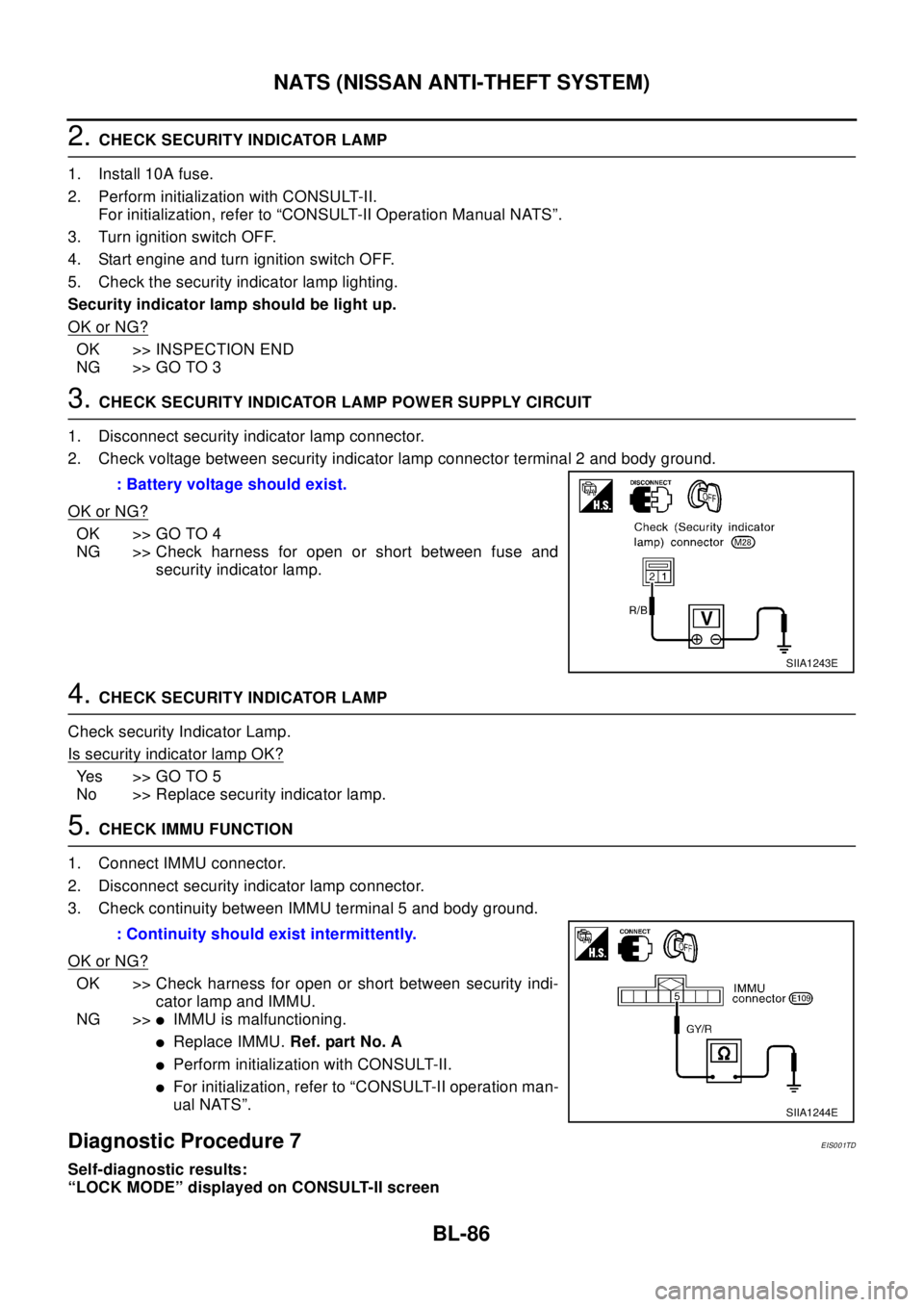
2. Check voltage between security indicator lamp connector terminal 2 and body ground.
OK or NG?
OK >> GO TO 4
NG >> Check harness for open or short between fuse and
security indicator lamp.
4.CHECK SECURITY INDICATOR LAMP
Check security Indicator Lamp.
Is security indicator lamp OK?
Yes >>GOTO5
No >> Replace security indicator lamp.
5.CHECK IMMU FUNCTION
1. Connect IMMU connector.
2. Disconnect security indicator lamp connector.
3. Check continuity between IMMU terminal 5 and body ground.
OK or NG?
OK >> Check harness for open or short between security indi-
cator lamp and IMMU.
NG >>
lIMMU is malfunctioning.
lReplace IMMU.Ref. part No. A
lPerform initialization with CONSULT-II.
lFor initialization, refer to “CONSULT-II operation man-
ual NATS”.
Diagnostic Procedure 7EIS001TD
Self-diagnostic results:
“LOCK MODE” displayed on CONSULT-II screen: Battery voltage should exist.
SIIA1243E
: Continuity should exist intermittently.
SIIA1244E
Page 831 of 3066
NATS (NISSAN ANTI-THEFT SYSTEM)
BL-87
C
D
E
F
G
H
J
K
L
MA
B
BL
1.CONFIRM SELF-DIAGNOSTIC RESULTS
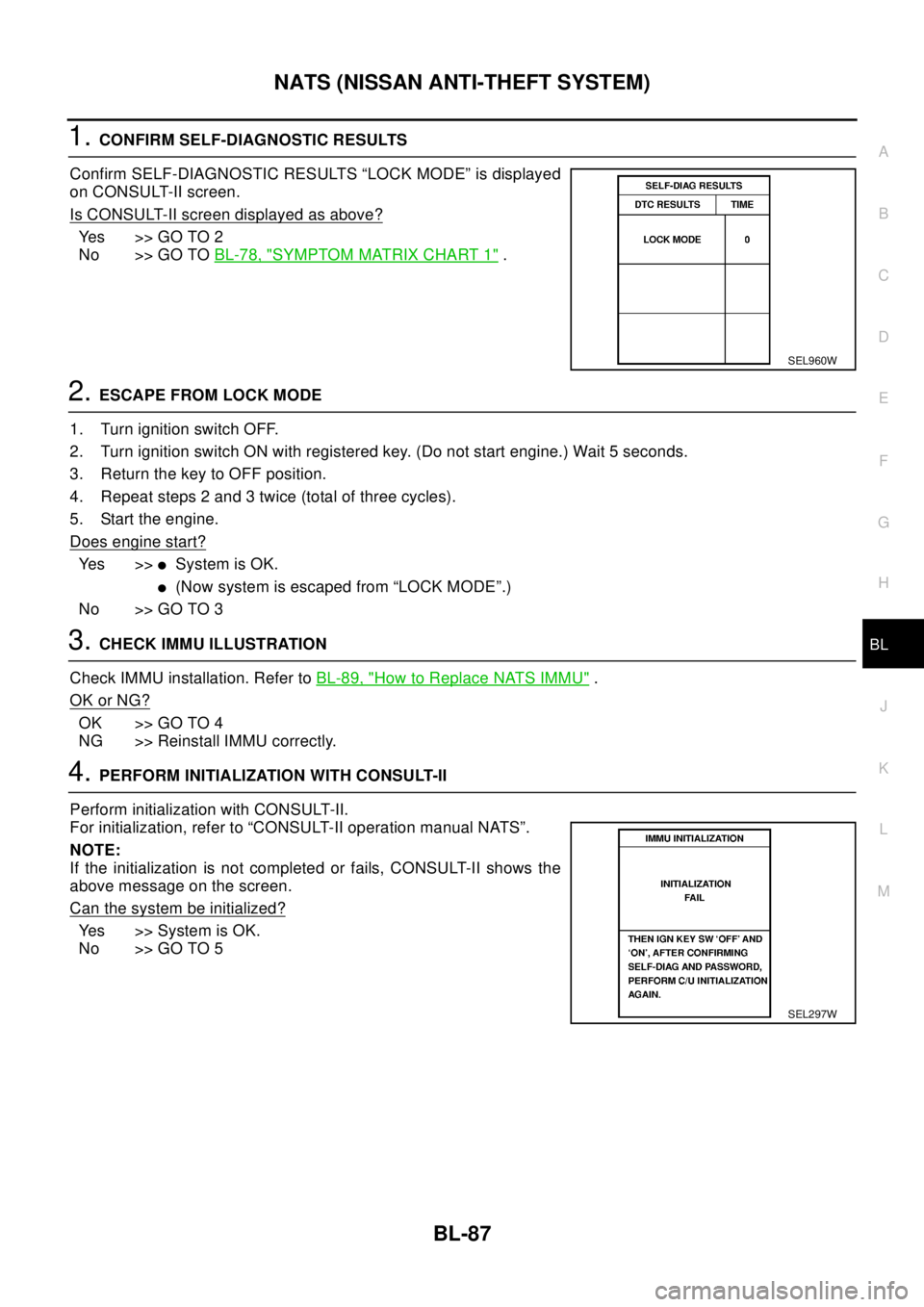
Confirm SELF-DIAGNOSTIC RESULTS “LOCK MODE” is displayed
on CONSULT-II screen.
Is CONSULT-II screen displayed as above?
Yes >>GOTO2
No >> GO TOBL-78, "
SYMPTOM MATRIX CHART 1".
2.ESCAPE FROM LOCK MODE
1. Turn ignition switch OFF.
2. Turn ignition switch ON with registered key. (Do not start engine.) Wait 5 seconds.
3. Return the key to OFF position.
4. Repeat steps 2 and 3 twice (total of three cycles).
5. Start the engine.
Does engine start?
Ye s > >lSystem is OK.
l(Now system is escaped from “LOCK MODE”.)
No >> GO TO 3
3.CHECK IMMU ILLUSTRATION
Check IMMU installation. Refer toBL-89, "
How to Replace NATS IMMU".
OK or NG?
OK >> GO TO 4
NG >> Reinstall IMMU correctly.
4.PERFORM INITIALIZATION WITH CONSULT-II
Perform initialization with CONSULT-II.
For initialization, refer to “CONSULT-II operation manual NATS”.
NOTE:
If the initialization is not completed or fails, CONSULT-II shows the
above message on the screen.
Can the system be initialized?
Ye s > > S y s t e m i s O K .
No >> GO TO 5
SEL960W
SEL297W
Page 841 of 3066
BRAKE PEDAL
BR-7
C
D
E
G
H
I
J
K
L
MA
B
BR
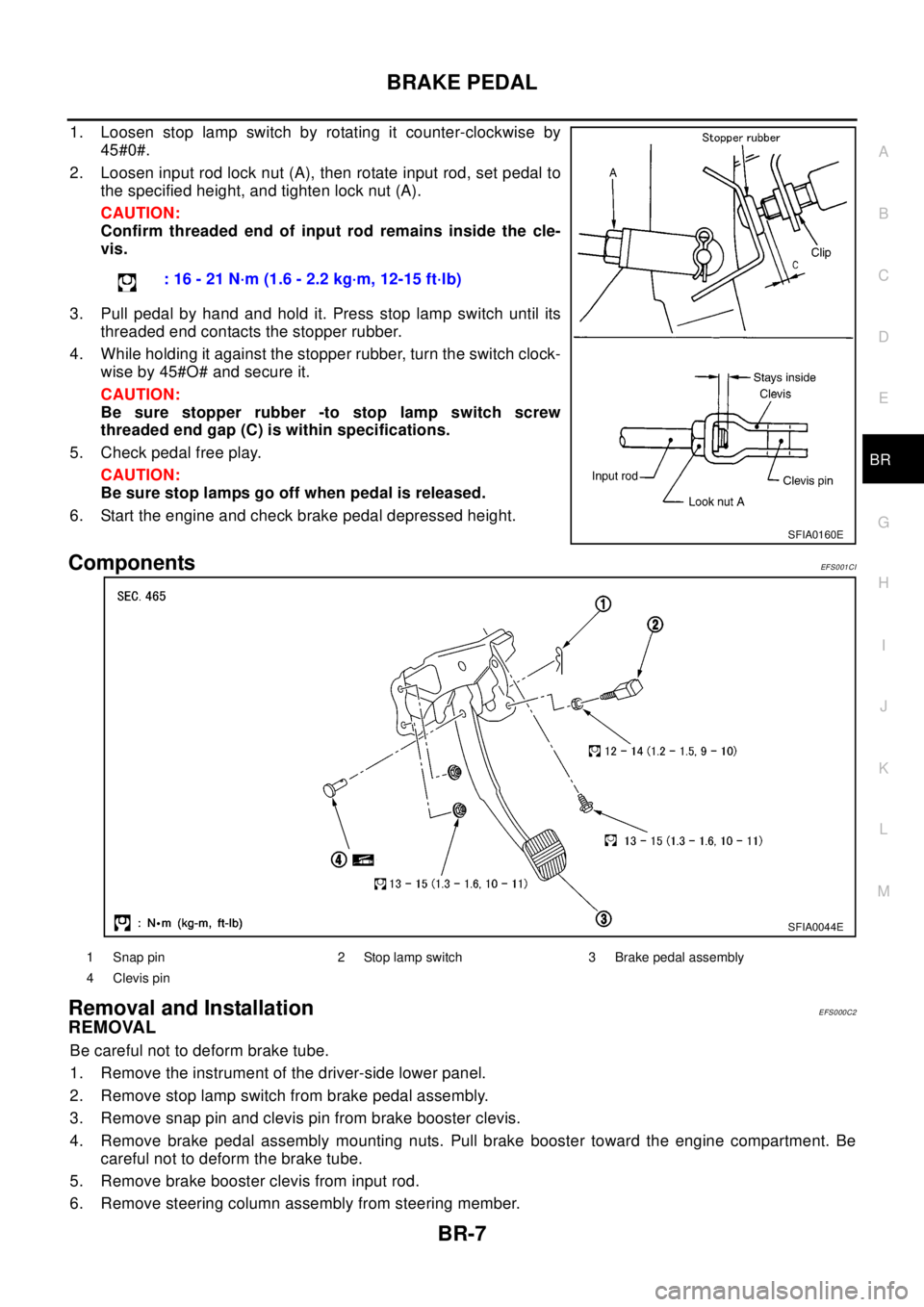
1. Loosen stop lamp switch by rotating it counter-clockwise by
45#0#.
2. Loosen input rod lock nut (A), then rotate input rod, set pedal to
the specified height, and tighten lock nut (A).
CAUTION:
Confirm threaded end of input rod remains inside the cle-
vis.
3. Pull pedal by hand and hold it. Press stop lamp switch until its
threaded end contacts the stopper rubber.
4. While holding it against the stopper rubber, turn the switch clock-
wise by 45#O# and secure it.
CAUTION:
Be sure stopper rubber -to stop lamp switch screw
threaded end gap (C) is within specifications.
5. Check pedal free play.
CAUTION:
Be sure stop lamps go off when pedal is released.
6. Start the engine and check brake pedal depressed height.
ComponentsEF S0 01 CI
Removal and InstallationEFS000C2
REMOVAL
Be careful not to deform brake tube.
1. Remove the instrument of the driver-side lower panel.
2. Remove stop lamp switch from brake pedal assembly.
3. Remove snap pin and clevis pin from brake booster clevis.
4. Remove brake pedal assembly mounting nuts. Pull brake booster toward the engine compartment. Be
careful not to deform the brake tube.
5. Remove brake booster clevis from input rod.
6. Remove steering column assembly from steering member.: 16 - 21 N·m (1.6 - 2.2 kg·m, 12-15 ft·lb)
SFIA0160E
SFIA0044E
1 Snap pin 2 Stop lamp switch 3 Brake pedal assembly
4 Clevis pin
Page 843 of 3066
BRAKE FLUID
BR-9
C
D
E
G
H
I
J
K
L
MA
B
BR
BRAKE FLUIDPFP:KN100
Checking Brake Fluid LevelEFS000C5
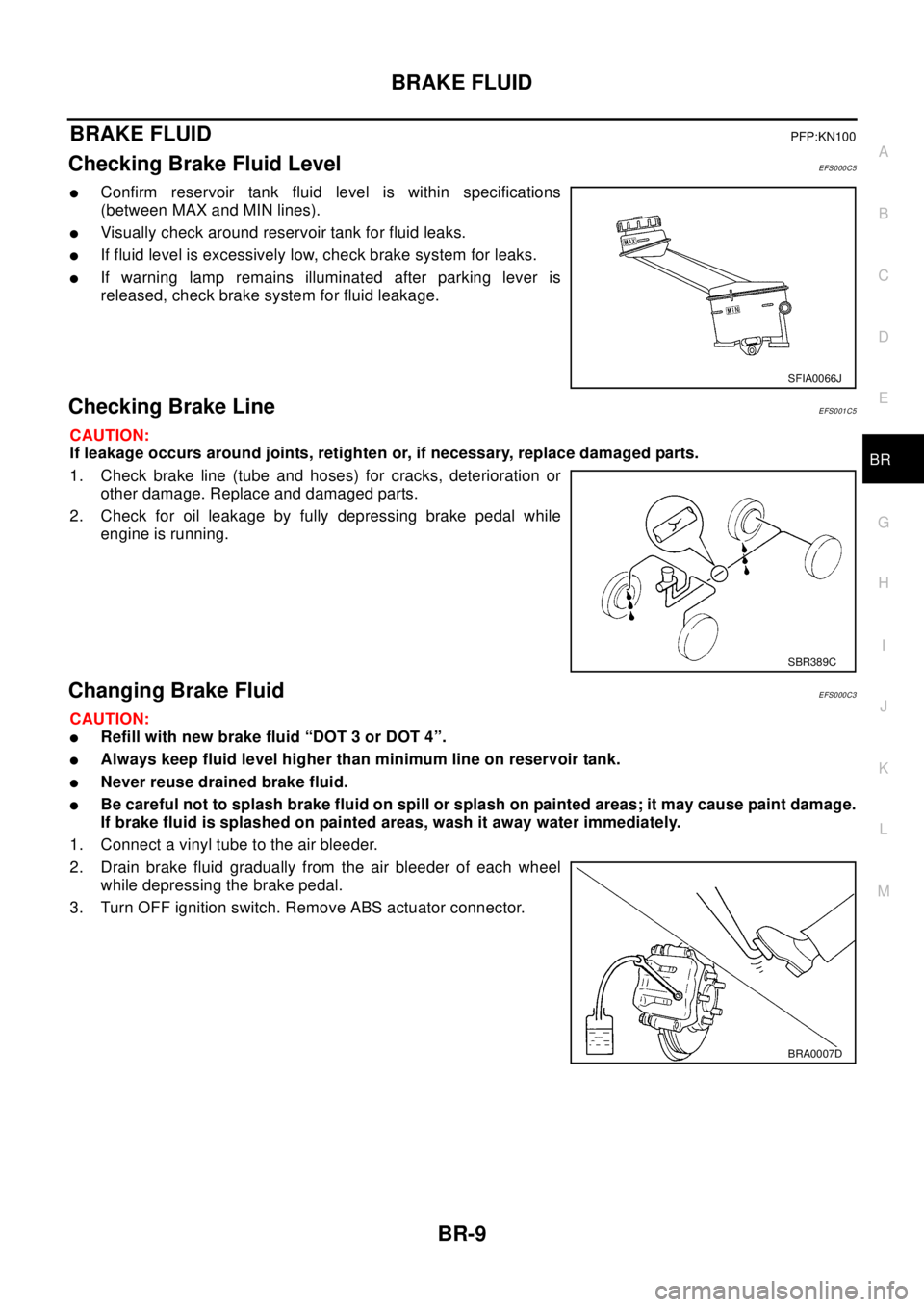
lConfirm reservoir tank fluid level is within specifications
(between MAX and MIN lines).
lVisually check around reservoir tank for fluid leaks.
lIf fluid level is excessively low, check brake system for leaks.
lIf warning lamp remains illuminated after parking lever is
released, check brake system for fluid leakage.
Checking Brake LineEFS001C5
CAUTION:
If leakage occurs around joints, retighten or, if necessary, replace damaged parts.
1. Check brake line (tube and hoses) for cracks, deterioration or
other damage. Replace and damaged parts.
2. Check for oil leakage by fully depressing brake pedal while
engine is running.
Changing Brake FluidEFS000C3
CAUTION:
lRefill with new brake fluid “DOT 3 or DOT 4”.
lAlways keep fluid level higher than minimum line on reservoir tank.
lNever reuse drained brake fluid.
lBe careful not to splash brake fluid on spill or splash on painted areas; it may cause paint damage.
If brake fluid is splashed on painted areas, wash it away water immediately.
1. Connect a vinyl tube to the air bleeder.
2. Drain brake fluid gradually from the air bleeder of each wheel
while depressing the brake pedal.
3. Turn OFF ignition switch. Remove ABS actuator connector.
SFIA0066J
SBR389C
BRA0007D
Page 846 of 3066
BR-12
BRAKE PIPING AND HOSE
5. Refill brake fluid until new brake fluid comes out of each air bleeder.
6. Afterwards, bleed air.
Removal and Installation of Rear Brake Piping and Brake HoseEFS000C8
REMOVAL
CAUTION:
lDo not allow brake fluid to spill or splash on painted surfaces. Brake fluid can seriously damage
paint. If it gets on a painted surface, wipe it off immediately and wash with water.
lDo not bend or twist the brake hose sharply, or strongly pull it.
lCover brake fluid line connections to prevent dust and other foreign material from entering.
1. Connect a vinyl tube to the air bleeder.
2. Drain brake fluid gradually from the air bleeder of each wheel while depressing the brake pedal.
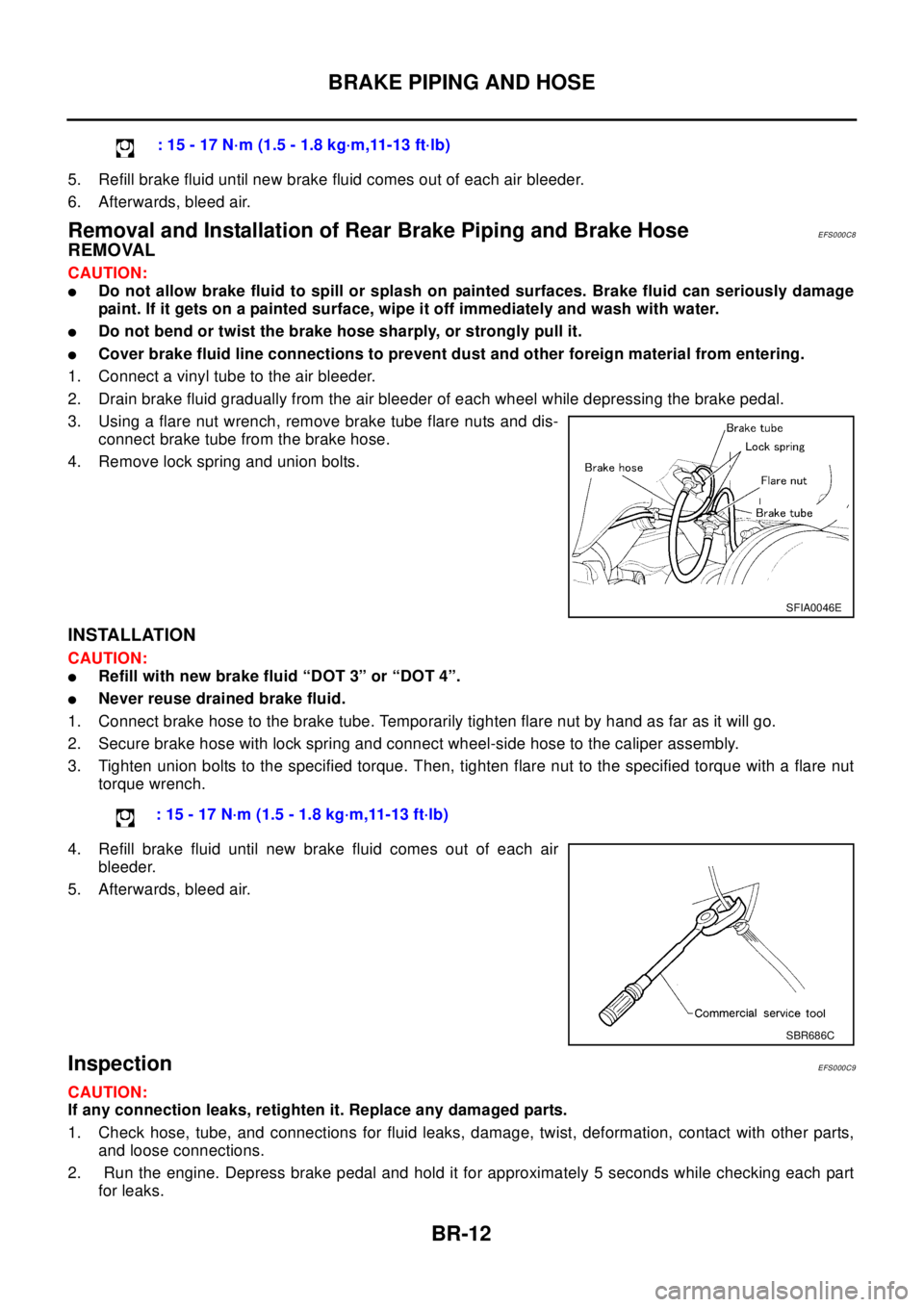
3. Using a flare nut wrench, remove brake tube flare nuts and dis-
connect brake tube from the brake hose.
4. Remove lock spring and union bolts.
INSTALLATION
CAUTION:
lRefill with new brake fluid “DOT 3” or “DOT 4”.
lNever reuse drained brake fluid.
1. Connect brake hose to the brake tube. Temporarily tighten flare nut by hand as far as it will go.
2. Secure brake hose with lock spring and connect wheel-side hose to the caliper assembly.
3. Tighten union bolts to the specified torque. Then, tighten flare nut to the specified torque with a flare nut
torque wrench.
4. Refill brake fluid until new brake fluid comes out of each air
bleeder.
5. Afterwards, bleed air.
InspectionEFS000C9
CAUTION:
If any connection leaks, retighten it. Replace any damaged parts.
1. Check hose, tube, and connections for fluid leaks, damage, twist, deformation, contact with other parts,
and loose connections.
2. Run the engine. Depress brake pedal and hold it for approximately 5 seconds while checking each part
for leaks.:15-17N·m(1.5-1.8kg·m,11-13ft·lb)
SFIA0046E
: 15 - 17 N·m (1.5 - 1.8 kg·m,11-13 ft·lb)
SBR686C
Page 851 of 3066
BRAKE BOOSTER
BR-17
C
D
E
G
H
I
J
K
L
MA
B
BR
BRAKE BOOSTERPFP:47200
On-Vehicle Inspection and ServiceEFS000CC
FUNCTION INSPECTION
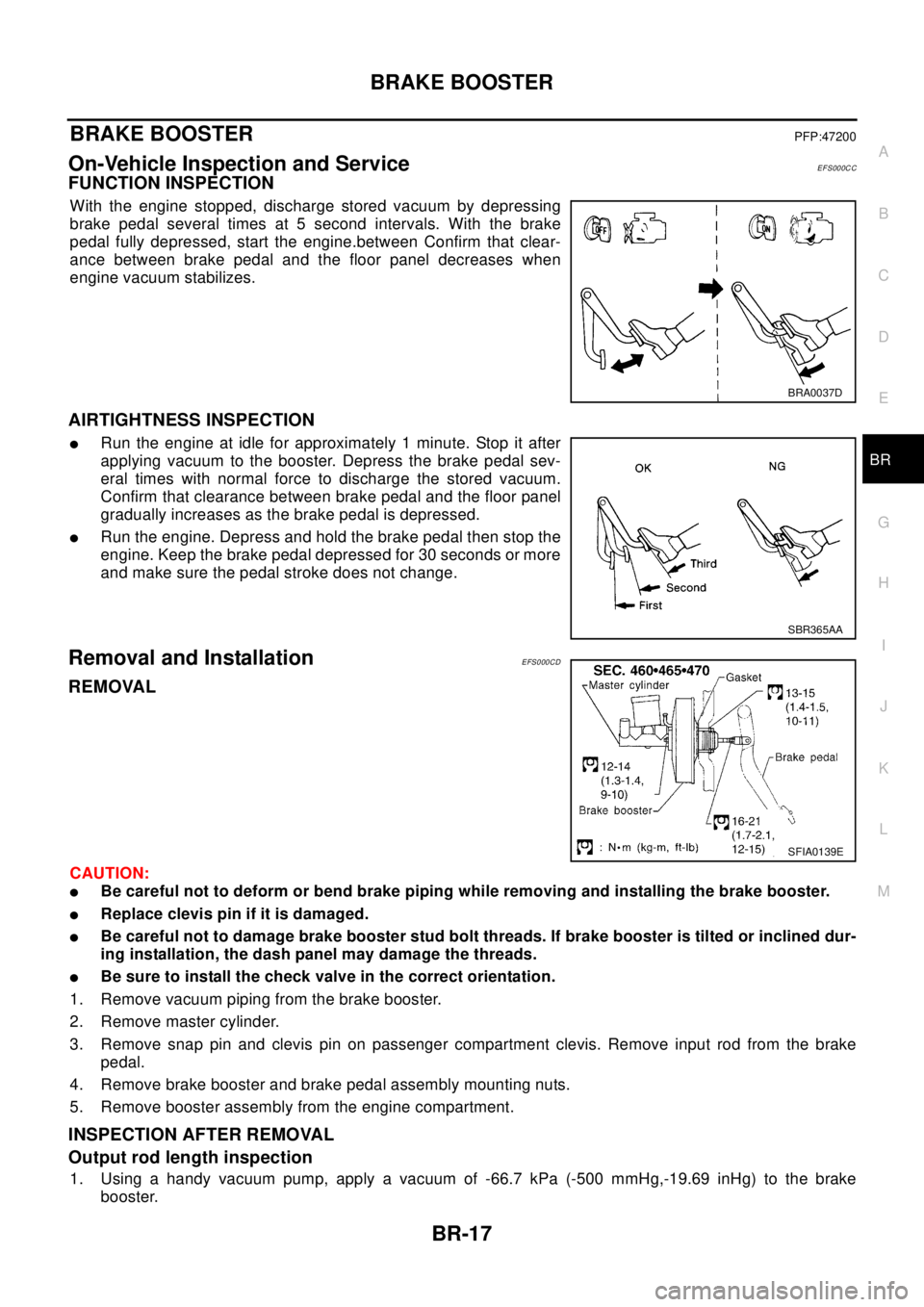
With the engine stopped, discharge stored vacuum by depressing
brake pedal several times at 5 second intervals. With the brake
pedal fully depressed, start the engine.between Confirm that clear-
ance between brake pedal and the floor panel decreases when
engine vacuum stabilizes.
AIRTIGHTNESS INSPECTION
lRun the engine at idle for approximately 1 minute. Stop it after
applying vacuum to the booster. Depress the brake pedal sev-
eral times with normal force to discharge the stored vacuum.
Confirm that clearance between brake pedal and the floor panel
gradually increases as the brake pedal is depressed.
lRun the engine. Depress and hold the brake pedal then stop the
engine. Keep the brake pedal depressed for 30 seconds or more
and make sure the pedal stroke does not change.
Removal and InstallationEFS000CD
REMOVAL
CAUTION:
lBe careful not to deform or bend brake piping while removing and installing the brake booster.
lReplace clevis pin if it is damaged.
lBe careful not to damage brake booster stud bolt threads. If brake booster is tilted or inclined dur-
ing installation, the dash panel may damage the threads.
lBe sure to install the check valve in the correct orientation.
1. Remove vacuum piping from the brake booster.
2. Remove master cylinder.
3. Remove snap pin and clevis pin on passenger compartment clevis. Remove input rod from the brake
pedal.
4. Remove brake booster and brake pedal assembly mounting nuts.
5. Remove booster assembly from the engine compartment.
INSPECTION AFTER REMOVAL
Output rod length inspection
1. Using a handy vacuum pump, apply a vacuum of -66.7 kPa (-500 mmHg,-19.69 inHg) to the brake
booster.
BRA0037D
SBR365AA
SFIA0139E
Page 854 of 3066
BR-20
VACUUM LINES
CHECK VALVE INSPECTION
Quick Inspection
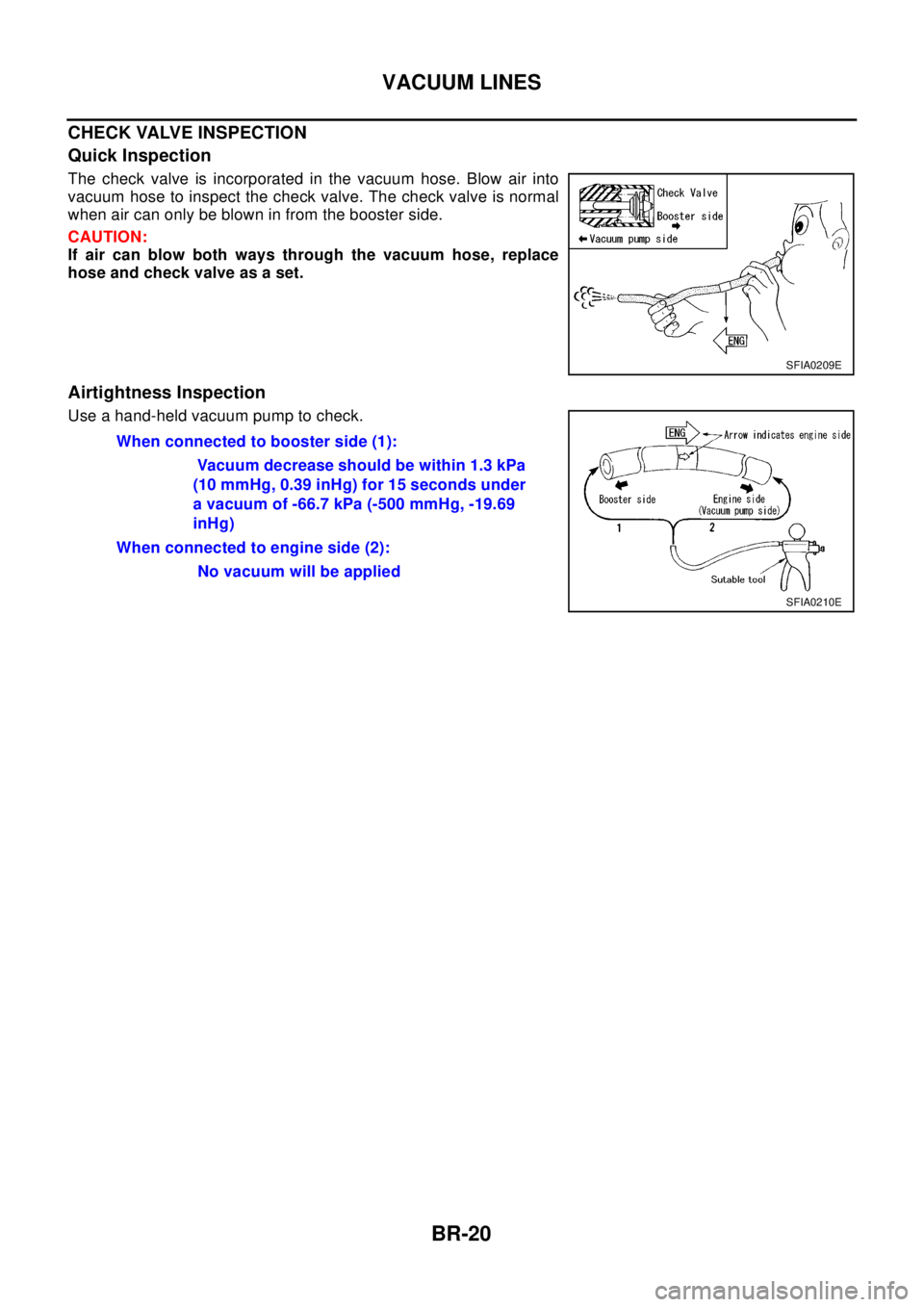
The check valve is incorporated in the vacuum hose. Blow air into
vacuum hose to inspect the check valve. The check valve is normal
when air can only be blown in from the booster side.
CAUTION:
If air can blow both ways through the vacuum hose, replace
hose and check valve as a set.
Airtightness Inspection
Use a hand-held vacuum pump to check.
SFIA0209E
When connected to booster side (1):
Vacuum decrease should be within 1.3 kPa
(10 mmHg, 0.39 inHg) for 15 seconds under
a vacuum of -66.7 kPa (-500 mmHg, -19.69
inHg)
When connected to engine side (2):
No vacuum will be applied
SFIA0210E
Page 870 of 3066

BRC-2
ACTUATOR RELAY) TURNS ON/OFF FRE-
QUENTLY ............................................................ 42
ABS warning lamp does not illuminate. (ABS warn-
ing lamp does not come on when the ignition switch
is turned ON.) ......................................................... 42
ABS warning lamp illuminates with ignition ON, but
does not illuminates after a few seconds. (ABS
warning lamp has illuminated.) ............................... 42
4WD warning lamp does not illuminate with ignition
ON. ......................................................................... 43
4WD warning lamp does not go out several seconds
after engine is started. (Drive mode indicator lamp
goes out.) ................................................................ 43
Heavy tight-corner braking symptom occurs when
the vehicle is driven in AUTO mode and the steering
wheel is turned fully to either side after the engine
is started. ................................................................ 44
Drive modes cannot be switched after engine is
started. .................................................................... 45
Wheel driving, 4WD warning lamp flashes rapidly.
(When it flashes for Approx. one minute, then does
not illuminate.) ........................................................ 45
Wheel driving, 4WD warning lamp flashes slowly.
(When it continues to illuminate until engine turns
OFF.) ....................................................................... 45
Vehicle does not enter 4WD mode even though
4WD warning lamp is off. ........................................ 46
Tight-corner braking symptom occurs when the
vehicle is started in AUTO mode (4WD warning lamp
remain OFF). .......................................................... 46
E-TS actuator relay (4WD solenoid actuator relay)
turns ON/OFF frequently. ........................................ 46
Inspection of drive mode change-over switch path... 47
WHEEL SENSORS ................................................... 48
Removal and Installation ........................................ 48
G-SENSOR (4WD MODEL ONLY) ............................ 49
Removal and Installation ........................................ 49
SENSOR ROTOR ...................................................... 50
Removal and Installation ........................................ 50
REMOVAL ........................................................... 50
INSTALLATION .................................................... 50
ACTUATOR ............................................................... 51
Removal and Installation ........................................ 51
REMOVAL ........................................................... 51
INSTALLATION .................................................... 51
ESP/TCS/ABS
PRECAUTIONS ......................................................... 52
Precautions for Supplemental Restraint System
(SRS) “AIR BAG” and “SEAT BELT PRE-TEN-
SIONER” ................................................................. 52
Precautions for Brake System ................................ 52
Precautions for Brake Control ................................ 52
Precautions for CAN System .................................. 53
FOR INSPECTION .............................................. 53
FOR HARNESS REPAIR .................................... 53ON-VEHICLE SERVICE ............................................54
Adjustment of Neutral Position of Steering Angle
Sensor .....................................................................54
GENERAL INFORMATION .......................................56
Fail-Safe ..................................................................56
ABS SYSTEM ......................................................56
ESP/TCS SYSTEM ..............................................56
Hydraulic Circuit ......................................................56
ABS Functions ........................................................56
TCS Functions ........................................................57
ESP Functions ........................................................57
System Diagram .....................................................58
CAN COMMUNICATION ...........................................59
System Description .................................................59
FOR M/T MODELS ..............................................59
TROUBLE DIAGNOSIS ............................................60
How to Perform Trouble Diagnoses for Quick and
Accurate Repair ......................................................60
INTRODUCTION .................................................60
WORK FLOW ......................................................61
ASKING COMPLAINTS .......................................62
EXAMPLE OF DIAGNOSIS SHEET ....................62
Component Parts and Harness Connector Location... 63
Schematic ...............................................................64
Wiring Diagram —ESP/TCS/ABS— .....................65
Control Unit Input/Output Signal Standard ..............71
STANDARDS USING A CIRCUIT TESTER AND
OSCILLOSCOPE .................................................71
STANDARDS WITH CONSULT-II ........................75
Functions of CONSULT-II .......................................77
CONSULT-II MAINLY FUNCTION APPLICA-
TION TO ESP/TCS/ABS ......................................77
SELF-DIAGNOSIS ...............................................78
DATA MONITOR ..................................................81
ACTIVE TEST ......................................................84
For Correct and Quick Diagnosis ............................88
PRECAUTIONS FOR TROUBLE DIAGNOSIS ... 88
Basic Inspection ......................................................89
PRELIMINARY CHECK 1: (BRAKE FLUID
LEVEL AND LEAK INSPECTION) .......................89
PRELIMINARY CHECK 2: (INSPECTION FOR
LOOSE POWER SUPPLY TERMINAL) ...............89
PRELIMINARY CHECK 3: (INSPECTION FOR
ABS WARNING LAMP, ESP OFF INDICATOR
LAMP, AND SLIP INDICATOR LAMP) .................89
Inspection 1 Wheel Speed Sensor and Circuit .......90
Inspection 2 Engine System ...................................92
Inspection 3 ESP/TCS/ABS Control Unit System ...92
Inspection 4 Pressure Sensor and the Circuit
between Pressure Sensor and ESP/TCS/ABS Con-
trol Unit. ...................................................................93
Inspection 5 Steering Angle Sensor and the Circuit
between Steering Angle Sensor and ESP/TCS/ABS
Control Unit. ............................................................94
Inspection 6 Yaw Rate Sensor/ Side G sensor and
the Circuit between Yaw Rate Sensor/ Side G sen-
sor and ESP/TCS/ABS Control Unit. ......................95
Inspection 7 Solenoid Valve, ESP Switch-over Sole-