2003 NISSAN SENTRA coolant temperature
[x] Cancel search: coolant temperaturePage 45 of 224

2 Instruments and controls
Instrument panel...................................2-2
Meters and gauges................................2-3
Speedometer and odometer.....................2-3
Tachometer (if so equipped).....................2-4
Engine coolant temperature gauge...............2-5
Fuel gauge....................................2-5
Warning/indicator lights and audible reminders.......2-7
Checking bulbs................................2-7
Warning lights.................................2-7
Indicator lights.................................2-9
Audible reminders.............................2-10
Security systems.................................2-11
Nissan vehicle immobilizer system (NVIS)
(if so equipped)...............................2-11
Vehicle security system (if so equipped)..........2-12
Windshield wiper and washer switch...............2-15
Switch operation..............................2-15
Rear window defroster switch......................2-16
Headlight and turn signal switch....................2-16
Headlight control switch........................2-17Fog light switch (if so equipped)...................2-18
Hazard warning flasher switch.....................2-19
Horn............................................2-19
Power outlet.....................................2-20
Storage.........................................2-21
Sunglasses holder (if so equipped)..............2-21
Cup holders..................................2-21
Glove box....................................2-22
Coin box.....................................2-22
Console box (if so equipped)...................2-23
Instrument panel storage (if so equipped)........2-23
Windows........................................2-24
Power windows (if so equipped)................2-24
Manual windows..............................2-26
Sunroof (if so equipped)...........................2-26
Electric sunroof...............................2-26
Interior light......................................2-27
Map lights (if so equipped)........................2-28
Trunk light.......................................2-28
ZREVIEW COPY:Ð2003 Sentra(b15)
Owners Manual(owners)ÐUSA English(nna)
12/10/02Ðdebbie
X
Page 49 of 224
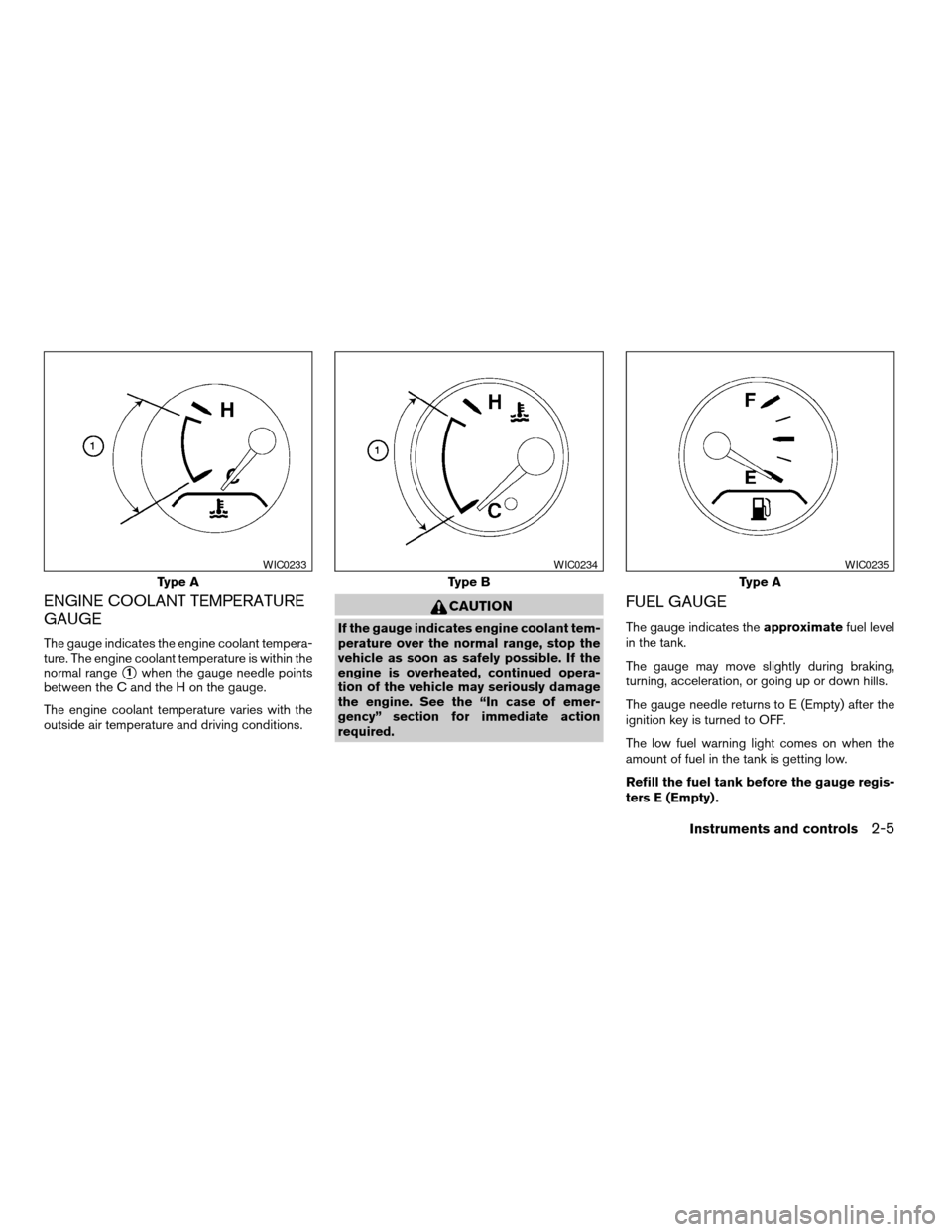
ENGINE COOLANT TEMPERATURE
GAUGE
The gauge indicates the engine coolant tempera-
ture. The engine coolant temperature is within the
normal range
s1when the gauge needle points
between the C and the H on the gauge.
The engine coolant temperature varies with the
outside air temperature and driving conditions.
CAUTION
If the gauge indicates engine coolant tem-
perature over the normal range, stop the
vehicle as soon as safely possible. If the
engine is overheated, continued opera-
tion of the vehicle may seriously damage
the engine. See the “In case of emer-
gency” section for immediate action
required.
FUEL GAUGE
The gauge indicates theapproximatefuel level
in the tank.
The gauge may move slightly during braking,
turning, acceleration, or going up or down hills.
The gauge needle returns to E (Empty) after the
ignition key is turned to OFF.
The low fuel warning light comes on when the
amount of fuel in the tank is getting low.
Refill the fuel tank before the gauge regis-
ters E (Empty) .
Type A
WIC0233
Type B
WIC0234
Type A
WIC0235
Instruments and controls2-5
ZREVIEW COPY:Ð2003 Sentra(b15)
Owners Manual(owners)ÐUSA English(nna)
12/10/02Ðdebbie
X
Page 94 of 224

4. Push thebutton. The indicator light
comes on.
5. Turn the temperature control dial to the de-
sired position.
Dehumidified defogging
This mode is used to defog the windows and
dehumidify the air.
1. Turn the air flow control dial to the
position.
2. Turn the fan control dial to the desired posi-
tion.
3. Push on the air conditioner button. The indi-
cator light comes on.
When the
,or positions in between
are selected, the air conditioner automatically
turns on (however, the indicator light will not
illuminate) if the outside temperature is more than
45°F (7°C) . The air conditioning system will con-
tinue to operate until the vehicle is shut OFF, even
if the air flow control dial is turned to a position
other than the
position. This dehumidifies
the air which helps defog the windshield.
The
mode automatically turns off, allowing
outside air to be drawn into the passenger com-
partment to further improve the defogging perfor-
mance.4. Turn the temperature control dial to the de-
sired position.
Operating tips
cKeep the windows and sunroof closed while
the air conditioner is in operation.
cAfter parking in the sun, drive for 2 or 3 min-
utes with the windows open to vent hot air
from the passenger compartment. Then, close
the windows. This allows the air conditioner to
cool the interior more quickly.
cThe air conditioning system should be
operated for approximately 10 minutes
at least once a month. This helps prevent
damage to the system due to lack of
lubrication.
cIf the engine coolant temperature gauge
indicates engine coolant temperature
over the normal range, turn the air con-
ditioner off. See “If your vehicle over-
heats” in the “In case of emergency”
section of this manual.
AIR FLOW CHARTS
The following charts show the button and dial
positions forMAXIMUM AND QUICKheating,
cooling or defrosting.The air recirculation
button should always be in the OFF posi-
tion for heating and defrosting.
4-6Heater, air conditioner and audio systems
ZREVIEW COPY:Ð2003 Sentra(b15)
Owners Manual(owners)ÐUSA English(nna)
12/10/02Ðdebbie
X
Page 140 of 224
If your vehicle is overheating (indicated by an
extremely high temperature gauge reading) , or if
you feel a lack of engine power, detect abnormal
noise, etc. take the following steps.
WARNING
cDo not continue to drive if your vehicle
overheats. Doing so could cause a ve-
hicle fire.
cTo avoid the danger of being scalded,
never remove the radiator cap while the
engine is still hot. When the radiator
cap is removed, pressurized hot water
will spurt out, possibly causing serious
injury.
cDo not open the hood if steam is com-
ing out.
1. Move the vehicle safely off the road, apply
the parking brake and move the shift lever to
N (Neutral) (manual transmission) or to P
(Park) (automatic transmission) .
Do not stop the engine.
2. Turn off the air conditioner (if so equipped) .
Open all the windows, move the heater or air
conditioner temperature control to maximum
hot and fan control to high speed.3. Get out of the vehicle. Look and listen for
steam or coolant escaping from the radiator
before opening the hood. (If steam or cool-
ant is escaping, turn off the engine.) Wait
until no steam or coolant can be seen before
proceeding.
4. Open the engine hood.
WARNING
If steam or water is coming from the en-
gine, stand clear to prevent getting
burned.
5. Visually check drive belts for damage or
looseness. Also check if the cooling fan is
running. The radiator hoses and radiator
should not leak water. If coolant is leaking,
the water pump belt is missing or loose, or
the cooling fan does not run, stop the en-
gine.
WARNING
Be careful not to allow your hands, hair,
jewelry or clothing to come into contact
with, or get caught in, engine belts or the
engine cooling fan. The engine cooling
fan can start at any time when the coolant
temperature is high.6. After the engine cools down, check the cool-
ant level in the reservoir tank with the engine
running. Add coolant to the reservoir tank if
necessary. Have your vehicle repaired at a
NISSAN dealer.
IF YOUR VEHICLE OVERHEATS
6-10In case of emergency
ZREVIEW COPY:Ð2003 Sentra(b15)
Owners Manual(owners)ÐUSA English(nna)
12/20/02Ðcathy
X
Page 149 of 224

8 Maintenance and do-it-yourself
Maintenance requirements..........................8-2
General maintenance..............................8-2
Explanation of general maintenance items.........8-2
Maintenance precautions...........................8-5
Engine compartment check locations................8-7
Engine cooling system.............................8-9
Checking engine coolant level...................8-9
Changing engine coolant.......................8-10
Engine oil........................................8-12
Checking engine oil level.......................8-12
Changing engine oil...........................8-13
Changing engine oil filter.......................8-14
Automatic transmission fluid.......................8-15
Temperature conditions for checking.............8-16
Power steering fluid...............................8-18
Brake and clutch fluid.............................8-18
Brake fluid....................................8-19
Clutch fluid...................................8-19
Window washer fluid.............................8-20
Window washer fluid reservoir..................8-20
Battery..........................................8-20
Jump starting.................................8-22
Drive belts.......................................8-22
Spark plugs......................................8-23Replacing spark plugs.........................8-23
Air cleaner.......................................8-24
In-cabin Microfilter (if so equipped)..............8-25
Windshield wiper blades..........................8-28
Cleaning.....................................8-28
Replacing....................................8-28
Parking brake and brake pedal.....................8-29
Checking parking brake........................8-29
Checking brake pedal..........................8-29
Brake booster.................................8-30
Fuses...........................................8-31
Engine compartment...........................8-31
Passenger compartment.......................8-32
Keyfob battery replacement........................8-33
Lights...........................................8-34
Headlights....................................8-34
Fog lights (if so equipped)......................8-35
Exterior and interior lights.......................8-36
Wheels and tires.................................8-39
Tire pressure..................................8-39
Types of tires..................................8-40
Tire chains....................................8-41
Changing wheels and tires.....................8-42
ZREVIEW COPY:Ð2003 Sentra(b15)
Owners Manual(owners)ÐUSA English(nna)
12/20/02Ðcathy
X
Page 152 of 224

Parking brake*Check that the lever has the
proper travel and confirm that your vehicle is held
securely on a fairly steep hill with only the parking
brake applied.
Automatic transmission P (Park) position
mechanismCheck that the lock release button
on the shift selector lever operates properly and
smoothly. On a fairly steep hill check that your
vehicle is held securely with the selector lever in
the P position without applying any brakes.
Under the hood and vehicle
The maintenance items listed here should be
checked periodically (for example, each time you
check the engine oil or refuel) .
Windshield washer fluid*Check that there is
adequate fluid in the reservoir.
Engine oil level*Check the level after parking
the vehicle on a level surface with the engine off.
Wait more than 10 minutes for the oil to drain
back into the oil pan.
Brake and clutch fluid levels*Make sure that
the brake and clutch fluid level is between the
MIN and MAX lines on the reservoir.
Power steering fluid level* and linesCheck
the level when the fluid is cold, with the engine
off. Check the lines for proper attachment, leaks,
cracks, etc.Automatic transmission fluid level*Check
the level after putting the selector lever in P with
the engine idling at operating temperature.
Engine coolant level*Check the coolant level
when the engine is cold.
Radiator and hosesCheck the front of the
radiator and clean off any dirt, insects, leaves,
etc., that may have accumulated. Make sure the
hoses have no cracks, deformation, rot or loose
connections.
Engine drive belts*Make sure the drive belts
are not frayed, worn, cracked or oily.
Battery*Check the fluid level in each cell. It
should be between the MAX and MIN lines. Ve-
hicles operated in high temperatures or under
severe conditions require frequent checks of the
battery fluid level.
Exhaust systemMake sure there are no loose
supports, cracks or holes. If the sound of the
exhaust seems unusual or there is a smell of
exhaust fumes, immediately have the exhaust
system inspected by a NISSAN dealer. See the
carbon monoxide warning in the “Starting and
driving” section of this manual.
UnderbodyThe underbody is frequently ex-
posed to corrosive substances such as those
used on icy roads or to control dust. It is very
important to remove these substances from theunderbody, otherwise rust may form on the floor
pan, frame, fuel lines and exhaust system. At the
end of winter, the underbody should be thor-
oughly flushed with plain water, in those areas
where mud and dirt may have accumulated. See
the “Appearance and care” section of this
manual.
Fluid leaksCheck under the vehicle for fuel, oil,
water or other fluid leaks after the vehicle has
been parked for a while. Water dripping from the
air conditioner after use is normal. If you should
notice any leaks or if gasoline fumes are evident,
check for the cause and have it corrected imme-
diately.
8-4Maintenance and do-it-yourself
ZREVIEW COPY:Ð2003 Sentra(b15)
Owners Manual(owners)ÐUSA English(nna)
12/20/02Ðcathy
X
Page 157 of 224
The engine cooling system is filled at the factory
with a high-quality, year-round, anti-freeze cool-
ant solution. The anti-freeze solution contains
rust and corrosion inhibitors; therefore, additional
engine cooling system additives are not neces-
sary.
WARNING
cNever remove the radiator cap when the
engine is hot. Serious burns could be
caused by high pressure fluid escaping
from the radiator.
cThe radiator is equipped with a pres-
sure type radiator cap. To prevent en-
gine damage, use only a genuine
NISSAN radiator cap.
Outside temperature
down toGenuine
NISSAN
Anti-freeze
coolant or
equivalentDemineral-
ized or dis-
tilled water
°C °F
-35 -30 50% 50%
CAUTION
When adding or replacing coolant, be sure
to use only a Genuine Nissan Anti-Freeze
coolant (green) or equivalent with the
proper mixture ratio of 50% anti-freeze
and 50% demineralized or distilled water.
The use of other types of coolant solu-
tions or coolant colors, such as orange,
may damage the engine cooling system.
CHECKING ENGINE COOLANT
LEVEL
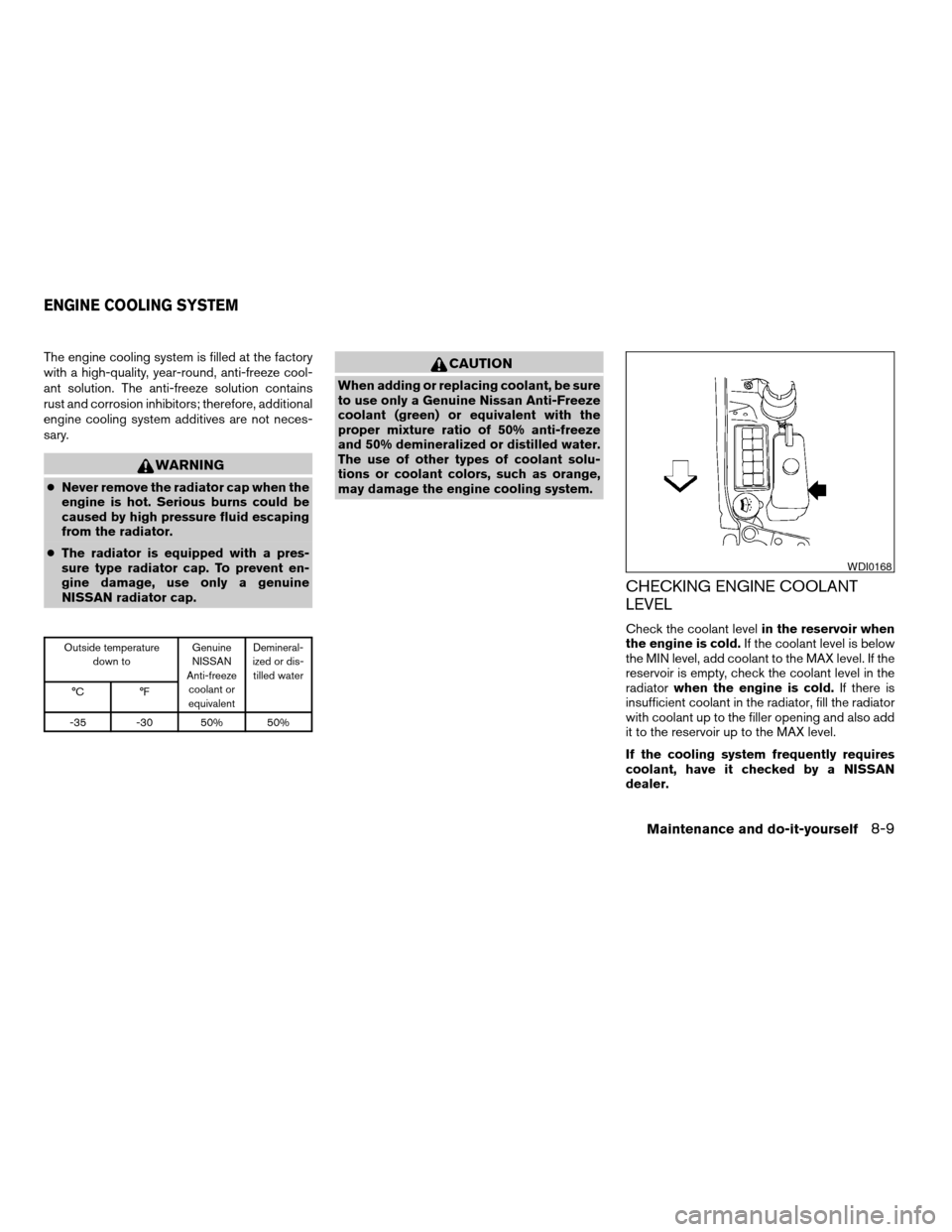
Check the coolant levelin the reservoir when
the engine is cold.If the coolant level is below
the MIN level, add coolant to the MAX level. If the
reservoir is empty, check the coolant level in the
radiatorwhen the engine is cold.If there is
insufficient coolant in the radiator, fill the radiator
with coolant up to the filler opening and also add
it to the reservoir up to the MAX level.
If the cooling system frequently requires
coolant, have it checked by a NISSAN
dealer.
WDI0168
ENGINE COOLING SYSTEM
Maintenance and do-it-yourself8-9
ZREVIEW COPY:Ð2003 Sentra(b15)
Owners Manual(owners)ÐUSA English(nna)
12/20/02Ðcathy
X
Page 159 of 224

2. Open the drain plug on the engine block.
3. Open the radiator cap to drain the coolant.
cWaste coolant must be disposed of prop-
erly.
cCheck your local regulations.
4. Flush the cooling system by running fresh
water through the radiator.
5. Close the drain plugs on the radiator and the
engine block securely.6. See the “Technical and consumer informa-
tion” section for cooling system capacity. Fill
the radiator slowly with the proper mixture of
coolant and water. Fill the reservoir tank up
to the MAX level.
7. For QG18DE engine only, open and close
the air release plug(s) to release air. Then fill
the radiator again and install the radiator
cap.8. Start the engine, and warm it up until it
reaches normal operating temperature.
Then race the engine two or three times
under no load. Watch the engine coolant
temperature gauge for signs of overheating.
9. Stop the engine. After it completely cools
down, refill the radiator up to the filler open-
ing. Fill the reservoir tank up to the MAX
level.
10. For QG18DE engine only, open and close
the air release plug(s) to release air. Then fill
the radiator again and install the radiator
cap.
11. Check the drain plugs on the radiator and
the engine block for any sign of leakage. For
QG18DE only, also check the air release
plug for any sign of leakage.
QG18DE engine
WDI0171
QG18DE engine
WDI0172
Maintenance and do-it-yourself8-11
ZREVIEW COPY:Ð2003 Sentra(b15)
Owners Manual(owners)ÐUSA English(nna)
12/20/02Ðcathy
X