2003 NISSAN SENTRA brake
[x] Cancel search: brakePage 194 of 224
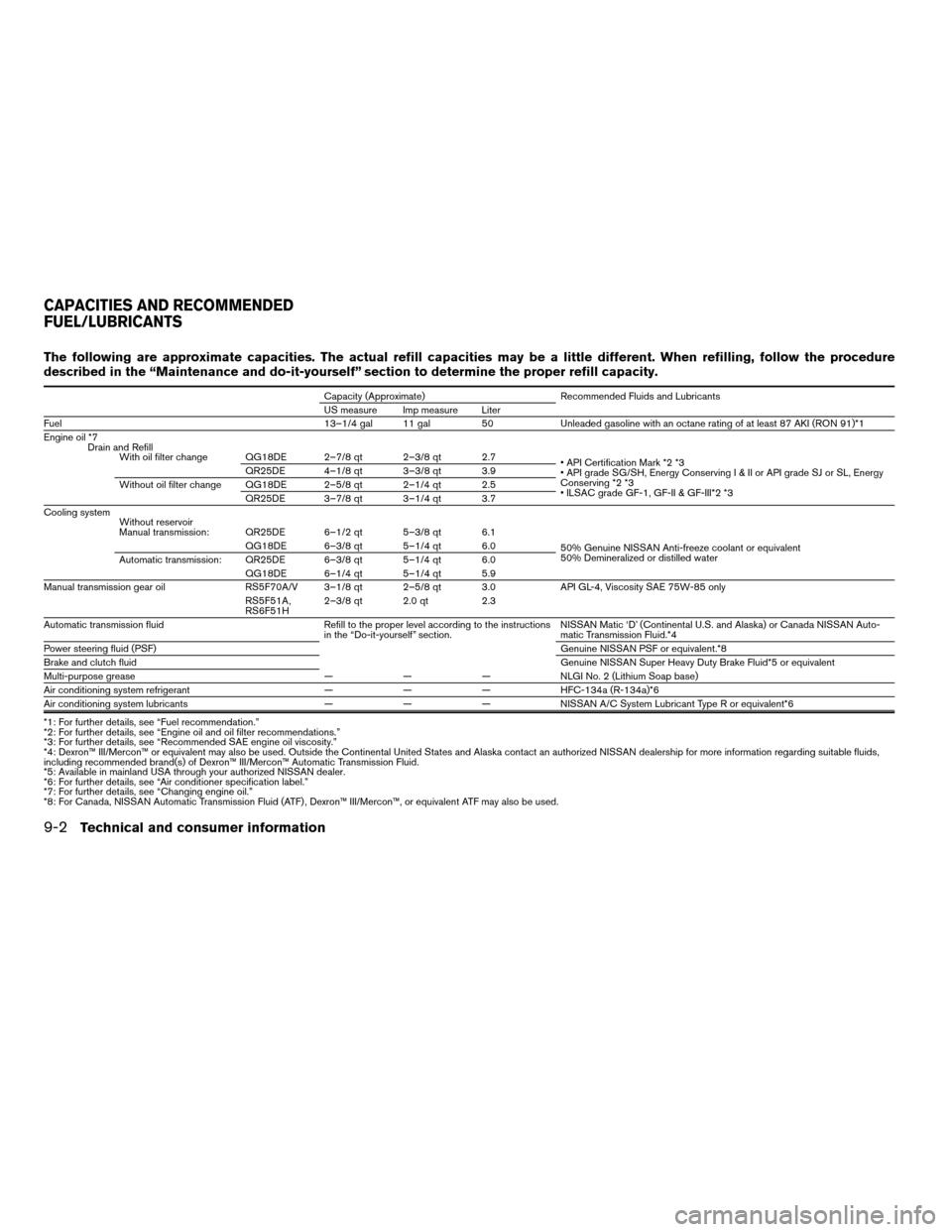
The following are approximate capacities. The actual refill capacities may be a little different. When refilling, follow the procedure
described in the “Maintenance and do-it-yourself” section to determine the proper refill capacity.
Capacity (Approximate) Recommended Fluids and Lubricants
US measure Imp measure Liter
Fuel 13–1/4 gal 11 gal 50 Unleaded gasoline with an octane rating of at least 87 AKI (RON 91)*1
Engine oil *7
Drain and Refill
With oil filter change QG18DE 2–7/8 qt 2–3/8 qt 2.7
• API Certification Mark *2 *3
• API grade SG/SH, Energy ConservingI&IIorAPIgrade SJ or SL, Energy
Conserving *2 *3
• ILSAC grade GF-1, GF-II & GF-III*2 *3 QR25DE 4–1/8 qt 3–3/8 qt 3.9
Without oil filter change QG18DE 2–5/8 qt 2–1/4 qt 2.5
QR25DE 3–7/8 qt 3–1/4 qt 3.7
Cooling system
Without reservoir
Manual transmission: QR25DE 6–1/2 qt 5–3/8 qt 6.1
50% Genuine NISSAN Anti-freeze coolant or equivalent
50% Demineralized or distilled water QG18DE 6–3/8 qt 5–1/4 qt 6.0
Automatic transmission: QR25DE 6–3/8 qt 5–1/4 qt 6.0
QG18DE 6–1/4 qt 5–1/4 qt 5.9
Manual transmission gear oil RS5F70A/V 3–1/8 qt 2–5/8 qt 3.0 API GL-4, Viscosity SAE 75W-85 only
RS5F51A,
RS6F51H2–3/8 qt 2.0 qt 2.3
Automatic transmission fluid Refill to the proper level according to the instructions
in the “Do-it-yourself” section.NISSAN Matic ‘D’ (Continental U.S. and Alaska) or Canada NISSAN Auto-
matic Transmission Fluid.*4
Power steering fluid (PSF)Genuine NISSAN PSF or equivalent.*8
Brake and clutch fluidGenuine NISSAN Super Heavy Duty Brake Fluid*5 or equivalent
Multi-purpose grease———NLGINo.2(Lithium Soap base)
Air conditioning system refrigerant— — — HFC-134a (R-134a)*6
Air conditioning system lubricants— — — NISSAN A/C System Lubricant Type R or equivalent*6
*1: For further details, see “Fuel recommendation.”
*2: For further details, see “Engine oil and oil filter recommendations.”
*3: For further details, see “Recommended SAE engine oil viscosity.”
*4: Dexron™ III/Mercon™ or equivalent may also be used. Outside the Continental United States and Alaska contact an authorized NISSAN dealership formore information regarding suitable fluids,
including recommended brand(s) of Dexron™ III/Mercon™ Automatic Transmission Fluid.
*5: Available in mainland USA through your authorized NISSAN dealer.
*6: For further details, see “Air conditioner specification label.”
*7: For further details, see “Changing engine oil.”
*8: For Canada, NISSAN Automatic Transmission Fluid (ATF) , Dexron™ III/Mercon™, or equivalent ATF may also be used.
CAPACITIES AND RECOMMENDED
FUEL/LUBRICANTS
9-2Technical and consumer information
ZREVIEW COPY:Ð2003 Sentra(b15)
Owners Manual(owners)ÐUSA English(nna)
12/20/02Ðcathy
X
Page 207 of 224
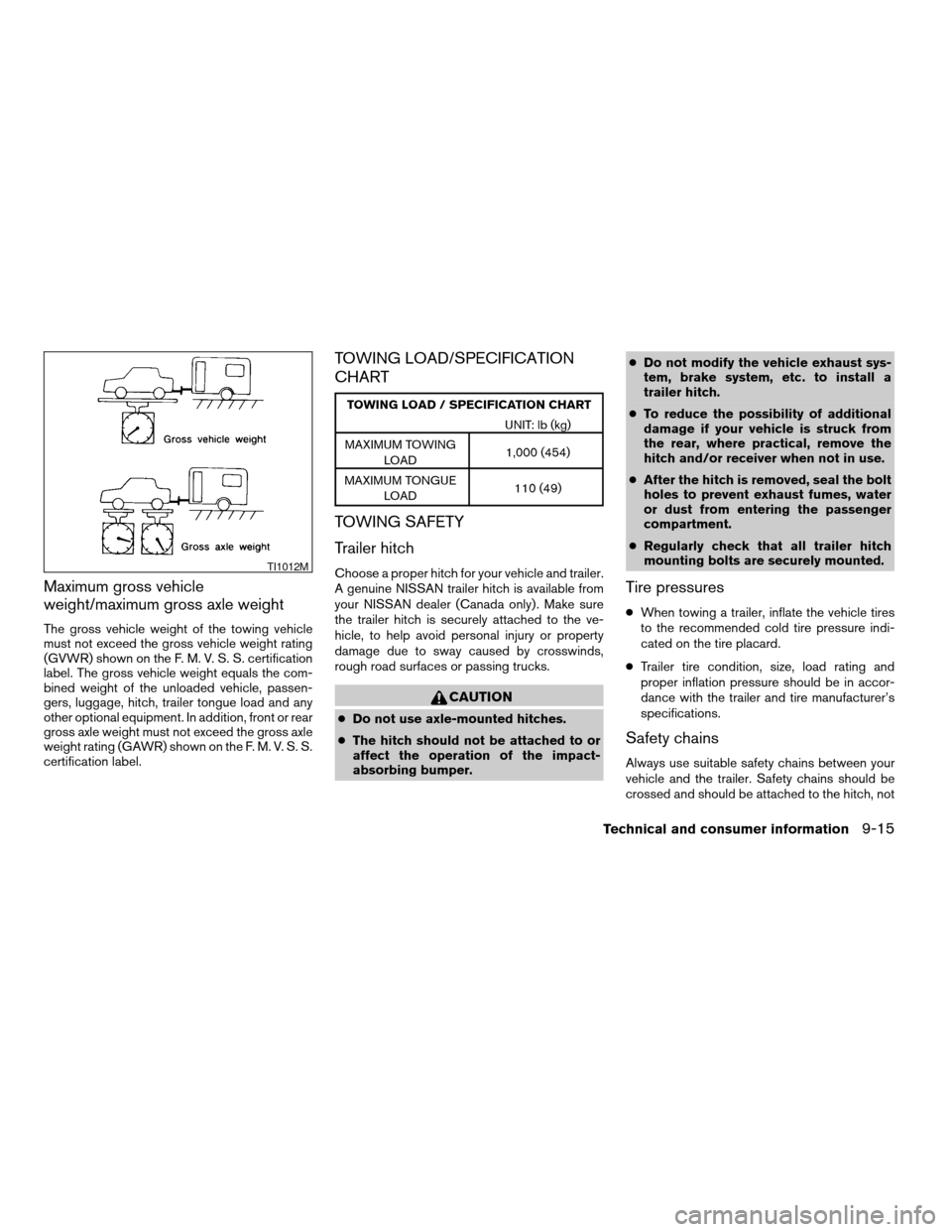
Maximum gross vehicle
weight/maximum gross axle weight
The gross vehicle weight of the towing vehicle
must not exceed the gross vehicle weight rating
(GVWR) shown on the F. M. V. S. S. certification
label. The gross vehicle weight equals the com-
bined weight of the unloaded vehicle, passen-
gers, luggage, hitch, trailer tongue load and any
other optional equipment. In addition, front or rear
gross axle weight must not exceed the gross axle
weight rating (GAWR) shown on the F. M. V. S. S.
certification label.
TOWING LOAD/SPECIFICATION
CHART
TOWING LOAD / SPECIFICATION CHART
UNIT: lb (kg)
MAXIMUM TOWING
LOAD1,000 (454)
MAXIMUM TONGUE
LOAD110 (49)
TOWING SAFETY
Trailer hitch
Choose a proper hitch for your vehicle and trailer.
A genuine NISSAN trailer hitch is available from
your NISSAN dealer (Canada only) . Make sure
the trailer hitch is securely attached to the ve-
hicle, to help avoid personal injury or property
damage due to sway caused by crosswinds,
rough road surfaces or passing trucks.
CAUTION
cDo not use axle-mounted hitches.
cThe hitch should not be attached to or
affect the operation of the impact-
absorbing bumper.cDo not modify the vehicle exhaust sys-
tem, brake system, etc. to install a
trailer hitch.
cTo reduce the possibility of additional
damage if your vehicle is struck from
the rear, where practical, remove the
hitch and/or receiver when not in use.
cAfter the hitch is removed, seal the bolt
holes to prevent exhaust fumes, water
or dust from entering the passenger
compartment.
cRegularly check that all trailer hitch
mounting bolts are securely mounted.
Tire pressures
cWhen towing a trailer, inflate the vehicle tires
to the recommended cold tire pressure indi-
cated on the tire placard.
cTrailer tire condition, size, load rating and
proper inflation pressure should be in accor-
dance with the trailer and tire manufacturer’s
specifications.
Safety chains
Always use suitable safety chains between your
vehicle and the trailer. Safety chains should be
crossed and should be attached to the hitch, not
TI1012M
Technical and consumer information9-15
ZREVIEW COPY:Ð2003 Sentra(b15)
Owners Manual(owners)ÐUSA English(nna)
12/20/02Ðcathy
X
Page 208 of 224
to the vehicle bumper or axle. Be sure to leave
enough slack in the chains to permit turning
corners.
Trailer lights
Trailer lights should comply with federal and/or
local regulations. When wiring the vehicle for
towing, connect the stop and tail light pickup into
the vehicle electrical circuit.
Trailer brakes
If your trailer is equipped with a braking system,
make sure it conforms to federal and/or local
regulations and that it is properly installed.
WARNING
Never connect a trailer brake system di-
rectly to the vehicle brake system.
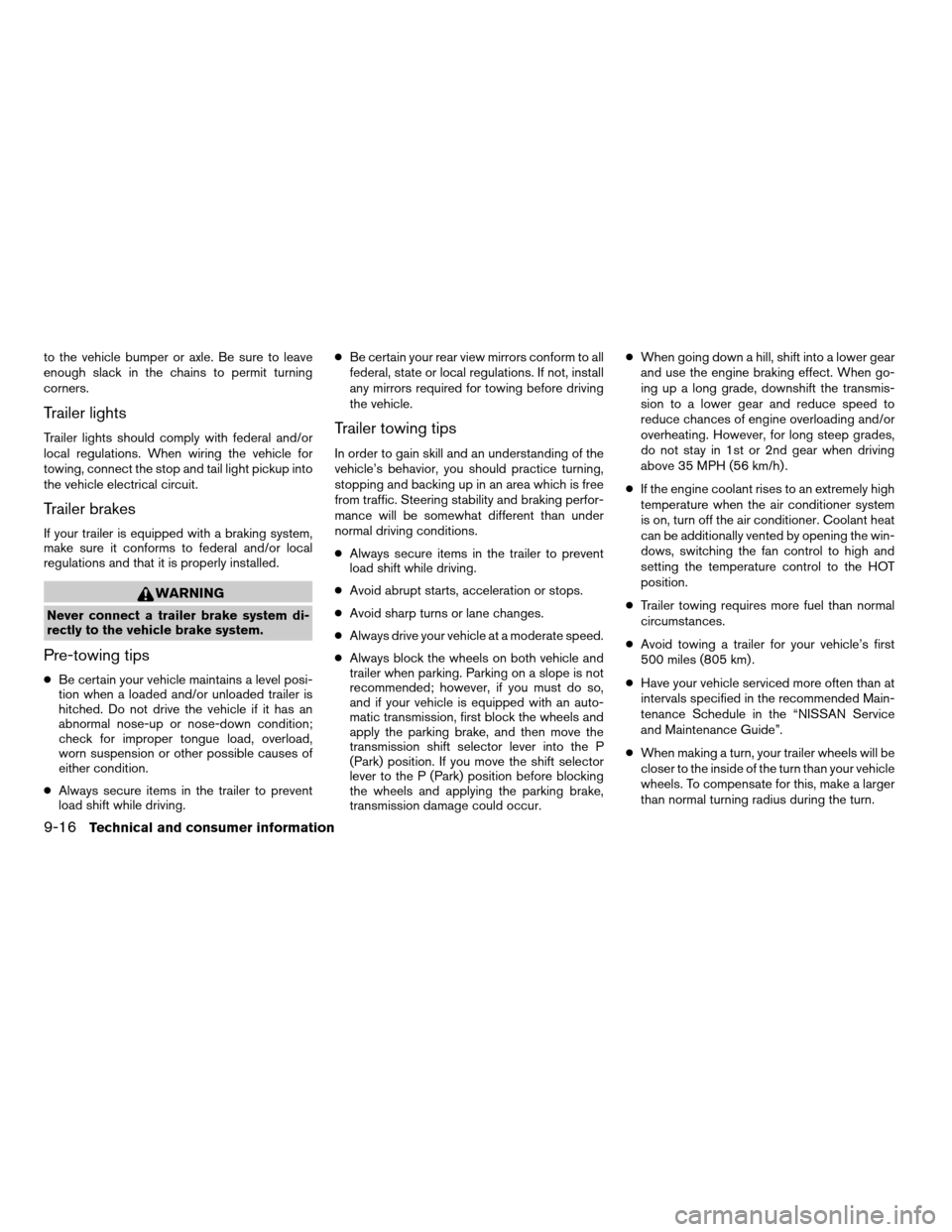
Pre-towing tips
cBe certain your vehicle maintains a level posi-
tion when a loaded and/or unloaded trailer is
hitched. Do not drive the vehicle if it has an
abnormal nose-up or nose-down condition;
check for improper tongue load, overload,
worn suspension or other possible causes of
either condition.
cAlways secure items in the trailer to prevent
load shift while driving.cBe certain your rear view mirrors conform to all
federal, state or local regulations. If not, install
any mirrors required for towing before driving
the vehicle.
Trailer towing tips
In order to gain skill and an understanding of the
vehicle’s behavior, you should practice turning,
stopping and backing up in an area which is free
from traffic. Steering stability and braking perfor-
mance will be somewhat different than under
normal driving conditions.
cAlways secure items in the trailer to prevent
load shift while driving.
cAvoid abrupt starts, acceleration or stops.
cAvoid sharp turns or lane changes.
cAlways drive your vehicle at a moderate speed.
cAlways block the wheels on both vehicle and
trailer when parking. Parking on a slope is not
recommended; however, if you must do so,
and if your vehicle is equipped with an auto-
matic transmission, first block the wheels and
apply the parking brake, and then move the
transmission shift selector lever into the P
(Park) position. If you move the shift selector
lever to the P (Park) position before blocking
the wheels and applying the parking brake,
transmission damage could occur.cWhen going down a hill, shift into a lower gear
and use the engine braking effect. When go-
ing up a long grade, downshift the transmis-
sion to a lower gear and reduce speed to
reduce chances of engine overloading and/or
overheating. However, for long steep grades,
do not stay in 1st or 2nd gear when driving
above 35 MPH (56 km/h) .
cIf the engine coolant rises to an extremely high
temperature when the air conditioner system
is on, turn off the air conditioner. Coolant heat
can be additionally vented by opening the win-
dows, switching the fan control to high and
setting the temperature control to the HOT
position.
cTrailer towing requires more fuel than normal
circumstances.
cAvoid towing a trailer for your vehicle’s first
500 miles (805 km) .
cHave your vehicle serviced more often than at
intervals specified in the recommended Main-
tenance Schedule in the “NISSAN Service
and Maintenance Guide”.
cWhen making a turn, your trailer wheels will be
closer to the inside of the turn than your vehicle
wheels. To compensate for this, make a larger
than normal turning radius during the turn.
9-16Technical and consumer information
ZREVIEW COPY:Ð2003 Sentra(b15)
Owners Manual(owners)ÐUSA English(nna)
12/20/02Ðcathy
X
Page 209 of 224
cCrosswinds and rough roads will adversely
affect vehicle/trailer handling, possibly caus-
ing vehicle sway. When being passed by
larger vehicles, be prepared for possible
changes in crosswinds that could affect ve-
hicle handling. If swaying does occur, firmly
grip the steering wheel, steer straight ahead,
and immediately (but gradually) reduce vehicle
speed. This combination will help stabilize the
vehicle. Never increase speed.
cBe careful when passing other vehicles. Pass-
ing while towing a trailer requires considerably
more distance than normal passing. Remem-
ber, the length of the trailer must also pass the
other vehicle before you can safely change
lanes.
cTo maintain engine braking efficiency and
electrical charging performance, do not use
5th gear (manual transmission) or overdrive
(automatic transmission) .
cAvoid holding the brake pedal down too long
or too frequently. This could cause the brakes
to overheat, resulting in reduced braking effi-
ciency.
When towing a trailer, transmission
oil/fluid should be changed more fre-
quently. For additional information, see the
“Maintenance and do-it-yourself” section
earlier in this manual.DOT (Department of Transportation) Quality
Grades: All passenger car tires must conform to
federal safety requirements in addition to these
grades.
Quality grades can be found where applicable on
the tire sidewall between tread shoulder and
maximum section width. For example:
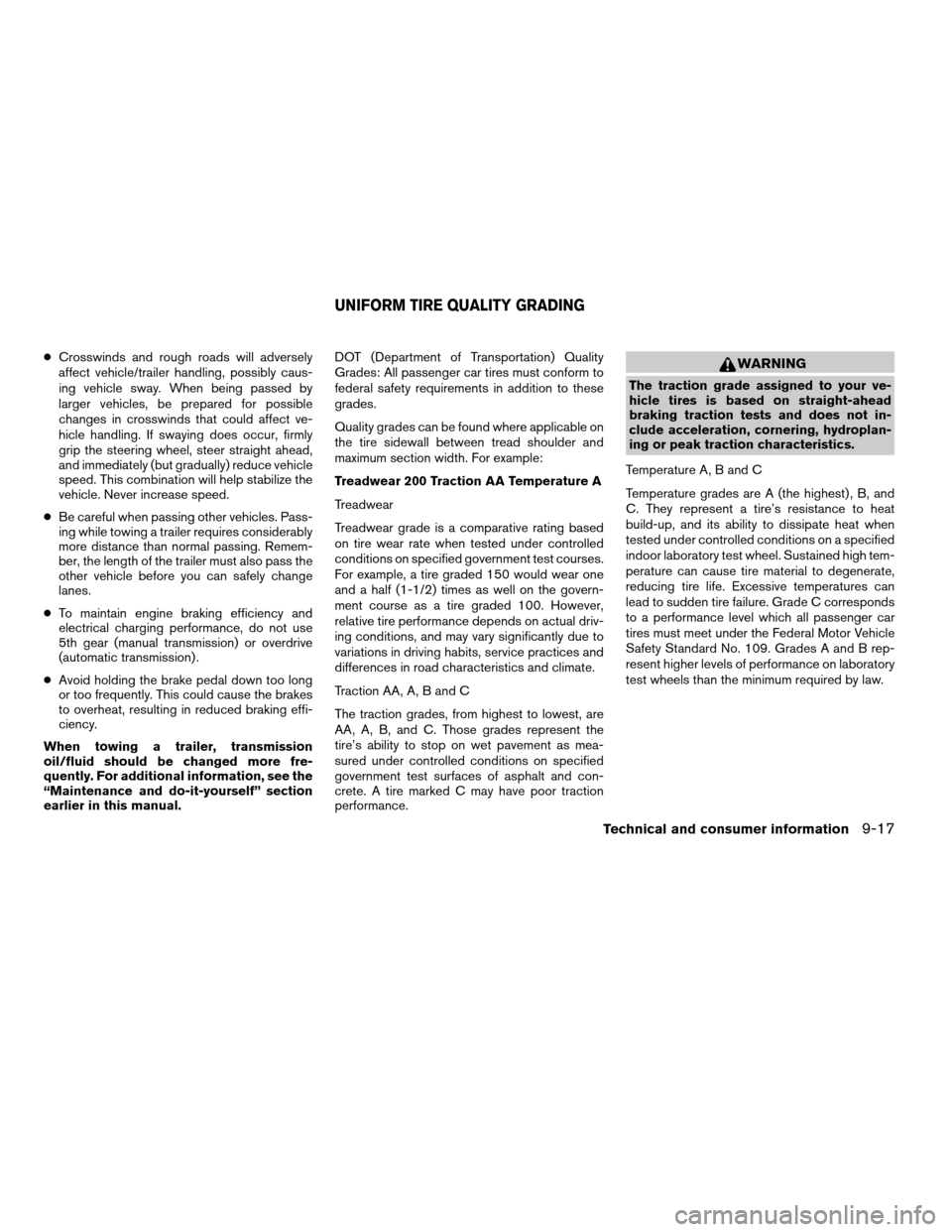
Treadwear 200 Traction AA Temperature A
Treadwear
Treadwear grade is a comparative rating based
on tire wear rate when tested under controlled
conditions on specified government test courses.
For example, a tire graded 150 would wear one
and a half (1-1/2) times as well on the govern-
ment course as a tire graded 100. However,
relative tire performance depends on actual driv-
ing conditions, and may vary significantly due to
variations in driving habits, service practices and
differences in road characteristics and climate.
Traction AA, A, B and C
The traction grades, from highest to lowest, are
AA, A, B, and C. Those grades represent the
tire’s ability to stop on wet pavement as mea-
sured under controlled conditions on specified
government test surfaces of asphalt and con-
crete. A tire marked C may have poor traction
performance.WARNING
The traction grade assigned to your ve-
hicle tires is based on straight-ahead
braking traction tests and does not in-
clude acceleration, cornering, hydroplan-
ing or peak traction characteristics.
Temperature A, B and C
Temperature grades are A (the highest) , B, and
C. They represent a tire’s resistance to heat
build-up, and its ability to dissipate heat when
tested under controlled conditions on a specified
indoor laboratory test wheel. Sustained high tem-
perature can cause tire material to degenerate,
reducing tire life. Excessive temperatures can
lead to sudden tire failure. Grade C corresponds
to a performance level which all passenger car
tires must meet under the Federal Motor Vehicle
Safety Standard No. 109. Grades A and B rep-
resent higher levels of performance on laboratory
test wheels than the minimum required by law.
UNIFORM TIRE QUALITY GRADING
Technical and consumer information9-17
ZREVIEW COPY:Ð2003 Sentra(b15)
Owners Manual(owners)ÐUSA English(nna)
12/20/02Ðcathy
X
Page 215 of 224

10 Index
A
Air bag (See supplemental restraint
system)......................1-6
Air bag warning light...........1-17, 2-9
Air cleaner housing filter............8-24
Air conditioner
Air conditioner operation...........4-5
Air conditioner service............4-9
Air conditioner specification label.....9-11
Air conditioner system refrigerant and
lubrication recommendations........9-6
Heater and air conditioner controls.....4-2
Servicing air conditioner...........4-9
Air flow charts..................4-6
Alarm system
(See vehicle security system).........2-11
Anchor point locations.............1-35
Antenna.....................4-19
Anti-lock brake system (ABS).........5-18
Anti-lock brake warning light..........2-7
Audible reminders................2-10
Audio system..................4-10
Compact Disc (CD) changer.......4-17
Compact disc (CD) player.........4-15
FM-AM radio with compact disc (CD)
player....................4-12
Radio....................4-10
Automatic
Automatic power window switch.....2-25
Automatic transmission fluid (ATF). . . .8-15Driving with automatic transmission.....5-7
Transmission selector lever lock release . .5-9
B
Battery......................8-20
Charge warning light.............2-8
Battery replacement
(See remote keyless entry system).......3-8
Before starting the engine............5-6
Belts (See drive belts).............8-22
Brake
Anti-lock brake system (ABS).......5-18
Brake booster................8-30
Brake fluid..................8-18
Brake light (See stop light).........8-36
Brake pedal.................8-29
Brake system................5-18
Brake warning light..............2-7
Brake wear indicators........2-10, 8-30
Parking brake check............8-29
Parking brake operation..........5-13
Self-adjusting brakes............8-30
Break-in schedule................5-15
Bulb check/instrument panel..........2-7
Bulb replacement................8-36
C
Capacities and recommended fuel/lubricants. .9-2Car phone or CB radio.............4-19
Cargo (See vehicle loading information) . . .9-12
CD changer (See audio system)........4-17
CD player (See audio system).........4-15
Check engine indicator light
(See malfunction indicator light).........2-9
Child restraint with top tether strap......1-34
Child restraints.......1-20, 1-21, 1-25, 1-33
Precautions on child restraints.......1-25
Child safety rear door lock............3-5
Chimes, audible reminders...........2-10
Cleaning exterior and interior..........7-2
Clock......................4-13
Clutch
Clutch fluid.................8-19
Coin box.....................2-22
Cold weather driving..............5-20
Compact disc (CD) player...........4-15
Console box...................2-23
Controls
Heater and air conditioner controls.....4-2
Coolant
Capacities and recommended
fuel/lubricants.................9-2
Changing engine coolant..........8-10
Checking engine coolant level........8-9
Engine coolant temperature gauge.....2-5
Corrosion protection...............7-5
Cruise control..................5-13
Cup holders...................2-21
ZREVIEW COPY:Ð2003 Sentra(b15)
Owners Manual(owners)ÐUSA English(nna)
12/20/02Ðcathy
X
Page 216 of 224

D
Daytime running light system (Canada only). .2-18
Defogger switch
Rear window defogger switch.......2-16
Door locks....................3-3
Door open warning light.............2-8
Drive belts....................8-22
Driving
Cold weather driving............5-20
Driving with automatic transmission.....5-7
Driving with manual transmission.....5-10
Precautions when starting and driving . . .5-2
E
Economy - fuel.................5-15
Emission control information label.......9-11
Emission control system warranty.......9-18
Engine
Before starting the engine..........5-6
Capacities and recommended
fuel/lubricants.................9-2
Changing engine coolant..........8-10
Changing engine oil............8-13
Changing engine oil filter..........8-14
Checking engine coolant level........8-9
Checking engine oil level..........8-12
Engine compartment check locations. . . .8-9
Engine coolant temperature gauge.....2-5
Engine cooling system............8-9
Engine oil..................8-12
Engine oil and oil filter recommendation . .9-5
Engine oil pressure warning light......2-8Engine oil viscosity..............9-5
Engine serial number............9-10
Starting the engine..............5-6
Exhaust gas (Carbon monoxide)........5-2
F
Flashers (See hazard warning
flasher switch)..................2-19
Flat tire......................6-2
Floor mat positioning aid.............7-4
Fluid
Automatic transmission fluid (ATF). . . .8-15
Brake fluid..................8-18
Capacities and recommended
fuel/lubricants.................9-2
Clutch fluid.................8-19
Engine coolant................8-9
Engine oil..................8-12
Power steering fluid.............8-18
Window washer fluid............8-20
F.M.V.S.S. certification label..........9-10
Folding rear seat.................1-4
Front fog light switch..............2-18
Front seats....................1-2
Fuel
Capacities and recommended
fuel/lubricants.................9-2
Fuel economy................5-15
Fuel filler cap................3-12
Fuel filler lid lock opener lever.......3-12
Fuel gauge..................2-5
Fuel octane rating..............9-4
Fuel recommendation............9-3
Fuses......................8-31Fusible links...................8-31
G
Gauge
Engine coolant temperature gauge.....2-5
Fuel gauge..................2-5
Odometer...................2-3
Speedometer.................2-3
Tachometer..................2-4
Trip odometer.................2-4
General maintenance..............8-2
Glove box....................2-22
H
Hazard warning flasher switch.........2-19
Head restraints..................1-5
Headlight aiming adjustment..........8-35
Headlight and turn signal switch........2-16
Headlights....................8-34
Heater
Heater and air conditioner controls.....4-2
Heater operation...............4-4
Hood release...................3-9
Horn.......................2-19
I
Ignition switch..................5-4
Immobilizer system..........2-11, 3-2, 5-5
Important vehicle information label.......9-10
In-cabin microfilter...............8-25
10-2
ZREVIEW COPY:Ð2003 Sentra(b15)
Owners Manual(owners)ÐUSA English(nna)
12/20/02Ðcathy
X
Page 217 of 224

Increasing fuel economy............5-15
Indicator lights and audible reminders
(See warning/indicator lights and
audible reminders)................2-7
Inside mirror...................3-14
Instrument brightness control.........2-18
Instrument panel.................2-2
Interior light...................2-27
Interior trunk lid release.............3-11
J
Jump starting...................6-7
K
Key ........................3-2
Keyless entry system (See remote keyless
entry system)...................3-5
L
Labels
Air conditioner specification label.....9-11
Emission control information label.....9-11
Engine serial number............9-10
F.M.V.S.S. certification label........9-10
Vehicle identification number (VIN) plate . .9-9
Warning labels (for SRS)..........1-16
LATCH (Lower Anchors and Tether for Children)
System......................1-33
License plate
Installing the license plate.........9-12Light
Air bag warning light.........1-17, 2-9
Brake light (See stop light).........8-36
Bulb check/instrument panel........2-7
Bulb replacement..............8-36
Charge warning light.............2-8
Front fog light switch............2-18
Headlight aiming adjustment........8-35
Headlight and turn signal switch......2-16
Headlights..................8-34
Interior light.................2-27
Light bulbs..................8-34
Low washer fluid warning light.......2-8
Spotlights (See map light).........2-28
Trunk light..................2-28
Warning/indicator lights and audible
reminders...................2-7
Lock
Child safety rear door lock..........3-5
Door locks..................3-3
Fuel filler lid lock opener lever.......3-12
Power door locks...............3-4
Trunk lid lock opener lever..........3-9
Low fuel warning light..............2-8
Luggage (See vehicle loading information) . .9-12
M
Maintenance
General maintenance............8-2
Inside the vehicle...............8-3
Maintenance precautions..........8-5
Outside the vehicle..............8-2
Seat belt maintenance...........1-25
Under the hood and vehicle.........8-4Malfunction indicator lamp (MIL)........2-9
Manual front seat adjustment..........1-2
Manual windows................2-26
Map lights....................2-28
Meters and gauges................2-3
Mirror
Inside mirror.................3-14
Outside mirror control...........3-15
Vanity mirror.................3-14
Multi-remote control system
(See remote keyless entry system).......3-5
Multi-remote controller battery replacement .8-33
N
Nissan vehicle immobilizer system
(NVIS).................2-11, 3-2, 5-5
O
Octane rating (See fuel octane rating).....9-4
Odometer.....................2-3
Oil
Capacities and recommended
fuel/lubricants.................9-2
Changing engine oil............8-13
Changing engine oil filter..........8-14
Checking engine oil level..........8-12
Engine oil..................8-12
Engine oil and oil filter recommendation . .9-5
Engine oil viscosity..............9-5
Outside mirror control.............3-15
Overdrive switch................5-10
10-3
ZREVIEW COPY:Ð2003 Sentra(b15)
Owners Manual(owners)ÐUSA English(nna)
12/20/02Ðcathy
X
Page 218 of 224

Overheat
If your vehicle overheats..........6-10
Owner’s manual order form..........9-20
Owner’s manual/service manual order
information....................9-20
P
Parking
Parking brake check............8-29
Parking brake operation..........5-13
Parking/parking on hills...........5-16
Power
Power door locks...............3-4
Power outlet.................2-20
Power steering fluid.............8-18
Power steering system...........5-17
Power windows...............2-24
Rear power windows............2-25
Precautions
Maintenance precautions..........8-5
Precautions on child restraints.......1-25
Precautions on seat belt usage......1-18
Precautions on supplemental restraint
system.....................1-6
Precautions when starting and driving . . .5-2
Push starting...................6-9
R
Radio
Car phone or CB radio...........4-19
Compact Disc (CD) changer.......4-17FM-AM radio with compact disc (CD)
player....................4-12
Readiness for inspection maintenance
(I/M) test.....................9-19
Rear power windows..............2-25
Rear seat.....................1-4
Rear window defogger switch.........2-16
Refrigerant recommendation..........9-6
Registering your vehicle in another country. . .9-9
Remote keyless entry system..........3-5
Reporting safety defects (US only)......9-18
S
Safety
Child safety rear door lock..........3-5
Reporting safety defects (US only). . . .9-18
Seat adjustment
Front manual seat adjustment........1-2
Seat belt
Precautions on seat belt usage......1-18
Seat belt extenders.............1-25
Seat belt maintenance...........1-25
Seat belts..................1-18
Shoulder belt height adjustment......1-24
Three-point type with retractor.......1-22
Seat belt warning light..............2-9
Seats
Adjustment..................1-2
Front seats..................1-2
Manual front seat adjustment........1-2
Rear seat...................1-4
Self-adjusting brakes..............8-30
Service manual order form...........9-20Servicing air conditioner.............4-9
Shift lock release.................5-9
Shifting
Automatic transmission...........5-8
Manual transmission............5-11
Shoulder belt height adjustment........1-24
Spark plug replacement............8-23
Speedometer...................2-3
Spotlights (See map light)...........2-28
SRS warning label...............1-16
Starting
Before starting the engine..........5-6
Jump starting.................6-7
Precautions when starting and driving . . .5-2
Push starting.................6-9
Starting the engine..............5-6
Steering
Power steering fluid.............8-18
Power steering system...........5-17
Tilting steering wheel............3-13
Stop light....................8-36
Storage.....................2-21
Storage tray...................2-23
Sunglasses case................2-21
Sunroof.....................2-26
Supplemental restraint system
Precautions on supplemental restraint
system.....................1-6
Supplemental restraint system
(Supplemental air bag system).........1-6
Switch
Automatic power window switch.....2-25
Front fog light switch............2-18
Hazard warning flasher switch.......2-19
Headlight and turn signal switch......2-16
10-4
ZREVIEW COPY:Ð2003 Sentra(b15)
Owners Manual(owners)ÐUSA English(nna)
12/20/02Ðcathy
X