2003 NISSAN SENTRA warning
[x] Cancel search: warningPage 33 of 224
cFollow all of the child restraint manu-
facturer’s instructions for installation
and use. When purchasing a child re-
straint, be sure to select one which will
fit your child and vehicle. It may not be
possible to properly install some types
of child restraints in your vehicle.
cIf the child restraint is not anchored
properly, the risk of a child being in-
jured in a collision or a sudden stop
greatly increases.
cAdjustable seatbacks should be posi-
tioned to fit the child restraint, but as
upright as possible.
cAfter attaching the child restraint, test it
before you place the child in it. Tilt it
from side to side. Try to tug it forward
and check to see if the belt holds the
restraint in place. The child restraint
should not move more than 1 inch. If the
restraint is not secure, tighten the belt
as necessary, or put the restraint in an-
other seat and test it again.cFor a front-facing child restraint, if the
seat position where it is installed has a
three-point type lap/shoulder belt,
check to make sure the shoulder belt
does not go in front of the child’s face or
neck. If it does, put the shoulder belt
behind the child restraint. If you must
install a front facing child restraint in
the front seat, see “Installation on front
passenger seat” later in this section.
cWhen your child restraint is not in use,
keep it secured with a seat belt to pre-
vent it from being thrown around in
case of a sudden stop or accident.
CAUTION
Remember that a child restraint left in a
closed vehicle can become very hot.
Check the seating surface and buckles
before placing your child in the child
restraint.
INSTALLATION ON REAR SEAT
CENTER OR OUTBOARD
POSITIONS
WARNING
cThe three-point seat belt in your vehicle
is equipped with an automatic locking
mode retractor which must be used
when installing a child restraint.
cFailure to use the retractor’s locking
mode will result in the child restraint
not being properly secured. The re-
straint could tip over or otherwise be
unsecured and cause injury to the child
in a sudden stop or collision.
Seats, restraints and supplemental air bag systems1-27
ZREVIEW COPY:Ð2003 Sentra(b15)
Owners Manual(owners)ÐUSA English(nna)
12/10/02Ðsysadmin
X
Page 39 of 224
WARNING
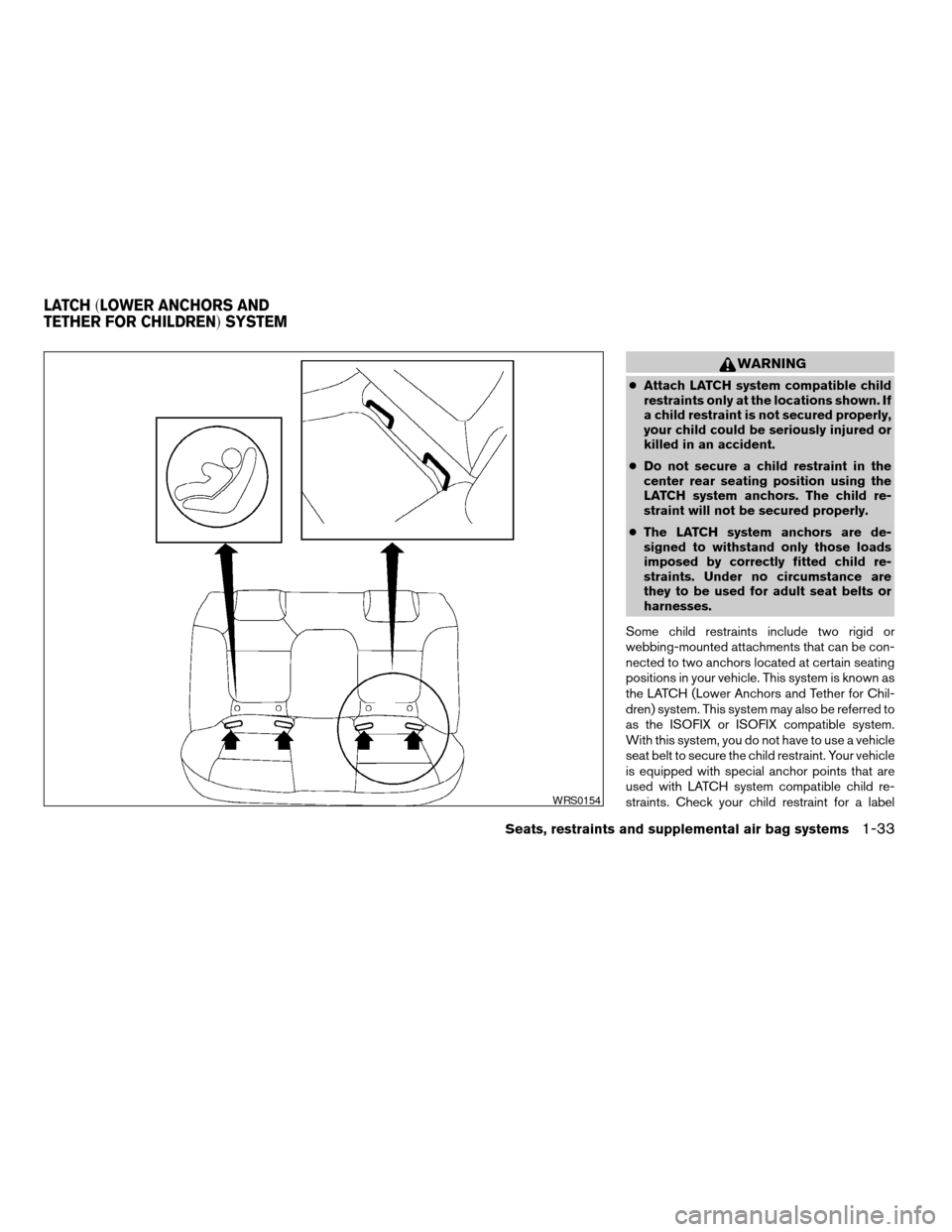
cAttach LATCH system compatible child
restraints only at the locations shown. If
a child restraint is not secured properly,
your child could be seriously injured or
killed in an accident.
cDo not secure a child restraint in the
center rear seating position using the
LATCH system anchors. The child re-
straint will not be secured properly.
cThe LATCH system anchors are de-
signed to withstand only those loads
imposed by correctly fitted child re-
straints. Under no circumstance are
they to be used for adult seat belts or
harnesses.
Some child restraints include two rigid or
webbing-mounted attachments that can be con-
nected to two anchors located at certain seating
positions in your vehicle. This system is known as
the LATCH (Lower Anchors and Tether for Chil-
dren) system. This system may also be referred to
as the ISOFIX or ISOFIX compatible system.
With this system, you do not have to use a vehicle
seat belt to secure the child restraint. Your vehicle
is equipped with special anchor points that are
used with LATCH system compatible child re-
straints. Check your child restraint for a label
WRS0154
LATCH~LOWER ANCHORS AND
TETHER FOR CHILDREN!SYSTEM
Seats, restraints and supplemental air bag systems1-33
ZREVIEW COPY:Ð2003 Sentra(b15)
Owners Manual(owners)ÐUSA English(nna)
12/10/02Ðsysadmin
X
Page 40 of 224
stating that it is compatible with the LATCH sys-
tem. This information may also be in the child
restraint owner’s manual. If you have such a child
restraint, refer to the illustration for the seating
positions equipped with LATCH system anchors
which can be used to secure the child restraint.
The LATCH system anchors are located at the
rear of the seat cushion near the seatback. A
label is attached to the seat back to help you
locate the LATCH system anchors.
LATCH child restraints generally require the use
of a top tether strap. See “Top tether strap child
restraint” later in this section for installation in-
structions.
When installing a child restraint, carefully read
and follow the instructions in this manual and
those supplied with the child restraint.
When you install a LATCH system compatible
child restraint to the lower anchor attachments,
follow these steps:WARNING
Inspect the lower anchors by inserting
your fingers into the lower anchor area
and feeling to make sure there are no
obstructions over the LATCH system an-
chors, such as seat belt webbing or seat
cushion material. The child restraint will
not be secured properly if the LATCH sys-
tem anchors are obstructed.
1. To install the LATCH system compatible
child restraint, insert the child restraint
LATCH system anchor attachments into the
anchor points on the seat. If the child re-
straint is equipped with a top tether, see
“Top tether strap child restraint” later in this
section for installation instructions.
2. After attaching the child restraint and before
placing the child in it, use force to tilt the
child restraint from side to side and tug it
forward to make sure that the child restraint
is securely held in place. It should not move
more than 1 inch.
3. Check to make sure that the child restraint is
properly secured prior to each use.
TOP TETHER STRAP CHILD
RESTRAINT
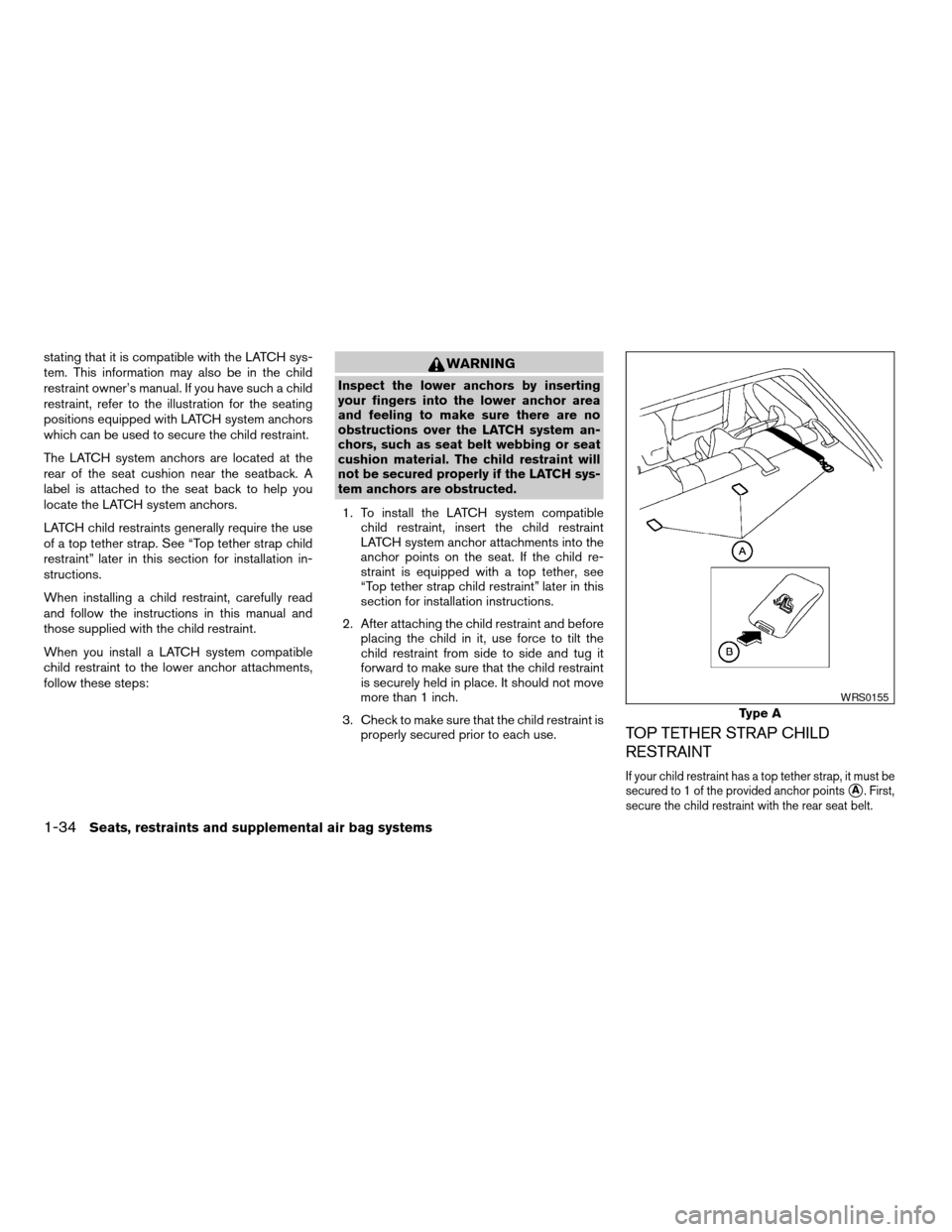
If your child restraint has a top tether strap, it must be
secured to 1 of the provided anchor points
sA. First,
secure the child restraint with the rear seat belt.
Type A
WRS0155
1-34Seats, restraints and supplemental air bag systems
ZREVIEW COPY:Ð2003 Sentra(b15)
Owners Manual(owners)ÐUSA English(nna)
12/10/02Ðdebbie
X
Page 41 of 224
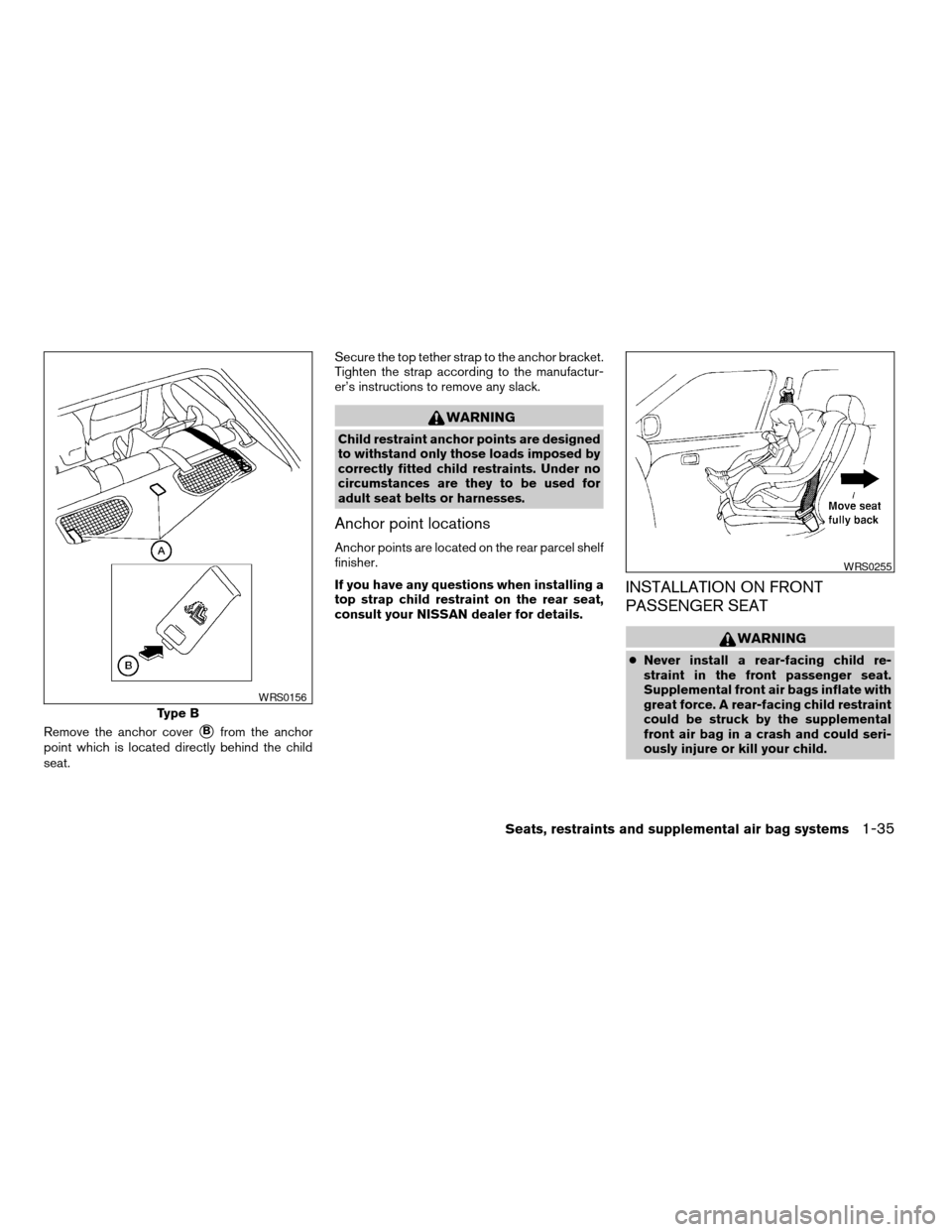
Remove the anchor coversBfrom the anchor
point which is located directly behind the child
seat.Secure the top tether strap to the anchor bracket.
Tighten the strap according to the manufactur-
er’s instructions to remove any slack.
WARNING
Child restraint anchor points are designed
to withstand only those loads imposed by
correctly fitted child restraints. Under no
circumstances are they to be used for
adult seat belts or harnesses.
Anchor point locations
Anchor points are located on the rear parcel shelf
finisher.
If you have any questions when installing a
top strap child restraint on the rear seat,
consult your NISSAN dealer for details.
INSTALLATION ON FRONT
PASSENGER SEAT
WARNING
cNever install a rear-facing child re-
straint in the front passenger seat.
Supplemental front air bags inflate with
great force. A rear-facing child restraint
could be struck by the supplemental
front air bag in a crash and could seri-
ously injure or kill your child.
Type B
WRS0156
WRS0255
Seats, restraints and supplemental air bag systems1-35
ZREVIEW COPY:Ð2003 Sentra(b15)
Owners Manual(owners)ÐUSA English(nna)
12/10/02Ðdebbie
X
Page 45 of 224

2 Instruments and controls
Instrument panel...................................2-2
Meters and gauges................................2-3
Speedometer and odometer.....................2-3
Tachometer (if so equipped).....................2-4
Engine coolant temperature gauge...............2-5
Fuel gauge....................................2-5
Warning/indicator lights and audible reminders.......2-7
Checking bulbs................................2-7
Warning lights.................................2-7
Indicator lights.................................2-9
Audible reminders.............................2-10
Security systems.................................2-11
Nissan vehicle immobilizer system (NVIS)
(if so equipped)...............................2-11
Vehicle security system (if so equipped)..........2-12
Windshield wiper and washer switch...............2-15
Switch operation..............................2-15
Rear window defroster switch......................2-16
Headlight and turn signal switch....................2-16
Headlight control switch........................2-17Fog light switch (if so equipped)...................2-18
Hazard warning flasher switch.....................2-19
Horn............................................2-19
Power outlet.....................................2-20
Storage.........................................2-21
Sunglasses holder (if so equipped)..............2-21
Cup holders..................................2-21
Glove box....................................2-22
Coin box.....................................2-22
Console box (if so equipped)...................2-23
Instrument panel storage (if so equipped)........2-23
Windows........................................2-24
Power windows (if so equipped)................2-24
Manual windows..............................2-26
Sunroof (if so equipped)...........................2-26
Electric sunroof...............................2-26
Interior light......................................2-27
Map lights (if so equipped)........................2-28
Trunk light.......................................2-28
ZREVIEW COPY:Ð2003 Sentra(b15)
Owners Manual(owners)ÐUSA English(nna)
12/10/02Ðdebbie
X
Page 46 of 224

1. Headlight and turn signal switch
(P. 2-16)
2. Meters/gauges (P. 2-3)
3. Windshield wiper/washer switch
(P. 2-15)
4. Heater/air conditioner control (P. 4-2)
5. Storage compartment (P. 2-23)
6. Hazard warning flasher switch (P. 2-19)
7. Center ventilators (P. 4-2)
8. Passenger supplemental air bag (P. 1-6)
9. Glove box (P. 2-22)
10. Pocket
11. 12 volt DC/cigarette lighter (accessory)
(P. 2-20)
12. 12 volt DC/cigarette lighter (accessory)
(if so equipped) (P. 2-20)
13. Radio/CD player/CD changer (P. 4-10)
14. Cruise control and main set switch
(P. 5-13)
15. Tilt steering lock lever (P. 3-13)
16. Trunk release Type B (P. 3-9)
17. Fuel filler lid opening lever (P. 3-12)
18. Driver supplemental air bag (P. 1-6)
19. Hood release lever (P. 3-9)
20. Fuse box cover/coin holder
(P. 8-31, 2-22)
21. Trunk release Type A (P. 3-9)
22. Instrument brightness control switch
(P. 2-18)
23. Outside mirror control switch (P. 3-15)
WIC0433
INSTRUMENT PANEL
2-2Instruments and controls
ZREVIEW COPY:Ð2003 Sentra(b15)
Owners Manual(owners)ÐUSA English(nna)
12/10/02Ðdebbie
X
Page 49 of 224
ENGINE COOLANT TEMPERATURE
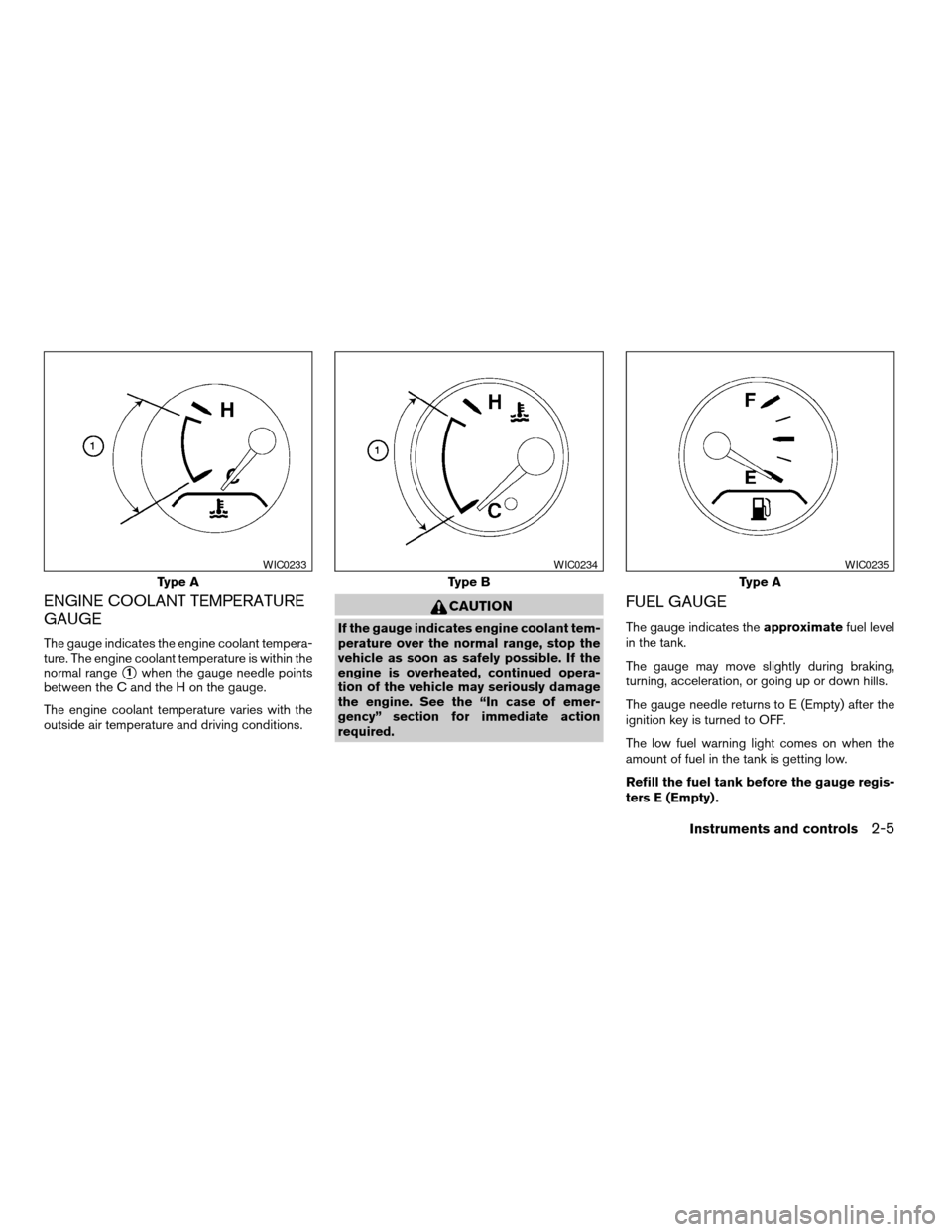
GAUGE
The gauge indicates the engine coolant tempera-
ture. The engine coolant temperature is within the
normal range
s1when the gauge needle points
between the C and the H on the gauge.
The engine coolant temperature varies with the
outside air temperature and driving conditions.
CAUTION
If the gauge indicates engine coolant tem-
perature over the normal range, stop the
vehicle as soon as safely possible. If the
engine is overheated, continued opera-
tion of the vehicle may seriously damage
the engine. See the “In case of emer-
gency” section for immediate action
required.
FUEL GAUGE
The gauge indicates theapproximatefuel level
in the tank.
The gauge may move slightly during braking,
turning, acceleration, or going up or down hills.
The gauge needle returns to E (Empty) after the
ignition key is turned to OFF.
The low fuel warning light comes on when the
amount of fuel in the tank is getting low.
Refill the fuel tank before the gauge regis-
ters E (Empty) .
Type A
WIC0233
Type B
WIC0234
Type A
WIC0235
Instruments and controls2-5
ZREVIEW COPY:Ð2003 Sentra(b15)
Owners Manual(owners)ÐUSA English(nna)
12/10/02Ðdebbie
X
Page 51 of 224

orAnti-lock brake warning light (if
so equipped)Low fuel warning lightCruise SET switch indicator light (if so
equipped)
orBrake warning lightLow washer fluid warning light (if so equipped)High beam indicator light (Blue)
Charge warning lightSeat belt warning light and chimeMalfunction indicator lamp (MIL)
Door open warning lightSupplemental air bag warning lightOverdrive off indicator light (automatic trans-
mission models only)
Engine oil pressure warning lightCRUISE main switch indicator light (if so
equipped)Turn signal/hazard indicator lights
CHECKING BULBS
With all doors closed, apply the parking brake
and turn the ignition key to the ON position
without starting the engine. The following lights
will come on:
,,or,,,
If equipped, the following lights come on briefly
and then go off:
or
If any light fails to come on, it may indicate
a burned-out bulb or an open circuit in the
electrical system. Have the system repaired
promptly.
WARNING LIGHTS
orAnti-lock brake
warning light (if so
equipped)
If the light comes on while the engine is running,
it may indicate the anti-lock brake system is not
functioning properly. Have the system checked
by a NISSAN dealer.
Turn off the engine, and start it again by
slowly turning the ignition key (quickly do-
ing so may cause the ABS light to stay on
when there is nothing wrong) . If the light
stays on, have the system checked by a
NISSAN dealer.If an abnormality occurs in the system, the anti-
lock function ceases, but the regular braking
system continues to operate.
If the light comes on while you are driving,
contact a NISSAN dealer for repair.orBrake warning light
This light functions for both the parking brake and
the foot brake systems.
WARNING/INDICATOR LIGHTS AND
AUDIBLE REMINDERS
Instruments and controls2-7
ZREVIEW COPY:Ð2003 Sentra(b15)
Owners Manual(owners)ÐUSA English(nna)
12/10/02Ðdebbie
X