Page 211 of 299
TOWING RECOMMENDED BY
NISSAN
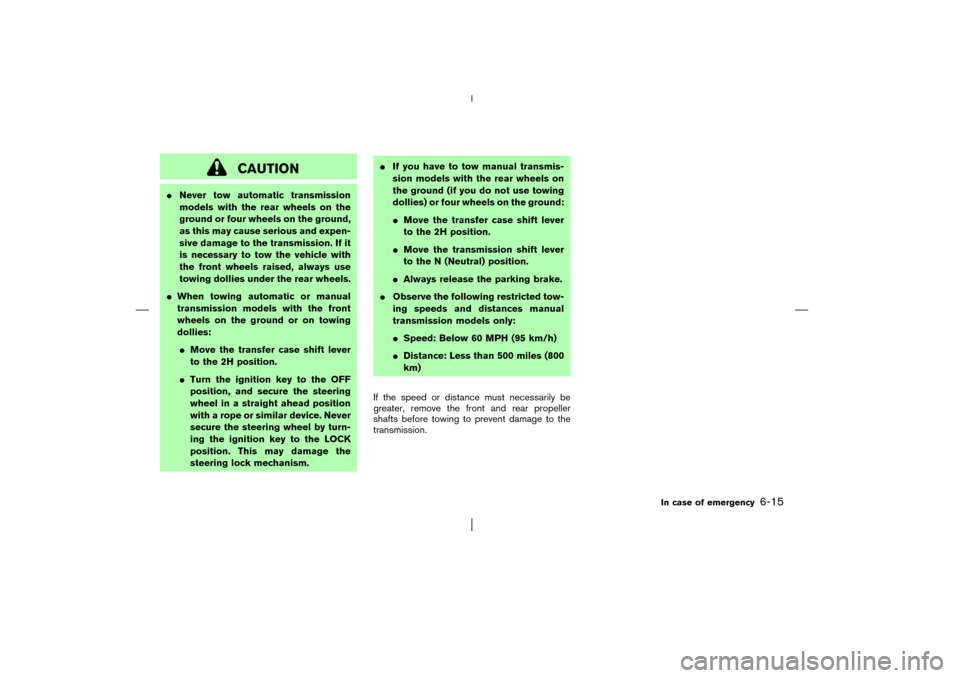
Two wheel drive modelsNISSAN recommends that your vehicle be
towed with the driving (rear) wheels off the
ground or place the vehicle on a flat bed truck as
illustrated.
CAUTION
�Never tow automatic transmission
models with the rear wheels on the
ground or four wheels on the ground
(forward or backward), as this may
cause serious and expensive damage
to the transmission. If it is necessary
to tow the vehicle with the front
wheels raised, always use towing
dollies under the rear wheels.
�When towing automatic or manual
transmission models with the front
wheels on the ground or on towing
dollies:
�Turn the ignition key to the OFF
position, and secure the steeringwheel in a straightahead position
with a rope or similar device. Never
secure the steering wheel by turn-
ing the ignition key to the LOCK
position. This may damage the
steering lock mechanism.
�If you have to tow manual transmis-
sion models with the rear wheels on
the ground or four wheels on the
ground (if you do not use towing
dollies):
�Always release the parking brake.
�Move the transmission shift lever
to the N(Neutral) position.
�Observe the following restricted tow-
ing speeds and distances for manual
transmission models only:
�Speed: Below 60 MPH (95 km/h)
�Distance: Less than 500 miles (800
km)
If the speed or distance must necessarily be
greater, remove the propeller shaft before tow-
ing to prevent damage to the transmission.
Part time four wheel drive modelsNISSAN recommends that towing dollies be
used when towing your vehicle or the vehicle be
placed on a flat bed truck as illustrated.
SCE0198
6-14
In case of emergency
�
03.1.28/R50-D/V5
�
Page 212 of 299
CAUTION
�Never tow automatic transmission
models with the rear wheels on the
ground or four wheels on the ground,
as this may cause serious and expen-
sive damage to the transmission. If it
is necessary to tow the vehicle with
the front wheels raised, always use
towing dollies under the rear wheels.
�When towing automatic or manual
transmission models with the front
wheels on the ground or on towing
dollies:
�Move the transfer case shift lever
to the 2H position.
�Turn the ignition key to the OFF
position, and secure the steering
wheel in a straight ahead position
with a rope or similar device. Never
secure the steering wheel by turn-
ing the ignition key to the LOCK
position. This may damage the
steering lock mechanism.�If you have to tow manual transmis-
sion models with the rear wheels on
the ground (if you do not use towing
dollies) or four wheels on the ground:
�Move the transfer case shift lever
to the 2H position.
�Move the transmission shift lever
to the N(Neutral) position.
�Always release the parking brake.
�Observe the following restricted tow-
ing speeds and distances manual
transmission models only:
�Speed: Below 60 MPH (95 km/h)
�Distance: Less than 500 miles (800
km)
If the speed or distance must necessarily be
greater, remove the front and rear propeller
shafts before towing to prevent damage to the
transmission.
In case of emergency
6-15
�
03.1.28/R50-D/V5
�
Page 226 of 299
ing and driving” section for exhaust gas (carbon
monoxide).
Underbody:
The underbody is frequently exposed to corro-
sive substances such as those used on icy roads
or to control dust. It is very important to remove
these substances, otherwise rust will form on the
floor pan, frame, fuel lines and around the ex-
haust system. At the end of winter, the under-
body should be thoroughly flushed with plain
water, being careful to clean those areas where
mud and dirt may accumulate. For additional
information, see “Cleaning exterior” in the “7.
Appearance and care” section.
Fluid leaks:
Check under the vehicle for fuel, oil, water or
other fluid leaks after the vehicle has been
parked for a while. Water dripping from the air
conditioner after use is normal. If you should
notice any leaks or if gasoline fumes are evident,
check for the cause and have it corrected imme-
diately.When performing any inspection or maintenance
work on your vehicle, always take care to prevent
serious accidental injury to yourself or damage to
the vehicle. The following are general precau-
tions which should be closely observed.
WARNING
�Park the vehicle on a level surface,
apply the parking brake securely and
block the wheels to prevent the ve-
hicle from moving. For a manual
transmission, move the shift lever to
Neutral. For an automatic transmis-
sion, move the selector lever to the P
(Park) position.
�Be sure the ignition key is in the OFF
or LOCK position when performing
any replacement or repair.
�If you must work with the engine
running, keep your hands, clothing,
hair and tools away from moving fans
belts and any other moving parts.
�It is advisable to secure or remove
any loose clothing and any jewelry,such as rings, watches, etc. before
working on your vehicle.
�Always wear eye protection when-
ever you work on your vehicle.
�If you must run the engine in an
enclosed space such as a garage, be
sure there is proper ventilation for
exhaust gases to escape.
�Never get under the vehicle while it is
supported only by a jack. If it is nec-
essary to work under the vehicle,
support it with safety stands.
�Keep smoking materials, flame and
sparks away from fuel and battery.
�Your vehicle is equipped with an au-
tomatic engine cooling fan. It may
come on at any time without warning,
even if the ignition key is in the OFF
position and the engine is not run-
ning. To avoid injury, always discon-
nect the negative battery cable be-
fore working near the fan.
�On gasoline engine models with theMAINTENANCE PRECAUTIONS
Maintenance and do-it-yourself
8-5
�
03.1.28/R50-D/V5
�
Page 227 of 299
multiport fuel injection (MFI) system,
the fuel filter or fuel lines should be
serviced by a NISSAN dealer because
the fuel lines are under high pressure
even when the engine is off.
CAUTION
�Do not work under the engine hood
while it is hot. Turn off the engine and
wait until it cools down.
�Never connect or disconnect either
the battery or any transistorized
component connector while the igni-
tion key is on.
�Never leave the engine or the auto-
matic transmission related compo-
nent harness connector discon-
nected while the ignition key is on.
�Avoid direct contact with used engine
oil and coolant. Improperly disposed
engine oil, engine coolant, and/or
other vehicle fluids can hurt the envi-ronment. Always conform to local
regulations for disposal of vehicle
fluid.
This section gives instructions regarding only
those items which are relatively easy for an
owner to perform. More involved service should
be done by your NISSAN dealer.
A genuine NISSAN Service Manual is also avail-
able. See “Owner’s Manual/Service Manual or-
der information” in the “9. Technical and con-
sumer information” section.
You should be aware that incomplete or im-
proper servicing may result in operating difficul-
ties or excessive emissions, and could affect
your warranty coverage.If in doubt about any
servicing, have it done by your NISSAN
dealer.8-6
Maintenance and do-it-yourself
�
03.1.28/R50-D/V5
�
Page 232 of 299
1. Perform the following procedure to open the
heater water cock.
�Turn the ignition key from OFF to ON.
�Move the heater or air conditioner tem-
perature control dial to the maximum hot
position then turn the ignition key to OFF.
2. Open the radiator drain plugs and radiator
cap.
Open the drain plugs on the engine block.
SDI1109SDI1118
SDI0409ASDI0410A
Maintenance and do-it-yourself
8-11
�
03.1.28/R50-D/V5
�
Page 243 of 299
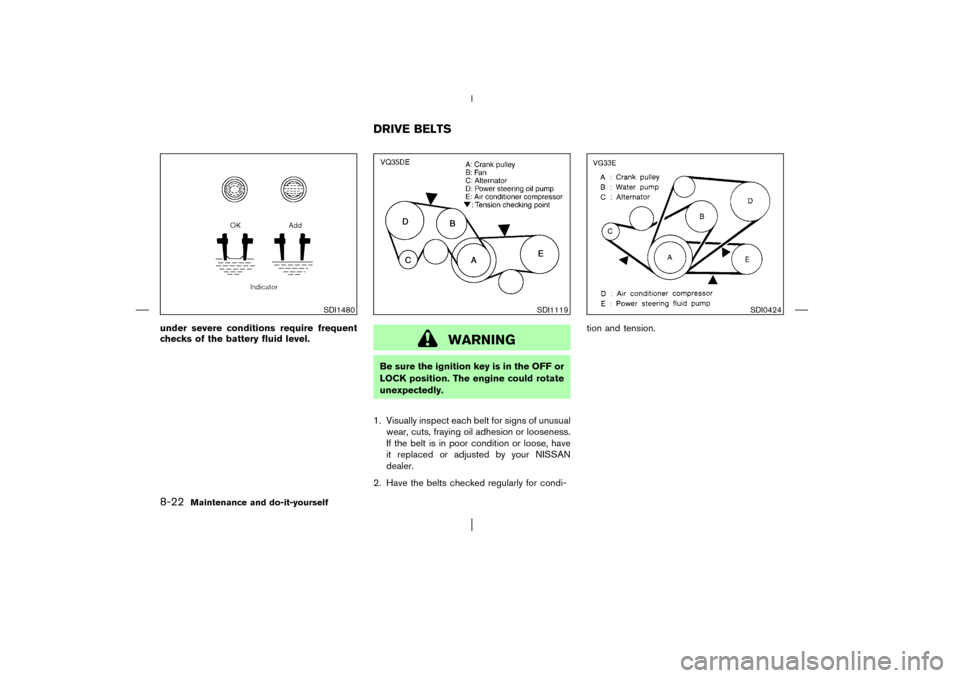
under severe conditions require frequent
checks of the battery fluid level.
WARNING
Be sure the ignition key is in the OFF or
LOCK position. The engine could rotate
unexpectedly.
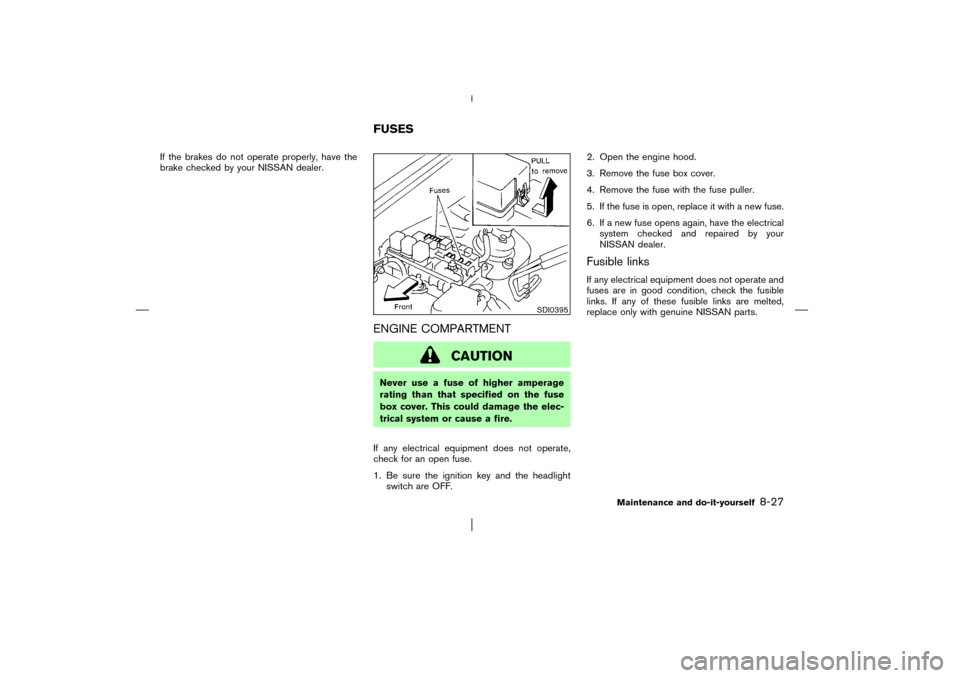
1. Visually inspect each belt for signs of unusual
wear, cuts, fraying oil adhesion or looseness.
If the belt is in poor condition or loose, have
it replaced or adjusted by your NISSAN
dealer.
2. Have the belts checked regularly for condi-tion and tension.
SDI1480
SDI1119
SDI0424
DRIVE BELTS
8-22
Maintenance and do-it-yourself
�
03.1.28/R50-D/V5
�
Page 244 of 299
REPLACING SPARK PLUGS
WARNING
Be sure the engine and ignition switch
are off and that the parking brake is
engaged securely.
CAUTION
Be sure to use the correct socket toremove the spark plugs. An incorrect
socket can cause damage the spark
plugs.
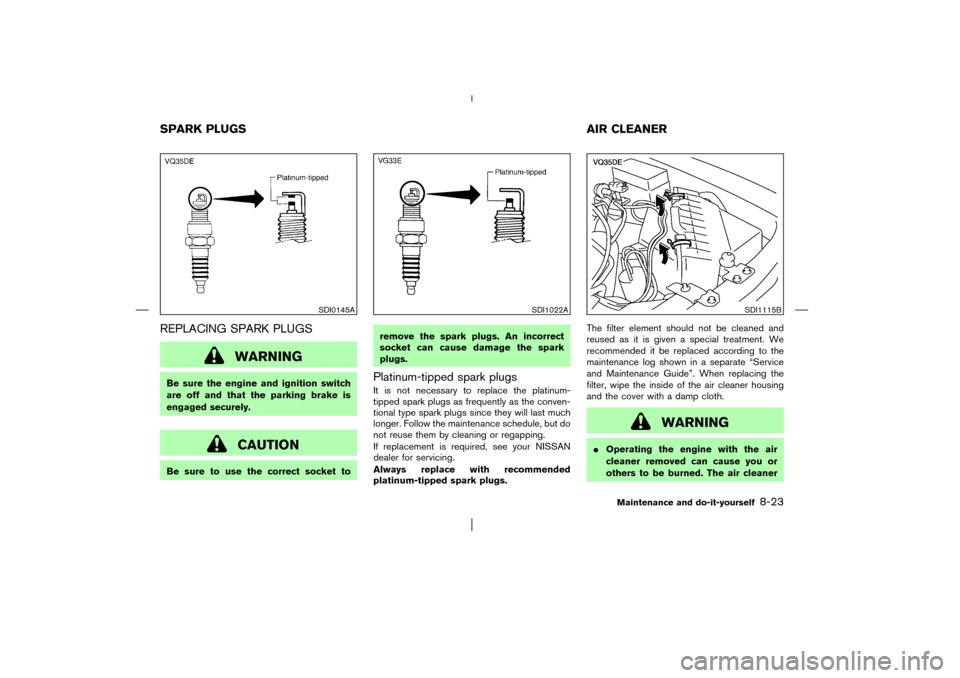
Platinum-tipped spark plugsIt is not necessary to replace the platinum-
tipped spark plugs as frequently as the conven-
tional type spark plugs since they will last much
longer. Follow the maintenance schedule, but do
not reuse them by cleaning or regapping.
If replacement is required, see your NISSAN
dealer for servicing.
Always replace with recommended
platinum-tipped spark plugs.The filter element should not be cleaned and
reused as it is given a special treatment. We
recommended it be replaced according to the
maintenance log shown in a separate “Service
and Maintenance Guide”. When replacing the
filter, wipe the inside of the air cleaner housing
and the cover with a damp cloth.
WARNING
�Operating the engine with the air
cleaner removed can cause you or
others to be burned. The air cleaner
SDI0145A
SDI1022A
SDI1115B
SPARK PLUGS AIR CLEANER
Maintenance and do-it-yourself
8-23
�
03.1.28/R50-D/V5
�
Page 248 of 299
If the brakes do not operate properly, have the
brake checked by your NISSAN dealer.
ENGINE COMPARTMENT
CAUTION
Never use a fuse of higher amperage
rating than that specified on the fuse
box cover. This could damage the elec-
trical system or cause a fire.
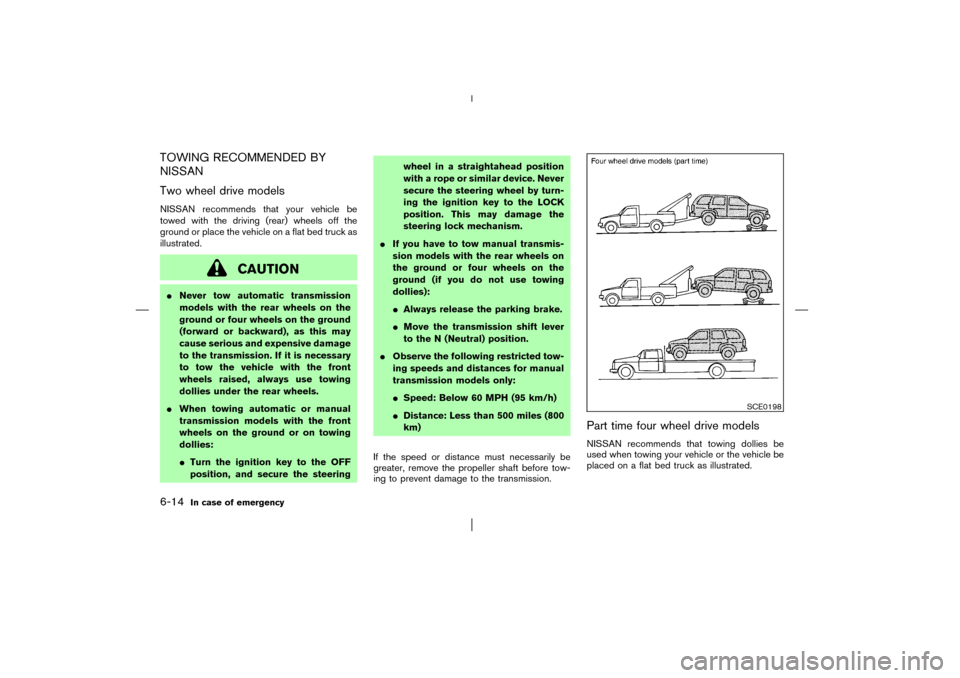
If any electrical equipment does not operate,
check for an open fuse.
1. Be sure the ignition key and the headlight
switch are OFF.2. Open the engine hood.
3. Remove the fuse box cover.
4. Remove the fuse with the fuse puller.
5. If the fuse is open, replace it with a new fuse.
6. If a new fuse opens again, have the electrical
system checked and repaired by your
NISSAN dealer.
Fusible linksIf any electrical equipment does not operate and
fuses are in good condition, check the fusible
links. If any of these fusible links are melted,
replace only with genuine NISSAN parts.
SDI0395
FUSES
Maintenance and do-it-yourself
8-27
�
03.1.28/R50-D/V5
�