Page 54 of 299
4. Allow the belt to retract. Pull up on the belt to
remove any slack in the belt.5. Before placing the child in the child restraint,
use force to tilt the child restraint from side to
side, and tug it forward to make sure that it is
securely held in place.
6. Check that the retractor is in the automatic
locking mode by trying to pull more belt out of
the retractor. If you cannot pull any more belt
webbing out of the retractor, the belt is in the
automatic locking mode.
7. Check to make sure that the child restraint is
properly secured prior to each use. If the lap
belt is not locked, repeat steps 3 through 6.
After the child restraint is removed and the seat
belt is allowed to wind back into the retractor,the automatic locking mode (child restraint
mode) is canceled; the seat belt only locks
during a sudden stop or impact.
SSS0056
SSS0114Seats, restraints and supplemental air bag systems
1-47
�
03.1.28/R50-D/V5
�
Page 81 of 299
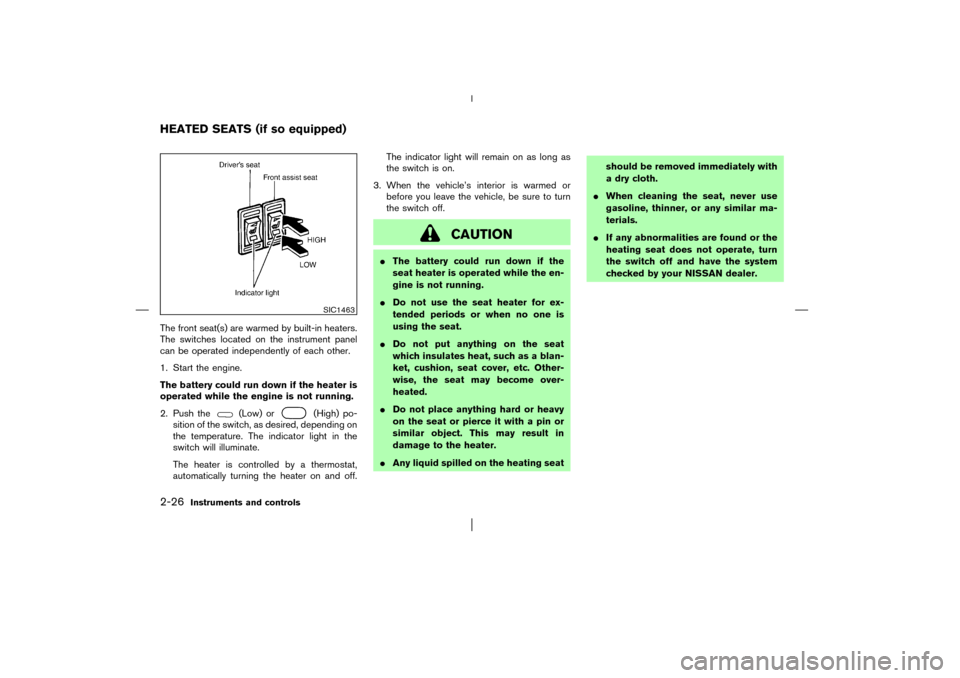
The front seat(s) are warmed by built-in heaters.
The switches located on the instrument panel
can be operated independently of each other.
1. Start the engine.
The battery could run down if the heater is
operated while the engine is not running.
2. Push the
(Low) or
(High) po-
sition of the switch, as desired, depending on
the temperature. The indicator light in the
switch will illuminate.
The heater is controlled by a thermostat,
automatically turning the heater on and off.The indicator light will remain on as long as
the switch is on.
3. When the vehicle’s interior is warmed or
before you leave the vehicle, be sure to turn
the switch off.
CAUTION
�The battery could run down if the
seat heater is operated while the en-
gine is not running.
�Do not use the seat heater for ex-
tended periods or when no one is
using the seat.
�Do not put anything on the seat
which insulates heat, such as a blan-
ket, cushion, seat cover, etc. Other-
wise, the seat may become over-
heated.
�Do not place anything hard or heavy
on the seat or pierce it with a pin or
similar object. This may result in
damage to the heater.
�Any liquid spilled on the heating seatshould be removed immediately with
a dry cloth.
�When cleaning the seat, never use
gasoline, thinner, or any similar ma-
terials.
�If any abnormalities are found or the
heating seat does not operate, turn
the switch off and have the system
checked by your NISSAN dealer.
SIC1463
HEATED SEATS (if so equipped)2-26
Instruments and controls
�
03.1.28/R50-D/V5
�
Page 89 of 299
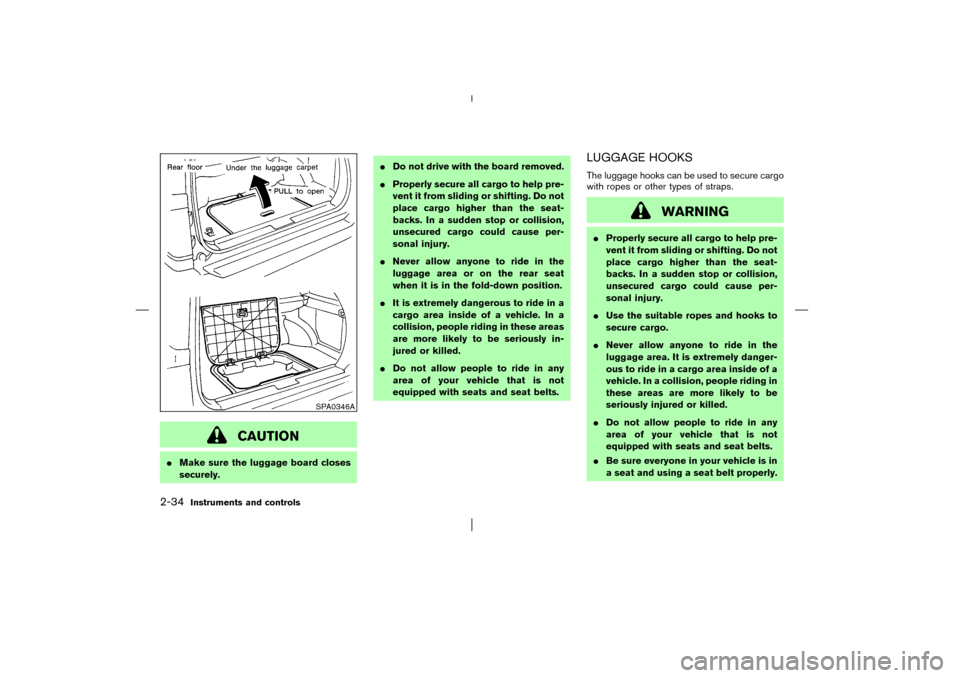
CAUTION
�Make sure the luggage board closes
securely.�Do not drive with the board removed.
�Properly secure all cargo to help pre-
vent it from sliding or shifting. Do not
place cargo higher than the seat-
backs. In a sudden stop or collision,
unsecured cargo could cause per-
sonal injury.
�Never allow anyone to ride in the
luggage area or on the rear seat
when it is in the fold-down position.
�It is extremely dangerous to ride in a
cargo area inside of a vehicle. In a
collision, people riding in these areas
are more likely to be seriously in-
jured or killed.
�Do not allow people to ride in any
area of your vehicle that is not
equipped with seats and seat belts.
LUGGAGE HOOKSThe luggage hooks can be used to secure cargo
with ropes or other types of straps.
WARNING
�Properly secure all cargo to help pre-
vent it from sliding or shifting. Do not
place cargo higher than the seat-
backs. In a sudden stop or collision,
unsecured cargo could cause per-
sonal injury.
�Use the suitable ropes and hooks to
secure cargo.
�Never allow anyone to ride in the
luggage area. It is extremely danger-
ous to ride in a cargo area inside of a
vehicle. In a collision, people riding in
these areas are more likely to be
seriously injured or killed.
�Do not allow people to ride in any
area of your vehicle that is not
equipped with seats and seat belts.
�Be sure everyone in your vehicle is in
a seat and using a seat belt properly.
SPA0346A
2-34
Instruments and controls
�
03.1.28/R50-D/V5
�
Page 218 of 299
ing. Follow the instructions supplied with the
wax.
�Do not use a wax containing any abrasives,
cutting compounds or cleaners that may
damage the vehicle finish.
�If the surface does not polish easily, use a
road tar remover and wax again.
Machine compounding or aggressive pol-
ishing on a base coat/clear coat paint
finish may dull the finish or leave swirl
marks.
Only apply black wax or black shoe polish to the
black urethane or polypropylene bumper.
REMOVING SPOTSRemove tar and oil spots, industrial dust, insects
and tree sap as quickly as possible from the
surface of the paint to avoid lasting damage or
staining. Special cleaning products are available
at your NISSAN dealer or any automotive acces-
sories store.UNDERBODYIn areas where road salt is used in winter, it is
necessary to clean the underbody regularly in
order to prevent dirt and salt from building up
and causing corrosion on the underbody and
suspension. Before the winter period and againin the spring, the underseal must be checked
and, if necessary, re-treated.
GLASSUse glass cleaner to remove smoke and dust film
from the glass surfaces. It is normal for glass to
be coated with a film after the vehicle is parked
in the hot sun. Glass cleaner and a soft cloth will
easily remove this film.
CAUTION
When cleaning the inside of the win-
dow, do not use sharp-edged tools,
abrasive cleaners or chlorine based dis-
infectant cleaners. They could damage
the electrical conductors, radio antenna
elements or rear window defogger ele-
ments.ALUMINUM ALLOY WHEELSWash regularly, especially during winter months
in areas where road salt is used. Salt could
discolor the wheel if not removed.CHROME PARTSClean all chrome parts regularly with a non-
abrasive chrome polish to maintain the finish.Occasionally remove loose dust from the interior
trim, plastic parts and seats using a vacuum
cleaner or soft brush. Wipe the vinyl and leather
surfaces with a clean, soft cloth dampened in
mild soap solution, then wipe clean with a dry
soft cloth. Before using any fabric protector,
read the manufacturer’s recommendations.
Some fabric protectors contains chemicals that
stain or bleach the seat material. Use a cloth
dampened only with water, to clean the meter
and gauge lens.
CAUTION
�Never use gasoline, thinner or any
similar material.
�The leather seats should be regularly
coated with a leather wax like saddle
soap. Never use car wax.
�Never use fabric protectors unless
recommended by the manufacturer.
�Do not use glass or plastic cleaner on
meter or gauge lens covers. It may
damage the lens cover.CLEANING INTERIOR
Appearance and care
7-3
�
03.1.28/R50-D/V5
�
Page 278 of 299
WARNING
�It is extremely dangerous to ride in a
cargo area inside of a vehicle. In a
collision, people riding in these areas
are more likely to be seriously in-
jured or killed.
�Do not allow people to ride in any
area of your vehicle that is not
equipped with seats and seat belts.
�Be sure everyone in your vehicle is in
a seat and using a seat belt properly.TERMSIt is important to familiarize yourself with the
following terms before loading your vehicle:
�CurbWeight (actual weight of your vehicle) -
vehicle weight including: standard and op-
tional equipment, fluids, emergency tools,
and spare tire assembly. This weightdoes
notinclude passengers and cargo.
�GVW (Gross Vehicle Weight) - curbweight
plus the combined weight of passengers and
cargo.�GVWR (Gross Vehicle Weight Rating) -
maximum total weight (load) limit specified for
the vehicle.
�GAWR (Gross Axle Weight Rating) - maxi-
mum weight (load) limit specified for the front
or rear axle.
DETERMINING VEHICLE PAYLOAD
CAPACITYThe payload capacity of this vehicle is deter-
mined by weight, not by available cargo space.
For example, a luggage rack, bike carrier, cartop
carrier or similar equipment does not increase
payload carrying capacity of your vehicle.
To determine vehicle payload capacity:
Vehicle weight can be determined by using a
commercial-grade scale, found at places such
as a truck stop, gravel quarry, grain elevator, or a
scrap metal recycling facility.
1) Determine the curbweight of your vehicle.
2) Compare the curbweight amount to the
GVWR specified for your vehicle to deter-
mine how much more weight your vehicle can
carry.
3) After loading (cargo and passengers), re-
weigh your vehicle to determine if either
GVWR or GAWR for your vehicle is ex-ceeded. If GVWR is exceeded, remove cargo
as necessary. If either the front or rear GAWR
is exceeded, shift the load or remove cargo
as necessary.
VEHICLE LOADING
INFORMATION
Technical and consumer information
9-15
�
03.1.28/R50-D/V5
�