Page 73 of 265
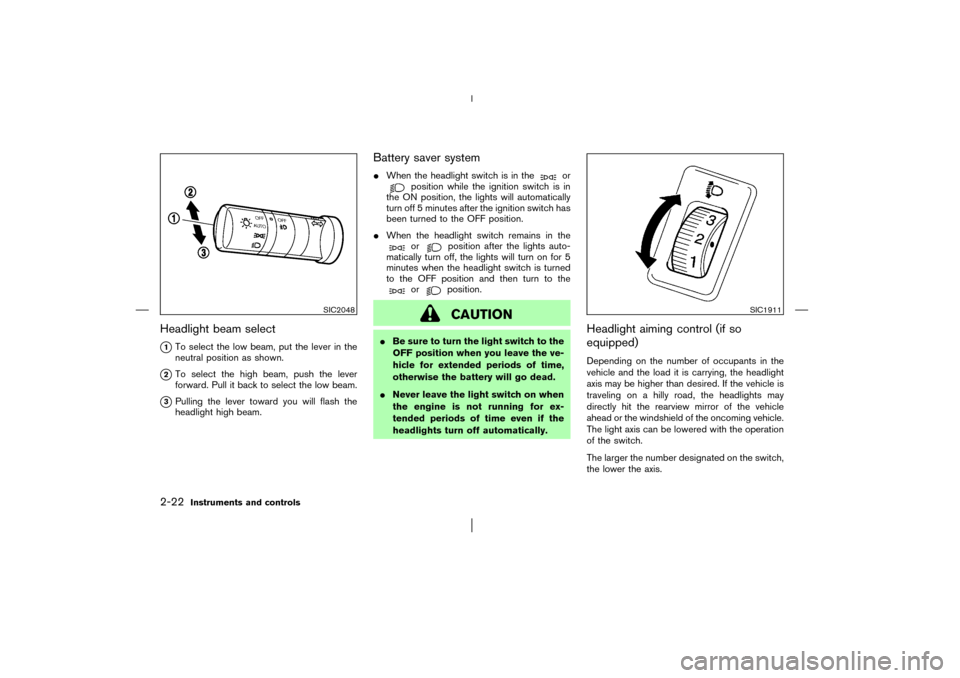
Headlight beam select
�1To select the low beam, put the lever in the
neutral position as shown.
�2To select the high beam, push the lever
forward. Pull it back to select the low beam.
�3Pulling the lever toward you will flash the
headlight high beam.
Battery saver system�When the headlight switch is in the
or
position while the ignition switch is in
the ON position, the lights will automatically
turn off 5 minutes after the ignition switch has
been turned to the OFF position.
�When the headlight switch remains in theor
position after the lights auto-
matically turn off, the lights will turn on for 5
minutes when the headlight switch is turned
to the OFF position and then turn to the
or
position.CAUTION
�Be sure to turn the light switch to the
OFF position when you leave the ve-
hicle for extended periods of time,
otherwise the battery will go dead.
�Never leave the light switch on when
the engine is not running for ex-
tended periods of time even if the
headlights turn off automatically.
Headlight aiming control (if so
equipped)Depending on the number of occupants in the
vehicle and the load it is carrying, the headlight
axis may be higher than desired. If the vehicle is
traveling on a hilly road, the headlights may
directly hit the rearview mirror of the vehicle
ahead or the windshield of the oncoming vehicle.
The light axis can be lowered with the operation
of the switch.
The larger the number designated on the switch,
the lower the axis.
SIC2048
SIC1911
2-22
Instruments and controls
�
03.1.28/Z50-D/V5.0
�
Page 74 of 265
When traveling with no heavy load or on a flat
road, select position 0.
WARNING
Xenon headlights are extremely bright
compared to conventional headlights. If
the xenon headlights hit the rearview
mirror of the vehicle ahead or the wind-
shield of the oncoming vehicle, the
driver of these vehicles may have diffi-
culty driving because of the brightness.
Use the headlight aiming control switch
to lower the light axis. See earlier in this
section for information on xenon head-
lights.DAYTIME RUNNING LIGHT SYSTEM
(CANADA ONLY)The fog lights automatically illuminate when the
engine is started. The daytime running lights
operate with the headlight switch in the OFF
position or in the
position.
The fog light may come on after turning the key
to the OFF position and immediately turning it to
the ON position. This is not a malfunction.The daytime running light will be turned off when
the headlight switch is turned to the AUTO or
position.
The daytime running light will remain on until the
ignition switch is turned to the ACC or OFF
position.
WARNING
When the daytime running light system
is active, tail lights on your vehicle are
not on. It is necessary at dusk to turn on
your headlights. Failure to do so could
cause an accident injuring yourself and
others.
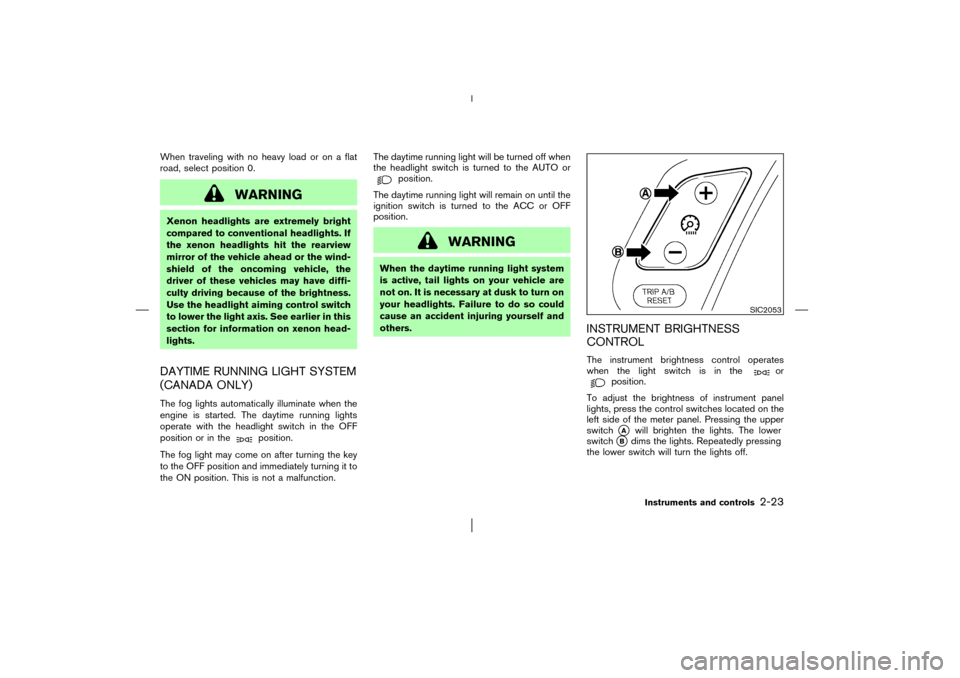
INSTRUMENT BRIGHTNESS
CONTROLThe instrument brightness control operates
when the light switch is in the
or
position.
To adjust the brightness of instrument panel
lights, press the control switches located on the
left side of the meter panel. Pressing the upper
switch�A
will brighten the lights. The lower
switch
�B
dims the lights. Repeatedly pressing
the lower switch will turn the lights off.
SIC2053
Instruments and controls
2-23
�
03.1.28/Z50-D/V5.0
�
Page 111 of 265
CAUTION
Do not adjust the pedal position with
your foot on the pedal.
CAUTION
Store the main sun visor after storing
the extension sun visor.
INSIDE MIRRORThe night position will reduce glare from the
headlights of vehicles behind you at night.
WARNING
Use the night position only when neces-
sary, because it reduces rear view clar-
ity.
SPA1583
PD1006M
SUNVISORS MIRRORS
3-14
Pre-driving checks and adjustments
�
03.1.28/Z50-D/V5.0
�
Page 112 of 265
AUTOMATIC ANTI-GLARE INSIDE
MIRROR (if so equipped)
WARNING
Use Automatic Anti-glare only when
necessary, because it reduces rear view
clarity.
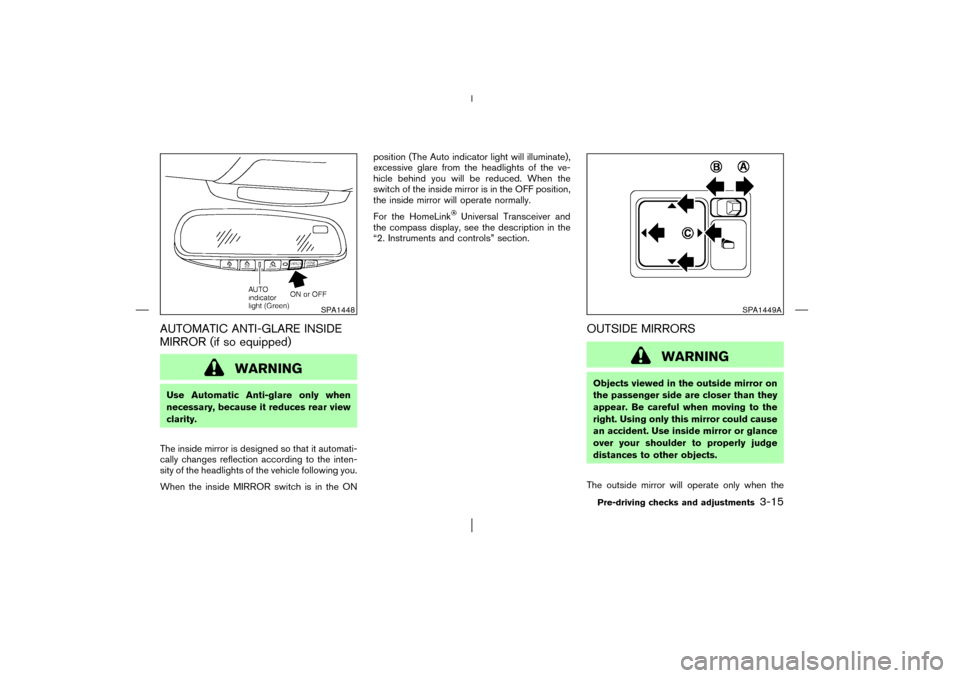
The inside mirror is designed so that it automati-
cally changes reflection according to the inten-
sity of the headlights of the vehicle following you.
When the inside MIRROR switch is in the ONposition (The Auto indicator light will illuminate),
excessive glare from the headlights of the ve-
hicle behind you will be reduced. When the
switch of the inside mirror is in the OFF position,
the inside mirror will operate normally.
For the HomeLink
Universal Transceiver and
the compass display, see the description in the
“2. Instruments and controls” section.
OUTSIDE MIRRORS
WARNING
Objects viewed in the outside mirror on
the passenger side are closer than they
appear. Be careful when moving to the
right. Using only this mirror could cause
an accident. Use inside mirror or glance
over your shoulder to properly judge
distances to other objects.
The outside mirror will operate only when the
SPA1448
SPA1449A
Pre-driving checks and adjustments
3-15
�
03.1.28/Z50-D/V5.0
�
Page 250 of 265
�After the hitch is removed, seal the
bolt holes to prevent exhaust fumes,
water or dust from entering the pas-
senger compartment.
�Regularly check all hitch mounting
bolts are securely mounted.
�To reduce the possibility of addi-
tional damage if your vehicle is
struck from the rear, where practical,
remove the hitch and/or receiver
when not in use.
�Never connect a trailer brake system
directly to the vehicle brake system.Tire pressures�When towing a trailer, inflate the vehicle tires
to the recommended cold tire pressure indi-
cated on the tire placard (located on the
driver’s door center pillar).
�Trailer tire condition, size, load rating and
proper inflation pressure should be in accor-
dance with the trailer and tire manufacturers’
specifications.
Safety chainAlways use a suitable chain between your ve-
hicle and the trailer. The chain should be
crossed and should be attached to the hitch, not
to the vehicle bumper or axle. Be sure to leave
enough slack in the chain to permit turning
corners.Trailer lightsTrailer lights should comply with federal and/or
local regulations. When wiring the vehicle for
towing, connect the stop and tail light pickup
into the vehicle electrical circuit at a point be-
tween the sensor and stop light or light switch.Trailer brakesIf your trailer is equipped with a braking system,
make sure it conforms to federal and/or local
regulations and that it is properly installed.
WARNING
Never connect a trailer brake system
directly to the vehicle brake system.Pre-towing tips�Be certain your vehicle maintains a levelposition when a loaded and/or unloaded
trailer is hitched. Do not drive the vehicle if it
has an abnormal nose-up or nose-down con-
dition; check for improper tongue load, over-
load, worn suspension or other possible
causes of either condition.
�Always secure items in the trailer to prevent
load shifts while driving.
�Be certain your rear view mirrors conform to
all federal, state or local regulations. If not,
install any mirrors required for towing before
driving the vehicle.
Trailer towing tipsIn order to gain skill and an understanding of the
vehicle’s behavior, you should practice turning,
stopping and backing up in an area which is free
from traffic. Steering stability, and braking per-
formance will be somewhat different than under
normal driving conditions.
�Always secure items in the trailer to prevent
load shift while driving.
�Avoid abrupt starts, acceleration or stops.
�Avoid sharp turns or lane changes.
�Always drive your vehicle at a moderate
speed.
�Always block the wheels on both vehicle andTechnical and consumer information
9-19
�
03.1.28/Z50-D/V5.0
�