2003 NISSAN FRONTIER length
[x] Cancel search: lengthPage 34 of 272
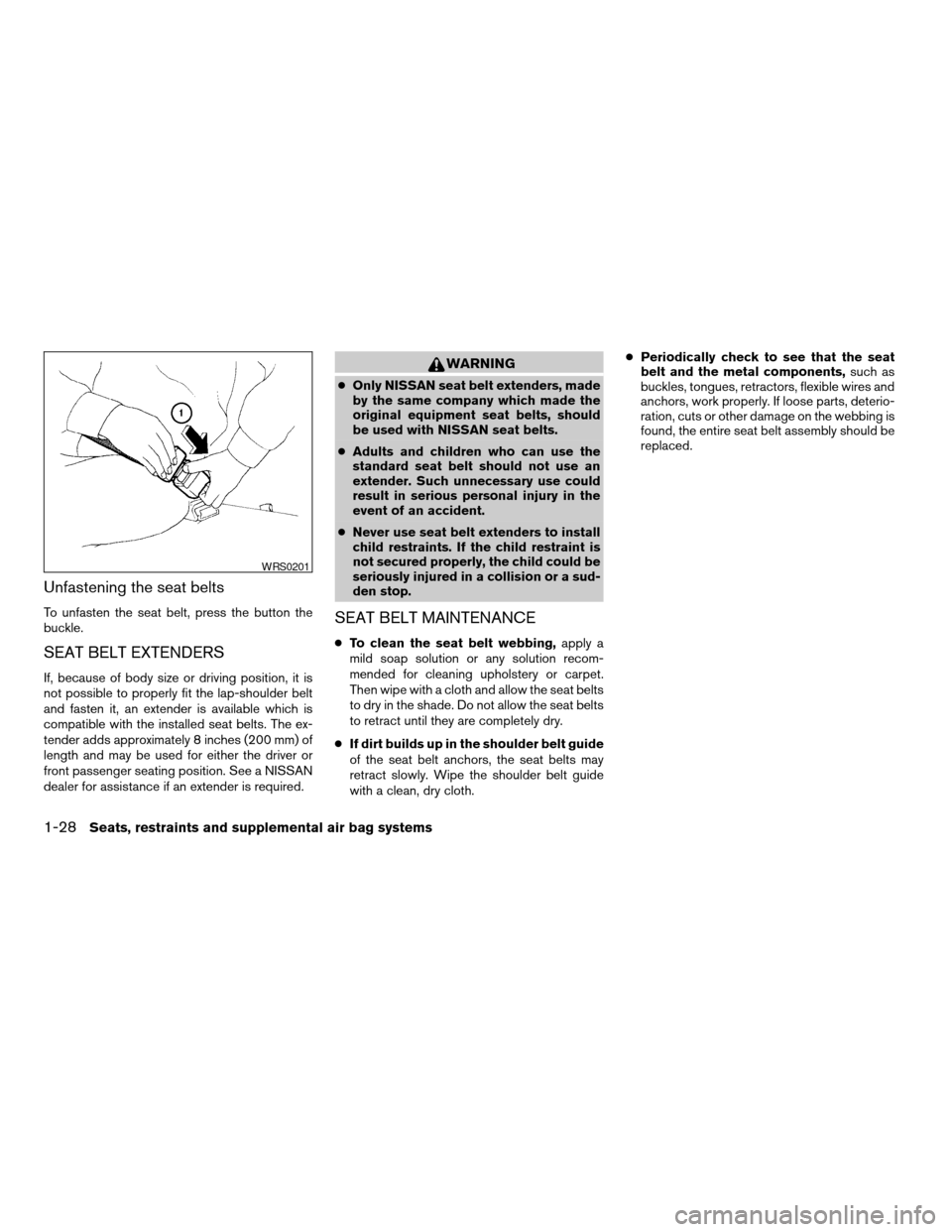
Unfastening the seat belts
To unfasten the seat belt, press the button the
buckle.
SEAT BELT EXTENDERS
If, because of body size or driving position, it is
not possible to properly fit the lap-shoulder belt
and fasten it, an extender is available which is
compatible with the installed seat belts. The ex-
tender adds approximately 8 inches (200 mm) of
length and may be used for either the driver or
front passenger seating position. See a NISSAN
dealer for assistance if an extender is required.
WARNING
cOnly NISSAN seat belt extenders, made
by the same company which made the
original equipment seat belts, should
be used with NISSAN seat belts.
cAdults and children who can use the
standard seat belt should not use an
extender. Such unnecessary use could
result in serious personal injury in the
event of an accident.
cNever use seat belt extenders to install
child restraints. If the child restraint is
not secured properly, the child could be
seriously injured in a collision or a sud-
den stop.
SEAT BELT MAINTENANCE
cTo clean the seat belt webbing,apply a
mild soap solution or any solution recom-
mended for cleaning upholstery or carpet.
Then wipe with a cloth and allow the seat belts
to dry in the shade. Do not allow the seat belts
to retract until they are completely dry.
cIf dirt builds up in the shoulder belt guide
of the seat belt anchors, the seat belts may
retract slowly. Wipe the shoulder belt guide
with a clean, dry cloth.cPeriodically check to see that the seat
belt and the metal components,such as
buckles, tongues, retractors, flexible wires and
anchors, work properly. If loose parts, deterio-
ration, cuts or other damage on the webbing is
found, the entire seat belt assembly should be
replaced.
WRS0201
1-28Seats, restraints and supplemental air bag systems
ZREVIEW COPY:Ð2003 Truck/Frontier(d22)
Owners Manual(owners)ÐUSA English(nna)
01/13/03Ðarosenma
X
Page 136 of 272
WARNING
cDo not leave children, impaired adults,
or pets alone in your vehicle. They could
accidentally injure themselves or oth-
ers through inadvertent operation of
the vehicle. Also, on hot, sunny days,
temperatures in a closed vehicle could
quickly become high enough to cause
severe or possibly fatal injuries to
people or animals.
cProperly secure all cargo with ropes or
straps to help prevent it from sliding or
shifting. Do not place cargo higher than
the seatbacks. In a sudden stop or col-
lision, unsecured cargo could cause
personal injury.
EXHAUST GAS (carbon monoxide)
WARNING
cDo not breathe exhaust gases; they
contain colorless and odorless carbon
monoxide. Carbon monoxide is danger-
ous. It can cause unconsciousness or
death.cIf you suspect that exhaust fumes are
entering the vehicle, drive with all win-
dows fully open, and have the vehicle
inspected immediately.
cDo not run the engine in closed spaces
such as a garage.
cDo not park the vehicle with the engine
running for any extended length of time.
cIf a special body, camper, or other
equipment is added for recreational or
other usage, follow the manufacturer’s
recommendation to prevent carbon
monoxide entry into the vehicle. Do not
occupy these areas while the engine is
running even if the vehicle is parked.
Some recreational vehicle appliances
such as stoves, refrigerators, heaters,
etc. may also generate carbon
monoxide.
cThe exhaust system and body should be
inspected by a qualified mechanic
whenever:
a. The vehicle is raised for service.
b. You suspect that exhaust fumes are
entering into the passenger
compartment.c. You notice a change in the sound of
the exhaust system.
d. You have had an accident involving
damage to the exhaust system, un-
derbody, or rear of the vehicle.
THREE-WAY CATALYST
The three-way catalyst is an emission control
device installed in the exhaust system. Exhaust
gases in the three-way catalyst are burned at
high temperatures to help reduce pollutants.
WARNING
cThe exhaust gas and the exhaust sys-
tem are very hot. Keep people, animals
or flammable materials away from the
exhaust system components.
cDo not stop or park the vehicle over
flammable materials such as dry grass,
waste paper or rags. They may ignite
and cause a fire.
CAUTION
cDo not use leaded gasoline. Deposits
from leaded gasoline will seriously re-
duce the three-way catalyst’s ability to
help reduce exhaust pollutants.
PRECAUTIONS WHEN STARTING
AND DRIVING
5-2Starting and driving
ZREVIEW COPY:Ð2003 Truck/Frontier(d22)
Owners Manual(owners)ÐUSA English(nna)
01/15/03Ðarosenma
X
Page 237 of 272

ENGINE
Model KA24DE VG33E/VG33ER
Type Gasoline, 4-cycle Gasoline, 4-cycle
Cylinder arrangement 4-cylinder in-line 6-cylinder, V-slanted at 60°
Bore x Stroke in (mm) 3.504 x 3.780 (89. x 96.0) 3.602 x 3.268 (91.5 x 83.0)
Displacement cu in (cm
3) 145.78 (2,389) 199.84 (3,275)
Firing order 1–3–4–2 1–2–3–4–5–6
Idle speed rpm
See the “Emission Control label” on the underside of the hood.
Ignition timing degree (B.T.D.C.) at idle speed degree/rpm
CO percentage at idle speed [No air] %
Except Supercharger Supercharger
Spark plug PFR5G-11 (Standard)*1 PFR5G-11 (Standard)*1 PFR6G-11 (Standard)*1
PFR6G-11 (Cold)*1 PFR6G-11 (Cold)*1 PFR7G-11 (Cold)*1
PFR4G-11 (Hot) *1 PFR5G-11 (Hot) *1
Spark plug gap (Nominal) in (mm) 0.043 (1.1) 0.043 (1.1)
Camshaft operation Timing chain Timing belt*2
Generator belt size
Width x Length in (mm) 0.413 x 35.63 (10.5 x 905) 0.701 x 31.69 (17.8 x 805)
*1: Always check with the Parts Department at a NISSAN dealer for the latest parts information.
*2: Periodic maintenance is necessary. See “Periodic maintenace schedules” in the “NISSAN Service and Maintenace Guide.”
The spark ignition system of this vehicle meets all requirements of the Canadian Interference-Causing Equipment Regulations.
SPECIFICATIONS
Technical and consumer information9-7
ZREVIEW COPY:Ð2003 Truck/Frontier(d22)
Owners Manual(owners)ÐUSA English(nna)
01/15/03Ðarosenma
X
Page 239 of 272

DIMENSIONS AND WEIGHTS
Unit: mm (in)
Drive Type 2WD 4WD
Body King Cab Crew Cab Crew Cab King Cab Crew Cab Crew Cab
Wheelbase Long Short Long Long Short Long
Overall length*1 5153 (202.9) 5077 (199.9) 5532 (217.8) 5153 (202.9) 5077 (199.9) 5532 (217.8)
Overall width 1808 (71.2)*4 1808 (71.2)**4 1808 (71.2)**4 1808 (71.2)*4 1808 (71.2)*4 1808 (71.2)*4
Overall height 1605 (63.2)*2
1694 (66.7)*3
1687 (66.4)*51694 (66.7)*3
1687 (66.4)*51694 (66.7)*3
1687 (66.4)*51694 (66.7)*3
1687 (66.4)*51687 (66.4) 1687 (66.4)
Front tread 1395 (54.9)*2
1525 (60)1525 (60) 1525 (60) 1525 (60) 1525 (60) 1525 (60)
Rear tread 1390 (54.7)*2
1507 (59.3)1507 (59.3) 1507 (59.3) 1507 (59.3) 1507 (59.3) 1507 (59.3)
Wheelbase 2950 (116.1) 2950 (116.1) 3329.9 (131.1) 2950 (116.1) 2950 (116.1) 3329.9 (131.1)
Gross vehicle weight rating
See the “F.M.V.S.S. certification label” on the driver side door jamb pillar. lb (kg)
Gross axle weight rating
Front lb (kg)
Rear lb (kg)
*1: Includes rear step bumper.
*2: XE with KA24DE engine.
*3: XE with VG33E engine and SE models.
*4: With over-fender.
*5: SC with VG33ER engine.
Technical and consumer information9-9
ZREVIEW COPY:Ð2003 Truck/Frontier(d22)
Owners Manual(owners)ÐUSA English(nna)
01/16/03Ðcathy
X
Page 252 of 272

Trailer towing tips
In order to gain skill and an understanding of the
vehicle’s behavior, you should practice turning,
stopping and backing up in an area which is free
from traffic. Steering stability and braking perfor-
mance will be somewhat different than under
normal driving conditions.
cAlways secure items in the trailer to prevent
load shift while driving.
cAvoid abrupt starts, acceleration or stops.
cAvoid sharp turns or lane changes.
cAlways drive your vehicle at a moderate speed.
cAlways block the wheels on both vehicle and
trailer when parking. Parking on a slope is not
recommended; however, if you must do so,
and if your vehicle is equipped with an auto-
matic transmission, first block the wheels and
apply the parking brake, and then move the
transmission shift selector lever into the P
(Park) position. If you move the shift selector
lever to the P (Park) position before blocking
the wheels and applying the parking brake,
transmission damage could occur.
cWhen going down a hill, shift into a lower gear
and use the engine braking effect. When go-
ing up a long grade, downshift the transmis-
sion to a lower gear and reduce speed toreduce chances of engine overloading and/or
overheating. However, for long steep grades,
do not stay in 1st or 2nd gear when driving
above 35 MPH (56 km/h) .
cIf the engine coolant rises to an extremely high
temperature when the air conditioner system
is on, turn off the air conditioner. Coolant heat
can be additionally vented by opening the win-
dows, switching the fan control to high and
setting the temperature control to the HOT
position.
cTrailer towing requires more fuel than normal
circumstances.
cAvoid towing a trailer for your vehicle’s first
500 miles (805 km) .
cHave your vehicle serviced more often than at
intervals specified in the recommended Main-
tenance Schedule in the “NISSAN Service
and Maintenance Guide”.
cWhen making a turn, your trailer wheels will be
closer to the inside of the turn than your vehicle
wheels. To compensate for this, make a larger
than normal turning radius during the turn.
cCrosswinds and rough roads will adversely
affect vehicle/trailer handling, possibly caus-
ing vehicle sway. When being passed by
larger vehicles, be prepared for possible
changes in crosswinds that could affect ve-hicle handling. If swaying does occur, firmly
grip the steering wheel, steer straight ahead,
and immediately (but gradually) reduce vehicle
speed. This combination will help stabilize the
vehicle. Never increase speed.
cBe careful when passing other vehicles. Pass-
ing while towing a trailer requires considerably
more distance than normal passing. Remem-
ber, the length of the trailer must also pass the
other vehicle before you can safely change
lanes.
cTo maintain engine braking efficiency and
electrical charging performance, do not use
5th gear (manual transmission) or overdrive
(automatic transmission) .
cAvoid holding the brake pedal down too long
or too frequently. This could cause the brakes
to overheat, resulting in reduced braking effi-
ciency.
When towing a trailer, transmission
oil/fluid should be changed more fre-
quently. For additional information, see the
“Maintenance and do-it-yourself” section
earlier in this manual.
9-22Technical and consumer information
ZREVIEW COPY:Ð2003 Truck/Frontier(d22)
Owners Manual(owners)ÐUSA English(nna)
01/15/03Ðarosenma
X