Page 34 of 360
34 Getting startedAdjusting
AdjustingSeatsWarning!
G
All seat, head restraint, steering wheel, and
rear view mirror adjustments, as well as fas-
tening of seat belts, must be done before
the vehicle is put into motion.Warning!
G
Do not adjust the driver’s seat while driving.
Adjusting the seat while driving could cause
the driver to lose control of the vehicle.
Never ride in a moving vehicle with the seat
back reclined. Sitting in an excessively re-
clined position can be dangerous. You could
slide under the seat belt in a collision. If you
slide under it, the belt would apply force at
the abdomen or neck. That could cause se-
rious or fatal injuries.
The seat back and seat belts provide the
best restraint when the wearer is in an up-
right position and belts are properly posi-
tioned on the body. Your seat must be
adjusted so that you can correctly fasten
your seat belt (
�page 40).
Never place hands under the seat or near
any moving parts while a seat is being ad-
justed.
Warning!
G
When leaving the vehicle, always remove the
key from the starter switch, and lock your
vehicle.
The power seats can also be operated with
the driver’s or front passenger door open.
Do not leave children unattended in the ve-
hicle, or with access to an unlocked vehicle.
Unsupervised use of vehicle equipment may
cause an accident and/or serious personal
injury.
Warning!
G
Children 12 years old and under must never
ride in the front seat, except in a
Mercedes-Benz authorized BabySmart
TM
compatible child seat, which operates with
the BabySmart
TM system installed in the ve-
hicle to deactivate the passenger side front
airbag when it is properly installed. Other-
wise they will be struck by the airbag when
it inflates in a crash. If this happens, serious
or fatal injury will result.
According to accident statistics, children
are safer when properly restrained in the
rear seating positions than in the front seat-
ing positions. Infants and small children
must be seated in an appropriate infant or
child restraint system, which is properly se-
cured with the vehicle's seat belt and top
tether strap, or secured via lower anchors
and top tether strap, fully in accordance
with the child seat manufacturer's instruc-
tions.
Page 41 of 360

41 Getting started
Driving
1Latch plate
2Buckle
3Release button�
With a smooth motion, pull the belt
from the belt outlet.
�
Place the belt over your shoulder.
�
Push latch plate1 into buckle2 until it
clicks.
A child’s risk of serious or fatal injuries is
significantly increased if the child restraints
are not properly secured in the vehicle and
the child is not properly secured in the child
restraint. Warning!
G
Never ride in a moving vehicle with the back-
rest reclined. Sitting in an excessively re-
clined position can be dangerous. You could
slide under the seat belt in a collision. If you
slide under it, the belt would apply force at
the abdomen or neck. That could cause se-
rious or even fatal injuries. The backrest and
seat belt provide the best restraint when the
wearer is in an upright position and the belt
is properly positioned on the body.
Warning!
G
Never let more people ride in the vehicle
than there are seat belts available. Be sure
everyone riding in the vehicle is correctly re-
strained with a separate seat belt - even
those in the rear.Warning!
G
Read and observe the additional warning no-
tices printed in the “Safety and Security”
section (
�page 58) and (
�page 60).
��
Page 61 of 360

61 Safety and Security
Occupant safety
Warning!
G
Never ride in a moving vehicle with the back-
rest reclined. Sitting in an excessively re-
clined position can be dangerous. You could
slide under the seat belt in a collision. If you
slide under it, the belt would apply force at
the abdomen or neck. That could cause se-
rious or even fatal injuries. The backrest and
seat belt provide the best restraint when the
wearer is in an upright position and the belt
is properly positioned on the body.Warning!
G
Never let more people ride in the vehicle
than there are seat belts available. Be sure
everyone riding in the vehicle is correctly re-
strained with a separate seat belt.
Warning!
G
Damaged seat belts or belts that were highly
stressed in an accident must be replaced
and their anchoring points must also be
checked.
Only use seat belts which have been ap-
proved by Mercedes-Benz.
Do not make any modifications to the seat
belts. This can lead to unintended activation
or to failure.
Have all work carried out only by an autho-
rized Mercedes-Benz Light Truck Center.
Warning!
G
USE SEAT BELTS PROPERLY�
Seat belts can only work when used
properly. Never wear seat belts in any
other way than as described in this sec-
tion, as that could result in serious inju-
ries in case of an accident.
�
Each occupant should wear their seat
belt at all times, because seat belts help
reduce the likelihood of and potential
severity of injuries in accidents, includ-
ing rollovers. The integrated restraint
system includes SRS (driver airbag and
front passenger airbag), ETD (seat belt
emergency tensioning device for driv-
er’s seat, passenger seat and the out-
board passenger seats). The system is
designed to enhance the protection of-
fered to properly belted occupants in
certain frontal (front airbags) impacts
which exceed preset deployment
thresholds.
Page 98 of 360
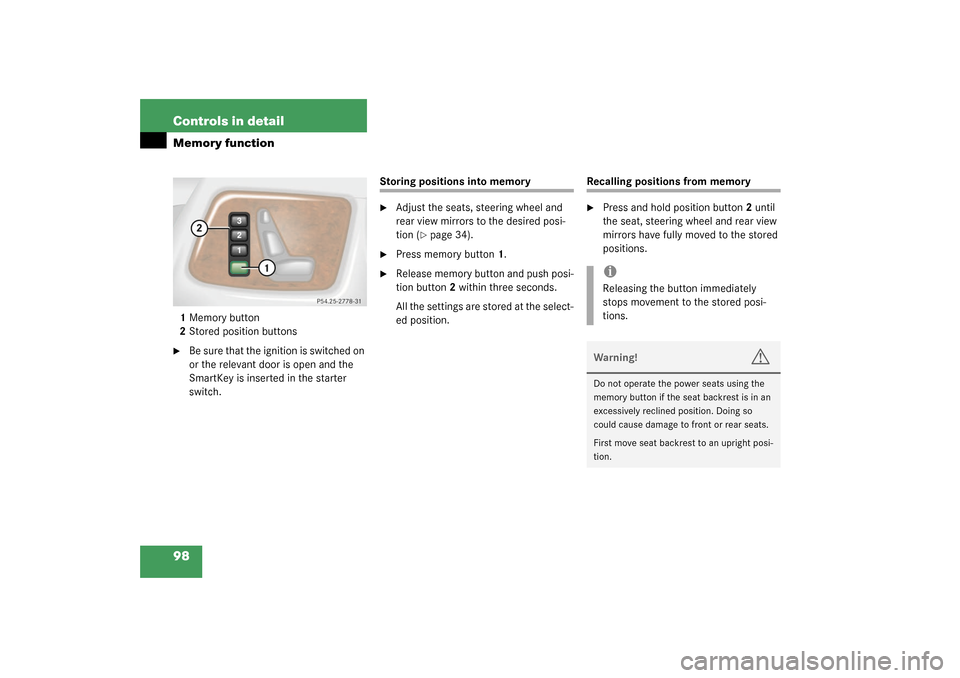
98 Controls in detailMemory function1Memory button
2Stored position buttons�
Be sure that the ignition is switched on
or the relevant door is open and the
SmartKey is inserted in the starter
switch.
Storing positions into memory�
Adjust the seats, steering wheel and
rear view mirrors to the desired posi-
tion (
�page 34).
�
Press memory button1.
�
Release memory button and push posi-
tion button2 within three seconds.
All the settings are stored at the select-
ed position.
Recalling positions from memory�
Press and hold position button2 until
the seat, steering wheel and rear view
mirrors have fully moved to the stored
positions.iReleasing the button immediately
stops movement to the stored posi-
tions.Warning!
G
Do not operate the power seats using the
memory button if the seat backrest is in an
excessively reclined position. Doing so
could cause damage to front or rear seats.
First move seat backrest to an upright posi-
tion.