210 OperationDriving instructionsOff-road driving increases strain on the ve-
hicle.
We recommend that you inspect the vehi-
cle for possible damage after each off-road
trip. Recognizing any damage and a subse-
quent timely repair reduces the chance of
a possible breakdown or accident later on.
Proceed as follows:�
Switch the transfer case in position
HIGH (
�page 141).
�
Disengage differential locks
(�page 146).
�
Remove excessive dirt from tires,
wheels, wheel housings, and under-
body.
For instance, after driving in mud, clean
the radiator, chassis, engine, brakes,
and wheels from extreme dirt using a
strong jet of water.
�
Inspect frame, oil pan, brake hoses,
etc., as well as vehicle underbody for
possible damage.
�
Check tires for possible damage and
remove foreign objects. Clean all exte-
rior lamps and conduct a brake test.
�
Clean all exterior lamps and check
them for possible damage.
�
Check for brush or branches caught in
the undercarriage.
They could increase the possibility of a
fire, as well as cut fuel and/or brake
lines, puncture rubber bellows of the
axles or drive shafts.
�
After continued operation in mud,
sand, water or other dirty conditions,
clean the brake discs, wheels, brake
pads and check and clean axle joints.
�
Conduct a brake test.Control and operation of radio trans-
mitters
COMAND, radio and telephone*Warning!
G
Do not forget that your primary responsibili-
ty is to drive the vehicle safely. Only operate
the COMAND, radio or telephone
1 if road,
traffic and weather conditions permit.
Bear in mind that at a speed of just 30 mph
(approximately 50 km / h), your vehicle is
covering a distance of approximately
50 feet (approximately 14 m) every second.
1Observe all legal requirements.
216 OperationEngine compartment
Engine compartmentHood
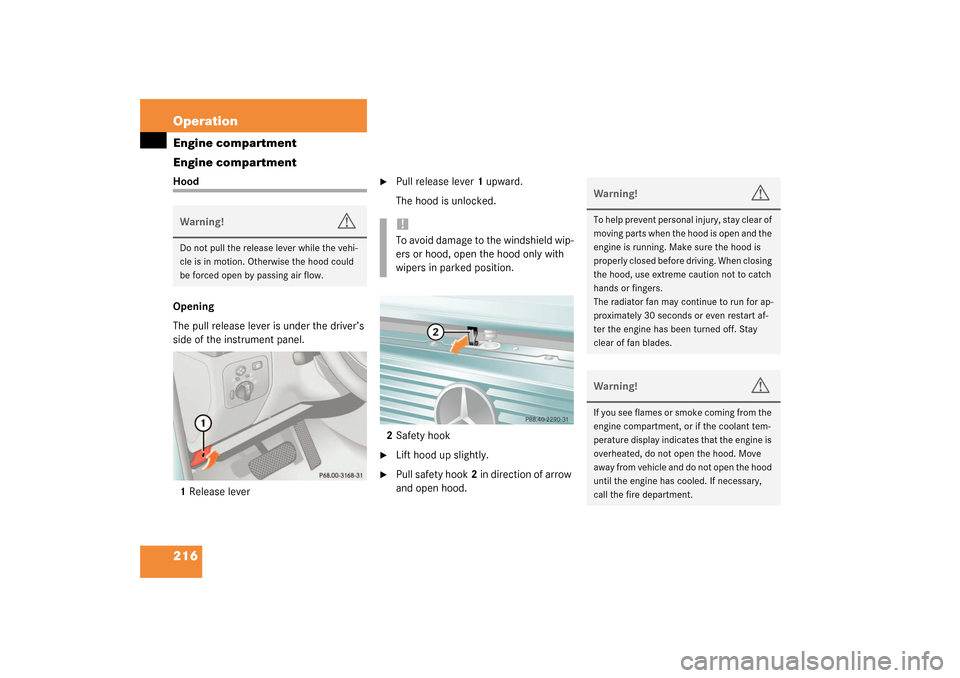
Opening
The pull release lever is under the driver’s
side of the instrument panel.
1Release lever
�
Pull release lever1 upward.
The hood is unlocked.
2Safety hook
�
Lift hood up slightly.
�
Pull safety hook2 in direction of arrow
and open hood.
Warning!
G
Do not pull the release lever while the vehi-
cle is in motion. Otherwise the hood could
be forced open by passing air flow.
!To avoid damage to the windshield wip-
ers or hood, open the hood only with
wipers in parked position.
Warning!
G
To help prevent personal injury, stay clear of
moving parts when the hood is open and the
engine is running. Make sure the hood is
properly closed before driving. When closing
the hood, use extreme caution not to catch
hands or fingers.
The radiator fan may continue to run for ap-
proximately 30 seconds or even restart af-
ter the engine has been turned off. Stay
clear of fan blades.Warning!
G
If you see flames or smoke coming from the
engine compartment, or if the coolant tem-
perature display indicates that the engine is
overheated, do not open the hood. Move
away from vehicle and do not open the hood
until the engine has cooled. If necessary,
call the fire department.
299 Practical hints
Towing the vehicle
Towing the vehicle
Mercedes-Benz recommends that the vehi-
cle be transported with all wheels off the
ground using flatbed or appropriate wheel
lift/dolly equipment. This method is pref-
erable to other types of towing.
When circumstances do not permit the
recommended towing methods, the vehi-
cle may be towed with all wheels on the ground only so far as necessary to have the
vehicle moved to a safe location where the
recommended towing methods can be em-
ployed.
!Use flatbed or wheel lift/dolly equip-
ment, with key in starter switch turned
to position0.
Do not tow with sling-type equipment.
Towing with sling-type equipment over
bumpy roads will damage radiator and
supports.
To prevent damage during transport,
do not tie down vehicle by its chassis or
suspension parts. Use the towing eyes.
Switch off the ESP (
�page 76),
tow-away alarm (
�page 80) and the
automatic central locking
(
�page 128).
!When towing the vehicle with all wheels
on the ground, the selector lever must
be in position N and the key m us t be in
starter switch position 2.
When towing the vehicle with all wheels
on the ground, the vehicle may be
towed only for distances up to 30 miles
(50 km) and at a speed not to exceed
30 mph (50 km/h).
If the vehicle is towed with one axle
raised (observe instructions regarding
flexible drive shaft and propeller
shafts), the engine must be shut off
(key in starter switch position1). Oth-
erwise, the 4-ETS may become en-
gaged which may cause loss of towing
control.
!Do not tow-start the vehicle.Warning!
G
Prior to towing the vehicle with all wheels on
the ground, make certain that the key is in
starter switch position2.
If the key is left in the starter switch
position0 for an extended period of time, it
can no longer be turned in the switch. In this
case, the steering is locked. To unlock, re-
move key from starter switch and reinsert.
Always tow with a tow bar if:�
the engine will not run
�
there is a malfunction in the power sup-
ply or in the vehicle’s electrical system
as that will be necessary to adequately con-
trol the towed vehicle.