Page 119 of 399

119 Controls in detail
Instrument cluster
Coolant temperature displayDuring severe operating conditions and
stop-and-go city traffic, the coolant tem-
perature may rise close to 248°F (120°C).
The engine should not be operated with
the coolant temperature above 248°F
(120°C). Doing so may cause serious en-
gine damage which is not covered by the
Mercedes-Benz Limited Warranty.
Trip odometer�
Check to see that the trip odometer
and main odometer (
�page 121) ap-
pear in the multifunction display.
�
Press and hold the reset knob on the in-
strument cluster (
�page 22) until the
trip odometer is reset.
Warning!
G
�
Driving when your engine is badly over-
heated can cause some fluids which
may have leaked into the engine com-
partment to catch fire. You could be se-
riously burned.
�
Steam from an overheated engine can
cause serious burns and can occur just
by opening the engine hood. Stay away
f r o m t h e e n g i n e i f y o u s e e o r h e a r s t e a m
coming from it.
Turn off the engine, get out of the vehicle
and do not stand near the vehicle until it
cools down.iExcessive coolant temperatures trigger
a warning in the multifunction display.
Page 120 of 399

120 Controls in detailInstrument clusterTachometer
The red marking on the tachometer de-
notes excessive engine speed.
To help protect the engine, the fuel supply
is interrupted if the engine is operated
within the red marking.
Outside temperature indicator
The temperature sensor is located in the
front bumper area. Due to its location, the
sensor can be affected by road or engine
heat during idling or slow driving. This
means that the accuracy of the displayed
temperature can only be verified by com-
parison to a thermometer placed next to
the sensor, not by comparison to external
displays (e.g. bank signs etc.).When moving the vehicle into colder ambi-
ent temperatures (e.g. when leaving your
garage), you will notice a delay before the
lower temperature is displayed.
A delay also occurs when ambient temper-
atures rise. This prevents inaccurate tem-
perature indications caused by heat
radiated from the engine during idling or
slow driving.
!Avoid driving at excessive engine
speeds, as it may result in serious en-
gine damage that is not covered by the
Mercedes-Benz Limited Warranty.
Warning!
G
The outside temperature indicator is not de-
signed to serve as an ice-warning device and
is therefore unsuitable for that purpose.
Indicated temperatures just above the freez-
ing point do not guarantee that the road sur-
face is free of ice. The road may still be icy,
especially in wooded areas or on bridges.
Page 151 of 399
151 Controls in detail
Automatic transmission
Automatic transmission
Information for driving with an automatic
transmission is found in the "Getting start-
ed" section (
�page 43).
Your transmission adapts its gear shifting
process to your individual driving style by
continually adjusting the shift points up or
down. These shift point adjustments are
performed based on current operating and
driving conditions.
If the operating conditions change, the au-
tomatic transmission reacts by adjusting
its gear shift program.The automatic transmission selects indi-
vidual gears automatically, depending on
�
the selector lever positionD with gear
ranges4, 3, 2, 1 (
�page 153)
�
the selected shift program (W/S)
(�page 155)
�
the position of the accelerator pedal
(�page 156)
�
the vehicle speed
The current selector lever position and
shift program (W/S) appear in the speed-
ometer display (
�page 121).
An additional indication of the current se-
lector lever position can be found on the
cover of the shifting-gate. The indicators
come on when you activate a switch (e.g.
unlocking the vehicle or opening a door)
and go out after approximately 15 min-
utes.When the selector lever is in positionD,
you can influence transmission shifting by
�
limiting the gear range
�
changing gears yourself
iDuring the brief warm-up, the transmis-
sion upshifting is delayed. This allows
the catalytic converter to heat up more
quickly to operating temperatures.
Warning!
G
It is dangerous to shift the selector lever out
of P or N if the engine speed is higher than
idle speed. If your foot is not firmly on the
brake pedal, the vehicle could accelerate
quickly forward or reverse. You could lose
control of the vehicle and hit someone or
something. Only shift into gear when the en-
gine is idling normally and when your right
foot is firmly on the brake pedal.
Page 164 of 399
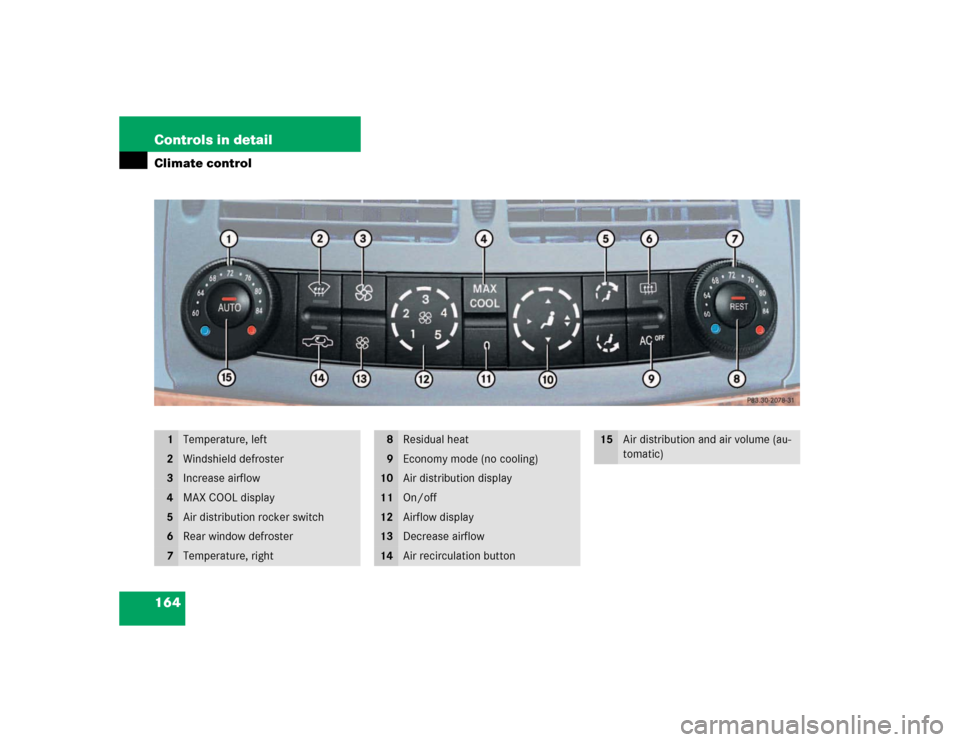
164 Controls in detailClimate control
1
Temperature, left
2
Windshield defroster
3
Increase airflow
4
MAX COOL display
5
Air distribution rocker switch
6
Rear window defroster
7
Temperature, right
8
Residual heat
9
Economy mode (no cooling)
10
Air distribution display
11
On/off
12
Airflow display
13
Decrease airflow
14
Air recirculation button
15
Air distribution and air volume (au-
tomatic)
Page 165 of 399

165 Controls in detail
Climate control
The climate control is operational whenev-
er the engine is running. You can operate
the climate control system in either the au-
tomatic or manual mode. The system cools
or heats the interior depending on the se-
lected interior temperature and the cur-
rent outside temperature.
Nearly all dust particles, pollutants and
odors are filtered out before outside air en-
ters the passenger compartment through
the air distribution system.
The air conditioning will not engage (no
cooling) if the AC
OFF
mode is selected
(
�page 170).
Setting the temperature
Use temperature controls1 and7 to sepa-
rately adjust the air temperature on each
side of the passenger compartment. You
should raise or lower the temperature set-
ting in small increments, preferably start-
ing at 72°F (22°C).
Increasing�
Turn the control slightly to the right.
The climate control system will corre-
spondingly adjust the interior air tem-
perature.
Decreasing
�
Turn the control slightly to the left.
The climate control system will corre-
spondingly adjust the interior air tem-
perature.
Warning!
G
Follow the recommended settings for heat-
ing and cooling given on the following pag-
es. Otherwise the windows could fog up,
impairing visibility and endangering you and
others.iIf the vehicle interior is hot, ventilate
the interior before driving off.
Keep the air intake grille in front of the
windshield free of snow and debris.
Do not obstruct air flow by placing ob-
jects on the air flow-through exhaust
slots below the rear window.
Page 166 of 399
166 Controls in detailClimate controlAdjusting air distribution
Adjusting manually
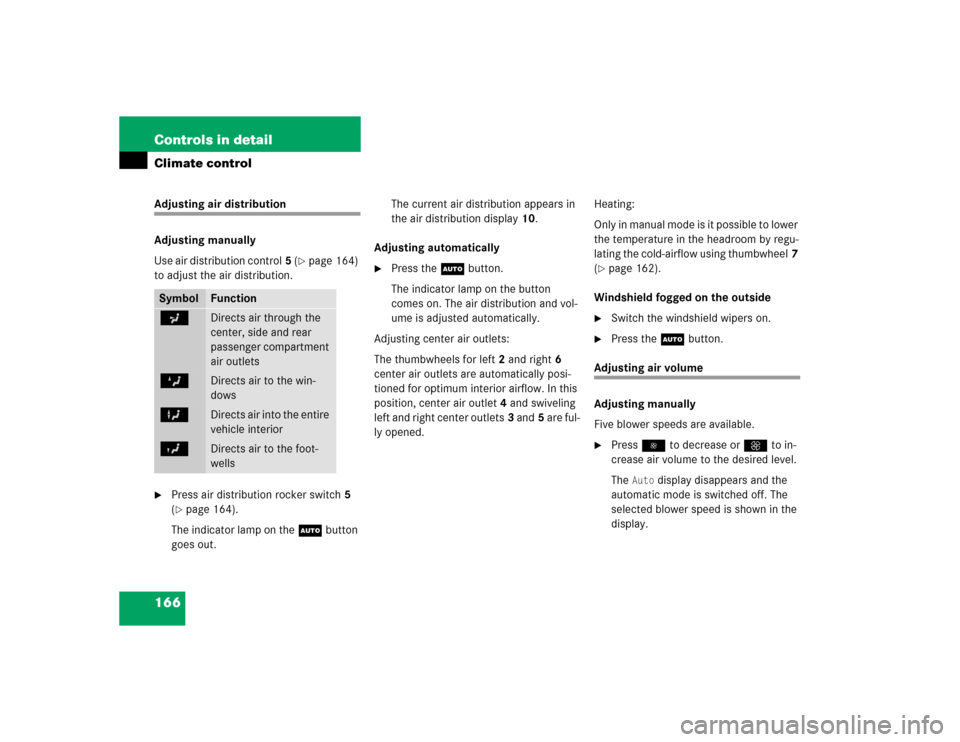
Use air distribution control5 (
�page 164)
to adjust the air distribution.
�
Press air distribution rocker switch5
(�page 164).
The indicator lamp on the U button
goes out.The current air distribution appears in
the air distribution display10.
Adjusting automatically
�
Press the U button.
The indicator lamp on the button
comes on. The air distribution and vol-
ume is adjusted automatically.
Adjusting center air outlets:
The thumbwheels for left2 and right6
center air outlets are automatically posi-
tioned for optimum interior airflow. In this
position, center air outlet4 and swiveling
left and right center outlets3 and5 are ful-
ly opened.Heating:
Only in manual mode is it possible to lower
the temperature in the headroom by regu-
lating the cold-airflow using thumbwheel7
(
�page 162).
Windshield fogged on the outside
�
Switch the windshield wipers on.
�
Press the U button.
Adjusting air volume
Adjusting manually
Five blower speeds are available.�
Press˜ to decrease orQ to in-
crease air volume to the desired level.
The
Auto
display disappears and the
automatic mode is switched off. The
selected blower speed is shown in the
display.
Symbol
Function
a
Directs air through the
center, side and rear
passenger compartment
air outlets
Z
Directs air to the win-
dows
X
Directs air into the entire
vehicle interior
Y
Directs air to the foot-
wells
Page 171 of 399
171 Controls in detail
Climate control
Residual heat and ventilation*
With the engine switched off, it is possible
to continue to heat or ventilate the interior
for up to 30 minutes. This feature makes
use of the residual heat produced by the
engine.
Activating�
Turn the key in the starter switch to
position1 or remove it from the starter
switch.
�
Press buttonT (
�page 164).
The indicator lamp on buttonT
comes on.Deactivating
�
Press buttonT (
�page 164).
The indicator lamp on buttonT
goes out.
The residual heat is automatically turned
off:
�
when the ignition is switched on
�
after about 30 minutes
�
if the battery voltage drops
iHow long the system will provide heat-
ing depends on the coolant tempera-
ture and the temperature set by the
operator. The blower will run at speed
setting1 regardless of the air distribu-
tion control setting.
Page 174 of 399
174 Controls in detailAutomatic climate control*
1
Air distribution, left
2
Windshield defroster
3
Temperature rocker switch, left
4
Display
5
Temperature rocker switch, right
6
Rear window defroster
7
Air distribution, right
8
Automatic air distribution, right and
blower speed
9
Activated charcoal filter
10
Rear air-conditioning remote con-
trol
11
Increase airflow
12
On/off
13
Decrease airflow
14
Economy mode (no cooling)
Residual heat
15
Air recirculation button
16
Automatic air distribution, left and
blower speed