Page 98 of 376

98 Controls in detailMemory function*
Memory function*
You can store up to three different settings
per key.
The following settings are saved for each
stored position:�
Driver’s seat and backrest position
�
Steering wheel position
�
Driver’s side exterior rear view mirror
position
�
Passenger side exterior rear view mir-
ror position
�
Front passenger seat position
These key-dependent memory settings
can be deactivated if desired (
�page 99).
!Prior to operating the vehicle, the driv-
er should check and adjust the seat
height, seat position fore and aft, and
seat backrest angle if necessary, to
ensure adequate control, reach and
comfort. The head restraint should also
be adjusted for proper height. Also see
airbag section (
�page 57) for proper
seat positioning.
In addition, adjust the steering wheel to
ensure adequate control, reach, opera-
tion and comfort. Both the inside and
outside rear view mirrors should be ad-
justed for adequate rear vision.
Fasten seat belts. Infants and small
children should be seated in a properly
secured restraint system that complies
with U.S. Federal Motor Vehicle Safety
Standards 213 and 225 and Canadian
Motor Vehicle Safety Standards 213
and 210.2.
Warning!
G
Do not activate the memory function while
driving. Activating the memory function
while driving could cause the driver to lose
control of the vehicle.
Page 200 of 376
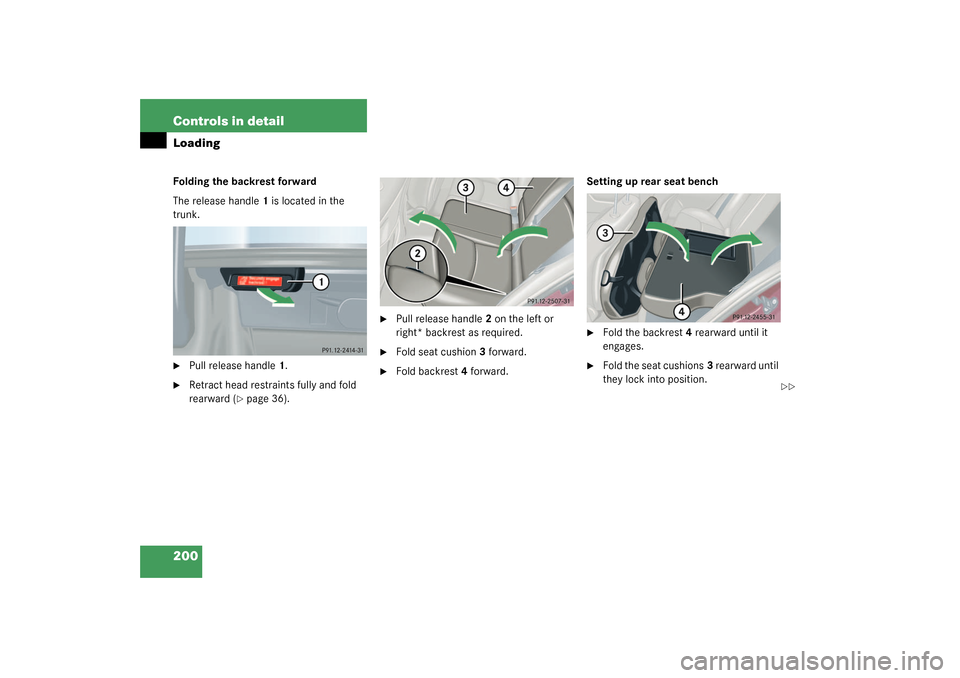
200 Controls in detailLoadingFolding the backrest forward
The release handle1 is located in the
trunk.�
Pull release handle1.
�
Retract head restraints fully and fold
rearward (
�page 36).
�
Pull release handle2 on the left or
right* backrest as required.
�
Fold seat cushion3 forward.
�
Fold backrest4 forward.Setting up rear seat bench
�
Fold the backrest4 rearward until it
engages.
�
Fold the seat cushions3 rearward until
they lock into position.
��
Page 257 of 376

257 Practical hints
What to do if …
-
The yellow ABS malfunction
indicator lamp comes on while
driving.
The ABS has detected a malfunction and has
switched off. The BAS and the ESP are also
switched off (see messages in display).
The brake system is still functioning normally
but without the ABS available.
�
Continue driving with added caution.
Wheels may lock during hard braking
reducing steering capability.
�
Have the system checked at an autho-
rized Mercedes-Benz Center as soon
as possible.
Failure to follow these instructions in-
creases the risk of an accident.
The charging voltage has fallen below
10 volts and the ABS has switched off.
�
When the voltage is above this value
again, the ABS is operational again.
�
If necessary, have the generator and
battery checked.
1
The red SRS indicator lamp lights
up while driving.
There is a malfunction in the restraint sys-
tems. The airbags or emergency tensioning
device (ETDs) could deploy unexpectedly or
fail to activate in an accident.
�
Drive with added caution to the
nearest authorized Mercedes-Benz
Center.
Problem
Possible cause
Suggested solution
Warning!
G
In the event a malfunction of the SRS is indi-
cated as outlined above, the SRS may not be
operational. For your safety, we strongly
recommend that you visit an authorized
Mercedes-Benz Center immediately to have
the system checked; otherwise the SRS may
not be activated when needed in an
accident, which could result in serious or
fatal injury, or it might deploy unexpectedly
and unnecessarily which could result in an
accident and/or injury to you or to others.
Page 260 of 376
260 Practical hintsWhat to do if …Lamp in center consoleProblem
Possible cause
Suggested solution
7
The indicator lamp lights up.
A BabySmart
TM child seat is installed on the
front passenger seat. Therefore the front
passenger airbag is switched off.
The system is malfunctioning when there is
no BabySmart
TM child seat installed on the
front passenger seat.
�
Have the system checked as soon as
possible by an authorized
Mercedes-Benz Center.
7
The indicator lamp does not light
up with a BabySmart
TM child
seat properly installed on the
front passenger seat.
The system is malfunctioning.
�
Make sure that there is nothing be-
tween seat cushion and child seat and
check installation of the child seat.
�
If the light remains out, have the sys-
tem checked as soon as possible by
an authorized Mercedes-Benz Center.
Do not use the BabySmart
TM restraint
to transport children on the front pas-
senger seat until the system has been
repaired.
Page 277 of 376

277 Practical hints
What to do if …
Display
Possible cause
Suggested solution
L
TELE AID
VISIT WORKSHOP!
One or more main functions of the Tele
Aid system* are malfunctioning.
�
Have the Tele Aid system* checked by
an authorized Mercedes-Benz Center.
ì
FUNCTION
NOT AVAILABLE!
This display appears if button
ì
or
í
on the multifunction steering
wheel is pressed and the vehicle is not
equipped with a telephone*.
1
RESTRAINT SYSTEM
VISIT WORKSHOP!
The system is malfunctioning.
�
Drive with added caution to the
nearest authorized Mercedes-Benz
Center.
Warning!
G
In the event a malfunction of the SRS is indi-
cated as outlined above, the SRS may not be
operational. For your safety, we strongly
recommend that you visit an authorized
Mercedes-Benz Center immediately to have
the system checked; otherwise the SRS may
not be activated when needed in an
accident, which could result in serious or
fatal injury, or it might deploy unexpectedly
and unnecessarily which could also result in
injury.
Page 305 of 376

305 Practical hints
Battery
Reconnecting the battery�
Turn off all electrical consumers.
�
Connect the positive lead and fasten its
cover.
�
Connect the negative lead.
�
Reinstall the filter box (
�page 303).Batteries contain materials that can harm
the environment if disposed of improperly.
Large 12 volt storage batteries contain
lead. Recycling of batteries is the preferred
method of disposal. Many states require
sellers of batteries to accept old batteries
for recycling.
!NEVER invert the terminal connections!!The battery, its filler caps and the vent
tube must always be securely installed
when the vehicle is in operation.
iThe following procedures must be car-
ried out following any interruption of
battery power (e.g. due to reconnec-
tion):�
Set the clock (
�page 120)
Vehicles with COMAND*:
see COMAND operator’s manual.
�
Resynchronize the front seat head
restraints (
�page 94).
�
Resynchronize the ESP
(�page 75).
�
Resynchronize side windows
(�page 189).
�
Resynchronize sliding/pop-up
roof* (
�page 191).
Page 341 of 376

341 Technical terms
ABS
(A
ntilock B
rake S
ystem)
Prevents the wheels from locking up
during braking so that the vehicle can
continue to be steered.
Alignment bolt
Metal pin with thread. The centering
pin is an aid used when changing a tire
to align the wheel with the wheel hub.
BabySmart
TM
airbag deactivation
system
This system detects if a special system
compatible child restraint seat is in-
stalled on the front passenger seat. The
system will automatically deactivate
the passenger front airbag when such a
seat is properly installed (indicator
lamp
7
located in the center con-
sole lights up). See your authorized
Mercedes-Benz Center for availability. BabySmart
TM
compatible child seats
Special restraint system for children.
The sensor system for the passenger
seat prevents deployment of the pas-
senger side airbag if a BabySmart
TM
compatible child seat is installed.
BAS
(B
rake A
ssist S
ystem)
System for potentially reducing braking
distances in emergency braking situa-
tions. The system is activated when it
senses an emergency based on how
fast the brake is applied.
Bi-Xenon headlamps*
Headlamps which use an electric arc as
the light source and produce a more
intense light than filament headlamps.
Bi-Xenon headlamps produce low
beam and high beam.CAC
(C
ustomer A
ssistance C
enter)
Mercedes-Benz customer service cen-
ter, which can help you with any ques-
tions about your vehicle and provide
assistance in the event of a break-
down.
CAN system
(C
ontroller A
rea N
etwork)
Data bus network serving to control
vehicle functions such as door locking
or windshield wiping.
Cockpit
All instruments, switches, buttons and
indicator/warning lamps in the passen-
ger compartment needed for vehicle
operation and monitoring.
Page 344 of 376

344 Technical termsPoly-V-belt drive
Drives engine-components (alternator,
AC compressor, etc.) from the engine.
Power train
Collective term designating all compo-
nents used to generate and transmit
motive power to the drive axles, includ-
ing
�
engine
�
clutch/torque converter
�
transmission
�
transfer case*
�
drive shaft
�
axle shafts/axles
Program mode selector switch
Used to switch the automatic transmis-
sion between standard operationS and
winter operationW.Remote Vehicle Diagnostics
Transmission of vehicle data and cur-
rent location to the Mercedes-Benz
Customer Assistance Center for sub-
scribers to Tele Aid service.
Restraint systems
Seat belts, belt tensioners, airbags and
child restraint systems. As indepen-
dent systems, their protective func-
tions complement one another.
RON
(R
esearch O
ctane N
umber)
The Research Octane Number for gaso-
line as determined by a standardized
method. It is an indication of a gaso-
line's ability to resist undesired detona-
tion (knocking). The average of both
the ->MON (Motor Octane Number)
and RON (Research Octane Number) is
posted at the pump, also known as
ANTI-KNOCK INDEX.Shift lock
When the vehicle is parked, this lock
prevents the transmission selector le-
ver from being moved out of positionP
without key turned and brake pedal
depressed.
SRS
(S
upplemental R
estraint S
ystem)
Seat belts, emergency tensioning de-
vice and airbags. Though independent
systems, they are closely interfaced to
provide effective occupant protection.