2003 MAZDA MODEL TRIBUTE cruise control
[x] Cancel search: cruise controlPage 1 of 248

Introduction 3
Instrument Cluster 8
Warning and control lights 10
Gauges 15
Entertainment Systems 17
AM/FM stereo with CD 17
AM/FM stereo with cassette and in-dash six CD 27
Climate Controls 44
Manual heating and air conditioning 44
Lights 48
Headlamps 48
Turn signal control 50
Bulb replacement 51
Driver Controls 56
Windshield wiper/washer control 56
Steering wheel adjustment 58
Power windows 60
Mirrors 61
Speed control (Cruise control) 62
Locks and Security 69
Keys 69
Locks 69
Anti-theft system 74
Seating and Safety Restraints 79
Seating 79
Safety restraints 89
Air bags 99
Child restraints 108
Table of Contents
1
Page 14 of 248

Four wheel drive indicator
(if equipped):Illuminates when
four-wheel drive is engaged, refer to
theDrivingchapter.
Note:If the light continues to flash,
have the system serviced.
Anti-theft system:Flashes when
the SecurilockyPassive Anti-theft
System has been activated. Refer to
SecuriLockypassive anti-theft
systemin theLocks and Securitychapter.
Speed control:Illuminates when
the speed control is activated. Turns
off when the speed control system
is deactivated, refer to theDriver Controlschapter.
Door ajar:Illuminates when the
ignition is in the ON position and
any door, liftgate, or liftgate window
is open.
Turn signals:Illuminates when the
left or right turn signal or the
hazard lights are turned on. If the
indicators stay on or flash faster, check for a burned out bulb.
High beams:Illuminates when the
high beam headlamps are turned on.
Safety belt warning chime:
Sounds to remind you to fasten your
safety belts.
Key-in-ignition warning chime:Sounds when the key is left in the
ignition in the OFF/LOCK or ACC position and the driver's door is
opened.
Headlamps on warning chime:Sounds when the headlamps or parking
lamps are on, the ignition is off (and the key is not in the ignition) and
the driver's door is opened.
CRUISE
Instrument Cluster
14
Page 132 of 248
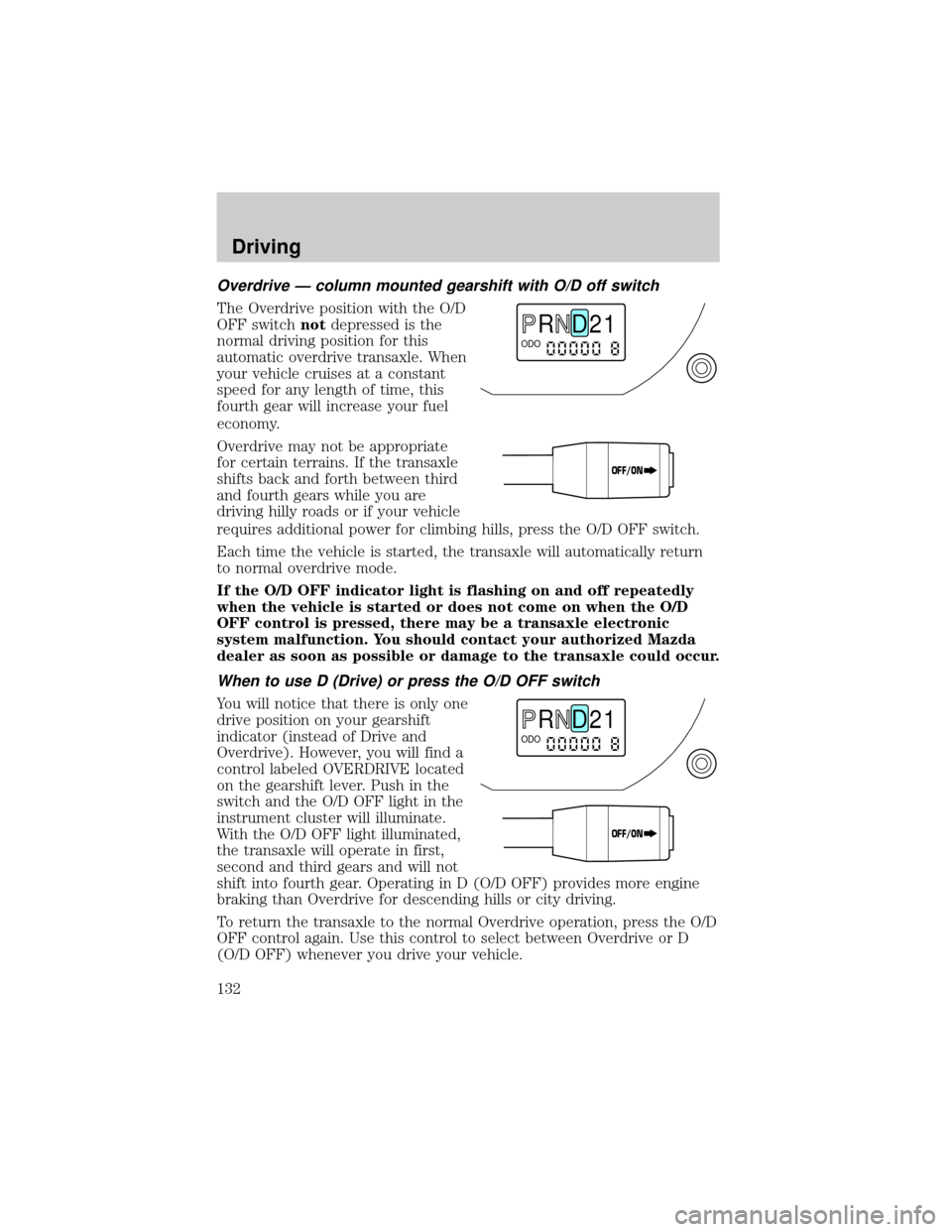
Overdrive Ð column mounted gearshift with O/D off switch
The Overdrive position with the O/D
OFF switchnotdepressed is the
normal driving position for this
automatic overdrive transaxle. When
your vehicle cruises at a constant
speed for any length of time, this
fourth gear will increase your fuel
economy.
Overdrive may not be appropriate
for certain terrains. If the transaxle
shifts back and forth between third
and fourth gears while you are
driving hilly roads or if your vehicle
requires additional power for climbing hills, press the O/D OFF switch.
Each time the vehicle is started, the transaxle will automatically return
to normal overdrive mode.
If the O/D OFF indicator light is flashing on and off repeatedly
when the vehicle is started or does not come on when the O/D
OFF control is pressed, there may be a transaxle electronic
system malfunction. You should contact your authorized Mazda
dealer as soon as possible or damage to the transaxle could occur.
When to use D (Drive) or press the O/D OFF switch
You will notice that there is only one
drive position on your gearshift
indicator (instead of Drive and
Overdrive). However, you will find a
control labeled OVERDRIVE located
on the gearshift lever. Push in the
switch and the O/D OFF light in the
instrument cluster will illuminate.
With the O/D OFF light illuminated,
the transaxle will operate in first,
second and third gears and will not
shift into fourth gear. Operating in D (O/D OFF) provides more engine
braking than Overdrive for descending hills or city driving.
To return the transaxle to the normal Overdrive operation, press the O/D
OFF control again. Use this control to select between Overdrive or D
(O/D OFF) whenever you drive your vehicle.
R D 2 1ODO
OFF/ON
R D 2 1ODO
OFF/ON
Driving
132
Page 222 of 248
![MAZDA MODEL TRIBUTE 2003 Owners Manual (in English) ²Carrying unnecessary weight may reduce fuel economy (approximately
0.4 km/L [1 mpg] is lost for every 180 kg [400 lb] of weight carried).
²Adding certain accessories to your vehicle (for example bu](/manual-img/28/15635/w960_15635-221.png "MAZDA MODEL TRIBUTE 2003 Owners Manual (in English) ²Carrying unnecessary weight may reduce fuel economy (approximately
0.4 km/L [1 mpg] is lost for every 180 kg [400 lb] of weight carried).
²Adding certain accessories to your vehicle (for example bu")
²Carrying unnecessary weight may reduce fuel economy (approximately
0.4 km/L [1 mpg] is lost for every 180 kg [400 lb] of weight carried).
²Adding certain accessories to your vehicle (for example bug
deflectors, rollbars/light bars, running boards, ski/luggage racks) may
reduce fuel economy.
²Using fuel blended with alcohol may lower fuel economy.
²Fuel economy may decrease with lower temperatures during the first
12±16 km (8±10 miles) of driving.
²Driving on flat terrain offers improved fuel economy as compared to
driving on hilly terrain.
²Transmissions give their best fuel economy when operated in the top
cruise gear and with steady pressure on the gas pedal.
²Close windows for high speed driving.
EPA window sticker
Every new vehicle should have the EPA window sticker. Contact your
dealer if the window sticker is not supplied with your vehicle. The EPA
window sticker should be your guide for the fuel economy comparisons
with other vehicles.
It is important to note the box in the lower left corner of the window
sticker. These numbers represent the Range of L/100 km (MPG)
expected on the vehicle under optimum conditions. Your fuel economy
may vary depending upon the method of operation and conditions.
EMISSION CONTROL SYSTEM
Your vehicle is equipped with various emission control components and a
catalytic converter which will enable your vehicle to comply with
applicable exhaust emission standards. To make sure that the catalytic
converter and other emission control components continue to work
properly:
²Use only the specified fuel listed.
²Avoid running out of fuel.
²Do not turn off the ignition while your vehicle is moving, especially at
high speeds.
²Have the items listed in your service maintenance section performed
according to the specified schedule.
The scheduled maintenance items listed in the scheduled maintenance
section are essential to the life and performance of your vehicle and to
its emissions system.
Maintenance and Specifications
222
Page 241 of 248

Cleaning your vehicle
engine compartment ..............188
instrument panel ....................190
interior .....................................190
interior trim ............................190
Mazda car care products .......191
plastic parts ............................189
washing ....................................187
waxing .....................................187
wheels ......................................188
wiper blades ............................189
Climate control (see Air
conditioning or Heating) ............44
Clock ......................................26, 39
Clutch
fluid ..........................................228
operation while driving ..........134
recommended shift speeds ....135
Console ........................................66
overhead ....................................58
Controls
power seat .................................81
Coolant
checking and adding ..............209
refill capacities ................213, 234
specifications ..........................236
Cruise control
(see Speed control) ....................62
Customer
Assistance ..................176±177, 180
D
Daytime running lamps
(see Lamps) ................................48
Defrost
rear window ..............................47Dipstick
automatic transmission
fluid ..........................................226
engine oil .................................203
Driving under special
conditions ..................133, 140, 143
sand .........................................142
snow and ice ...........................144
through water .................142, 147
E
Emergencies, roadside
jump-starting ..........................169
Emission control system ..........222
Engine ........................................236
cleaning ...................................188
coolant .....................................209
idle speed control ...................207
lubrication specifications .......236
refill capacities ........................234
service points ..................200±201
Engine block heater .................123
Engine oil ..................................203
checking and adding ..............203
dipstick ....................................203
filter, specifications ................206
recommendations ...................206
refill capacities ........................234
specifications ..........................236
Exhaust fumes ..........................123
F
Fluid capacities .........................234
Foglamps .....................................48
Four-Wheel Drive vehicles
description ..............................138
driving off road .......................139
indicator light .........................138
Index
241