2003 MAZDA MODEL TRIBUTE change time
[x] Cancel search: change timePage 194 of 248
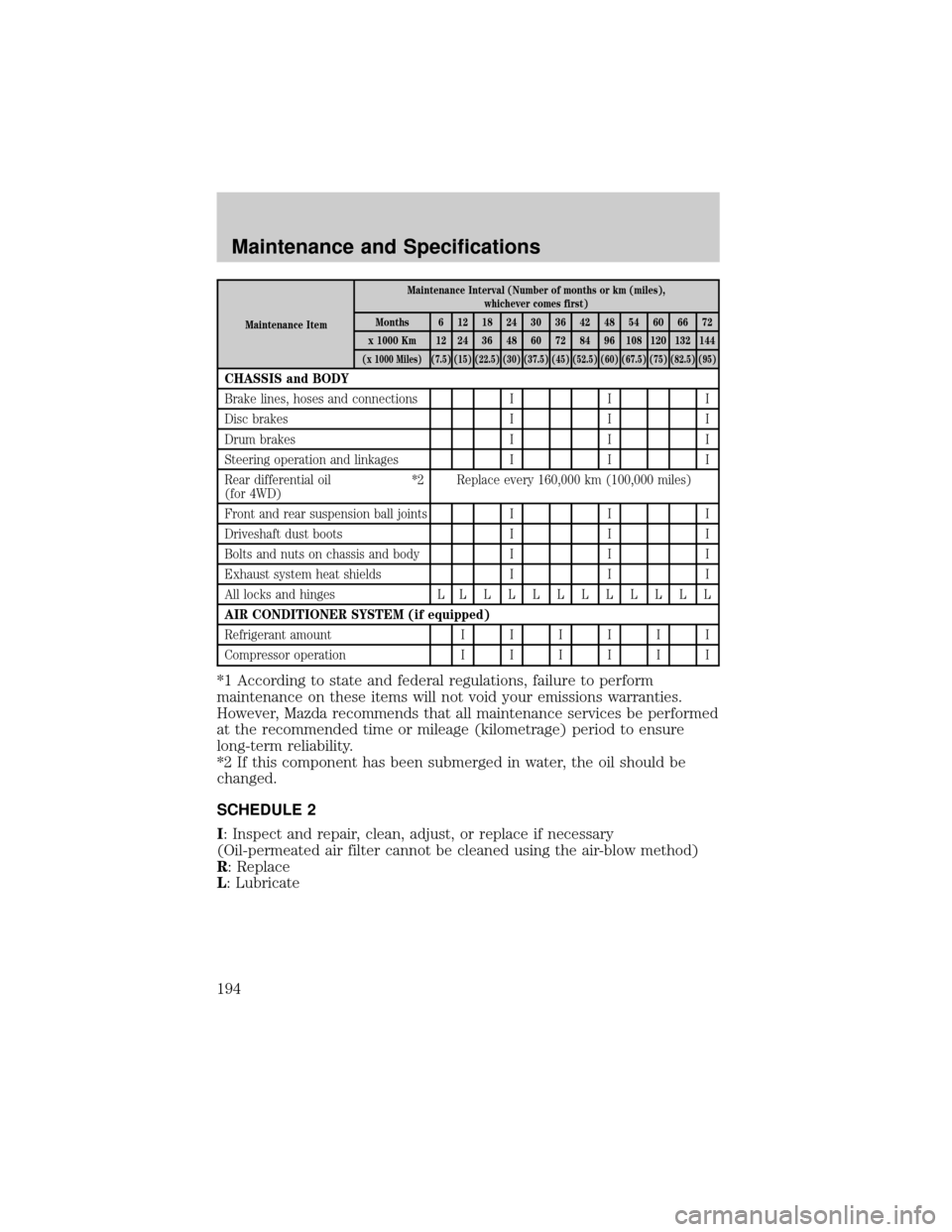
Maintenance ItemMaintenance Interval (Number of months or km (miles),
whichever comes first)
Months 6 12 18 24 30 36 42 48 54 60 66 72
x 1000 Km 12 24 36 48 60 72 84 96 108 120 132 144
(x 1000 Miles)(7.5) (15) (22.5) (30) (37.5) (45) (52.5) (60) (67.5) (75) (82.5) (95)
CHASSIS and BODY
Brake lines, hoses and connections I I I
Disc brakes I I I
Drum brakes I I I
Steering operation and linkages I I I
Rear differential oil
(for 4WD)*2 Replace every 160,000 km (100,000 miles)
Front and rear suspension ball joints I I I
Driveshaft dust boots I I I
Bolts and nuts on chassis and body I I I
Exhaust system heat shields I I I
All locks and hinges LLLLLLLLLLLL
AIR CONDITIONER SYSTEM (if equipped)
Refrigerant amountIIIIII
Compressor operationIIIIII
*1 According to state and federal regulations, failure to perform
maintenance on these items will not void your emissions warranties.
However, Mazda recommends that all maintenance services be performed
at the recommended time or mileage (kilometrage) period to ensure
long-term reliability.
*2 If this component has been submerged in water, the oil should be
changed.
SCHEDULE 2
I: Inspect and repair, clean, adjust, or replace if necessary
(Oil-permeated air filter cannot be cleaned using the air-blow method)
R: Replace
L: Lubricate
Maintenance and Specifications
194
Page 196 of 248

Maintenance ItemMaintenance Interval (Number of months or km (miles),
whichever comes first)
Months 4 8 12 16 20 24 28 32 36 40 44 48
x 1000 Km 8 16 24 32 40 48 56 64 72 80 88 96
(x 1000 Miles) (5) (10) (15) (20) (25) (30) (35) (40) (45) (50) (55) (60)
CHASSIS and BODY
Brake lines, hoses and connections I I
Brake fluid level IIIIIIIIIIII
Disc brakesIIII
Drum brakes I I
Tire inflation pressure and tire wear IIIIIIIIIIII
Steering operation and linkages I I
Power steering fluid level IIIIIIIIIIII
Manual transaxle oil Replace every 48,000 km (30,000 miles)
Automatic transaxle fluid Replace every 48,000 km (30,000 miles)
Rear differential oil
(for 4WD)*2 Replace every 160,000 km (100,000 miles)
Transfer oil (for 4WD) *2 Replace every 48,000 km (30,000 miles)
Front and rear suspension ball
jointsII
Driveshaft dust boots I I
Bolts and nuts on chassis and bodyIIII
Exhaust system heat shields I I
All locks and hinges LLLLLLLLLLLL
Washer fluid level IIIIIIIIIIII
AIR CONDITIONER SYSTEM (if equipped)
Refrigerant amountIIII
Compressor operationIIII
*1 According to state and federal regulations, failure to perform
maintenance on these items will not void your emissions warranties.
However, Mazda recommends that all maintenance services be performed
at the recommended time or mileage (kilometrage) period to ensure
long-term reliability.
*2 If this component has been submerged in water, the oil should be
changed.
Maintenance and Specifications
196
Page 221 of 248

Driving style Ð good driving and fuel economy habits
Give consideration to the lists that follow and you may be able to change
a number of variables and improve your fuel economy.
Habits
²Smooth, moderate operation can yield up to 10% savings in fuel.
²Steady speeds without stopping will usually give the best fuel
economy.
²Idling for long periods of time (greater than one minute) may waste
fuel.
²Anticipate stopping; slowing down may eliminate the need to stop.
²Sudden or hard accelerations may reduce fuel economy.
²Slow down gradually.
²Driving at reasonable speeds (traveling at 88 km/h [55 mph] uses 15%
less fuel than traveling at 105 km/h [65 mph]).
²Revving the engine before turning it off may reduce fuel economy.
²Using the air conditioner or defroster may reduce fuel economy.
²You may want to turn off the speed control in hilly terrain if
unnecessary shifting between third and fourth gear occurs.
Unnecessary shifting of this type could result in reduced fuel
economy.
²Warming up a vehicle on cold mornings is not required and may
reduce fuel economy.
²Resting your foot on the brake pedal while driving may reduce fuel
economy.
²Combine errands and minimize stop-and-go driving.
Maintenance
²Keep tires properly inflated and use only recommended size.
²Operating a vehicle with the wheels out of alignment will reduce fuel
economy.
²Use recommended engine oil. Refer toLubricant specificationsin
this chapter.
²Perform all regularly scheduled maintenance items. Follow the
recommended maintenance schedule and owner maintenance checks
found in your vehicle service maintenance section.
Conditions
²Heavily loading a vehicle or towing a trailer may reduce fuel economy
at any speed.
Maintenance and Specifications
221
Page 226 of 248

TRANSMISSION FLUID
Checking automatic transmission fluid
Refer to your scheduled maintenance section for scheduled intervals for
fluid checks and changes. Your transaxle does not consume fluid.
However, the fluid level should be checked if the transaxle is not working
properly, i.e., if the transaxle slips or shifts slowly or if you notice some
sign of fluid leakage.
Automatic transmission fluid expands when warmed. To obtain an
accurate fluid check, drive the vehicle until it is warmed up
(approximately 30 km [20 miles]). If your vehicle has been
operated for an extended period at high speeds, in city traffic
during hot weather or pulling a trailer, the vehicle should be
turned off for about 30 minutes to allow fluid to cool before
checking.
1. Drive the vehicle 30 km (20 miles) or until it reaches normal
operating temperature.
2. Park the vehicle on a level surface and engage the parking brake.
3. With the parking brake engaged and your foot on the brake pedal,
start the engine and move the gearshift lever through all of the gear
ranges. Allow sufficient time for each gear to engage.
4. Latch the gearshift lever in P (Park) and leave the engine running.
5. Remove the dipstick, wiping it clean with a clean, dry lint free rag. If
necessary, refer toIdentifying components in the engine
compartmentin this chapter for the location of the dipstick.
6. Install the dipstick making sure it is fully seated in the filler tube.
7. Remove the dipstick and inspect the fluid level. The fluid should be
in the crosshatch zone for normal operating temperature.
Low fluid level
Do not drive the vehicle if the fluid
level is at the bottom of the dipstick
and the outside temperatures are
above 10ÉC (50ÉF).
Correct fluid level
The transmission fluid should be checked at normal operating
temperatures 66ÉC-77ÉC (150ÉF-170ÉF) on a level surface. The normal
operating temperature can be reached after approximately 30 km (20
miles) of driving.
Maintenance and Specifications
226
Page 243 of 248

K
Keys
positions of the ignition .........120
L
Lamps
bulb replacement
specifications chart ..................51
cargo lamps ...............................49
daytime running light ...............48
fog lamps ...................................48
headlamps .................................48
headlamps, flash to pass ..........49
instrument panel, dimming .....49
interior lamps .....................50±51
replacing bulbs ...................51±55
Lane change indicator
(see Turn signal) ........................50
Liftgate ........................................67
Lights, warning and indicator ....10
anti-lock brakes (ABS) ..........126
Load limits .................................147
GAWR ......................................147
GVWR ......................................147
trailer towing ..........................147
Loading instructions .................149
Locks
childproof ..................................70
doors ..........................................69
Lubricant specifications ...........236
Lumbar support, seats .........80±81
M
Manual transaxle .......................134
fluid, checking and adding ....228
reverse .....................................136Manual transmission
fluid capacities ........................234
Mirrors ...................................59, 61
fold away ...................................62
heated ........................................62
side view mirrors (power) .......61
Moon roof ....................................66
Motorcraft parts ........................219
O
Octane rating ............................217
Oil (see Engine oil) ..................203
Overdrive ...................................130
Overheating ...............................162
P
Parking .......................................136
Parking brake ............................126
Power distribution box
(see Fuses) ...............................159
Power door locks ........................69
Power point ...........................59±60
Power Seats .................................81
Power steering ..........................127
fluid, checking and adding ....224
fluid, refill capacity ................234
fluid, specifications .................236
Power Windows ...........................60
Preparing to drive your
vehicle ........................................128
R
Radio ......................................17, 27
Radio reception .....................42±43
Index
243