2003 MAZDA MODEL TRIBUTE brakes
[x] Cancel search: brakesPage 141 of 248

WARNING: If the parking brake is fully released, but the brake
warning lamp remains illuminated, the brakes may not be
working properly. See your authorized Mazda dealership.
Do not rock the vehicle if the engine is not at normal operating
temperature or damage to the transaxle may occur.
WARNING: Do not spin the wheels at over 56 km/h (35 mph).
The tires may fail and injure a passenger or bystander.
Emergency maneuvers
²In an unavoidable emergency situation where a sudden sharp turn
must be made, remember to avoid ªover-drivingº your vehicle, i.e.,
turn the steering wheel only as rapidly and as far as required to avoid
the emergency. Excessive steering will result in less vehicle control,
not more. Additionally, smooth variations of the accelerator and/or
brake pedal pressure should be utilized if changes in vehicle speed are
called for. Avoid abrupt steering, acceleration or braking which could
result in an increased risk of loss of vehicle control, vehicle rollover
and/or personal injury. Use all available road surface to return the
vehicle to a safe direction of travel.
²In the event of an emergency stop, avoid skidding the tires and do not
attempt any sharp steering wheel movements.
WARNING: Vehicles with a higher center of gravity such as
utility and four-wheel drive vehicles handle differently than
vehicles with a lower center of gravity. Utility and four-wheel
drive vehicles are not designed for cornering at speeds as high
as passenger cars any more than low-slung sports cars are
designed to perform satisfactorily under off-road conditions.
Avoid sharp turns, excessive speed and abrupt maneuvers in
these vehicles. Failure to drive cautiously could result in an
increased risk of loss of vehicle control, vehicle rollover,
personal injury and death.
²If the vehicle goes from one type of surface to another (i.e., from
concrete to gravel) there will be a change in the way the vehicle
responds to a maneuver (steering, acceleration or braking). Again,
avoid these abrupt inputs.
Driving
141
Page 142 of 248

Sand
When driving over sand, try to keep all four wheels on the most solid
area of the trail. Avoid reducing the tire pressures but shift to a lower
gear and drive steadily through the terrain. Apply the accelerator slowly
and avoid spinning the wheels.
If you must reduce the tire pressure for whatever reason in sand, make
sure you re-inflate the tires as soon as possible.
Avoid excessive speed because vehicle momentum can work against you
and cause the vehicle to become stuck to the point that assistance may
be required from another vehicle. Remember, you may be able to back
out the way you came if you proceed with caution.
Mud and water
NOTE:
²If you must drive through high
water, drive slowly. Traction or
brake capability may be limited.
²When driving through water,
determine the depth; avoid water
higher than the bottom of the hubs (if possible) and proceed slowly. If
the ignition system gets wet, the vehicle may stall.
²Once through water, always try the brakes. Wet brakes do not stop the
vehicle as effectively as dry brakes. Drying can be improved by moving
your vehicle slowly while applying light pressure on the brake pedal.
Be cautious of sudden changes in vehicle speed or direction when you
are driving in mud. Even 4x4 vehicles can lose traction in slick mud. As
when you are driving over sand, apply the accelerator slowly and avoid
spinning your wheels. If the vehicle does slide, steer in the direction of
the slide until you regain control of the vehicle.
After driving through mud, clean off residue stuck to rotating
driveshafts, halfshafts and tires. Excess mud on tires and rotating
driveshafts causes an imbalance that could damage drive
components.
NOTE:
If the transaxle Power Take Off unit or rear axle are submerged in water,
their fluids should be checked and changed, if necessary.
Driving
142
Page 144 of 248

Descend a hill in the same gear you
would use to climb up the hill to
avoid excessive brake application
and brake overheating. Do not
descend in neutral; instead,
disengage overdrive or manually
shift to a lower gear. When
descending a steep hill, avoid
sudden hard braking as you could
lose control. When you brake hard,
the front wheels can't turn and if
they aren't turning, you won't be
able to steer. The front wheels have to be turning in order to steer the
vehicle. Rapid pumping of the brake pedal will help you slow the vehicle
and still maintain steering control.
If your vehicle has anti-lock brakes, apply the brakes steadily. Do not
ªpumpº the brakes.
Driving on snow and ice
²4x4 vehicles have advantages over 2WD vehicles in snow and ice but
can skid like any other vehicle.
²Should you start to slide while driving on snowy or icy roads, turn the
steering wheel in the direction of the slide until you regain control.
²Avoid sudden applications of power and quick changes of direction on
snow and ice. Apply the accelerator slowly and steadily when starting
from a full stop.
²Avoid sudden braking as well. Although a 4x4 vehicle may accelerate
better than a two-wheel drive vehicle in snow and ice, it won't stop
any faster, because as in other vehicles, braking occurs at all four
wheels. Do not become overconfident as to road conditions.
²Make sure you allow sufficient distance between you and other
vehicles for stopping. Drive slower than usual and consider using one
of the lower gears. In emergency stopping situations, avoid locking of
the wheels. Use a ªsqueezeº technique, push on the brake pedal with a
steadily increasing force which allows the wheels to brake yet
continue to roll so that you may steer in the direction you want to
travel. If you lock the wheels, release the brake pedal and repeat the
squeeze technique. If your vehicle is equipped with a Four Wheel
Anti-Lock Brake System (ABS), apply the brake steadily. Do not
ªpumpº the brakes. Refer to theBrakessection of this chapter for
additional information on the operation of the anti-lock brake system.
Driving
144
Page 147 of 248

DRIVING THROUGH WATER
Do not drive quickly through standing water, especially if the
depth is unknown. Traction or brake capability may be limited
and if the ignition system gets wet, your engine may stall. Water
may also enter your engine's air intake and severely damage your
engine.
If driving through deep or standing water is unavoidable, proceed very
slowly. Never drive through water that is higher than the bottom of the
hubs (for trucks) or the bottom of the wheel rims (for cars).
Once through the water, always try the brakes. Wet brakes do not stop
the vehicle as effectively as dry brakes. Drying can be improved by
moving your vehicle slowly while applying light pressure on the brake
pedal.
Driving through deep water where the transmission vent tube is
submerged may allow water into the transmission and cause
internal transmission damage. Have the fluid checked and, if
water is found, replace the fluid.
VEHICLE LOADING
Before loading a vehicle, familiarize yourself with the following terms:
²Base Curb Weight:Weight of the vehicle including any standard
equipment, fluids, lubricants, etc. It does not include occupants or
aftermarket equipment.
²Payload:Combined maximum allowable weight of cargo, occupants
and optional equipment. The payload equals the gross vehicle weight
rating minus base curb weight.
²GVW (Gross Vehicle Weight):Base curb weight plus payload
weight. The GVW is not a limit or a specification.
²GVWR (Gross Vehicle Weight Rating):Maximum permissible total
weight of the base vehicle, occupants, optional equipment and cargo.
The GVWR is specific to each vehicle and is listed on the Safety
Certification Label on the driver's door pillar.
²GAWR (Gross Axle Weight Rating):Carrying capacity for each axle
system. The GAWR is specific to each vehicle and is listed on the
Safety Certification Label on the driver's door pillar.
²GCW (Gross Combined Weight):The combined weight of the
towing vehicle (including occupants and cargo) and the loaded trailer.
²GCWR (Gross Combined Weight Rating):Maximum permissible
combined weight of towing vehicle (including occupants and cargo)
and the loaded trailer.
Driving
147
Page 149 of 248

WARNING: Exceeding any vehicle weight rating limitation
could result in serious damage to the vehicle loss of vehicle
control, vehicle rollover, and/or personal injury.
Special loading instructions for owners of pickup trucks and
utility-type vehicles
WARNING: For important information regarding safe operation
of this type of vehicle, see the Preparing to drive your vehicle
section in this chapter.
WARNING: Loaded vehicles may handle differently than
unloaded vehicles. Extra precautions, such as slower speeds and
increased stopping distance, should be taken when driving a
heavily loaded vehicle.
Your vehicle can haul more cargo and people than most passenger cars.
Depending upon the type and placement of the load, hauling cargo and
people may raise the center of gravity of the vehicle.
Calculating the load your vehicle can carry/tow
1. Use the appropriate maximum GCWR chart (in theTrailer Towing
section in this chapter) for your type of engine and rear axle ratio.
2. Weigh your vehicle without cargo. To obtain correct weights, take
your vehicle to a shipping company or an inspection station for
trucks.
3. Subtract your loaded weight from the maximum GCWR in the chart.
This is the maximum trailer weight your vehicle can tow. It must be
below the maximum trailer weight shown in the chart.
TRAILER TOWING
Trailer towing with your vehicle may require the use of a trailer tow
option package.
Trailer towing puts additional loads on your vehicle's engine, transaxle,
axle, brakes, tires, and suspension. For your safety and to maximize
vehicle performance, be sure to use the proper equipment while towing.
Follow these guidelines to ensure safe towing procedure:
²Stay within your vehicle's load limits.
Driving
149
Page 152 of 248

Safety chains
Always connect the trailer's safety chains to the frame or hook retainers
of the vehicle hitch. To connect the trailer's safety chains, cross the
chains under the trailer tongue and allow slack for turning corners.
If you use a rental trailer, follow the instructions that the rental agency
gives to you.
Do not attach safety chains to the bumper.
Trailer brakes
Electric brakes and manual, automatic or surge-type trailer brakes are
safe if installed properly and adjusted to the manufacturer's
specifications. The trailer brakes must meet local and Federal
regulations.
WARNING: Do not connect a trailer's hydraulic brake system
directly to your vehicle's brake system. Your vehicle may not
have enough braking power and your chances of having a
collision greatly increase.
The braking system of the tow vehicle is rated for operation at the
GVWR not GCWR.
Trailer lamps
Trailer lamps are required on most towed vehicles. Make sure your
trailer lamps conform to local and Federal regulations. See your
authorized Mazda dealer for proper instructions and equipment for
hooking up trailer lamps.
Driving while you tow
When towing a trailer:
²Turn off the speed control. The speed control may shut off
automatically when you are towing on long, steep grades.
²Consult your local motor vehicle speed regulations for towing a trailer.
²To eliminate excessive shifting, use a lower gear. This will also assist
in transmission cooling.
²Anticipate stops and brake gradually.
²Do not exceed the GCWR rating or transmission damage may occur.
Driving
152
Page 192 of 248

INTRODUCTION
Be extremely careful to prevent injury to yourself and others and
damage to your vehicle when using this manual for inspection and
maintenance.
If you're unsure about any procedure it describes, we strongly urge you
to have a reliable and qualified service shop perform the work, preferably
an Authorized Mazda Dealer.
Factory-trained Mazda technicians and genuine Mazda parts are best for
your vehicle. Without this expertise and the parts that have been
designed and made especially for your Mazda, inadequate, incomplete,
and insufficient servicing may result in problems. This could lead to
vehicle damage or an accident and injuries.
For expert advice and quality service, consult an Authorized Mazda
Dealer.
The owner should retain evidence that proper maintenance has been
performed as prescribed.
A claim against a warranty will not qualify if it results from lack of
maintenance and not from defective material or authorized Mazda
workmanship.
Any auto repair shop using parts equivalent to your Mazda's original
equipment may perform maintenance.But we recommend that it
always be done by an Authorized Mazda Dealer using genuine
Mazda parts.
SCHEDULED MAINTENANCE
Follow Schedule 1 if the vehicle is operated mainly where none of the
following conditions apply. If any do apply, follow Schedule 2.
²Repeated short trips of less than 16 kilometers (10 miles)
²Driving in dusty, sandy or wet conditions
²Driving with an extended use of brakes
²Driving in areas where salt or other corrosive materials are being used
²Driving on rough or muddy roads
²Extended periods of idling or low-speed operation
²Driving for long periods in cold temperatures or extremely humid
climates
²Towing a trailer or using a car-top carrier
NOTE:After the described period, continue to follow the described
maintenance at the recommended intervals.
Maintenance and Specifications
192
Page 194 of 248
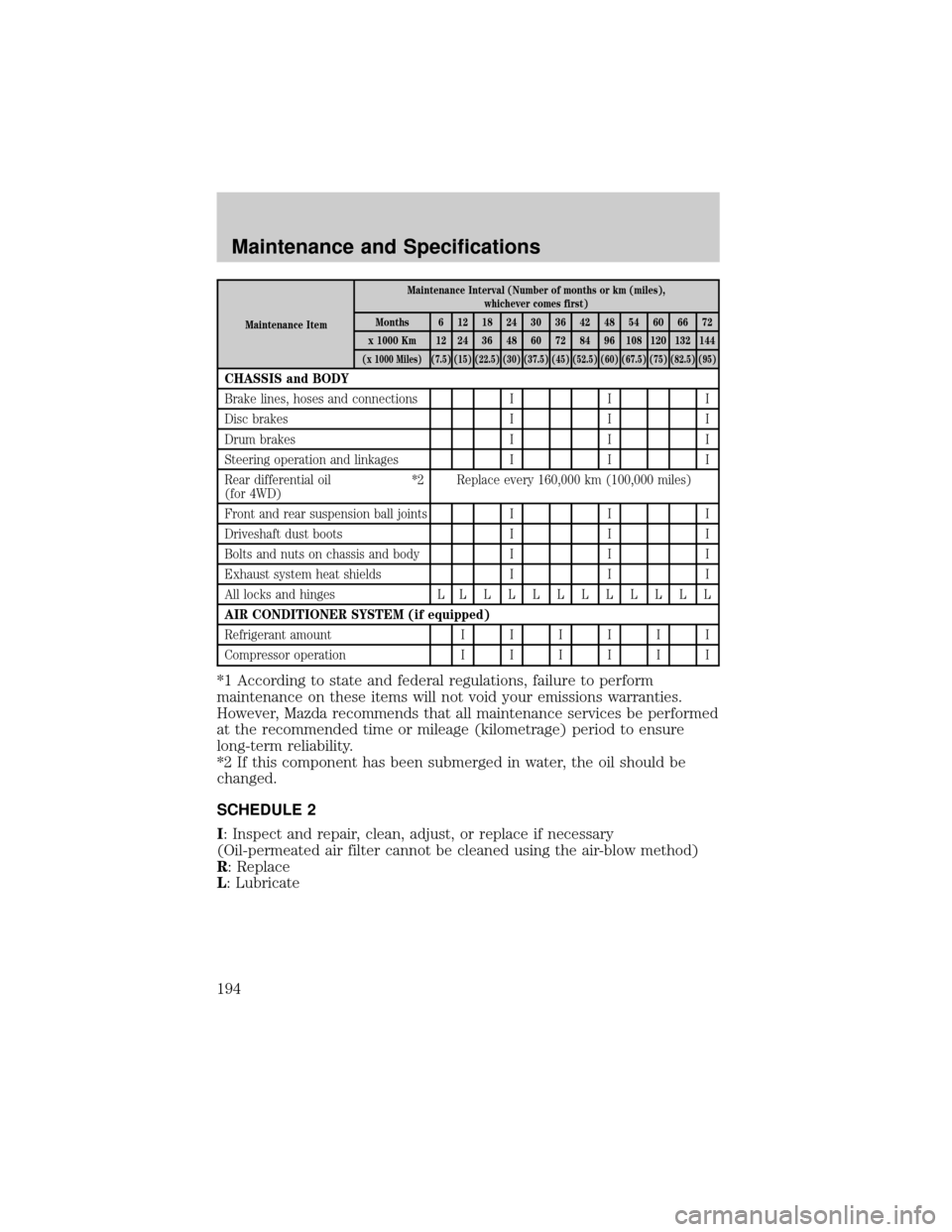
Maintenance ItemMaintenance Interval (Number of months or km (miles),
whichever comes first)
Months 6 12 18 24 30 36 42 48 54 60 66 72
x 1000 Km 12 24 36 48 60 72 84 96 108 120 132 144
(x 1000 Miles)(7.5) (15) (22.5) (30) (37.5) (45) (52.5) (60) (67.5) (75) (82.5) (95)
CHASSIS and BODY
Brake lines, hoses and connections I I I
Disc brakes I I I
Drum brakes I I I
Steering operation and linkages I I I
Rear differential oil
(for 4WD)*2 Replace every 160,000 km (100,000 miles)
Front and rear suspension ball joints I I I
Driveshaft dust boots I I I
Bolts and nuts on chassis and body I I I
Exhaust system heat shields I I I
All locks and hinges LLLLLLLLLLLL
AIR CONDITIONER SYSTEM (if equipped)
Refrigerant amountIIIIII
Compressor operationIIIIII
*1 According to state and federal regulations, failure to perform
maintenance on these items will not void your emissions warranties.
However, Mazda recommends that all maintenance services be performed
at the recommended time or mileage (kilometrage) period to ensure
long-term reliability.
*2 If this component has been submerged in water, the oil should be
changed.
SCHEDULE 2
I: Inspect and repair, clean, adjust, or replace if necessary
(Oil-permeated air filter cannot be cleaned using the air-blow method)
R: Replace
L: Lubricate
Maintenance and Specifications
194