Page 203 of 250

WARNING: When lifting a plastic-cased battery, excessive
pressure on the end walls could cause acid to flow through the
vent caps, resulting in personal injury and/or damage to the
vehicle or battery. Lift the battery with a battery carrier or with
your hands on opposite corners.
WARNING: Keep batteries out of reach of children. Batteries
contain sulfuric acid. Avoid contact with skin, eyes or clothing.
Shield your eyes when working near the battery to protect
against possible splashing of acid solution. In case of acid
contact with skin or eyes, flush immediately with water for a
minimum of 15 minutes and get prompt medical attention. If
acid is swallowed, call a physician immediately.
WARNING: Battery posts, terminals and related accessories
contain lead and lead compounds. Wash hands after handling.
Because your vehicle’s engine is electronically controlled by a computer,
some control conditions are maintained by power from the battery. When
the battery is disconnected or a new battery is installed, the engine must
relearn its idle and fuel trim strategy for optimum driveability and
performance. To begin this process: 1. With the vehicle at a complete stop, set the parking brake.
2. Put the gearshift lever in P (Park), turn off all accessories and start the engine.
3. Run the engine until it reaches normal operating temperature.
4. Allow the engine to idle for at least one minute.
5. Turn the A/C on and allow the engine to idle for at least one minute.
6. Drive the vehicle to complete the relearning process.
• The vehicle may need to be driven to relearn the idle and fuel trim
strategy.
• If you do not allow the engine to relearn its idle trim, the idle
quality of your vehicle may be adversely affected until the idle
trim is eventually relearned.
When the battery is disconnected or a new battery installed, the
transmission must relearn its adaptive strategy. As a result of this, the
transmission may shift firmly. This operation is considered normal and
Maintenance and Specifications
203
Page 204 of 250

will not affect function or durability of the transmission. Over time the
adaptive learning process will fully update transmission operation to its
optimum shift feel.
If the battery has been disconnected or a new battery has been installed,
the clock and the preset radio stations must be reset once the battery is
reconnected.
•Always dispose of automotive
batteries in a responsible manner.
Follow your local authorized
standards for disposal. Call your
local authorized recycling center
to find out more about recycling
automotive batteries.
ENGINE COOLANT
Checking engine coolant
Your engine’s cooling system has been factory-filled with a 50/50 mixture
of distilled water and Mazda Genuine Engine Coolant, or an equivalent
premium engine coolant that meets Mazda specification.
A 50/50 mixture of distilled water and Mazda Genuine Engine Coolant
provides:
• maximum cooling system efficiency.
• freeze protection down to -36° C (-34° F).
• boiling protection up to 129° C (265° F).
• protection against rust and other forms of corrosion.
• an accurate temperature readout from the engine coolant
gauge.
The engine coolant must be maintained at the correct fluid level
and concentration to work properly. If the engine coolant fluid
level and concentration is not maintained correctly, damage to
the engine and cooling system may result.
LEAD
RETURN
RECYCLE
Maintenance and Specifications
204
Page 217 of 250

•Revving the engine before turning it off may reduce fuel economy.
• Using the air conditioner or defroster may reduce fuel economy.
• You may want to turn off the speed control in hilly terrain if
unnecessary shifting between third and fourth gear occurs.
Unnecessary shifting of this type could result in reduced fuel
economy.
• Warming up a vehicle on cold mornings is not required and may
reduce fuel economy.
• Resting your foot on the brake pedal while driving may reduce fuel
economy.
• Combine errands and minimize stop-and-go driving.
Maintenance
• Keep tires properly inflated and use only recommended size.
• Operating a vehicle with the wheels out of alignment will reduce fuel
economy.
• Use recommended engine oil. Refer to Lubricant specificationsin
this chapter.
• Perform all regularly scheduled maintenance items. Follow the
recommended maintenance schedule and owner maintenance checks
found in your vehicle service maintenance section.
Conditions
• Heavily loading a vehicle or towing a trailer may reduce fuel economy
at any speed.
• Carrying unnecessary weight may reduce fuel economy (approximately
0.4 km/L [1 mpg] is lost for every 180 kg [400 lb] of weight carried).
• Adding certain accessories to your vehicle (for example bug
deflectors, rollbars/light bars, running boards, ski/luggage racks) may
reduce fuel economy.
• Using fuel blended with alcohol may lower fuel economy.
• Fuel economy may decrease with lower temperatures during the first
12–16 km (8–10 miles) of driving.
• Driving on flat terrain offers improved fuel economy as compared to
driving on hilly terrain.
• Transmissions give their best fuel economy when operated in the top
cruise gear and with steady pressure on the gas pedal.
2003 Mazda B Series (mbs)
New Owners Guide own2002 (own2002)
USA English (fus)
Maintenance and Specifications
217
Page 223 of 250

1. Clean the reservoir cap beforeremoval to prevent dirt and
water from entering the
reservoir.
2. Remove cap and rubber diaphragm from reservoir.
3. Add fluid until the level reaches the step in the reservoir.
4. Reinstall rubber diaphragm and cap onto reservoir.
TRANSMISSION FLUID
Checking automatic transmission fluid (if equipped)
Refer to your service maintenance section for scheduled intervals for
fluid checks and changes. Your transmission does not consume fluid.
However, the fluid level should be checked if the transmission is not
working properly, i.e., if the transmission slips or shifts slowly or if you
notice some sign of fluid leakage.
Automatic transmission fluid expands when warmed. To obtain an
accurate fluid check, drive the vehicle until it is at normal operating
temperature (approximately 30 km [20 miles]). If your vehicle has been
operated for an extended period at high speeds, in city traffic during hot
weather or pulling a trailer, the vehicle should be turned off for about 30
minutes to allow fluid to cool before checking. 1. Drive the vehicle 30 km (20 miles) or until it reaches normal operating temperature.
2. Park the vehicle on a level surface and engage the parking brake.
3. With the parking brake engaged and your foot on the brake pedal, start the engine and move the gearshift lever through all of the gear
ranges. Allow sufficient time for each gear to engage.
4. Latch the gearshift lever in P (Park) and leave the engine running.
5. Remove the dipstick, wiping it clean with a clean, dry lint free rag. If necessary, refer to Identifying components in the engine
compartment in this chapter for the location of the dipstick.
Maintenance and Specifications
223
Page 224 of 250

6. Install the dipstick making sure it is fully seated in the filler tube.
7. Remove the dipstick and inspect the fluid level. The fluid should bein the designated area for normal operating temperature or ambient
temperature.
Low fluid level
Do not drive the vehicle if the fluid
level is at the bottom of the dipstick
and the ambient temperature is
above 10°C (50°F).
Correct fluid level
The transmission fluid should be checked at normal operating
temperature 66°C-77°C (150°F-170°F) on a level surface. The normal
operating temperature can be reached after approximately 30 km (20
miles) of driving.
You can check the fluid without driving if the ambient temperature is
above 10°C (50°F). However, if fluid is added at this time, an overfill
condition could result when the vehicle reaches normal operating
temperature.
The transmission fluid should be in
this range if at normal operating
temperature (66°C-77°C
[150°F-170°F]).
The transmission fluid should be in
this range if at ambient temperature
(10°C-35°C [50°F-95°F]).
High fluid level
Fluid levels above the safe range
may result in transmission failure.
An overfill condition of transmission
fluid may cause shift and/or
engagement concerns and/or
possible damage.
High fluid levels can be caused by an overheating condition.
Adjusting automatic transmission fluid levels
Before adding any fluid, make sure the correct type is used. The type of
fluid used is normally indicated on the dipstick and also in the
Lubricant specifications section in this chapter.
Maintenance and Specifications
224
Page 225 of 250
Use of a non-approved automatic transmission fluid may cause
internal transmission component damage.
If necessary, add fluid in 250 ml (1/2 pint) increments through the filler
tube until the level is correct.
If an overfill occurs, excess fluid
should be removed by a qualified
technician.
An overfill condition of
transmission fluid may cause
shift and/or engagement concerns and/or possible damage.
Do not use supplemental transmission fluid additives, treatments or
cleaning agents. The use of these materials may affect transmission
operation and result in damage to internal transmission components.
Checking and adding manual transmission fluid (if equipped)1. Park the vehicle on a level surface.
2. Engage the parking brake fully – put in first gear.
3. Assure the vehicle cannot move.
4. Clean the filler plug.
5. Remove the filler plug and inspect the fluid level.
Maintenance and Specifications
225
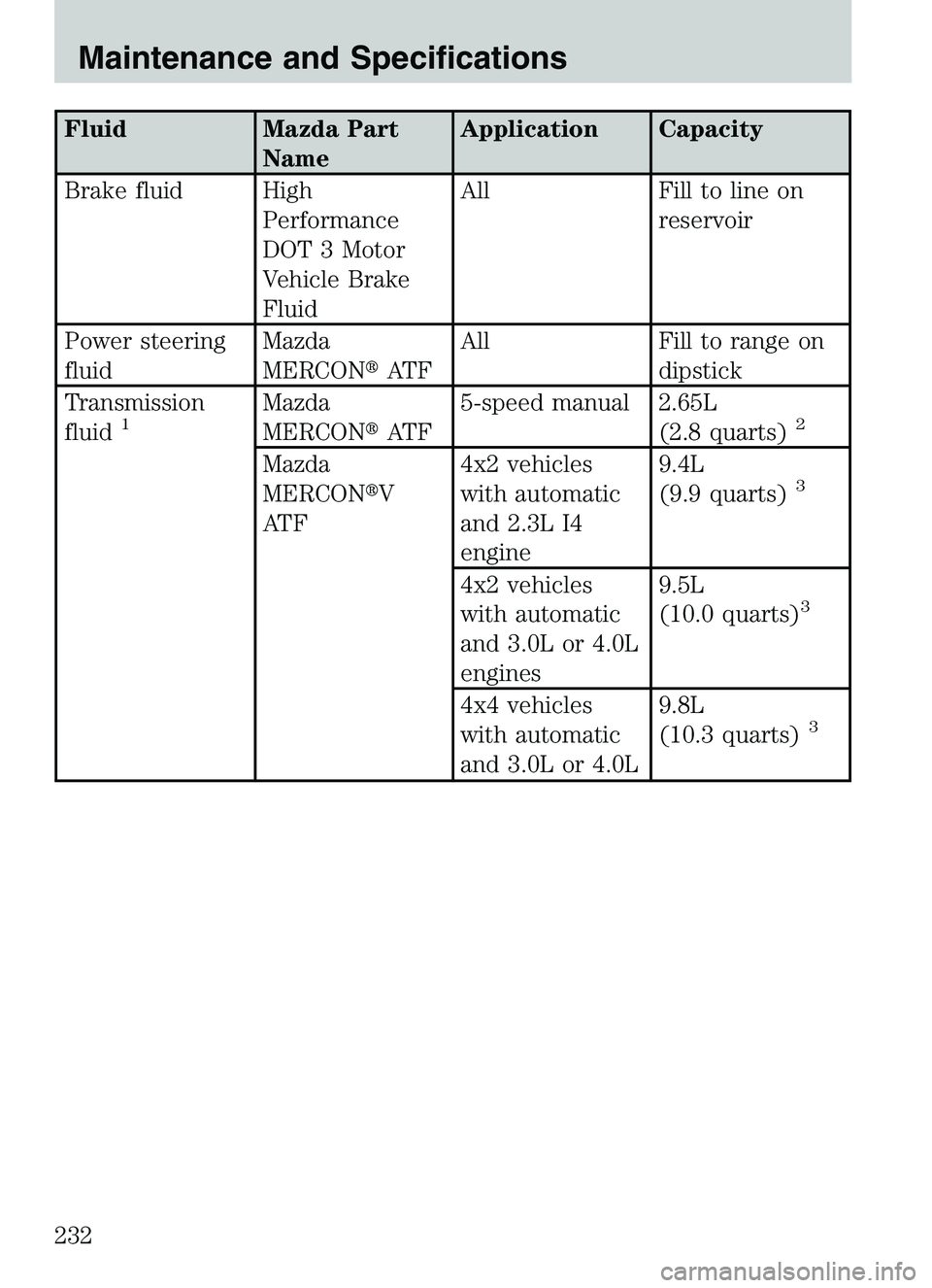
Page 232 of 250
FluidMazda Part
NameApplication Capacity
Brake fluid High Performance
DOT 3 Motor
Vehicle Brake
FluidAll
Fill to line on
reservoir
Power steering
fluid Mazda
MERCON�
AT FAll
Fill to range on
dipstick
Transmission
fluid
1Mazda
MERCON� AT F5-speed manual 2.65L
(2.8 quarts)2
Mazda
MERCON�V
AT F4x2 vehicles
with automatic
and 2.3L I4
engine9.4L
(9.9 quarts)3
4x2 vehicles
with automatic
and 3.0L or 4.0L
engines9.5L
(10.0 quarts)3
4x4 vehicles
with automatic
and 3.0L or 4.0L
9.8L
(10.3 quarts)3
Maintenance and Specifications
232
Page 233 of 250
FluidMazda Part
NameApplication Capacity
Engine coolant
4Premium Engine
Coolant 2.3 L I4 engine
with manual
transmission10.0L
(10.5 quarts)
2.3L I4 engine
with automatic
transmission 9.7L
(10.2 quarts)
3.0L V6 engine
with manual
transmission 14.3L
(15.1 quarts)
3.0L V6 engine
with automatic
transmission 14.0L
(14.8 quarts)
4.0L V6 engine
with manual
transmission 13.0L
(13.7 quarts)
4.0L V6 engine
with automatic
transmission 12.5L
(13.2 quarts)
Fuel tank N/A Regular cab (Short wheel
base)62.4L
(16.5 gallons)
Regular cab
(Long wheel
base) 75.7L
(20.0 gallons)
SuperCab 73.8L (19.5 gallons)
Transfer Case
Fluid Mazda
MERCON�
AT F4x4 Vehicles 1.2L
(1.25 quarts)
Front axle
lubricant Mazda SAE
80W-90
Premium Rear
Axle Lubricant4x4 Vehicles 1.7L
(3.6 pints)
Maintenance and Specifications
233