Page 138 of 250

4x2 equipped with a manual transmission:
Before you have your vehicle towed:
•Release the parking brake.
• Move the gearshift to the neutral position.
• Turn the key in the ignition to the OFF/UNLOCKED position.
• The maximum recommended speed is 88 km/h (55 mph).
• The maximum recommended distance is unlimited.
• The vehicle must be towed in the forward position to ensure no
damage is done to the internal transfer case components.
In addition, it is recommended that you follow the instructions
provided by the aftermarket manufacturer of the towing
apparatus if one has been installed.
4x2 equipped with automatic transmission and 4x4 vehicles:
4x2 vehicles with automatic transmissions or 4x4 vehicles with an
electronic-shift transfer case and automatic transmission, follow these
guidelines for recreational towing:
• Release the parking brake.
• Turn the key in the ignition to the OFF/UNLOCKED position.
• Place the transmission in N (Neutral).
• Do not exceed a distance of 80 km (50 miles).
• Do not exceed 56 km/h (35 mph) vehicle speed.
• The vehicle must be towed in the forward position to ensure no
damage is done to the internal transfer case components.
If a distance of 80 km (50 miles) or a speed of 56 km/h (35 mph) must
be exceeded, you must disconnect the front (4x4 only) and rear
driveshafts. Mazda recommends the driveshafts be removed/installed only
by a qualified technician. See your local dealer for driveshaft
removal/installation.
Improper removal/installation of the driveshaft can cause
transmission fluid or transfer case fluid loss, damage to the
driveshaft and internal transmission and transfer case
components.
CAMPER BODIES
Your pickup is not recommended for slide–in camper bodies.
Driving
138
Page 142 of 250
To remove a fuse use the fuse puller tool provided.
The fuses are coded as follows:
Fuse/RelayLocation Fuse Amp
Rating Passenger Compartment Fuse
Panel Description
1 5A Power mirror switch
2 10A Daytime Running Lights (DRL), Back-up lamps, Transmission,
Passenger air bag deactivation
switch, Blower motor relay
3 7.5A Left stop/turn trailer tow connector
4 — Not used
5 15A 4x4 control module
6 2A Brake pressure switch
7 7.5A Right stop/turn trailer tow connector
Roadside Emergencies
142
Page 143 of 250
Fuse/RelayLocation Fuse Amp
Rating Passenger Compartment Fuse
Panel Description
8 — Not used
9 7.5A Brake pedal position switch
10 7.5A Speed control servo/amplifier assembly, Generic Electronic
Module (GEM), Shift lock
actuator, Turn signals, 4x4
11 7.5A Instrument cluster, 4x4, Main light switch, Central Security Module
(CSM), Generic Electronic Module
(GEM)
12 — Not used
13 20A Brake pedal position switch
14 10A Anti-lock Brake System (ABS) control module
15 — Not used
16 30A Windshield wiper motor, Wiper HI/LO relay, Wiper run/park relay
17 20A Cigar lighter, Data Link Connector (DLC)
18 — Not used
19 25A Powertrain Control Module (PCM) power diode, Ignition, PATS
(Passive Anti-Theft System)
20 7.5A Generic Electronic Module (GEM), Radio
21 15A Hazard flasher
22 20A Auxiliary power socket
23 — Not used
24 7.5A Clutch Pedal Position (CPP) switch, Starter interrupt relay
25 — Not used
Roadside Emergencies
143
Page 145 of 250
WARNING: To reduce risk of electrical shock, always replace
the cover to the Power Distribution Box before reconnecting
the battery or refilling fluid reservoirs.
If the battery has been disconnected and reconnected, refer to the
Battery section of the Maintenance and specifications chapter.
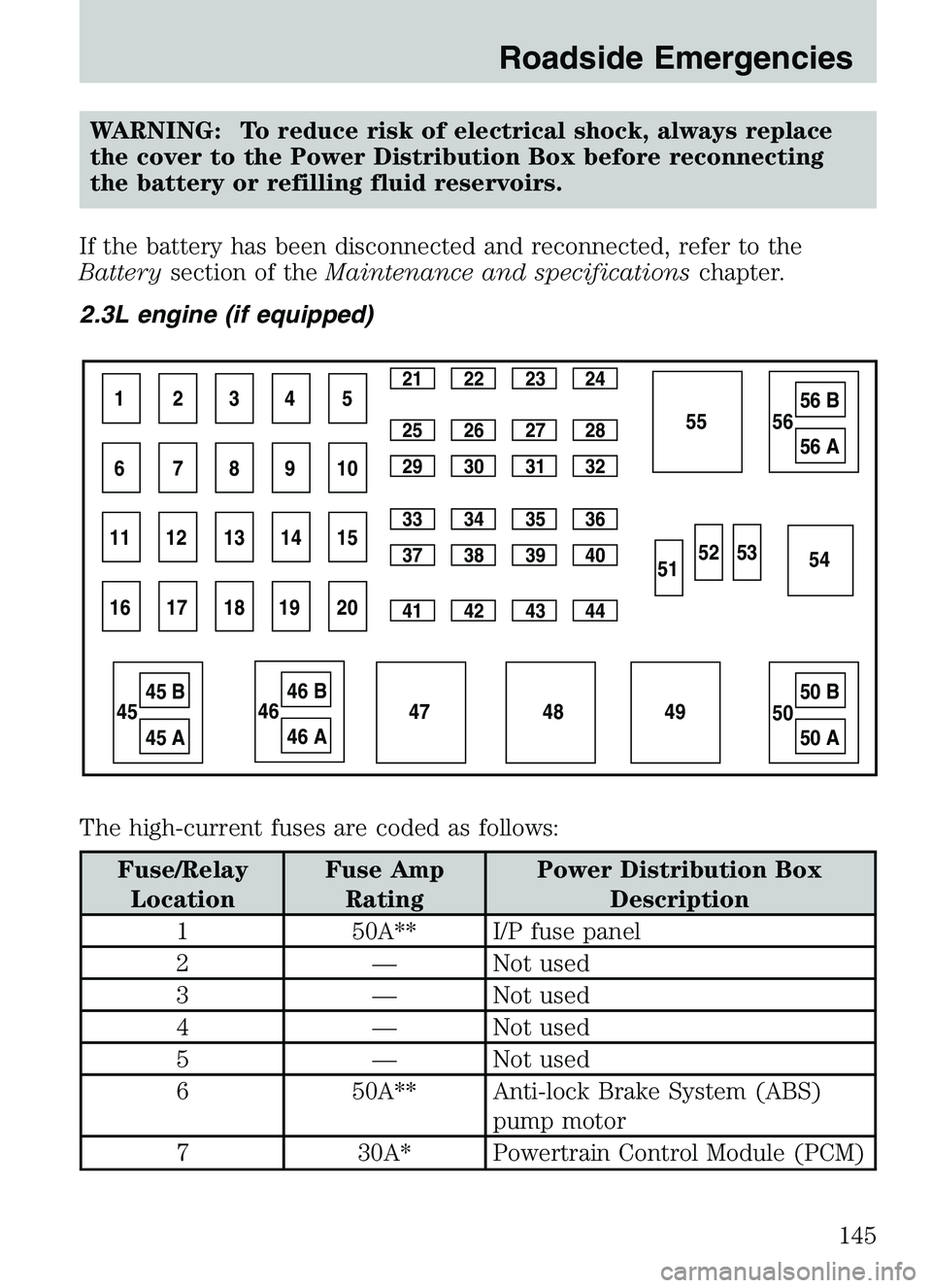
2.3L engine (if equipped)
The high-current fuses are coded as follows:
Fuse/Relay Location Fuse Amp
Rating Power Distribution Box
Description
1 50A** I/P fuse panel
2 — Not used
3 — Not used
4 — Not used
5 — Not used
6 50A** Anti-lock Brake System (ABS)
pump motor
7 30A* Powertrain Control Module (PCM)
1234521 22 23 24
25 26 27 28
29 30 31 32
33 34 35 36
37 38 39 40
41 42 43 44
678910 55
49
48 54
5352
51 56
56 B
56 A
50 50 B
50 A
47
45 45 B
45 A
4646 B
46 A
11 12 13 14 15
16 17 18 19 20
Roadside Emergencies
145
Page 148 of 250
3.0L and 4.0L engines (if equipped)
The high-current fuses are coded as follows:
Fuse/RelayLocation Fuse Amp
Rating Power Distribution Box
Description
1 50A** I/P fuse panel
2 — Not used
3 — Not used
4 — Not used
5 — Not used
6 50A** Anti-lock Brake System (ABS)
Pump Motor
7 30A* Powertrain Control Module (PCM)
8 20A* Power door locks, Remote entry
9 — Not used
10 — Not used
11 50A** Starter relay, Ignition switch
12 20A* Power windows
13 20A* 4x4 motor
Roadside Emergencies
148
Page 149 of 250
Fuse/RelayLocation Fuse Amp
Rating Power Distribution Box
Description
14 — Not used
15 — Not used
16 40A** Blower motor
17 — Not used
18 — Not used
19 — Not used
20 — Not used
21 10A* Powertrain Control Module (PCM) memory
22 — Not used
23 20A* Fuel pump motor
24 30A* Headlamps
25 10A* A/C clutch solenoid
26 — Not used
27 — Not used
28 30A* Anti-lock Brake System (ABS) module
29 — Not used
30 15A* Trailer tow
31 20A* Foglamps, Daytime Running Lamps (DRL)
32 — Not used
33 15A* Park lamp
34 — Not used
35 — Not used
36 — Not used
37 — Not used
38 10A* Left headlamp low beam
39 — Not used
40 — Not used
41 20A* Heated oxygen sensors
Roadside Emergencies
149
Page 150 of 250

Fuse/RelayLocation Fuse Amp
Rating Power Distribution Box
Description
42 10A* Right headlamp low beam
43 — Not used
44 — Not used
45A — Wiper HI/LO relay 45B — Wiper park/run relay
46A — Fuel pump relay 46B — Trailer tow relay
47A — A/C clutch solenoid relay 47B — Front washer pump relay
48A — Fog lamps 48B — Fog lamp relay 51 — Not used
52 — Not used
53 — Powertrain Control Module (PCM) Diode
54 — Powertrain Control Module (PCM)
55 — Blower relay
56 — Starter relay
* Mini Fuses ** Maxi Fuses
OVERHEATING
If the temperature gauge indicates overheating and you experience
power loss, you hear a loud knocking or pinging noise, the engine is
probably too hot.
If this happens: 1. Drive safely to the side of the road and park off the right-of-way.
2. Shift the automatic transmission into P (Park) or the manual transmission into the neutral position, and apply the parking brake.
3. Turn off the air conditioner.
WARNING: Steam from an overheated engine is dangerous. The
escaping steam could seriously burn you. Open the hood ONLY
after steam is no longer escaping from the engine.
Roadside Emergencies
150
Page 151 of 250

4. Check whether coolant or steam is escaping from under the hood orfrom the engine compartment.
• If steam is coming from the engine compartment:do not go near
the front of the vehicle. Stop the engine, then turn the ignition switch
to the ON position without starting the engine. The radiator cooling
fans will start to cool the engine.
• If neither coolant nor steam is escaping: open the hood and idle
the engine until it cools. If this does not lower the temperature, stop
the engine and let it cool.
5. Check the coolant level. If it is low, look for leaks in the radiator hoses and connections, heater hoses and connections, radiator and
water pump.
If you find a leak or other damage, or if coolant is still leaking, stop the
engine and call an Authorized Mazda dealer.
See Adding coolant in theMaintenance and specifications section. If
you find no problems, the engine is cool and no leaks are obvious,
carefully add coolant as required.
WARNING: When the engine and radiator are hot, scalding
coolant and steam may shoot out under pressure and cause
serious injury. Do not remove the cooling system cap when the
engine and radiator are hot.
Note: If the engine continues to overheat or frequently overheats, have
the cooling system inspected. The engine could be seriously damaged
unless repairs are made.
CHANGING THE TIRES
If you get a flat tire while driving, do not apply the brake heavily.
Instead, gradually decrease your speed. Hold the steering wheel firmly
and slowly move to a safe place on the side of the road.
WARNING: The use of tire sealants is not recommended and
may compromise the integrity of your tires.
2003 Mazda B Series (mbs)
New Owners Guide own2002 (own2002)
USA English (fus)
Roadside Emergencies
151