2003 MAZDA MODEL B4000 brake light
[x] Cancel search: brake lightPage 142 of 250

To remove a fuse use the fuse puller tool provided.
The fuses are coded as follows:
Fuse/RelayLocation Fuse Amp
Rating Passenger Compartment Fuse
Panel Description
1 5A Power mirror switch
2 10A Daytime Running Lights (DRL), Back-up lamps, Transmission,
Passenger air bag deactivation
switch, Blower motor relay
3 7.5A Left stop/turn trailer tow connector
4 — Not used
5 15A 4x4 control module
6 2A Brake pressure switch
7 7.5A Right stop/turn trailer tow connector
Roadside Emergencies
142
Page 143 of 250

Fuse/RelayLocation Fuse Amp
Rating Passenger Compartment Fuse
Panel Description
8 — Not used
9 7.5A Brake pedal position switch
10 7.5A Speed control servo/amplifier assembly, Generic Electronic
Module (GEM), Shift lock
actuator, Turn signals, 4x4
11 7.5A Instrument cluster, 4x4, Main light switch, Central Security Module
(CSM), Generic Electronic Module
(GEM)
12 — Not used
13 20A Brake pedal position switch
14 10A Anti-lock Brake System (ABS) control module
15 — Not used
16 30A Windshield wiper motor, Wiper HI/LO relay, Wiper run/park relay
17 20A Cigar lighter, Data Link Connector (DLC)
18 — Not used
19 25A Powertrain Control Module (PCM) power diode, Ignition, PATS
(Passive Anti-Theft System)
20 7.5A Generic Electronic Module (GEM), Radio
21 15A Hazard flasher
22 20A Auxiliary power socket
23 — Not used
24 7.5A Clutch Pedal Position (CPP) switch, Starter interrupt relay
25 — Not used
Roadside Emergencies
143
Page 176 of 250
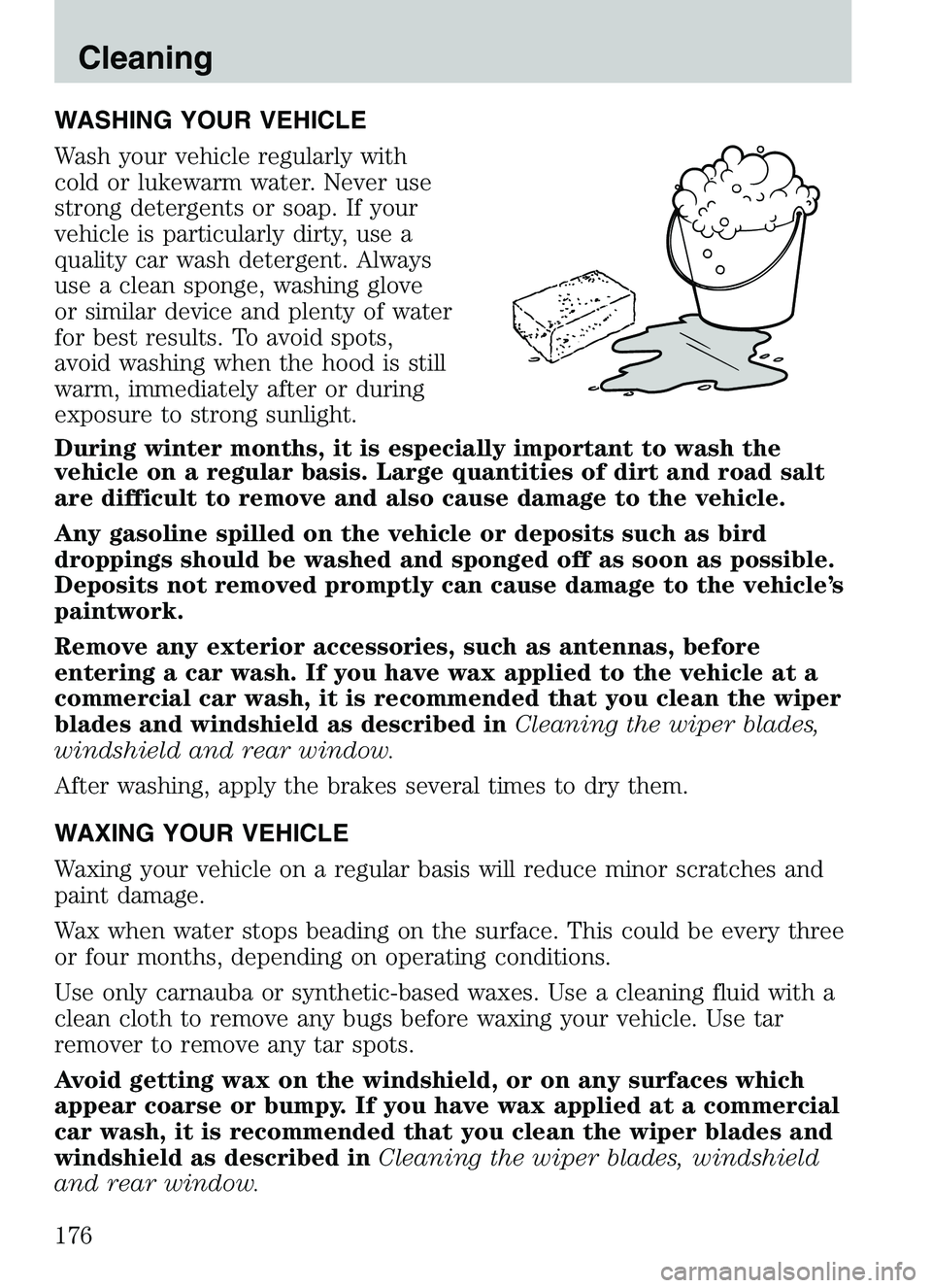
WASHING YOUR VEHICLE
Wash your vehicle regularly with
cold or lukewarm water. Never use
strong detergents or soap. If your
vehicle is particularly dirty, use a
quality car wash detergent. Always
use a clean sponge, washing glove
or similar device and plenty of water
for best results. To avoid spots,
avoid washing when the hood is still
warm, immediately after or during
exposure to strong sunlight.
During winter months, it is especially important to wash the
vehicle on a regular basis. Large quantities of dirt and road salt
are difficult to remove and also cause damage to the vehicle.
Any gasoline spilled on the vehicle or deposits such as bird
droppings should be washed and sponged off as soon as possible.
Deposits not removed promptly can cause damage to the vehicle’s
paintwork.
Remove any exterior accessories, such as antennas, before
entering a car wash. If you have wax applied to the vehicle at a
commercial car wash, it is recommended that you clean the wiper
blades and windshield as described inCleaning the wiper blades,
windshield and rear window.
After washing, apply the brakes several times to dry them.
WAXING YOUR VEHICLE
Waxing your vehicle on a regular basis will reduce minor scratches and
paint damage.
Wax when water stops beading on the surface. This could be every three
or four months, depending on operating conditions.
Use only carnauba or synthetic-based waxes. Use a cleaning fluid with a
clean cloth to remove any bugs before waxing your vehicle. Use tar
remover to remove any tar spots.
Avoid getting wax on the windshield, or on any surfaces which
appear coarse or bumpy. If you have wax applied at a commercial
car wash, it is recommended that you clean the wiper blades and
windshield as described in Cleaning the wiper blades, windshield
and rear window.
Cleaning
176
Page 189 of 250

While operating your vehicle
•Note any changes in the sound of the exhaust or any smell or exhaust
fumes in the vehicle.
• Check for vibrations in the steering wheel. Notice any increased
steering effort or looseness in the steering wheel, or change in the
straight ahead position.
• Notice if your vehicle constantly turns slightly or “pulls” to one side
when traveling on a smooth, level road.
• When stopping, listen and check for strange sounds, pulling to one
side, increased brake pedal travel or “hard to push” brake pedal.
• If any slipping or changes in the operation of your transmission occur,
check the transmission fluid level.
• Check automatic transmission Park function.
• Check parking brake.
At least monthly
• Check function of all interior and exterior lights.
• Check tires for wear and proper air pressure.
• Check engine oil level.
• Check coolant level in the coolant reservoir.
• Check washer fluid level.
At least twice a year (for example, every spring and fall)
• Check power steering fluid level.
• Check clutch fluid level (if equipped).
• Check and clean body and door drain holes.
• Check and lubricate all hinges, latches, and outside locks.
• Check and lubricate door rubber weather strips.
• Check parking brake for proper operation.
• Check lap/shoulder belts and seat latches for wear and function.
• Check air pressure in spare tire.
• Check windshield washer spray and wiper operation. Clean wiper
blades with clean cloth dampened with washer fluid.
• Check safety warning lamps (brake, ABS, air bag, safety belt) for
operation.
Maintenance and Specifications
189
Page 190 of 250

•Check cooling system fluid level and coolant strength.
• Check battery water level (non-maintenance free).
• Check battery connections and clean if necessary.
SERVICE RECOMMENDATIONS
To help you service your vehicle:
• We highlight do-it-yourself items in the engine compartment for easy
location.
• We provide a Scheduled Maintenance section which makes tracking
routine service easy.
If your vehicle requires professional service, your dealership can provide
necessary parts and service. Check your “Warranty Information” to find
out which parts and services are covered.
Use only recommended fuels, lubricants, fluids and service parts
conforming to specifications. Genuine Mazda parts are designed and built
to provide the best performance in your vehicle.
PRECAUTIONS WHEN SERVICING YOUR VEHICLE
• Do not work on a hot engine.
• Make sure that nothing gets caught in moving parts.
• Do not work on a vehicle with the engine running in an enclosed
space, unless you are sure you have enough ventilation.
• Keep all open flames and other lit material away from the battery and
all fuel related parts.
Working with the engine off
• Automatic transmission:
1. Set the parking brake and shift to P (Park).
2. Turn off the engine and remove the key.
3. Block the wheels.
• Manual transmission:
1. Set the parking brake, depress the clutch and place the gearshift in 1 (First).
2. Turn off the engine and remove the key.
3. Block the wheels.
Maintenance and Specifications
190
Page 217 of 250

•Revving the engine before turning it off may reduce fuel economy.
• Using the air conditioner or defroster may reduce fuel economy.
• You may want to turn off the speed control in hilly terrain if
unnecessary shifting between third and fourth gear occurs.
Unnecessary shifting of this type could result in reduced fuel
economy.
• Warming up a vehicle on cold mornings is not required and may
reduce fuel economy.
• Resting your foot on the brake pedal while driving may reduce fuel
economy.
• Combine errands and minimize stop-and-go driving.
Maintenance
• Keep tires properly inflated and use only recommended size.
• Operating a vehicle with the wheels out of alignment will reduce fuel
economy.
• Use recommended engine oil. Refer to Lubricant specificationsin
this chapter.
• Perform all regularly scheduled maintenance items. Follow the
recommended maintenance schedule and owner maintenance checks
found in your vehicle service maintenance section.
Conditions
• Heavily loading a vehicle or towing a trailer may reduce fuel economy
at any speed.
• Carrying unnecessary weight may reduce fuel economy (approximately
0.4 km/L [1 mpg] is lost for every 180 kg [400 lb] of weight carried).
• Adding certain accessories to your vehicle (for example bug
deflectors, rollbars/light bars, running boards, ski/luggage racks) may
reduce fuel economy.
• Using fuel blended with alcohol may lower fuel economy.
• Fuel economy may decrease with lower temperatures during the first
12–16 km (8–10 miles) of driving.
• Driving on flat terrain offers improved fuel economy as compared to
driving on hilly terrain.
• Transmissions give their best fuel economy when operated in the top
cruise gear and with steady pressure on the gas pedal.
2003 Mazda B Series (mbs)
New Owners Guide own2002 (own2002)
USA English (fus)
Maintenance and Specifications
217
Page 240 of 250
A
ABS (see Brakes) .....................115
Air bag supplemental
restraint system ..........................81and child safety seats ..............84
description ................................81
disposal ......................................87
driver air bag ............................85
indicator light ...........................87
operation ...................................85
passenger air bag .....................85
passenger deactivation switch...88
Ambulance packages ....................7
Antifreeze
(see Engine coolant) ................204
Anti-lock brake system
(see Brakes) ......................115–116
Audio system 6-CD in dash .............................24
AM/FM .......................................19
MACH MP3 ...............................27
Single CD ..................................21
Audio system
(see Radio) ................19, 21, 24, 27
Automatic dimming rear
view mirror ..................................50
Automatic transmission ............119 driving an automatic
overdrive .................................120
fluid, adding ............................223
fluid, checking ........................223
fluid, refill capacities ..............231
fluid, specification ..................236
Auxiliary power point .................49
Axle lubricant specifications ..235–236
refill capacities ........................231
traction lok ..............................118 B
Battery .......................................202
acid, treating emergencies .....202
jumping a disabled battery ....159
maintenance-free ....................202
servicing ..................................202
Bed extender ..............................57
BeltMinder ...................................76
Brakes ........................................115 anti-lock ...........................115–116
anti-lock brake system
(ABS) warning light ...............116
fluid, checking and adding ....221
fluid, refill capacities ..............231
fluid, specifications .........235–236
lubricant specifications ..235–236
parking ....................................116
shift interlock ..........................119
Break-in period .............................5
Bulbs ............................................40
C
Calculating load ........................130
Capacities for refilling fluids ....231
Cassette tape player .............21, 24
CD-single premium ...............19, 27
Cell phone warning ...................239
Certification Label ....................238
Changing a tire .........................151
Child safety restraints ................94 child safety belts ......................94
Child safety seats ........................97 attaching with tether straps ..102
in front seat ..............................99
in rear seat ................................99
LATCH .....................................106
2003 Mazda B Series (mbs)
New Owners Guide own2002 (own2002)
USA English (fus)
Index
240
Page 243 of 250

Instrument panelcleaning ...................................180
cluster ................................12, 180
lighting up panel and interior...39
location of components ............12
J
Jack ............................................151 positioning ...............................151
storage .............................151–154
Jump-starting your vehicle ......159
K
Keyless remote entry system -
see Remote entry system ...........59
Keys positions of the ignition .........110
L
Lamps bulb replacement
specifications chart ..................40
cargo lamps ...............................39
courtesy .....................................40
daytime running light ...............38
fog lamps ...................................38
headlamps .................................38
headlamps, flash to pass ..........39
instrument panel, dimming .....39
interior lamps .....................40–41
replacing bulbs . 40–41, 43, 45–46
Lane change indicator
(see Turn signal) ........................40
LATCH anchors .........................106
Lights, warning and indicator ....12 anti-lock brakes (ABS) ..........116 Limited slip axle
(see Traction-Lok) ....................118
Load limits .................................129
GAWR ......................................129
GVWR ......................................129
trailer towing ..........................129
Loading instructions .................128
Lubricant specifications ...235–236
Lumbar support, seats ...............68
M
Manual transmission .................122 fluid capacities ........................231
lubricant specifications ..........236
reverse .....................................123
Mirrors automatic dimming rearview
mirror ........................................50
cleaning ...................................179
side view mirrors (power) .......53
Motorcraft parts ........................214
O
Octane rating ............................213
Oil (see Engine oil) ..................195
Overdrive .....................................56
Overheating ...............................150
P
Parking brake ............................116
Passive anti-theft system
(PATS) .........................................64
Power distribution box
(see Fuses) ...............................144
Power door locks ........................59
2003 Mazda B Series (mbs)
New Owners Guide own2002 (own2002)
USA English (fus)
Index
243