Page 143 of 250
Fuse/RelayLocation Fuse Amp
Rating Passenger Compartment Fuse
Panel Description
8 — Not used
9 7.5A Brake pedal position switch
10 7.5A Speed control servo/amplifier assembly, Generic Electronic
Module (GEM), Shift lock
actuator, Turn signals, 4x4
11 7.5A Instrument cluster, 4x4, Main light switch, Central Security Module
(CSM), Generic Electronic Module
(GEM)
12 — Not used
13 20A Brake pedal position switch
14 10A Anti-lock Brake System (ABS) control module
15 — Not used
16 30A Windshield wiper motor, Wiper HI/LO relay, Wiper run/park relay
17 20A Cigar lighter, Data Link Connector (DLC)
18 — Not used
19 25A Powertrain Control Module (PCM) power diode, Ignition, PATS
(Passive Anti-Theft System)
20 7.5A Generic Electronic Module (GEM), Radio
21 15A Hazard flasher
22 20A Auxiliary power socket
23 — Not used
24 7.5A Clutch Pedal Position (CPP) switch, Starter interrupt relay
25 — Not used
Roadside Emergencies
143
Page 145 of 250
WARNING: To reduce risk of electrical shock, always replace
the cover to the Power Distribution Box before reconnecting
the battery or refilling fluid reservoirs.
If the battery has been disconnected and reconnected, refer to the
Battery section of the Maintenance and specifications chapter.
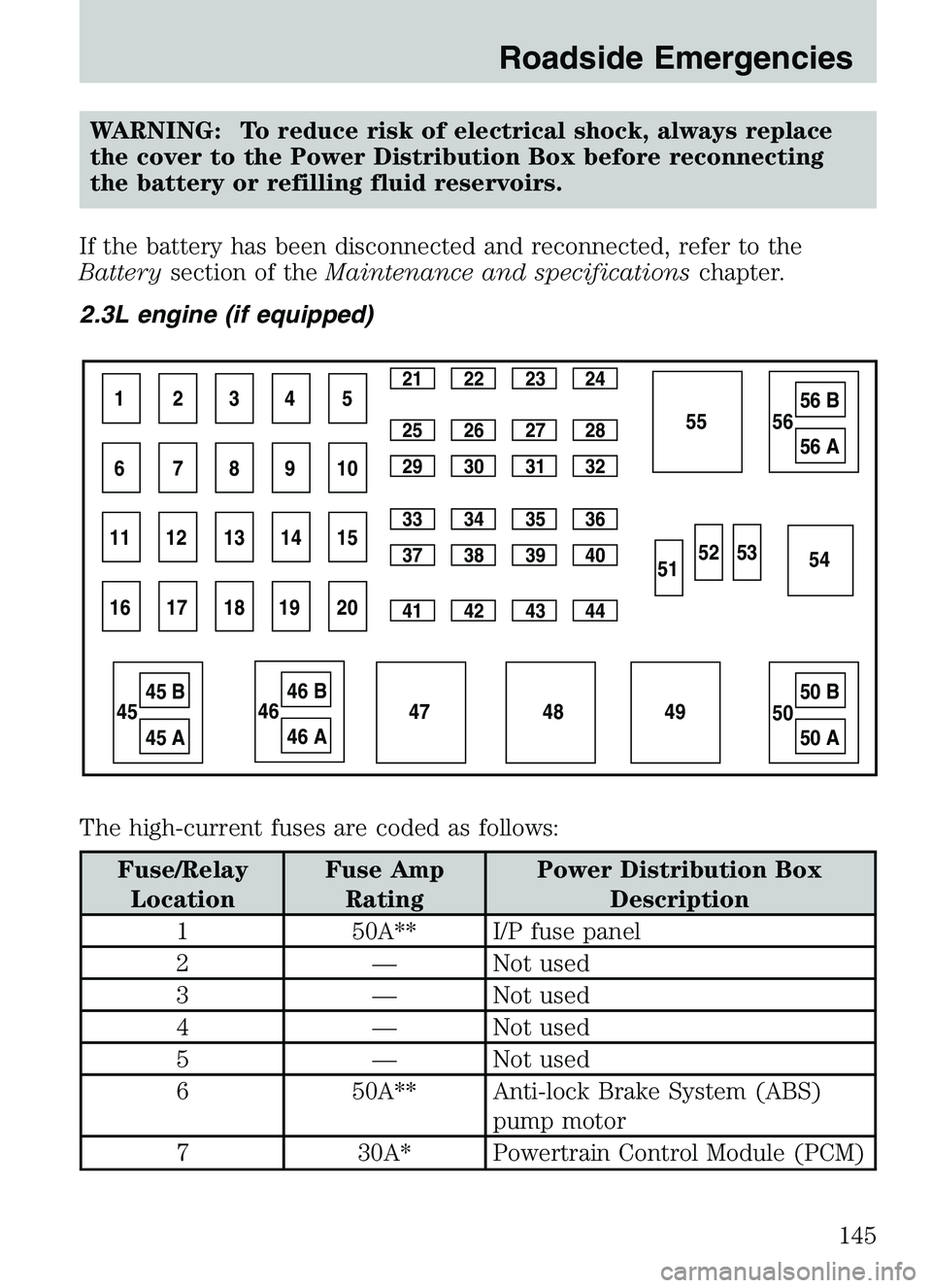
2.3L engine (if equipped)
The high-current fuses are coded as follows:
Fuse/Relay Location Fuse Amp
Rating Power Distribution Box
Description
1 50A** I/P fuse panel
2 — Not used
3 — Not used
4 — Not used
5 — Not used
6 50A** Anti-lock Brake System (ABS)
pump motor
7 30A* Powertrain Control Module (PCM)
1234521 22 23 24
25 26 27 28
29 30 31 32
33 34 35 36
37 38 39 40
41 42 43 44
678910 55
49
48 54
5352
51 56
56 B
56 A
50 50 B
50 A
47
45 45 B
45 A
4646 B
46 A
11 12 13 14 15
16 17 18 19 20
Roadside Emergencies
145
Page 146 of 250
Fuse/RelayLocation Fuse Amp
Rating Power Distribution Box
Description
8 20A* Central security module, Power
door locks, Remote entry
9 — Not used
10 — Not used
11 50A** Starter relay, Ignition switch
12 20A* Power windows
13 — Not used
14 — Not used
15 — Not used
16 40A** Blower motor
17 20A** Auxiliary cooling fan
18 — Not used
19 — Not used
20 — Not used
21 10A* PCM memory
22 — Not used
23 20A* Fuel pump motor
24 30A* Headlamps
25 10A* A/C clutch relay
26 — Not used
27 — Not used
28 30A* ABS module
29 — Not used
30 15A* Trailer Tow
31 20A* Foglamp, Daytime Running Lamps
(DRL)
32 — Not used
33 15A* Park lamp, Central security
module
34 — Not used
35 — Not used
Roadside Emergencies
146
Page 148 of 250
3.0L and 4.0L engines (if equipped)
The high-current fuses are coded as follows:
Fuse/RelayLocation Fuse Amp
Rating Power Distribution Box
Description
1 50A** I/P fuse panel
2 — Not used
3 — Not used
4 — Not used
5 — Not used
6 50A** Anti-lock Brake System (ABS)
Pump Motor
7 30A* Powertrain Control Module (PCM)
8 20A* Power door locks, Remote entry
9 — Not used
10 — Not used
11 50A** Starter relay, Ignition switch
12 20A* Power windows
13 20A* 4x4 motor
Roadside Emergencies
148
Page 149 of 250
Fuse/RelayLocation Fuse Amp
Rating Power Distribution Box
Description
14 — Not used
15 — Not used
16 40A** Blower motor
17 — Not used
18 — Not used
19 — Not used
20 — Not used
21 10A* Powertrain Control Module (PCM) memory
22 — Not used
23 20A* Fuel pump motor
24 30A* Headlamps
25 10A* A/C clutch solenoid
26 — Not used
27 — Not used
28 30A* Anti-lock Brake System (ABS) module
29 — Not used
30 15A* Trailer tow
31 20A* Foglamps, Daytime Running Lamps (DRL)
32 — Not used
33 15A* Park lamp
34 — Not used
35 — Not used
36 — Not used
37 — Not used
38 10A* Left headlamp low beam
39 — Not used
40 — Not used
41 20A* Heated oxygen sensors
Roadside Emergencies
149
Page 171 of 250

AMERICAN SAMOA
Polynesia Motors, Inc.
P.O. Box 1120, Pago Pago, American Samoa 96799
TEL: (684) 699–1854
ADD-ON NON-GENUINE PARTS AND ACCESSORIES
Non-genuine parts and accessories for Mazda vehicles can be found in
stores. These may fit your vehicle, but they are not approved by the
manufacturer for use with Mazda vehicles. When you install non-genuine
parts or accessories, they could affect your vehicle’s performance or
safety system; the manufacturer’s warranty doesn’t cover this. Before you
install any non-genuine parts or accessories, consult an Authorized
Mazda Dealer.WARNING: Installation of Non-Genuine Parts or Accessories:
Installation of non-genuine parts or accessories could be
dangerous. Improperly designed parts or accessories could
seriously affect your vehicle’s performance or safety system.
This could cause you to have an accident or increase your
chances of injuries in an accident. Always consult an Authorized
Mazda Dealer before you install non-genuine parts or
accessories.
WARNING: Add-On Electrical and Electronic Equipment:
Incorrectly choosing or installing improper add-on equipment or
choosing an improper installer could be dangerous. Essential
systems could be damaged, causing engine stalling, air-bag
(SRS) activation, ABS inactivation, or a fire in the vehicle. Be
very careful in choosing and installing add-on electrical
equipments, such as mobile telephones, two-way radios, stereo
systems, and car alarm systems.
Mazda assumes no responsibility for death, injury, or expenses that may
result from the installation of add-on non-genuine parts or accessories.
WARRANTIES FOR YOUR MAZDA
• New Vehicle Limited Warranty
• Safety Restraint System Limited Warranty
• Anti-perforation Limited Warranty
• Federal Emission Control Warranty
– Emission Defect Warranty
– Emission Performance Warranty
Customer Assistance
171
Page 189 of 250

While operating your vehicle
•Note any changes in the sound of the exhaust or any smell or exhaust
fumes in the vehicle.
• Check for vibrations in the steering wheel. Notice any increased
steering effort or looseness in the steering wheel, or change in the
straight ahead position.
• Notice if your vehicle constantly turns slightly or “pulls” to one side
when traveling on a smooth, level road.
• When stopping, listen and check for strange sounds, pulling to one
side, increased brake pedal travel or “hard to push” brake pedal.
• If any slipping or changes in the operation of your transmission occur,
check the transmission fluid level.
• Check automatic transmission Park function.
• Check parking brake.
At least monthly
• Check function of all interior and exterior lights.
• Check tires for wear and proper air pressure.
• Check engine oil level.
• Check coolant level in the coolant reservoir.
• Check washer fluid level.
At least twice a year (for example, every spring and fall)
• Check power steering fluid level.
• Check clutch fluid level (if equipped).
• Check and clean body and door drain holes.
• Check and lubricate all hinges, latches, and outside locks.
• Check and lubricate door rubber weather strips.
• Check parking brake for proper operation.
• Check lap/shoulder belts and seat latches for wear and function.
• Check air pressure in spare tire.
• Check windshield washer spray and wiper operation. Clean wiper
blades with clean cloth dampened with washer fluid.
• Check safety warning lamps (brake, ABS, air bag, safety belt) for
operation.
Maintenance and Specifications
189
Page 209 of 250

WARNING: The fuel system may be under pressure. If the fuel
filler cap is venting vapor or if you hear a hissing sound, wait
until it stops before completely removing the fuel filler cap.
Otherwise, fuel may spray out and injure you or others.
WARNING: If you do not use the proper fuel filler cap,
excessive pressure or vacuum in the fuel tank may damage the
fuel system or cause the fuel cap to disengage in a collision,
which may result in possible personal injury.
WARNING: Automotive fuels can cause serious injury or death
if misused or mishandled.
WARNING: Fuel ethanol and gasoline may contain benzene,
which is a cancer-causing agent.
Observe the following guidelines when handling automotive fuel:
• Extinguish all smoking materials
and any open flames before
fueling your vehicle.
• Always turn off the vehicle before
fueling.
• Automotive fuels can be harmful
or fatal if swallowed. Fuels such as gasoline and ethanol are highly
toxic and if swallowed can cause death or permanent injury. If fuel is
swallowed, call a physician immediately, even if no symptoms are
immediately apparent. The toxic effects of fuel may not be visible for
hours.
• Avoid inhaling fuel vapors. Inhaling too much fuel vapor of any kind
can lead to eye and respiratory tract irritation. In severe cases,
excessive or prolonged breathing of fuel vapor can cause serious
illness and permanent injury.
• Avoid getting fuel liquid in your eyes. If fuel is splashed in the eyes,
remove contact lenses (if worn), flush with water for 15 minutes and
seek medical attention. Failure to seek proper medical attention could
lead to permanent injury.
• Fuels can also be harmful if absorbed through the skin. If fuel is
splashed on the skin and/or clothing, promptly remove contaminated
2003 Mazda B Series (mbs)
New Owners Guide own2002 (own2002)
USA English (fus)
Maintenance and Specifications
209