2003 LINCOLN TOWN CAR Front passenger
[x] Cancel search: Front passengerPage 155 of 272
SAFETY RESTRAINTS FOR CHILDREN
See the following sections for directions on how to properly use safety
restraints for children. Also seeAir bag supplemental restraint system
(SRS)in this chapter for special instructions about using air bags.
Important child restraint precautions
You are required by law to use safety restraints for children in the U.S.
and Canada. If small children (generally children who are four years old
or younger and who weigh 18 kg [40 lbs] or less) ride in your vehicle,
you must put them in safety seats made especially for children. Check
your local and state or provincial laws for specific requirements
regarding the safety of children in your vehicle. When possible, always
place children under age 12 in the rear seat of your vehicle. Accident
statistics suggest that children are safer when properly restrained in the
rear seating positions than in the front seating position.
Never let a passenger hold a child on his or her lap while the
vehicle is moving. The passenger cannot protect the child from
injury in a collision.
Always follow the instructions and warnings that come with any infant or
child restraint you might use.
Children and safety belts
If the child is the proper size, restrain the child in a safety seat.
Children who are too large for child safety seats (as specified by your
child safety seat manufacturer) should always wear safety belts.
Follow all the important safety restraint and air bag precautions that
apply to adult passengers in your vehicle.
If the shoulder belt portion of a combination lap and shoulder belt can
be positioned so it does not cross or rest in front of the child’s face or
neck, the child should wear the lap and shoulder belt. Moving the child
closer to the center of the vehicle may help provide a good shoulder belt
fit.
Do not leave children, unreliable adults, or pets unattended in
your vehicle.
2003 Town Car(tow)
Owners Guide (post-2002-fmt)
USA English(fus)
Seating and Safety Restraints
155
Page 190 of 272
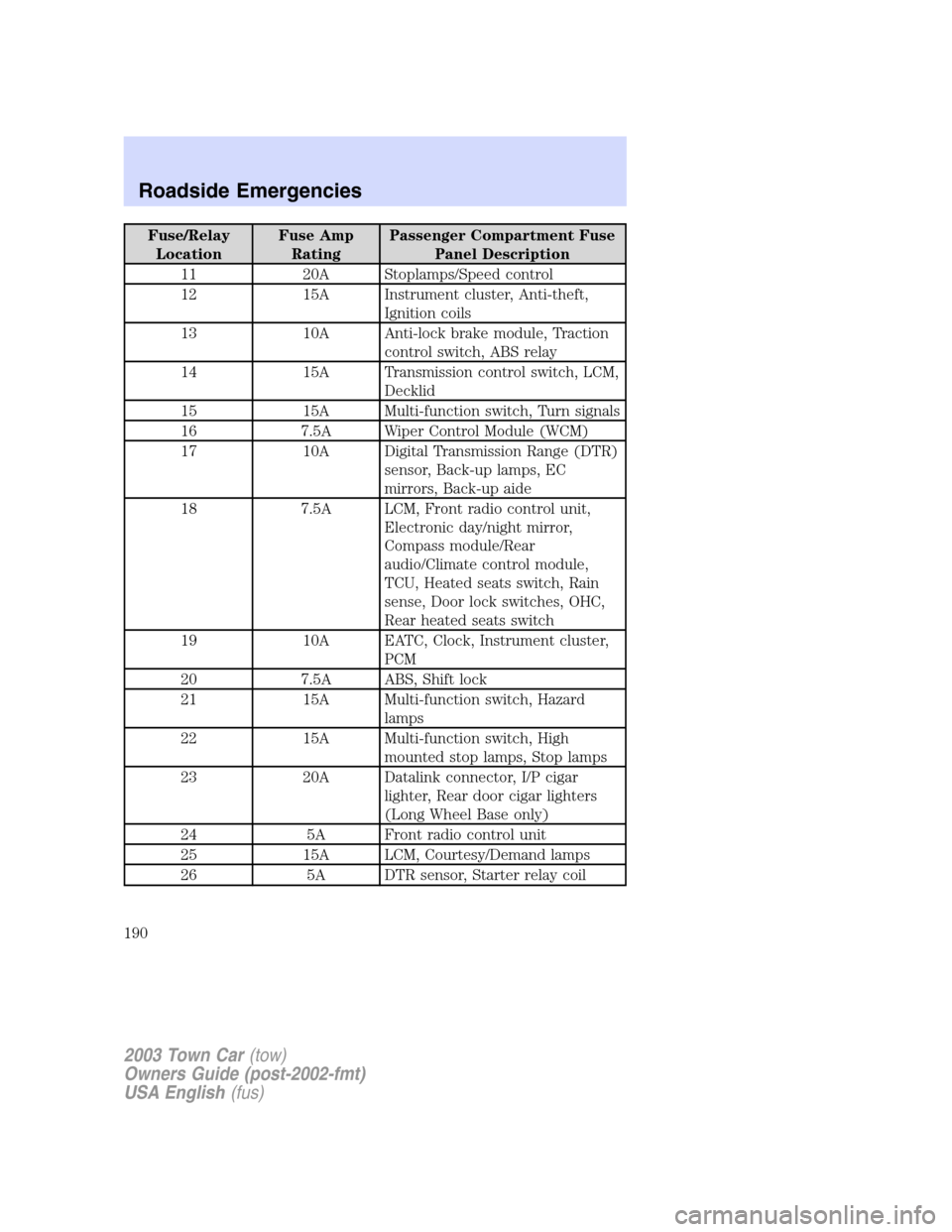
Fuse/Relay
LocationFuse Amp
RatingPassenger Compartment Fuse
Panel Description
11 20A Stoplamps/Speed control
12 15A Instrument cluster, Anti-theft,
Ignition coils
13 10A Anti-lock brake module, Traction
control switch, ABS relay
14 15A Transmission control switch, LCM,
Decklid
15 15A Multi-function switch, Turn signals
16 7.5A Wiper Control Module (WCM)
17 10A Digital Transmission Range (DTR)
sensor, Back-up lamps, EC
mirrors, Back-up aide
18 7.5A LCM, Front radio control unit,
Electronic day/night mirror,
Compass module/Rear
audio/Climate control module,
TCU, Heated seats switch, Rain
sense, Door lock switches, OHC,
Rear heated seats switch
19 10A EATC, Clock, Instrument cluster,
PCM
20 7.5A ABS, Shift lock
21 15A Multi-function switch, Hazard
lamps
22 15A Multi-function switch, High
mounted stop lamps, Stop lamps
23 20A Datalink connector, I/P cigar
lighter, Rear door cigar lighters
(Long Wheel Base only)
24 5A Front radio control unit
25 15A LCM, Courtesy/Demand lamps
26 5A DTR sensor, Starter relay coil
2003 Town Car(tow)
Owners Guide (post-2002-fmt)
USA English(fus)
Roadside Emergencies
190
Page 191 of 272
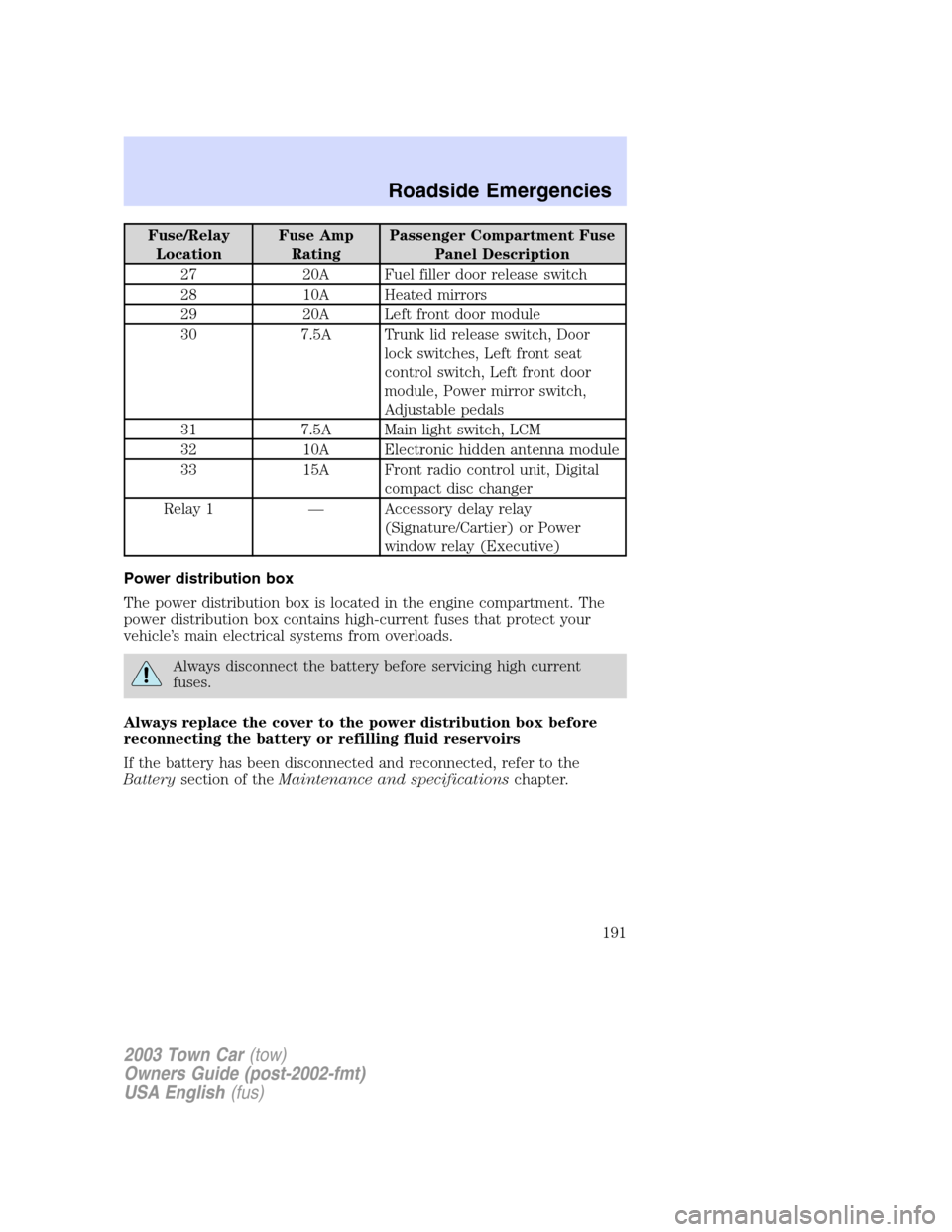
Fuse/Relay
LocationFuse Amp
RatingPassenger Compartment Fuse
Panel Description
27 20A Fuel filler door release switch
28 10A Heated mirrors
29 20A Left front door module
30 7.5A Trunk lid release switch, Door
lock switches, Left front seat
control switch, Left front door
module, Power mirror switch,
Adjustable pedals
31 7.5A Main light switch, LCM
32 10A Electronic hidden antenna module
33 15A Front radio control unit, Digital
compact disc changer
Relay 1—Accessory delay relay
(Signature/Cartier) or Power
window relay (Executive)
Power distribution box
The power distribution box is located in the engine compartment. The
power distribution box contains high-current fuses that protect your
vehicle’s main electrical systems from overloads.
Always disconnect the battery before servicing high current
fuses.
Always replace the cover to the power distribution box before
reconnecting the battery or refilling fluid reservoirs
If the battery has been disconnected and reconnected, refer to the
Batterysection of theMaintenance and specificationschapter.
2003 Town Car(tow)
Owners Guide (post-2002-fmt)
USA English(fus)
Roadside Emergencies
191
Page 192 of 272
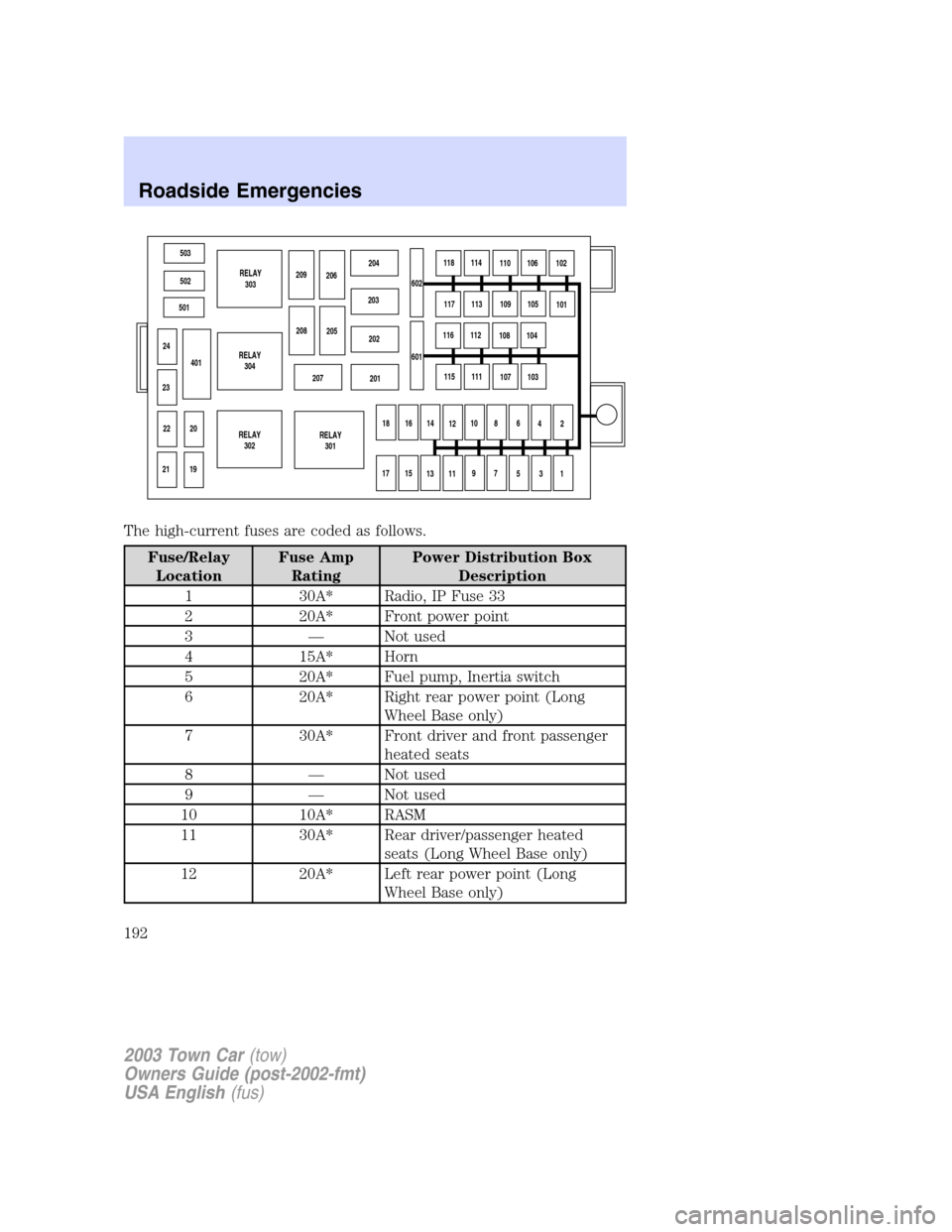
The high-current fuses are coded as follows.
Fuse/Relay
LocationFuse Amp
RatingPower Distribution Box
Description
1 30A* Radio, IP Fuse 33
2 20A* Front power point
3—Not used
4 15A* Horn
5 20A* Fuel pump, Inertia switch
6 20A* Right rear power point (Long
Wheel Base only)
7 30A* Front driver and front passenger
heated seats
8—Not used
9—Not used
10 10A* RASM
11 30A* Rear driver/passenger heated
seats (Long Wheel Base only)
12 20A* Left rear power point (Long
Wheel Base only)
503
502
501
24
23401
20
19 22
21RELAY
302 RELAY
304 RELAY
303
RELAY
301 207
201 202 203204
209
206
208
205602
601118
114
110
106
102
117
113
109
105
101
116
112
108
104
115
111
107
103
18
16
14
1210
8
6
4
2
17
15
13
119
7
5
3
1
2003 Town Car(tow)
Owners Guide (post-2002-fmt)
USA English(fus)
Roadside Emergencies
192
Page 264 of 272
Protection and appearance equipment
All-weather floor mats
Car cover
Carpeted floor mats
Chrome arch wheel molding
Door edge guards
First aid kit
Flat splash guards
Front end covers
Highway safety kit
Molded splash guards
Molded vinyl floor mats
Side window deflectors
Styled hood deflector
Universal floor mats
For maximum vehicle performance, keep the following information in
mind when adding accessories or equipment to your vehicle:
•When adding accessories, equipment, passengers and luggage to your
vehicle, do not exceed the total weight capacity of the vehicle or of
the front or rear axle (GVWR or GAWR as indicated on the Safety
compliance certification label). Consult your dealer for specific weight
information.
•The Federal Communications Commission (FCC) and Canadian Radio
Telecommunications Commission (CRTC) regulate the use of mobile
communications systems - such as two-way radios, telephones and
theft alarms - that are equipped with radio transmitters. Any such
equipment installed in your vehicle should comply with FCC or CRTC
regulations and should be installed only by a qualified service
technician.
•Mobile communications systems may harm the operation of your
vehicle, particularly if they are not properly designed for automotive
use or are not properly installed. When operated, such systems may
cause the engine to stumble or stall or cause the transmission to be
damaged or operate improperly. In addition, such systems may be
damaged or their performance may be affected by operating your
vehicle. (Citizens band [CB] transceivers, garage door openers and
2003 Town Car(tow)
Owners Guide (post-2002-fmt)
USA English(fus)
Accessories
264
Page 266 of 272
A
Accessory delay ..........................97
Air bag supplemental
restraint system ........147–148, 152
and child safety seats ............149
description ......................148, 152
disposal ....................................154
driver air bag ..................150, 153
indicator light .................151, 154
operation .........................150, 153
passenger air bag ...........150, 153
side air bag ..............................152
Air cleaner filter .......250–251, 255
Air suspension ...........................173
description ..............................173
Antifreeze
(see Engine coolant) ................231
Anti-lock brake system
(see Brakes) ..............................170
Anti-theft system ......................126
Audio system (see Radio) .........17
Automatic transmission
driving an automatic
overdrive .................................175
fluid, adding ............................248
fluid, checking ........................248
fluid, refill capacities ..............256
fluid, specification ..................259
Auxiliary power point .................96
Axle
lubricant specifications ..257, 259
refill capacities ........................256
traction lok ..............................177
B
Battery .......................................229
acid, treating emergencies .....229jumping a disabled battery ....199
maintenance-free ....................229
replacement, specifications ...255
servicing ..................................229
BeltMinder .................................142
Brakes ........................................170
anti-lock ...................................170
anti-lock brake system
(ABS) warning light ...............170
fluid, checking and adding ....247
fluid, refill capacities ..............256
fluid, specifications .........257, 259
lubricant
specifications ..................257, 259
shift interlock ..........................174
Bulbs ............................................79
C
Capacities for refilling fluids ....256
CD changer .................................21
CD-single premium .....................17
Cell phone use ..........................104
Certification Label ....................261
Changing a tire .........................194
Child safety restraints ..............155
child safety belts ....................155
Child safety seats ......................158
attaching with tether straps ..162
in front seat ............................159
in rear seat ..............................159
Cleaning your vehicle
engine compartment ..............216
instrument panel ....................218
interior .............................218–219
plastic parts ............................217
safety belts ..............................220
washing ....................................215
2003 Town Car(tow)
Owners Guide (post-2002-fmt)
USA English(fus)
Index
Index
266