2003 LINCOLN LS window
[x] Cancel search: windowPage 236 of 288
•If tar or grease spots are present, use Ford Extra Strength Tar and
Road Oil Removal (B7A-19520–AA).
WINDOWS AND WIPER BLADES
The windshield, rear window and wiper blades should be cleaned
regularly. If the wiper does not wipe properly, substances on the
windshield, rear window or the wiper blades may be the cause. These
may include hot wax treatments used by commercial car washes, tree
sap, or other organic contamination. To clean these items, please follow
these tips:
•The windshield or rear window may be cleaned with a non-abrasive
cleaner such as Motorcraft Ultra Clear Spray Glass Cleaner (ZC-23),
available from your dealer.
•Do not use abrasives, as they may cause scratches.
•Do not use fuel, kerosene, or paint thinner to clean any parts.
•Wiper blades can be cleaned with isopropyl (rubbing) alcohol or
windshield washer solution. Be sure to replace wiper blades when they
appear worn or do not function properly.
INSTRUMENT PANEL AND CLUSTER LENS
Clean the instrument panel with a damp cloth, then dry with a dry cloth.
•Avoid cleaners or polish that increase the gloss of the upper portion of
the instrument panel. The dull finish in this area helps protect the
driver from undesirable windshield reflection.
Do not use chemical solvents or strong detergents when cleaning
the steering wheel or instrument panel to avoid contamination of
the air bag system.
•Be certain to wash or wipe your hands clean if you have been in
contact with certain products such as insect repellent and suntan
lotion in order to avoid possible damage to the interior painted
surfaces.
CLEANING SEATS EQUIPPED WITH SIDE AIR BAGS
Remove dust and loose dirt with a vacuum cleaner. In order to remove
stains and soil, clean with Extra Strength Upholstery Cleaner
(E8AZ-19523–AA).
Never saturate the seat covers with any cleaning solution.
Cleaning
236
Page 261 of 288
•Warming up a vehicle on cold mornings is not required and may
reduce fuel economy.
•Resting your foot on the brake pedal while driving may reduce fuel
economy.
•Combine errands and minimize stop-and-go driving.
Maintenance
•Keep tires properly inflated and use only recommended size.
•Operating a vehicle with the wheels out of alignment will reduce fuel
economy.
•Use recommended engine oil. Refer toLubricant specificationsin
this chapter.
•Perform all regularly scheduled maintenance items. Follow the
recommended maintenance schedule and owner maintenance checks
found in your vehicle scheduled maintenance guide.
Conditions
•Heavily loading a vehicle or towing a trailer may reduce fuel economy
at any speed.
•Carrying unnecessary weight may reduce fuel economy (approximately
0.4 km/L [1 mpg] is lost for every 180 kg [400 lb] of weight carried).
•Adding certain accessories to your vehicle (for example bug
deflectors, rollbars/light bars, running boards, ski/luggage racks) may
reduce fuel economy.
•Using fuel blended with alcohol may lower fuel economy.
•Fuel economy may decrease with lower temperatures during the first
12–16 km (8–10 miles) of driving.
•Driving on flat terrain offers improved fuel economy as compared to
driving on hilly terrain.
•Transmissions give their best fuel economy when operated in the top
cruise gear and with steady pressure on the gas pedal.
•Close windows for high speed driving.
EPA window sticker
Every new vehicle should have the EPA window sticker. Contact your
dealer if the window sticker is not supplied with your vehicle. The EPA
window sticker should be your guide for the fuel economy comparisons
with other vehicles.
Maintenance and Specifications
261
Page 262 of 288
It is important to note the box in the lower left corner of the window
sticker. These numbers represent the Range of L/100 km (MPG)
expected on the vehicle under optimum conditions. Your fuel economy
may vary depending upon the method of operation and conditions.
EMISSION CONTROL SYSTEM
Your vehicle is equipped with various emission control components and a
catalytic converter which will enable your vehicle to comply with
applicable exhaust emission standards. To make sure that the catalytic
converter and other emission control components continue to work
properly:
•Use only the specified fuel listed.
•Avoid running out of fuel.
•Do not turn off the ignition while your vehicle is moving, especially at
high speeds.
•Have the items listed in your scheduled maintenance guide performed
according to the specified schedule.
The scheduled maintenance items listed in the scheduled maintenance
guide are essential to the life and performance of your vehicle and to its
emissions system.
If other than Ford, Motorcraft or Ford-authorized parts are used for
maintenance replacements or for service of components affecting
emission control, such non-Ford parts should be equivalent to genuine
Ford Motor Company parts in performance and durability.
Do not park, idle, or drive your vehicle in dry grass or other dry
ground cover. The emission system heats up the engine
compartment and exhaust system, which can start a fire.
Illumination of the“Check Engine”light, charging system warning light
or the temperature warning light, fluid leaks, strange odors, smoke or
loss of engine power, could indicate that the emission control system is
not working properly.
Exhaust leaks may result in entry of harmful and potentially
lethal fumes into the passenger compartment.
Do not make any unauthorized changes to your vehicle or engine. By
law, vehicle owners and anyone who manufactures, repairs, services,
sells, leases, trades vehicles, or supervises a fleet of vehicles are not
Maintenance and Specifications
262
Page 280 of 288
Protection and appearance equipment
Air bag anti-theft locks
All weather floor mats
Allow wheels (chrome and painted)
Car cover
Carpet floor mats
First aid kit
Front end covers (mini and full)
Highway safety kit
Molded splash guards
Moon roof air deflector
Park pilot/reverse park aid
Rear spoiler
Side window deflector
For maximum vehicle performance, keep the following information in
mind when adding accessories or equipment to your vehicle:
•When adding accessories, equipment, passengers and luggage to your
vehicle, do not exceed the total weight capacity of the vehicle or of
the front or rear axle (GVWR or GAWR as indicated on the Safety
compliance certification label). Consult your dealer for specific weight
information.
•
The Federal Communications Commission (FCC) and Canadian Radio
Telecommunications Commission (CRTC) regulate the use of mobile
communications systems - such as two-way radios, telephones and theft
alarms - that are equipped with radio transmitters. Any such equipment
installed in your vehicle should comply with FCC or CRTC regulations and
should be installed only by a qualified service technician.
•Mobile communications systems may harm the operation of your
vehicle, particularly if they are not properly designed for automotive
use or are not properly installed. When operated, such systems may
cause the engine to stumble or stall or cause the transmission to be
damaged or operate improperly. In addition, such systems may be
damaged or their performance may be affected by operating your
vehicle. (Citizens band [CB] transceivers, garage door openers and
other transmitters with outputs of five watts or less will not ordinarily
affect your vehicle’s operation.)
•Ford cannot assume responsibility for any adverse affects or damage
that may result from the use of such equipment.
Accessories
280
Page 282 of 288
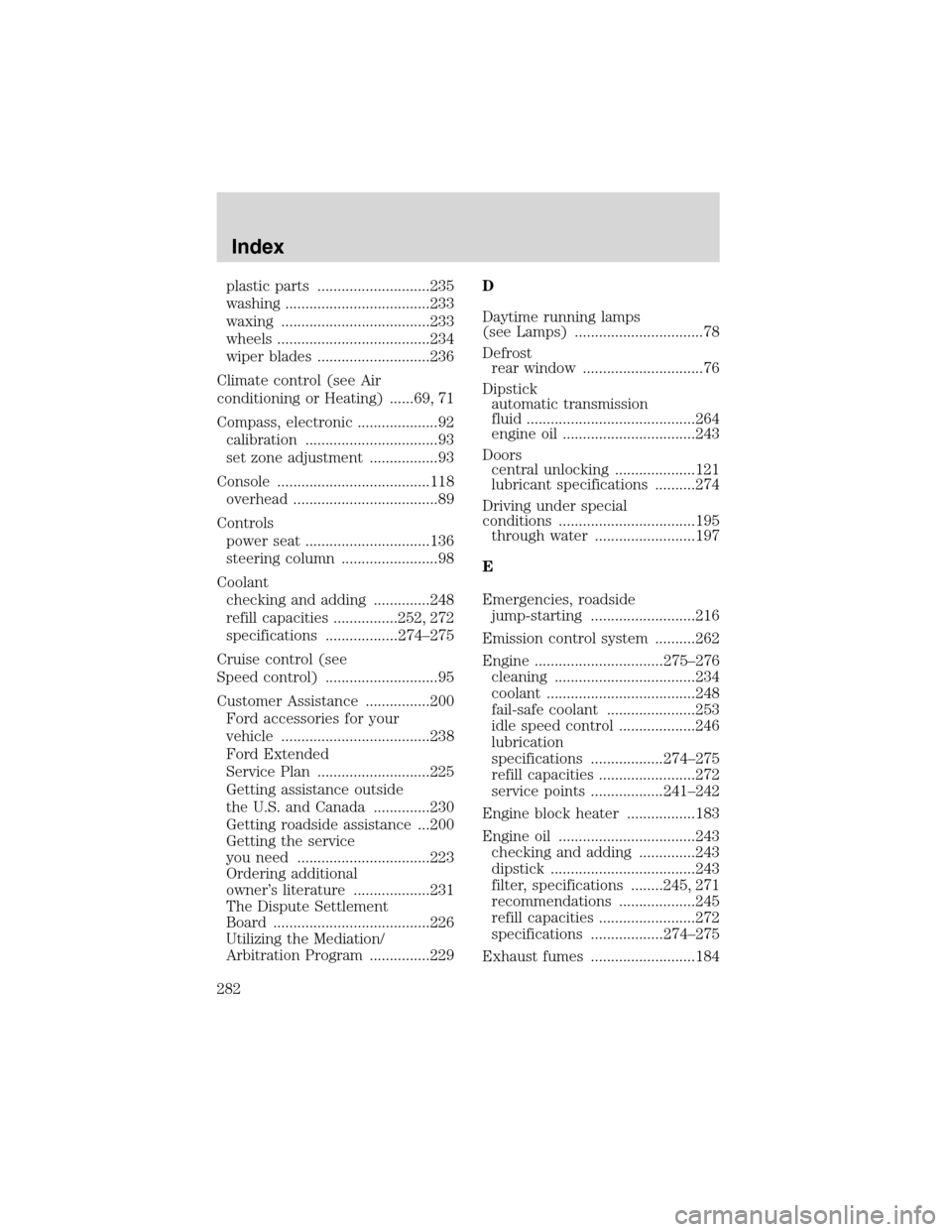
plastic parts ............................235
washing ....................................233
waxing .....................................233
wheels ......................................234
wiper blades ............................236
Climate control (see Air
conditioning or Heating) ......69, 71
Compass, electronic ....................92
calibration .................................93
set zone adjustment .................93
Console ......................................118
overhead ....................................89
Controls
power seat ...............................136
steering column ........................98
Coolant
checking and adding ..............248
refill capacities ................252, 272
specifications ..................274–275
Cruise control (see
Speed control) ............................95
Customer Assistance ................200
Ford accessories for your
vehicle .....................................238
Ford Extended
Service Plan ............................225
Getting assistance outside
the U.S. and Canada ..............230
Getting roadside assistance ...200
Getting the service
you need .................................223
Ordering additional
owner’s literature ...................231
The Dispute Settlement
Board .......................................226
Utilizing the Mediation/
Arbitration Program ...............229D
Daytime running lamps
(see Lamps) ................................78
Defrost
rear window ..............................76
Dipstick
automatic transmission
fluid ..........................................264
engine oil .................................243
Doors
central unlocking ....................121
lubricant specifications ..........274
Driving under special
conditions ..................................195
through water .........................197
E
Emergencies, roadside
jump-starting ..........................216
Emission control system ..........262
Engine ................................275–276
cleaning ...................................234
coolant .....................................248
fail-safe coolant ......................253
idle speed control ...................246
lubrication
specifications ..................274–275
refill capacities ........................272
service points ..................241–242
Engine block heater .................183
Engine oil ..................................243
checking and adding ..............243
dipstick ....................................243
filter, specifications ........245, 271
recommendations ...................245
refill capacities ........................272
specifications ..................274–275
Exhaust fumes ..........................184
Index
282
Page 285 of 288

Passenger Occupant
Classification Sensor .................143
Pedals (see Power
adjustable foot pedals) ...............95
Power adjustable foot pedals .....95
Power distribution box
(see Fuses) .......................206, 209
Power door locks ......................120
Power steering ..........................186
fluid, checking and adding ....263
fluid, refill capacity ................272
fluid, specifications .........274–275
Power Windows ...........................90
R
Radio ......................................16, 20
Rear Park Assist .......................195
Rear window defroster ...............76
Relays ........................................202
Remote entry system ...............124
opening the trunk ...................125
Roadside assistance ..................200
Roof rack ...................................119
S
Safety Belt Maintenance ..........156
Safety belts (see Safety
restraints) ..........142, 145, 147–151
Safety defects, reporting ..........232
Safety restraints ...............142, 145,
147–151
belt minder .............................152
extension assembly ................156
for adults .........................147–150
for children .............................169Occupant Classification
Sensor ......................................143
safety belt maintenance .........156
warning light and
chime ...............................151–152
Safety seats for children ..........172
Seat belts (see
Safety restraints) ......................142
Seats ..........................................135
child safety seats ....................172
cleaning ...................................236
climate control ........................138
easy access/easyout
feature .....................................137
memory seat ...................128, 138
Select Shift Transmission
(SST) shifter .............................193
Servicing your vehicle ..............239
Spare tire (see
Changing the Tire) ...................212
Spark plugs,
specifications .............271, 275–276
Specification chart,
lubricants ...........................274–275
Speed control ..............................95
Starting your vehicle ........181–183
jump starting ..........................216
Steering
speed sensitive .......................186
Steering column lock ..................89
Steering wheel
controls ......................................98
tilting .........................................88
T
Tires ...........................211, 266–268
changing ..........................211–213
Index
285
Page 286 of 288

checking the pressure ............268
replacing ..................................270
rotating ....................................268
snow tires and chains ............271
tire grades ...............................267
treadwear ................................267
Towing .......................................198
recreational towing .................199
trailer towing ..........................198
wrecker ....................................222
Traction control ........................186
Transmission .............................190
fluid, checking and adding
(automatic) .............................264
fluid, refill capacities ..............272
lubricant specifications ..274–275
Trunk .........................................122
remote release ................117, 125
Turn signal ..................................81
V
Vehicle dimensions ...................276Vehicle Identification Number
(VIN)
..........................................278
Vehicle loading
..........................198
Ventilating your vehicle
...........184
W
Warning lights (see Lights)
.......10
Washer fluid
..............................243
Water, Driving through
.............197
Windows
power
.........................................90
Windshield washer fluid and
wipers
..........................................86
checking and adding fluid
.....243
replacing wiper blades
.............87
Wrecker towing
.........................222
Index
286