Page 248 of 288
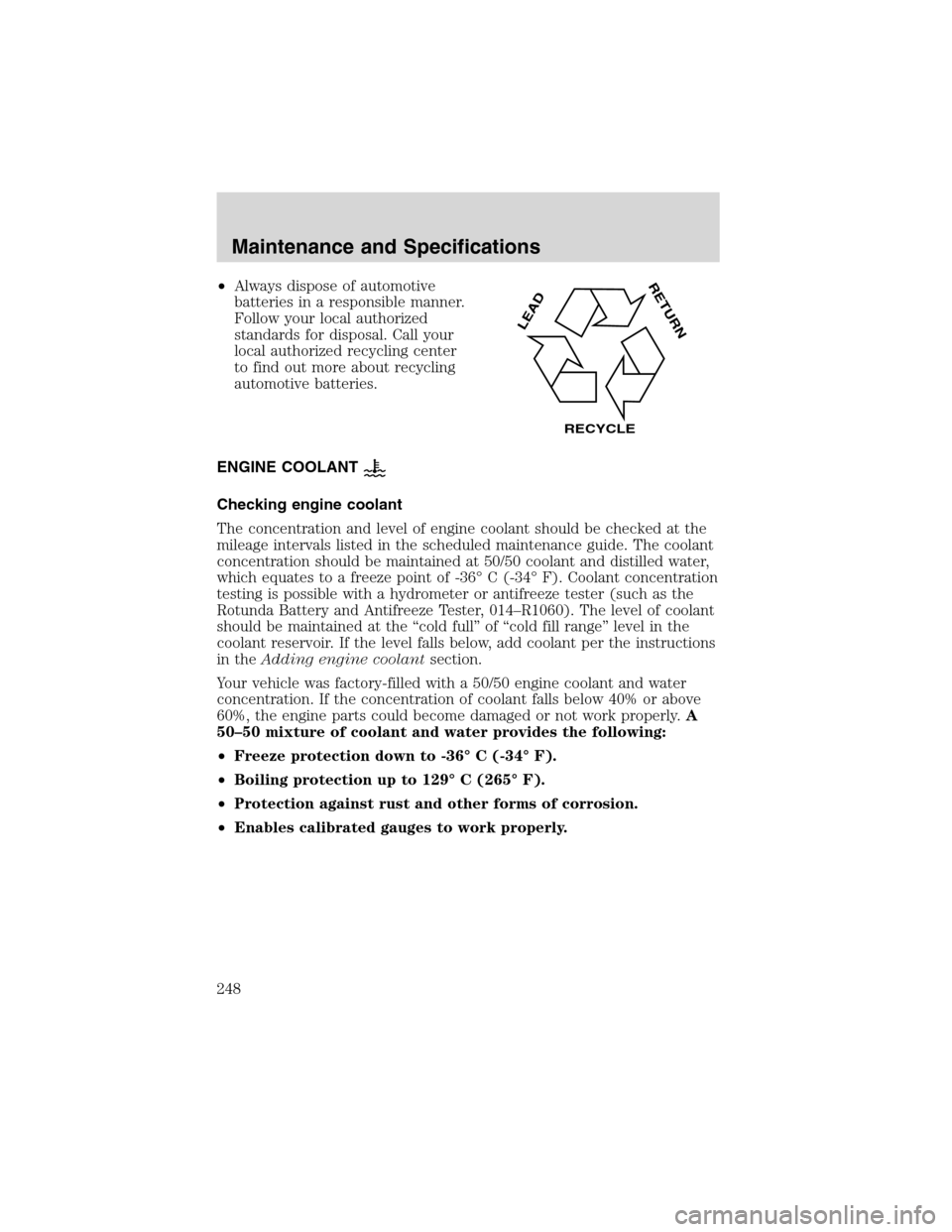
•Always dispose of automotive
batteries in a responsible manner.
Follow your local authorized
standards for disposal. Call your
local authorized recycling center
to find out more about recycling
automotive batteries.
ENGINE COOLANT
Checking engine coolant
The concentration and level of engine coolant should be checked at the
mileage intervals listed in the scheduled maintenance guide. The coolant
concentration should be maintained at 50/50 coolant and distilled water,
which equates to a freeze point of -36°C (-34°F). Coolant concentration
testing is possible with a hydrometer or antifreeze tester (such as the
Rotunda Battery and Antifreeze Tester, 014–R1060). The level of coolant
should be maintained at the“cold full”of“cold fill range”level in the
coolant reservoir. If the level falls below, add coolant per the instructions
in theAdding engine coolantsection.
Your vehicle was factory-filled with a 50/50 engine coolant and water
concentration. If the concentration of coolant falls below 40% or above
60%, the engine parts could become damaged or not work properly.A
50–50 mixture of coolant and water provides the following:
•Freeze protection down to -36°C (-34°F).
•Boiling protection up to 129°C (265°F).
•Protection against rust and other forms of corrosion.
•Enables calibrated gauges to work properly.
LEAD
RETURN
RECYCLE
Maintenance and Specifications
248
Page 263 of 288
permitted to intentionally remove an emission control device or prevent
it from working. Information about your vehicle’s emission system is on
the Vehicle Emission Control Information Decal located on or near the
engine. This decal identifies engine displacement and gives some tune up
specifications.
Please consult yourWarranty Guidefor complete emission warranty
information.
Readiness for Inspection/Maintenance (I/M) testing
In some localities, it may be a legal requirement to pass an I/M test of
the on-board diagnostics system. If your“Check Engine/Service Engine
Soon”light is on, refer to the description in theWarning lights and
chimessection of theInstrument clusterchapter. Your vehicle may not
pass the I/M test with the“Check Engine/Service Engine Soon”light on.
If the vehicle’s powertrain system or its battery has just been serviced,
the on-board diagnostics system is reset to a“not ready for I/M test”
condition. To ready the on-board diagnostics system for I/M testing, a
minimum of 30 minutes of city and highway driving is necessary as
described below:
•First, at least 10 minutes of driving on an expressway or highway.
•Next, at least 20 minutes driving in stop-and-go, city-type traffic with
at least four idle periods.
Allow the vehicle to sit for at least eight hours without starting the
engine. Then, start the engine and complete the above driving cycle. The
engine must warm up to its normal operating temperature. Once started,
do not turn off the engine until the above driving cycle is complete.
POWER STEERING FLUID
Refer to the scheduled maintenance guide for the service interval
schedules. If adding fluid is necessary, use only MERCON�AT F.
Maintenance and Specifications
263
Page 271 of 288
Tires that are larger or smaller than your vehicle’s original tires may also
affect the accuracy of your speedometer.
SNOW TIRES AND CHAINS
Snow tires must be the same size and grade as the tires you
currently have on your vehicle.
The tires on your vehicle have all weather treads to provide traction in
rain and snow. However, in some climates, you may need to use snow
tires or chains.
Follow these guidelines when using snow tires and chains:
•Use only SAE Class S chains with P225/55R16 tires.
•Do not use tire chains with size P235/50R17 tires. Use of SAE Class S
chains or other chain types may damage your vehicle.
•Install chains securely, verifying that the chains do not touch any
wiring, brake lines or fuel lines.
•Drive cautiously. If you hear the chains rub or bang against your
vehicle, stop and re-tighten the chains. If this does not work, remove
the chains to prevent damage to your vehicle.
•If possible, avoid fully loading your vehicle.
•Remove the tire chains when they are no longer needed. Do not use
tire chains on dry roads.
•The suspension insulation and bumpers will help prevent vehicle
damage. Do not remove these components from your vehicle when
using snow tires or chains.
MOTORCRAFT PART NUMBERS
Component 3.0L-4V V6 engine 3.9L-4V V8 engine
Air filter element FA-1679 FA-1679
Fuel filter FG-1011 FG-1011
Battery (standard) BXT-66-650 BXT-66-650
Battery (optional) BXT-66-750 BXT-66-750
Oil filter FL-400S FL-218
PCV valve EV-257 N/A
Spark plugs* AGSF-22FSM AGSP-32F
* Refer to Vehicle Emissions Control Information (VECI) decal for spark
plug information.
Maintenance and Specifications
271
Page 281 of 288
A
Accessory delay ..........................91
AdvanceTrac ..............................187
Air bag supplemental restraint
system ................157–158, 162, 165
and child safety seats ............159
description ..............158, 162, 165
disposal ....................................168
driver air bag ..........160, 163, 167
indicator light .........161, 164, 168
operation .................160, 163, 167
passenger air bag ...160, 163, 167
side air bag ......................162, 165
Air cleaner filter ...............265, 271
Air conditioning ....................69, 71
Antifreeze (see
Engine coolant) ........................248
Anti-lock brake system
(see Brakes) ......................184–185
Anti-theft system ......................133
arming the system ..................134
disarming a triggered
system .....................................134
Audio system (see Radio) ...16, 20
Automatic transmission
driving an automatic
overdrive .................................191
fluid, adding ............................264
fluid, checking ........................264
fluid, refill capacities ..............272
fluid, specification ..................275
Axle
lubricant
specifications ..................274–275
refill capacities ........................272
B
Battery .......................................246acid, treating emergencies .....246
jumping a disabled battery ....216
maintenance-free ....................246
replacement, specifications ...271
servicing ..................................246
BeltMinder .................................152
Brakes ........................................184
anti-lock ...........................184–185
anti-lock brake system
(ABS) warning light ...............184
fluid, checking and adding ....264
fluid, refill capacities ..............272
fluid, specifications .........274–275
lubricant specifications ..274–275
parking ....................................185
shift interlock ..........................190
Bulbs ............................................81
C
Capacities for refilling fluids ....272
Cargo net ...................................119
Cassette tape player ...................16
CD-single premium .....................20
Cell phone use ..........................106
Certification Label ....................277
Changing a tire .........................211
Child safety restraints ..............169
child safety belts ....................169
Child safety seats ......................172
attaching with tether straps ..176
in front seat ............................173
in rear seat ..............................173
Cleaning your vehicle
engine compartment ..............234
instrument panel ....................236
interior .............................236–237
interior trim ............................237
Index
281