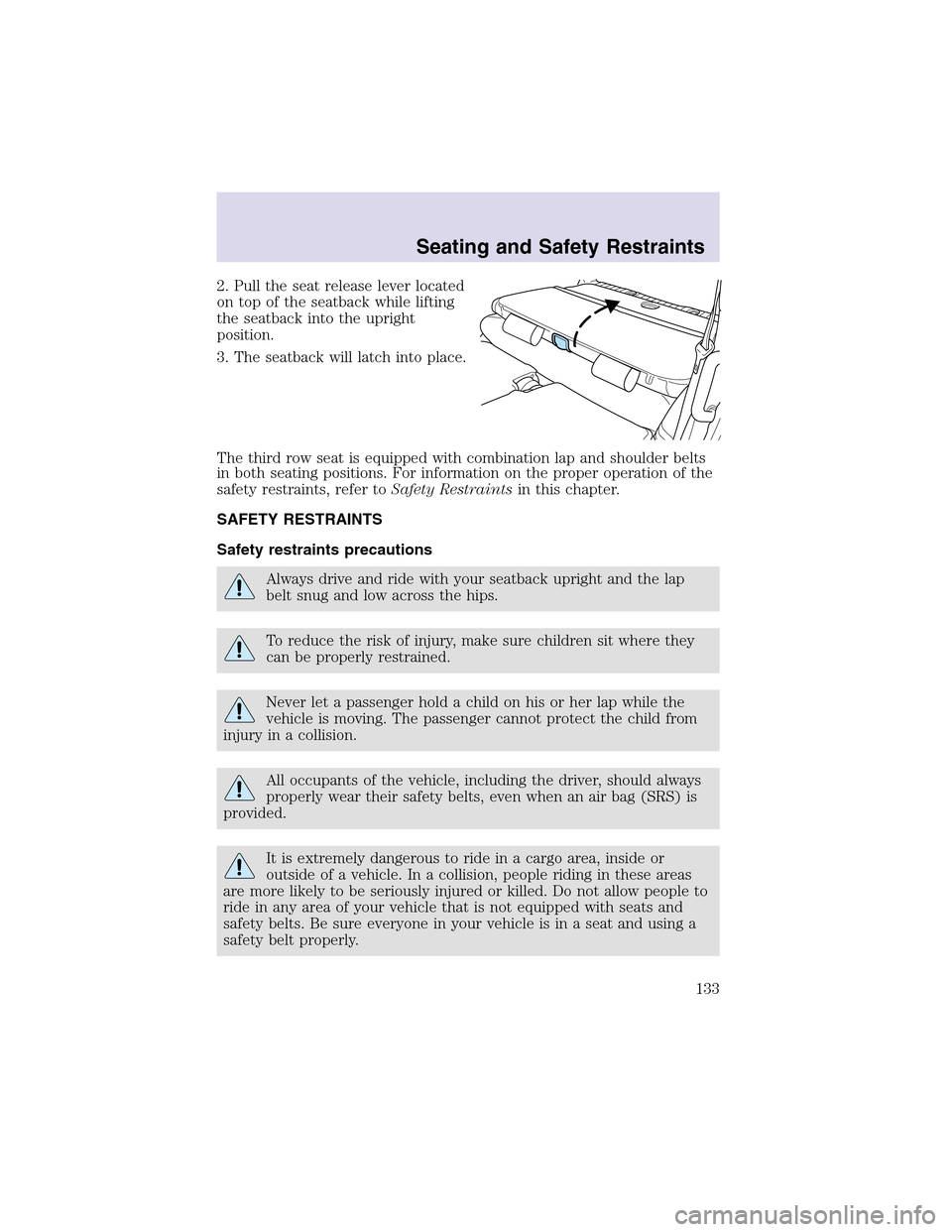
2. Pull the seat release lever located
on topof the seatback while lifting
the seatback into the upright
position.
3. The seatback will latch into place.
The third row seat is equipped with combination lap and shoulder belts
in both seating positions. For information on the proper operation of the
safety restraints, refer toSafety Restraintsin this chapter.
SAFETY RESTRAINTS
Safety restraints precautions
Always drive and ride with your seatback upright and the lap
belt snug and low across the hips.
To reduce the risk of injury, make sure children sit where they
can be properly restrained.
Never let a passenger hold a child on his or her lap while the
vehicle is moving. The passenger cannot protect the child from
injury in a collision.
All occupants of the vehicle, including the driver, should always
properly wear their safety belts, even when an air bag (SRS) is
provided.
It is extremely dangerous to ride in a cargo area, inside or
outside of a vehicle. In a collision, people riding in these areas
are more likely to be seriously injured or killed. Do not allow people to
ride in any area of your vehicle that is not equipped with seats and
safety belts. Be sure everyone in your vehicle is in a seat and using a
safety belt properly.
Seating and Safety Restraints
133
•Two side crash sensors mounted at the base of the B-pillar (one on
each side).
•Two side crash sensors located at the c-pillar behind the rear doors
(one on each side).
•Roll over sensor in the restraints control module (RCM).
The Safety Canopy�system, in combination with seat belts, can help
reduce the risk of severe injuries in the event of a significant side impact
collision or rollover event.
Children 12 years old and under should always be properly restrained in
the second or third row seats (if equipped). The Safety Canopy�will
not interfere with children restrained using a properly installed child or
booster seat because it is designed to inflate downward from the
headliner above the doors along the side window openings.
The Safety Canopy�system is designed to activate when the vehicle
sustains lateral deceleration sufficient to cause the side crash sensor to
close an electrical circuit that initiates Safety Canopy�inflation or when
a certain likelihood of a rollover event is detected by the rollover sensor.
The Safety Canopy�is mounted to the roof side-rail sheet metal, behind
the headliner, above the first and second row seats. In certain lateral
collisions or rollover events, the Safety Canopy�system will be
activated, regardless of which seats are occupied. The Safety Canopy�is
designed to inflate between the side window area and occupants to
further enhance protection provided in side impact collisions and rollover
events.
The fact that the Safety Canopy�system did not activate in a collision
does not mean that something is wrong with the system. Rather, it
means the forces were not of the type sufficient to cause activation. The
Safety Canopy�is designed to inflate in certain side impact collisions or
rollover events, not in rear impact, frontal or near-frontal collisions,
unless the collision causes sufficient lateral deceleration or rollover
likelihood.
Seating and Safety Restraints
149