Page 195 of 288
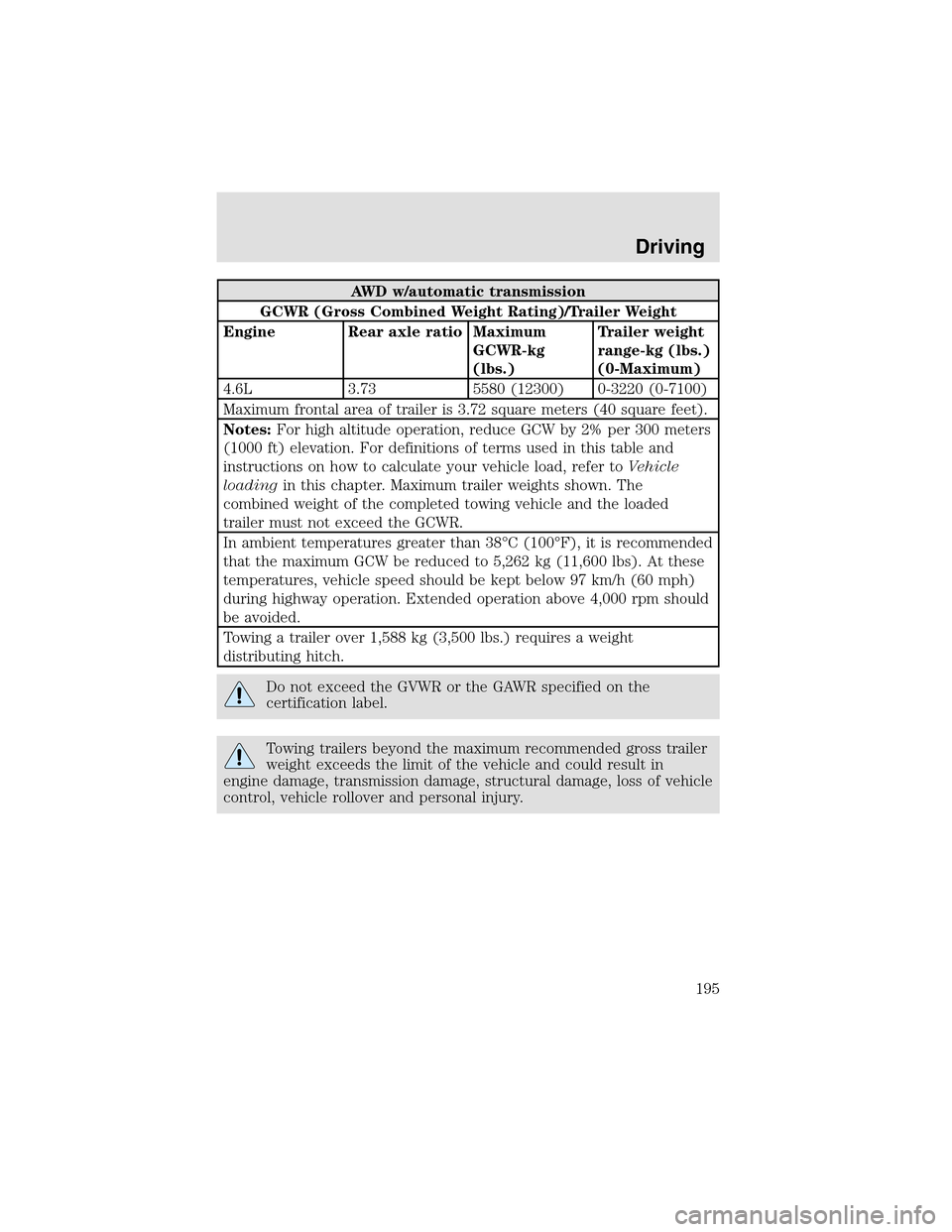
AWD w/automatictransmission
GCWR (Gross Combined Weight Rating)/Trailer Weight
Engine Rear axle ratio Maximum
GCWR-kg
(lbs.)Trailer weight
range-kg (lbs.)
(0-Maximum)
4.6L 3.73 5580 (12300) 0-3220 (0-7100)
Maximum frontal area of trailer is 3.72 square meters (40 square feet).
Notes:For high altitude operation, reduce GCW by 2% per 300 meters
(1000 ft) elevation. For definitions of terms used in this table and
instructions on how to calculate your vehicle load, refer toVehicle
loadingin this chapter. Maximum trailer weights shown. The
combined weight of the completed towing vehicle and the loaded
trailer must not exceed the GCWR.
In ambient temperatures greater than 38°C (100°F), it is recommended
that the maximum GCW be reduced to 5,262 kg (11,600 lbs). At these
temperatures, vehicle speed should be kept below 97 km/h (60 mph)
during highway operation. Extended operation above 4,000 rpm should
be avoided.
Towing a trailer over 1,588 kg (3,500 lbs.) requires a weight
distributing hitch.
Do not exceed the GVWR or the GAWR specified on the
certification label.
Towing trailers beyond the maximum recommended gross trailer
weight exceeds the limit of the vehicle and could result in
engine damage, transmission damage, structural damage, loss of vehicle
control, vehicle rollover and personal injury.
Driving
195
Page 197 of 288
Do not attach safety chains to the bumper.
Trailer brakes
Electric brakes and manual, automatic or surge-type trailer brakes are
safe if installed properly and adjusted to the manufacturer’s
specifications. The trailer brakes must meet local and Federal
regulations.
Do not connect a trailer’s hydraulic brake system directly to your
vehicle’s brake system. Your vehicle may not have enough
braking power and your chances of having a collision greatly increase.
The braking system of the tow vehicle is rated for operation at the
GVWR not GCWR.
Trailer lamps
Trailer lamps are required on most towed vehicles. Make sure your
trailer lamps conform to local and Federal regulations. See your dealer or
trailer rental agency for proper instructions and equipment for hooking
uptrailer lamps.
Never connect any trailer lighting to the vehicle’s taillamp
circuits, because it may damage the electrical system resulting in
fire. Contact your local Ford dealership for assistance in proper trailer
tow wiring installation. Additional electrical equipment may be
required.
Driving while you tow
When towing a trailer:
•Turn off the speed control. The speed control may shut off
automatically when you are towing on long, steepgrades.
•Consult your local motor vehicle speed regulations for towing a trailer.
•To eliminate excessive shifting, use a lower gear. This will also assist
in transmission cooling. (For additional information, refer to the
Driving with a 5–speed automatic transmissionsection in this
chapter.
•Under extreme conditions with large frontal trailers, high outside
temperatures and highway speeds, the coolant gauge may indicate
higher than normal coolant temperatures. If this occurs, reduce speed
Driving
197
Page 219 of 288

JUMP STARTING YOUR VEHICLE
The gases around the battery can explode if exposed to flames,
sparks, or lit cigarettes. An explosion could result in injury or
vehicle damage.
Batteries contain sulfuric acid which can burn skin, eyes and
clothing, if contacted.
Do not attempt to push-start your vehicle. Automatic
transmissions do not have push-start capability; also, the
catalytic converter may become damaged.
Preparing your vehicle
When the battery is disconnected or a new battery is installed, the
transmission must relearn its shift strategy. As a result, the transmission
may have firm and/or soft shifts. This operation is considered normal and
will not affect function or durability of the transmission. Over time, the
adaptive learning process will fully update transmission operation.
1.Use only a 12–volt supply to start your vehicle.
2. Do not disconnect the battery of the disabled vehicle as this could
damage the vehicle’s electrical system.
3. Park the booster vehicle close to the hood of the disabled vehicle
making sure the two vehiclesdo nottouch. Set the parking brake on
both vehicles and stay clear of the engine cooling fan and other moving
parts.
4. Check all battery terminals and remove any excessive corrosion before
you attach the battery cables. Ensure that vent caps are tight and level.
5. Turn the heater fan on in both vehicles to protect any electrical
surges. Turn all other accessories off.
Roadside Emergencies
219
Page 265 of 288

1. Start the engine and let it run
until it reaches normal operating
temperature (the engine coolant
temperature gauge indicator will be
near the center of the normal area
between H and C).
2. While the engine idles, turn the
steering wheel left and right several
times.
3. Turn the engine off.
4. Check the fluid level in the
reservoir. It should be between the
MIN and MAX lines. Do not add
fluid if the level is in this range.
5. If the fluid is low, add fluid in
small amounts, continuously
checking the level until it reaches
the range between the MIN and
MAX lines. Be sure to put the cap
back on the reservoir.
BRAKE FLUID RESERVOIR
The fluid level will dropslowly as
the brakes wear, and will rise when
the brake components are replaced.
Fluid levels below the “MAX” line
that do not trigger the brake system
warning lampare within the normal
operating range, there is no need to
add fluid. If the fluid levels are outside of the normal operating range,
the performance of your brake system could be compromised, seek
service from your dealer immediately.
TRANSMISSION FLUID
Checking automatic transmission fluid
The automatic transmission does not have a transmission fluid dipstick.
Maintenance and Specifications
265
Page 271 of 288
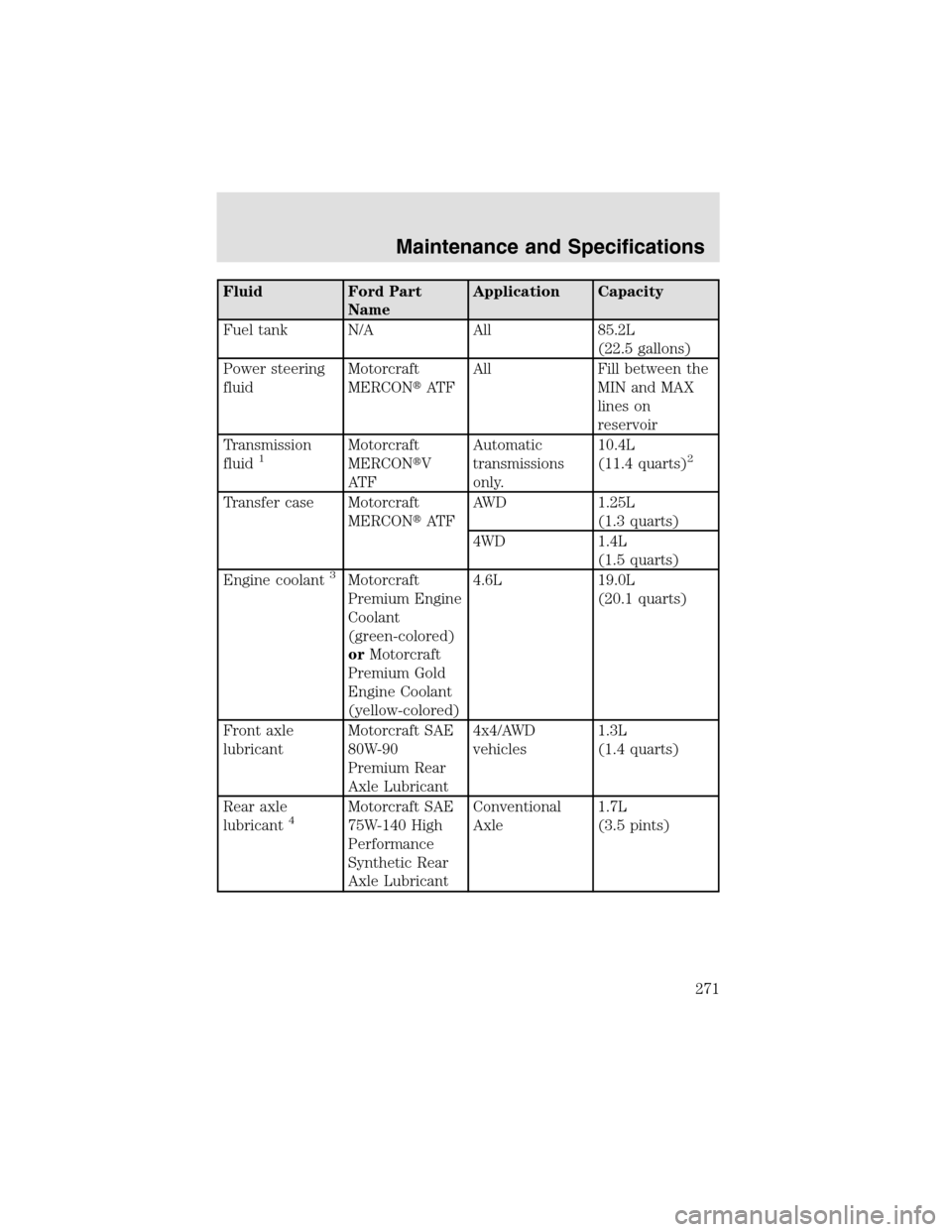
Fluid Ford Part
NameApplication Capacity
Fuel tank N/A All 85.2L
(22.5 gallons)
Power steering
fluidMotorcraft
MERCON�AT FAll Fill between the
MIN and MAX
lines on
reservoir
Transmission
fluid
1Motorcraft
MERCON�V
AT FAutomatic
transmissions
only.10.4L
(11.4 quarts)2
Transfer case Motorcraft
MERCON�AT FAWD 1.25L
(1.3 quarts)
4WD 1.4L
(1.5 quarts)
Engine coolant
3Motorcraft
Premium Engine
Coolant
(green-colored)
orMotorcraft
Premium Gold
Engine Coolant
(yellow-colored)4.6L 19.0L
(20.1 quarts)
Front axle
lubricantMotorcraft SAE
80W-90
Premium Rear
Axle Lubricant4x4/AWD
vehicles1.3L
(1.4 quarts)
Rear axle
lubricant
4Motorcraft SAE
75W-140 High
Performance
Synthetic Rear
Axle LubricantConventional
Axle1.7L
(3.5 pints)
Maintenance and Specifications
271
Page 272 of 288
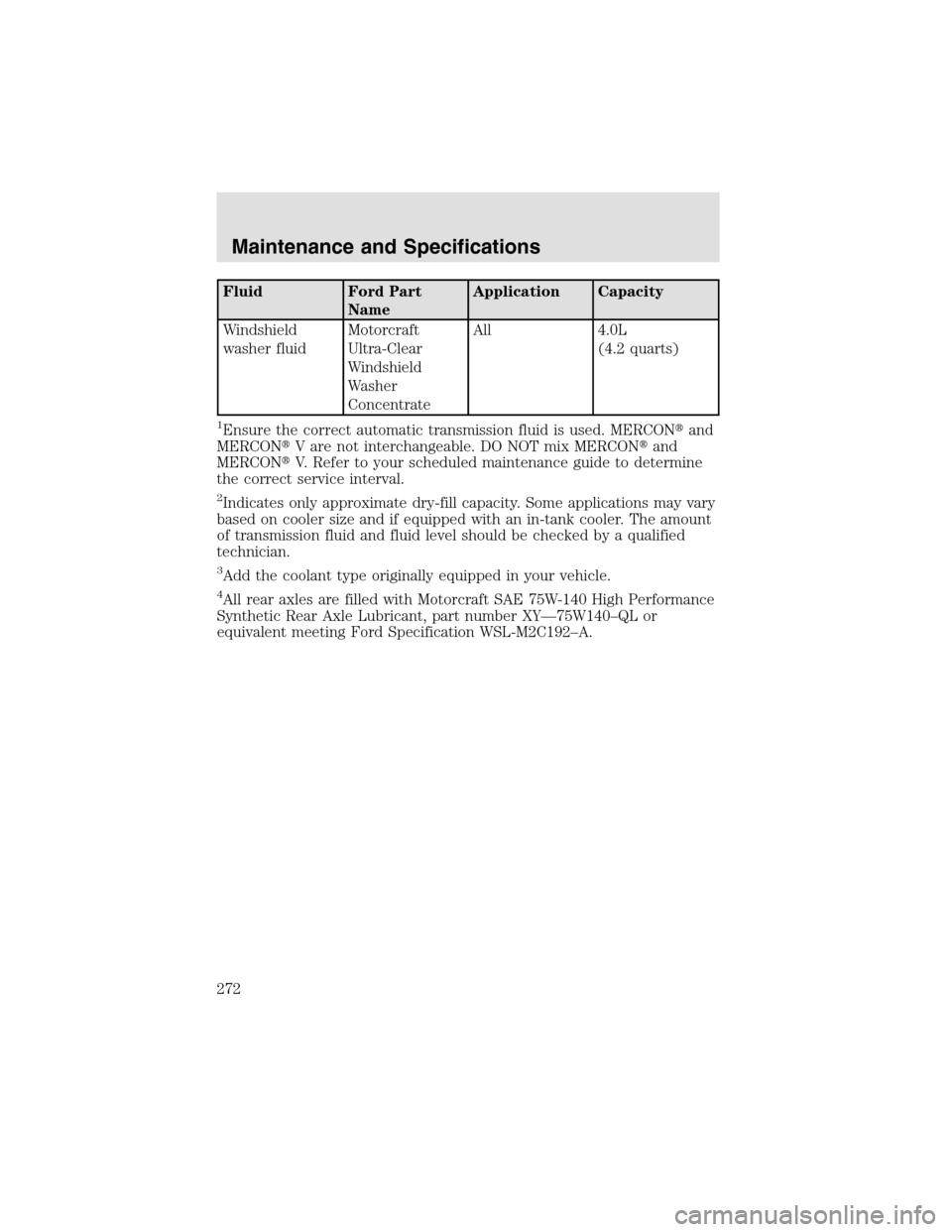
Fluid Ford Part
NameApplication Capacity
Windshield
washer fluidMotorcraft
Ultra-Clear
Windshield
Washer
ConcentrateAll 4.0L
(4.2 quarts)
1Ensure the correct automatic transmission fluid is used. MERCON�and
MERCON�V are not interchangeable. DO NOT mix MERCON�and
MERCON�V. Refer to your scheduled maintenance guide to determine
the correct service interval.
2Indicates only approximate dry-fill capacity. Some applications may vary
based on cooler size and if equipped with an in-tank cooler. The amount
of transmission fluid and fluid level should be checked by a qualified
technician.
3Add the coolant type originally equipped in your vehicle.
4All rear axles are filled with Motorcraft SAE 75W-140 High Performance
Synthetic Rear Axle Lubricant, part number XY—75W140–QL or
equivalent meeting Ford Specification WSL-M2C192–A.
Maintenance and Specifications
272
Page 274 of 288
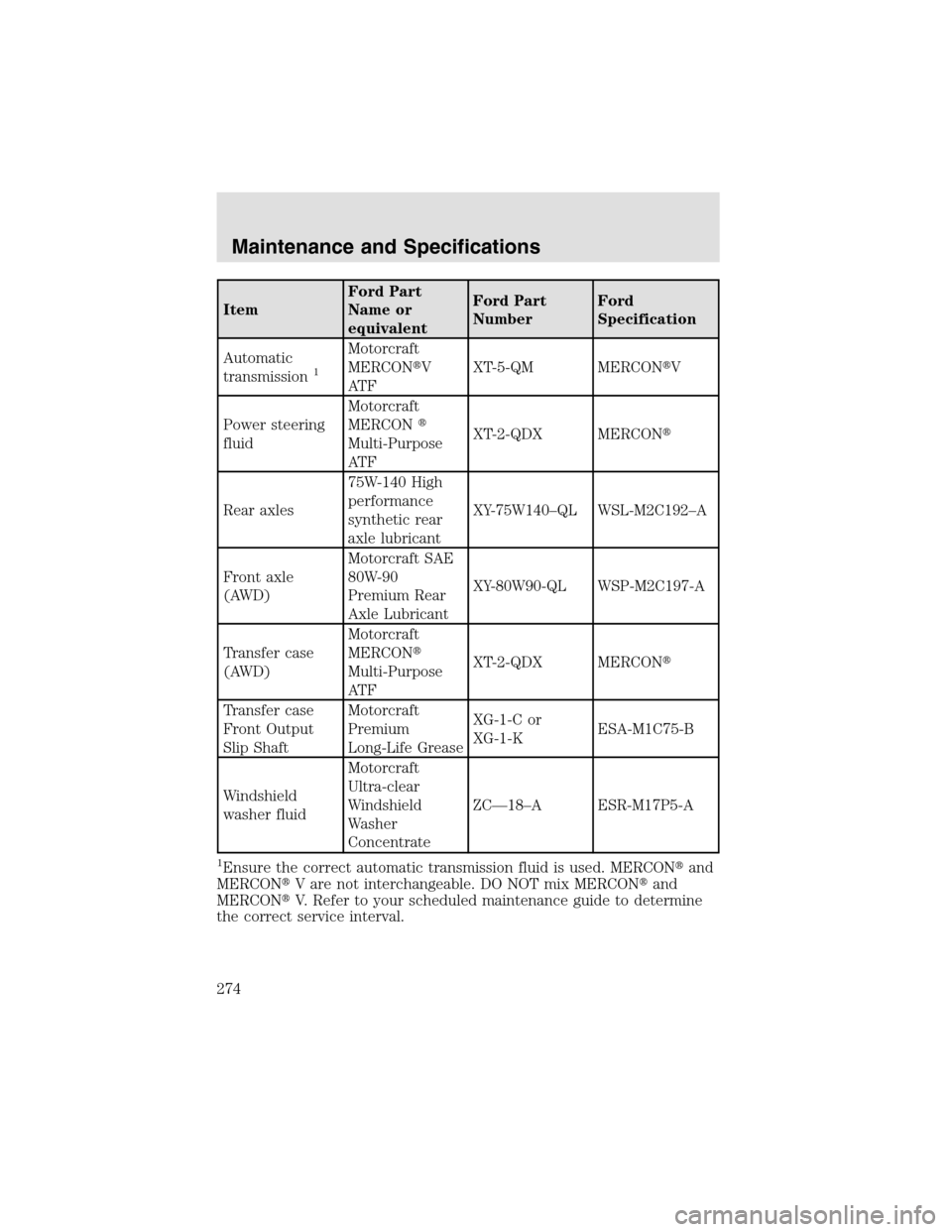
ItemFord Part
Name or
equivalentFord Part
NumberFord
Specification
Automatic
transmission
1
Motorcraft
MERCON�V
AT FXT-5-QM MERCON�V
Power steering
fluidMotorcraft
MERCON�
Multi-Purpose
AT FXT-2-QDX MERCON�
Rear axles75W-140 High
performance
synthetic rear
axle lubricantXY-75W140–QL WSL-M2C192–A
Front axle
(AWD)Motorcraft SAE
80W-90
Premium Rear
Axle LubricantXY-80W90-QL WSP-M2C197-A
Transfer case
(AWD)Motorcraft
MERCON�
Multi-Purpose
AT FXT-2-QDX MERCON�
Transfer case
Front Output
SlipShaftMotorcraft
Premium
Long-Life GreaseXG-1-C or
XG-1-KESA-M1C75-B
Windshield
washer fluidMotorcraft
Ultra-clear
Windshield
Washer
ConcentrateZC—18–A ESR-M17P5-A
1Ensure the correct automatic transmission fluid is used. MERCON�and
MERCON�V are not interchangeable. DO NOT mix MERCON�and
MERCON�V. Refer to your scheduled maintenance guide to determine
the correct service interval.
Maintenance and Specifications
274
Page 281 of 288

A
ABS (see Brakes) .....................168
Accessory delay ..........................73
Air bag supplemental
restraint system ........143–144, 147
and child safety seats ............145
description ......................144, 147
disposal ....................................151
driver air bag ..................146, 148
indicator light ...................12, 150
operation .........................146, 148
passenger air bag ...........146, 148
side air bag ..............................147
Air cleaner filter .......................270
Air conditioning ..........................41
auxiliary heater and air
conditioner ................................47
All Wheel Drive (AWD),
driving off road .........................181
Ambulance packages ....................7
Antifreeze
(see Engine coolant) ................251
Anti-lock brake system
(see Brakes) ......................168–169
Anti-theft system ......................117
arming the system ..................117
disarming a triggered
system .....................................118
Audio system (see Radio) ...18, 27
Automatic transmission
driving an automatic
overdrive .................................176
fluid, adding ............................265
fluid, checking ........................265
fluid, refill capacities ..............270
fluid, specification ..................275
Auxiliary power point .................69Axle
lubricant
specifications ..................273, 275
refill capacities ........................270
B
Battery .......................................249
acid, treating emergencies .....249
charging system warning
light ............................................12
jumping a disabled battery ....219
maintenance-free ....................249
replacement, specifications ...270
servicing ..................................249
BeltMinder .................................139
Brakes ........................................167
anti-lock ...........................168–169
anti-lock brake system
(ABS) warning light .........12, 169
brake warning light ..................11
fluid, checking and adding ....265
fluid, refill capacities ..............270
fluid, specifications .........273, 275
lubricant
specifications ..................273, 275
parking ....................................169
shift interlock ..........................174
Bulbs ............................................56
C
Calculating load ........................193
Capacities for refilling fluids ....270
Cargo cover ...............................102
CD-single premium .....................18
Cell phone use ............................98
Certification Label ....................276
Changing a tire .........................211
Index
281