2003 JEEP GRAND CHEROKEE Anti
[x] Cancel search: AntiPage 1820 of 2199

(5)Position low range fork and sleeve in case. Be
sure low range fork pin is engaged in shift sector slot.
(6) Install first mainshaft bearing spacer on main-
shaft (Fig. 72).
(7) Install bearing rollers on mainshaft (Fig. 72).
Coat bearing rollers with generous quantity of petro-
leum jelly to hold them in place.
(8) Install remaining bearing spacer on mainshaft
(Fig. 72). Do not displace any bearings while install-
ing spacer.(9) Install differential (Fig. 73). Do not displace
mainshaft bearings when installing differential.
Fig. 70 Input Gear Snap-Ring Installation
1 - INPUT GEAR
2 - SNAP-RING
Fig. 71 Installing Front Bearing Retainer
1 - FRONT BEARING RETAINER
Fig. 72 Installing Mainshaft Bearing Rollers and
Spacers
1 - MAINSHAFT BEARING ROLLERS
2 - BEARING SPACERS
Fig. 73 Differential Installation
1 - DIFFERENTIAL
2 - MAINSHAFT
WJTRANSFER CASE - NV242 21 - 301
TRANSFER CASE - NV242 (Continued)
Page 1825 of 2199

REAR RETAINER - NV242LD
(1) Apply bead of MopartSealer, or LoctiteŸ
Ultra Gray, to mating surface of rear retainer. Sealer
bead should be a maximum of 3/16 in.
(2) Install rear retainer on rear case. Tighten
retainer bolts to 20-27 N´m (15-20 ft. lbs.) torque.
(3) Install rear bearing I.D. retaining ring and
spacer on output shaft.
(4) Apply liberal quantity of petroleum jelly to new
rear seal and to output shaft. Petroleum jelly is
needed to protect seal lips during installation.
(5) Slide seal onto Seal Protector 6992 (Fig. 88).
Slide seal protector and seal onto output shaft.(6) Slide Installer C-4076-B onto seal protector
with the recessed side of the tool toward the seal.
Drive seal into rear bearing retainer with Installer
C-4076-B and Handle MD-998323 (Fig. 89).
(7) Install rear slinger with Installer 8408.
(8) Install boot on output shaft slinger and crimp
retaining clamp with tool C-4975-A (Fig. 90).
Fig. 88 Output Shaft Seal and Protector
1 - OUTPUT SHAFT SEAL
2 - SPECIAL TOOL 6992
3 - TRANSFER CASE
Fig. 87 Installing Case Magnet
1 - MAGNET
Fig. 89 Rear Seal Installation
1 - SPECIAL TOOL 8691
2 - HANDLE
3 - TRANSFER CASE
Fig. 90 Slinger Boot Installation
1 - SPECIAL TOOL C-4975-A
2 - SLINGER
3 - BOOT
4 - CLAMP
21 - 306 TRANSFER CASE - NV242WJ
TRANSFER CASE - NV242 (Continued)
Page 1865 of 2199

TIRES
DESCRIPTION
DESCRIPTION - TIRES
Tires are designed and engineered for each specific
vehicle. They provide the best overall performance
for normal operation. The ride and handling charac-
teristics match the vehicle's requirements. With
proper care they will give excellent reliability, trac-
tion, skid resistance, and tread life.
Driving habits have more effect on tire life than
any other factor. Careful drivers will obtain in most
cases, much greater mileage than severe use or care-
less drivers. A few of the driving habits which will
shorten the life of any tire are:
²Rapid acceleration
²Severe brake applications
²High speed driving
²Excessive speeds on turns
²Striking curbs and other obstacles
Radial-ply tires are more prone to irregular tread
wear. It is important to follow the tire rotation inter-
val shown in the section on Tire Rotation.(Refer to 22
- TIRES/WHEELS - STANDARD PROCEDURE),
This will help to achieve a greater tread life.
TIRE IDENTIFICATION
Tire type, size, aspect ratio and speed rating are
encoded in the letters and numbers imprinted on the
side wall of the tire. Refer to the chart to decipher
the tire identification code (Fig. 12).
Performance tires have a speed rating letter after
the aspect ratio number. The speed rating is not
always printed on the tire sidewall. These ratings
are:
²Qup to 100 mph
²Sup to 112 mph
²Tup to 118 mph
²Uup to 124 mph
²Hup to 130 mph
²Vup to 149 mph
²Zmore than 149 mph (consult the tire manu-
facturer for the specific speed rating)
An All Season type tire will have eitherM+S,M
&SorM±S(indicating mud and snow traction)
imprinted on the side wall.
TIRE CHAINS
Tire snow chains may be used oncertainmodels.
Refer to the Owner's Manual for more information.
DESCRIPTION - RADIAL±PLY TIRES
Radial-ply tires improve handling, tread life and
ride quality, and decrease rolling resistance.Radial-ply tires must always be used in sets of
four. Under no circumstances should they be used on
the front only. They may be mixed with temporary
spare tires when necessary. A maximum speed of 50
MPH is recommended while a temporary spare is in
use.
Radial-ply tires have the same load-carrying capac-
ity as other types of tires of the same size. They also
use the same recommended inflation pressures.
The use of oversized tires, either in the front or
rear of the vehicle, can cause vehicle drive train fail-
ure. This could also cause inaccurate wheel speed
signals when the vehicle is equipped with Anti-Lock
Brakes.
The use of tires from different manufactures on the
same vehicle is NOT recommended. The proper tire
pressure should be maintained on all four tires.
DESCRIPTION - TIRE INFLATION PRESSURES
Under inflation will cause rapid shoulder wear, tire
flexing, and possible tire failure (Fig. 13).
Over inflation will cause rapid center wear and
loss of the tire's ability to cushion shocks (Fig. 14).
Improper inflation can cause:
²Uneven wear patterns
²Reduced tread life
²Reduced fuel economy
Fig. 12 Tire Identification
22 - 6 TIRES/WHEELSWJ
Page 1886 of 2199

(3) Engage clips attaching glass retainer to glass
lift plate.
(4) Locate glass to full down position.
(5) Install outer belt weatherstrip, (Refer to 23 -
BODY/WEATHERSTRIP/SEALS/FDR OUTER BELT
WEATHERSTRIP - INSTALLATION).
(6) Install inner belt weatherstrip, (Refer to 23 -
BODY/WEATHERSTRIP/SEALS/FDR INNER BELT
WEATHERSTRIP - INSTALLATION).
(7) Install waterdam, refer to (Refer to 23 - BODY/
DOOR - FRONT/WATERDAM - INSTALLATION).
EXTERIOR HANDLE
REMOVAL
(1) Remove glass run channel, refer to (Refer to 23
- BODY/DOOR - FRONT/GLASS RUN CHANNEL -
REMOVAL).
(2) Disconnect lock cylinder to latch rod.
(3) Disconnect outside handle to latch rod
(4) Remove fasteners attaching outside handle to
door (Fig. 5).
(5) Remove outside handle from door.
(6) Disconnect anti-theft harness connector, if
equipped.
(7) Separate outside handle from vehicle.
INSTALLATION
(1) Position outside handle at door (Fig. 5).
(2) Connect anti-theft harness connector, if
equipped.
(3) Position outside handle in door.(4) Install fasteners attaching outside handle to
door.
(5) Connect outside handle to latch rod
(6) Connect lock cylinder to latch rod.
(7) Install glass run channel, refer to (Refer to 23 -
BODY/DOOR - FRONT/GLASS RUN CHANNEL -
INSTALLATION).
GLASS RUN CHANNEL
REMOVAL
NOTE: Only the rearward glass run channel is ser-
viceable.
(1) Remove the waterdam, refer to (Refer to 23 -
BODY/DOOR - FRONT/WATERDAM - REMOVAL).
(2) Remove inner belt weatherstrip, refer to (Refer
to 23 - BODY/WEATHERSTRIP/SEALS/FDR INNER
BELT WEATHERSTRIP - REMOVAL).
(3) Remove outer belt weatherstrip, refer to (Refer
to 23 - BODY/WEATHERSTRIP/SEALS/FDR OUTER
BELT WEATHERSTRIP - REMOVAL).
(4) Remove bolt attaching run channel to inner
door panel (Fig. 6).
(5) Peel back glass run channel weatherstrip on
rear run channel.
(6) Pull glass run channel downward to separate
from door.
Fig. 4 Front Door Glass Retainer
1 - GLASS
2 - RETAINER
3 - LIFT PLATE
4 - STUD
Fig. 5 Front Door Outside Handle
1 - DOOR
2 - OUTSIDE HANDLE
WJDOOR - FRONT 23 - 13
DOOR GLASS (Continued)
Page 1889 of 2199

ADJUSTMENTS
DOOR LATCH
DOOR LATCH ADJUSTMENT
(1) Locate access hole (Fig. 11).
(2) Insert a 5/32-inch hex-wrench through hole and
into adjustment screw. Loosen screw.
(3) Operate outside handle button several times to
release any restriction because of mis-alignment.
(4) Tighten adjustment screw to 3 N´m (30 in-lbs)
torque.
(5) Test handle button and lock cylinder for proper
operation.
LATCH STRIKER
REMOVAL
(1) Remove screws attaching striker to B-pillar.
(2) Separate striker and spacer from B-pillar (Fig.
12).
INSTALLATION
(1) Position striker and spacer on B-pillar.
(2) Install screws attaching striker to B-pillar.
Tighten screws to 28 N´m (20 ft. lbs.) torque (Fig.
12).
LOCK CYLINDER
REMOVAL
(1) Remove outside door handle, refer to (Refer to
23 - BODY/DOOR - FRONT/EXTERIOR HANDLE -
REMOVAL).
(2) Remove screw securing lock cylinder retainer
to outside door handle (Fig. 13).
(3) Separate lock cylinder from door handle.
(4) Disconnect lock cylinder switch, if equipped.
Fig. 11 Door Latch Adjustment
1 - ACCESS HOLE
2 - DOOR
3 - LATCH MOUNTING BOLTS
4-LATCH
Fig. 12 Front Door Latch Striker
1 - B-PILLAR
2 - SPACER
3 - STRIKER
Fig. 13 Front Door Lock Cylinder
1 - OUTSIDE DOOR HANDLE
2 - LOCK CYLINDER
3 - ANTI-THEFT SWITCH
4 - RETAINER
23 - 16 DOOR - FRONTWJ
LATCH (Continued)
Page 1954 of 2199
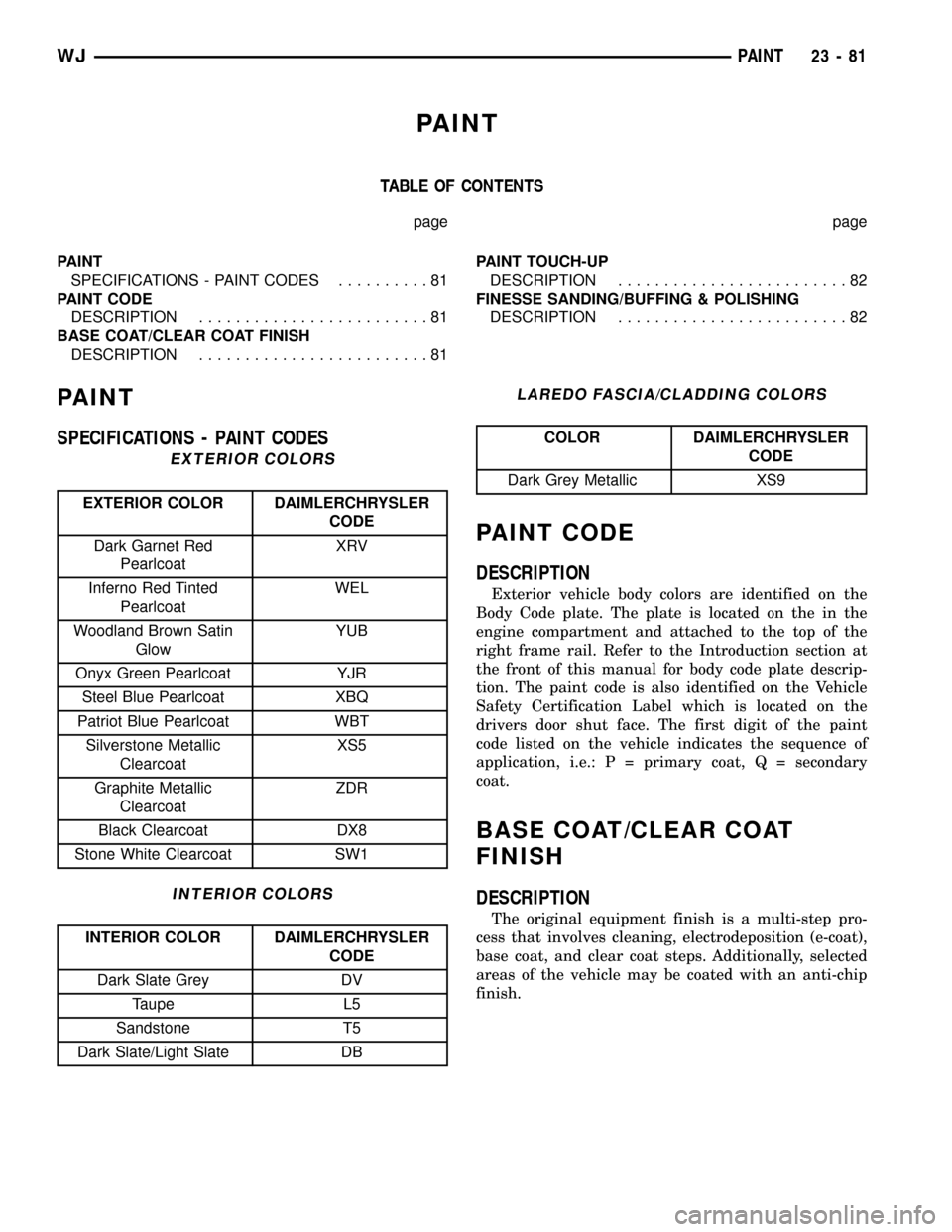
PAINT
TABLE OF CONTENTS
page page
PAINT
SPECIFICATIONS - PAINT CODES..........81
PAINT CODE
DESCRIPTION.........................81
BASE COAT/CLEAR COAT FINISH
DESCRIPTION.........................81PAINT TOUCH-UP
DESCRIPTION.........................82
FINESSE SANDING/BUFFING & POLISHING
DESCRIPTION.........................82
PAINT
SPECIFICATIONS - PAINT CODES
EXTERIOR COLORS
EXTERIOR COLOR DAIMLERCHRYSLER
CODE
Dark Garnet Red
PearlcoatXRV
Inferno Red Tinted
PearlcoatWEL
Woodland Brown Satin
GlowYUB
Onyx Green Pearlcoat YJR
Steel Blue Pearlcoat XBQ
Patriot Blue Pearlcoat WBT
Silverstone Metallic
ClearcoatXS5
Graphite Metallic
ClearcoatZDR
Black Clearcoat DX8
Stone White Clearcoat SW1
INTERIOR COLORS
INTERIOR COLOR DAIMLERCHRYSLER
CODE
Dark Slate Grey DV
Taupe L5
Sandstone T5
Dark Slate/Light Slate DB
LAREDO FASCIA/CLADDING COLORS
COLOR DAIMLERCHRYSLER
CODE
Dark Grey Metallic XS9
PAINT CODE
DESCRIPTION
Exterior vehicle body colors are identified on the
Body Code plate. The plate is located on the in the
engine compartment and attached to the top of the
right frame rail. Refer to the Introduction section at
the front of this manual for body code plate descrip-
tion. The paint code is also identified on the Vehicle
Safety Certification Label which is located on the
drivers door shut face. The first digit of the paint
code listed on the vehicle indicates the sequence of
application, i.e.: P = primary coat, Q = secondary
coat.
BASE COAT/CLEAR COAT
FINISH
DESCRIPTION
The original equipment finish is a multi-step pro-
cess that involves cleaning, electrodeposition (e-coat),
base coat, and clear coat steps. Additionally, selected
areas of the vehicle may be coated with an anti-chip
finish.
WJPAINT 23 - 81