2003 Hyundai Tiburon engine coolant
[x] Cancel search: engine coolantPage 142 of 169
DO-IT-YOURSELF MAINTENANCE
6-11
G120C02A-AATRecommended Brake Fluid
Use only hydraulic brake fluid conforming to
DOT 3 or DOT 4 specifications in your braking
system. Follow the instructions printed on the
container.
G120D01A-AAT
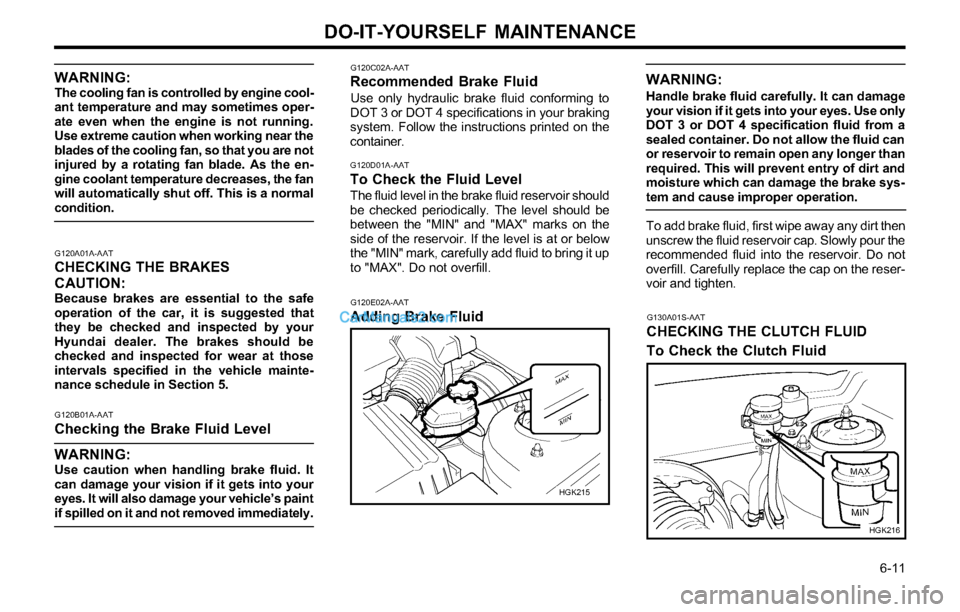
To Check the Fluid LevelThe fluid level in the brake fluid reservoir should
be checked periodically. The level should be
between the "MIN" and "MAX" marks on the
side of the reservoir. If the level is at or below
the "MIN" mark, carefully add fluid to bring it up
to "MAX". Do not overfill.
G120E02A-AAT
Adding Brake FluidWARNING:
Handle brake fluid carefully. It can damage
your vision if it gets into your eyes. Use only
DOT 3 or DOT 4 specification fluid from a
sealed container. Do not allow the fluid can
or reservoir to remain open any longer than
required. This will prevent entry of dirt and
moisture which can damage the brake sys-
tem and cause improper operation.
To add brake fluid, first wipe away any dirt then
unscrew the fluid reservoir cap. Slowly pour the
recommended fluid into the reservoir. Do not
overfill. Carefully replace the cap on the reser-
voir and tighten.
G130A01S-AAT
CHECKING THE CLUTCH FLUID
To Check the Clutch Fluid
HGK215
HGK216
G120A01A-AATCHECKING THE BRAKES
CAUTION:
Because brakes are essential to the safe
operation of the car, it is suggested that
they be checked and inspected by your
Hyundai dealer. The brakes should be
checked and inspected for wear at those
intervals specified in the vehicle mainte-
nance schedule in Section 5.
G120B01A-AAT
Checking the Brake Fluid Level
WARNING:
Use caution when handling brake fluid. It
can damage your vision if it gets into your
eyes. It will also damage your vehicle’s paint
if spilled on it and not removed immediately.
WARNING:The cooling fan is controlled by engine cool-
ant temperature and may sometimes oper-
ate even when the engine is not running.
Use extreme caution when working near the
blades of the cooling fan, so that you are not
injured by a rotating fan blade. As the en-
gine coolant temperature decreases, the fan
will automatically shut off. This is a normal
condition.
Page 147 of 169

DO-IT-YOURSELF MAINTENANCE
6-16o Charge batteries only in a well ventilated
area.
o Do not permit flames, sparks or smoking in
the area.
o Keep children away from the area.
G220B01A-AATChecking Engine Cooling Fan
The engine cooling fan should come on auto-
matically if the engine coolant temperature is
high.
G220C01A-AAT
Checking Condenser Cooling Fan
The condenser coolant fan should come on
automatically whenever the air conditioning is
in operation.
G210B02A-AAT
Checking the BatteryKeep the battery clean. Any evidence of corro-
sion around the battery posts or terminals should
be removed using a solution of household bak-
ing soda and warm water. After the battery
terminals are dry, cover them with a light coat-
ing of grease.
PROPOSITION 65 WARNING:Battery posts, terminals, and related acces-
sories contain lead and lead compounds,
chemicals known to the state of California
to cause cancer and reproductive harm.
Wash hands after handling.
G230A03A-AATPOWER STEERING FLUID LEVEL
The power steering fluid level should be checked
regularly. To check the power steering fluid
level, be sure the engine is "OFF", then check
to make certain that the power steering fluid
level is between the "MAX" and "MIN" level
markings on the fluid reservoir.
HGK214 G220A01A-AAT
CHECKING ELECTRIC COOLING
FANS
WARNING:
The cooling fan is controlled by engine cool-
ant temperature and may sometimes oper-
ate even when the engine is not running.
Use extreme caution when working near the
blades of the coolant fan, so that you are not
injured by a rotating fan blade. As the en-
gine coolant temperature decreases the fan
will automatically shut off. This is a normal
condition.
G210A01A-AATCHECKING THE BATTERY
WARNING:
Batteries can be dangerous! When working
with batteries, carefully observe the follow-
ing precautions to avoid serious injuries.
The fluid in the battery contains a strong solu-
tion of sulfuric acid, which is poisonous and
highly corrosive. Be careful not to spill it on
yourself or the car. If you do spill battery fluid on
yourself, immediately do the following:
o If battery fluid is on your skin, flush the
affected areas with water for at least 15
minutes and then seek medical assistance.
o If battery fluid is in your eyes, rinse out your
eyes with water and get medical assistance
as soon as possible. While you are being
driven to get medical assistance, continue
to rinse your eyes by using a sponge or soft
cloth saturated with water.
o If you swallow battery fluid, drink a large
quantity of water or milk followed by milk of
magnesia, eat a raw egg or drink vegetable
oil. Get medical assistance as soon as
possible.
While batteries are being charged (either by a
battery charger or by the vehicle’s generator),
they produce explosive gases. Always observe
these warnings to prevent injuries from occur-
ring:
Page 149 of 169

DO-IT-YOURSELF MAINTENANCE
6-18
G290A02GK-AATHEADLIGHT AIMING ADJUSTMENT
Before performing aiming adjustment, make sure
of the following.
1. Keep all tires inflated to the correct pres-
sure.
2. Place the vehicle on level ground and press
the front bumper & rear bumper down sev-
eral times. Place vehicle at a distance of 118
in. (3m) from the test wall.
3. See that the vehicle is unloaded (except for
full levels of coolant, engine oil and fuel, and
spare tire, jack, and tools).
4. Clean the head light lenses and turn on the
headlights (low beam).
5. Open the hood.
6. Draw the vertical line (through the center of
each headlight beam pattern) and the hori-
zontal line (through the center of each head-
light beam pattern) on the aiming screen.And then, draw the parallel line at 0.827 in.
(21 mm) under the horizontal line.
7. Adjust each cut-off line of the low beam to
the parallel line with a phillips screwdriver -
VERTICAL AIMING.
8. Adjust each cut-off line of the low beam to
the each vertical line with a phillips screw-
driver - HORIZONTAL AIMING.
WARNING:Horizontal aiming should be adjusted by an
authorized Hyundai Dealer.
G290B01GK-AATAdjustment After Headlight Assembly
Replacement
G290B01GK
Vertical
line
Cut-off line
Ground line Horizontal line
LW
H
H
"P"
0.827in.(21mm)
If the vehicle has had front body repair and the
headlight assembly has been replaced, the
headlight aiming should be checked using the
aiming screen as shown in the illustration. Turn
on the headlight switch.
Horizontal
aiming
G290A03GK
Vertical
aiming
Low Beam1. Adjust headlights so that main axis of light is
parallel to center line of the body and is
aligned with point "P" shown in the illustra-
tion.
2. Dotted lines in the illustration show the cen-
ter of headlights.
SPECIFICATION:"H"
Horizontal center line of headlights from ground:
Low Beam: 26.7 in. (679mm)
High Beam: 26.5 in. (672mm)
"W"
Distance between each headlight center :
Low Beam: 47.3 in. (1,202mm)
High Beam: 38.0 in. (966mm)
"L"
Distance between the headlights and the wall
that the lights are tested against : 118 in. (3,000
mm)
Page 153 of 169

EMISSION CONTROL SYSTEMS
7-1
7. EMISSION CON-
TROL SYSTEMSH010B01A-AAT1. Crankcase Emission Control
System
The Positive Crankcase Ventilation System is
employed to prevent air pollution caused by
blow-by gases being emitted from the crank-
case. This system supplies fresh filtered air to
the crankcase through the air intake hose.
Inside the crankcase, the fresh air mixes with
blow-by gases, which then pass through the
PCV valve and into the induction system.
H010C01S-AAT2. Evaporative Emission Control (In-
cluding ORVR: Onboard Refueling
Vapor Recovery) System
The Evaporative Emission Control System is
designed to prevent fuel vapors from escaping
into the atmosphere.
(The ORVR system is designed to allow the
vapors from the fuel tank to be loaded into
a canister while refueling at the gas station,
preventing the escape of fuel vapors into
the atmosphere.)
Canister
Fuel vapors generated inside the fuel tank are
absorbed and stored in the onboard canister.
When the engine is running, the fuel vapors
absorbed in the canister are drawn into the
induction system through the purge control so-
lenoid valve.
Purge Control Solenoid Valve (PCSV)
The purge control solenoid valve is controlled
by the Engine Control Module (ECM); when the
engine coolant temperature is low during idling,
the PCSV closes so that evaporated fuel is not
taken into the engine. After the engine warms-
up during ordinary driving, the PCSV opens to
introduce evaporated fuel to the engine.
H010D01A-AAT
3. Exhaust Emission Control System
The Exhaust Emission Control System is a
highly effective system which controls exhaust
emissions while maintaining good vehicle per-
formance.
H010A01GK-AAT
EMISSION CONTROL SYSTEM
Your Hyundai is equipped with an emission
control system to meet all requirements of the
U.S. Environmental Protection Agency or Cali-
fornia Air Resources Board.
There are three emission control systems which
are as follows.
1) Crankcase Emission Control System
2) Evaporative Emission Control System
3) Exhaust Emission Control System
In order to ensure the proper function of the
emission control systems, it is recommended
that you have your car inspected and main-
tained by an authorized Hyundai dealer in ac-
cordance with the maintenance schedule in this
manual.
Caution for Inspection and Maintenance Test
(Vehicle with Traction Control System)
o To prevent the vehicle from misfiring
during dynamometer testing, disconnect
the ABS connector located inside of the
wheel guard (driver side).
o For more information, see shop manual
(BR Group, Wheel Speed Sensor).
H020A01S-AAT
CATALYTIC CONVERTER
Catalytic Converter
(California)
SSA7020A
Catalytic Converter
(Federal, California)
7
Page 163 of 169

VEHICLE SPECIFICATIONS
9-3 4.2(4.5)
J080A02GK-AAT
LUBRICATION CHART
Oil & Grease Standard
API SH, Hot Climate: SAE 20W-40, 20W-50 (ABOVE 32°F OR 0°C)
SG or Normal Climate:SAE 10W-30 10W-40, 10W-50 (ABOVE -10°F OR -23°C)
SG/CD Cold Climate:SAE 5W-30 5W-40 (BELOW 95°F OR 35°C)
HYUNDAI GENUINE PARTS MTF 75W/90 (API GL-4)
HYUNDAI GENUINE ATF, DIAMOND ATF SP-III or SK ATF SP-III
PSF-3
DOT 3 or DOT 4 equivalent
Ethylene glycol base for aluminum radiatorItem
Engine Oil
Transaxle
Power Steering
Brake Fluid
CoolantQ'ty (us.qts.) (liter)
2.3 (2.15)
8.2 (7.8)
As required
As required
2.0L : 7.4 (7.0) 2.7L : 8.5 (8.0)
Manual
Auto
Engine Oil
Oil Pan
Oil Filter2.0L2.7L
3.7(3.55)(MAX)
2.7(2.6)(MIN)
0.23(0.3)4(3.85)
4.3(4.2)(MAX)
3.5(3.4)(MIN)
Page 165 of 169

INDEX
10-2Drive Belts .................................................................................. 6-12, 6-14
Driving
Economical driving .......................................................................... 2-10
Smooth cornering ............................................................................. 2-11
Winter driving ................................................................................... 2-11
E
Emissions Control Systems ................................................................... 7-1
Engine
Before starting the engine ................................................................. 2-2
Compartment ..................................................................................... 6-1
Coolant .............................................................................................. 6-5
Coolant temperature gauge ............................................................. 1-28
If the engine overheats ...................................................................... 3-2
Number .............................................................................................. 8-1
Oil ...................................................................................................... 6-3
Starting .............................................................................................. 2-3
Engine Exhaust Can Be Dangerous .................................................... 2-1
F
Floor mat Anchor .................................................................................. 1-43
Front Fog Light Switch ......................................................................... 1-39
Front Seats
Adjustable front seats .........................................................................1-6
Adjustable headrests ......................................................................... 1-7
Adjusting seatback angle ................................................................... 1-7
Adjusting seat forward and rearward ................................................. 1-7
Lumbar support control ...................................................................... 1-8
Seat cushion height adjustment ......................................................... 1-8
Fuel
Capacity ..............................................................................................9-1
Gauge ............................................................................................... 1-28Recommendations ............................................................................. 1-1
Fuel Filler Lid
Remote release ................................................................................ 1-40
Fuses .................................................................................................... 6-14
Fuse Panel Description .................................................................... 6-20
G
General Everyday Checks .................................................................... 6-3
Glove box ............................................................................................ 1-37
H
Hazard Warning System ...................................................................... 1-33
Headlight Aiming Adjustment .............................................................. 6-18
Headlight Bulb ...................................................................................... 6-17
Heating and Cooling Control
Rotary Type ........................................................................... 1-47 ~ 1-52
Automatic Type ..................................................................... 1-53 ~ 1-58
High-mounted Rear Stop light .............................................................. 1-39
Hood Release ...................................................................................... 1-40
Horn ...................................................................................................... 1-43
I
Ignition Switch ....................................................................................... 2-2
Instrument Cluster and Indicator Lights ................................................ 1-25
Instrument Panel Light Control ............................................................. 1-34
Instruments and Controls .................................................................... 1-24
Intermittent Wiper ................................................................................. 1-32
J
Jump Starting ........................................................................................ 3-1