2003 Hyundai Tiburon stop start
[x] Cancel search: stop startPage 110 of 169

DRIVING YOUR HYUNDAI
2- 15 9. If the trailer has electric brakes, start your
vehicle and trailer moving, and then apply
the trailer brake controller by hand to be
sure the brakes are working. This lets you
check your electrical connection at the same
time.
10. During your trip, occasionally check to be
sure that the load is secure, and that the
lights and any trailer brakes are still working.
11. Avoid jerky starts, sudden acceleration or
sudden stops.
12. Avoid sharp turns and rapid lane changes.
13. Avoid holding the brake pedal down too long
or too frequently. This could cause the brakes
to overheat, resulting in reduced braking
efficiency.
14. When going down a hill, shift into a lower
gear and use the engine braking effect.
When ascending a long grade, downshift the
transaxle to a lower gear and reduce speed
to reduce chances of engine overloading
and/or overheating.
15. If you have to stop while going uphill, do not
hold the vehicle in place by pressing on the
accelerator. This can cause the automatic
transaxle to overheat. Use the parking brake
or footbrake.
NOTE:When towing check transaxle fluid more
frequently.
C190F01S-AATTrailer or Vehicle Towing Tips
1. Before towing, check hitch and safety chain
connections as well as proper operation of
the trailer running lights, brake lights, and
turn signals.
2. Always drive your vehicle at a moderate
speed. (Less than 60 mph)
3. Trailer towing requires more fuel than nor-
mal conditions.
4. To maintain engine braking efficiency and
electrical charging performance, do not use
fifth gear (manual transaxle) or overdrive
(automatic transaxle).
5. Always secure items in the trailer to prevent
load shift while driving.
6. Check the condition and air pressure of all
tires on the trailer and your car. Low tire
pressure can seriously affect the handling.
Also check the spare tire.
7. The vehicle/trailer combination is more af-
fected by crosswind and buffeting.
When being passed by a large vehicle, keep
a constant speed and steer straight ahead.
If there is too much wind buffeting slow
down to get out of the other vehicle's air
turbulence.
8. When parking your car and trailer, especial-
ly on a hill, be sure to follow all the normal
precautions. Turn your front wheel into the
curb, set the parking brake firmly, and put
the transaxle in 1st or Reverse (manual) or
Park (automatic). In addition, place wheel
chocks at each of the trailer's tires.
CAUTION:If overheating should occur when towing,
(the temperature gauge reads near red zone),
taking the following action may reduce or
eliminate the problem.
1. Turn off the air conditioner.
2. Reduce highway speed.
3. Select a lower gear when going uphill.
4. While in stop and go traffic, place the gear
selector in park or neutral and idle the en-
gine at a higher speed.
Page 112 of 169

WHAT TO DO IN AN EMERGENCY
3-2 to follow this procedure, seek qualified as-
sistance. Automobile batteries contain sul-
furic acid. This is poisonous and highly
corrosive. When jump starting, wear protec-
tive glasses and be careful not to get acid on
yourself, your clothing or on the car.
o If you should accidentally get acid on your
skin or in your eyes, immediately remove
any contaminated clothing and flush the
area with clear water for at least 15 minutes.
Then promptly obtain medical attention. If
you must be transported to an emergency
facility, continue to apply water to the affect-
ed area with a sponge or cloth.
o The gas produced by the battery during the
jump-start operation is highly explosive. Do
not smoke or allow a spark or an open flame
in the vicinity.
o The battery being used to provide the jump
start must be 12-volt. If you cannot deter-
mine that it is a 12-volt battery, do not
attempt to use it for the jump start.
o To jump start a car with a discharged bat-
tery, follow this procedure exactly:
1. If the booster battery is installed in another
vehicle, be sure the two vehicles are not
touching.
2. Turn off all unnecessary lights and acces-
sories in both vehicles.
3. Attach the clamps of the jumper cable in the
exact location shown on the previous page.
First, attach one clamp of the jumper cableto the positive (+) post or cable of the dis-
charged battery. Then attach the other end
of the same cable to the positive (+) post or
cable of the booster battery. Next, using the
other cable, attach one clamp to the nega-
tive (-) post or cable of the booster battery.
Then attach the other end of that cable to a
solid metal part of the engine away from the
battery. Do not connect the cable to any
moving part.
4. Start the engine in the car with the booster
battery and let it run for a few minutes. This
will help to assure that the booster battery is
fully charged. During the jumping operation,
run the engine in this vehicle at about 2,000
rpm.
5. Start your engine using the normal starting
procedure. After the engine starts, leave the
jumper cables connected and let the engine
run at fast idle or about 2,000 rpm for sev-
eral minutes.
6. Carefully remove the jumper cables in the
reverse order of attachment.
If you do not know why your battery became
discharged (because the lights were left on,
etc.), have the charging system checked by your
Hyundai dealer.
D030A01A-AATIF THE ENGINE OVERHEATS
If your temperature gauge indicates overheating,
you experience a loss of power, or hear loud
pinging or knocking and the engine is probably
too hot. If this happens and, you should:
1. Pull off the road and stop as soon as it is
safe to do so.
2. Place the gear selector lever in "P" (auto-
matic), or neutral (manual transaxle) and set
the parking brake. If the air conditioning is
on, turn it off.
3. If engine coolant is running out under the car
or steam is coming out from the hood, stop
the engine. Do not open the hood until the
engine coolant has stopped running or the
steaming has stopped. If there is no visible
loss of engine coolant and no steam, leave
the engine running and check to be sure the
engine cooling fan is operating. If the fan is
not running, turn the engine off.
4. Check to see if the water pump drive belt is
missing. If it is not missing, check to see that
it is tight. If the drive belt seems to be
satisfactory, check for engine coolant leak-
ing from the radiator, hoses or under the car.
(If the air conditioning had been in use, it is
normal for cold water to be draining from it
when you stop).
Page 131 of 169

VEHICLE MAINTENANCE REQUIREMENTS
5-7
F070E04A-AATo Automatic Transaxle Fluid
The fluid level should be in the "HOT" range of
the dipstick, after the engine and transaxle are
at normal operating temperature. Check the
automatic transaxle fluid level with the engine
running and the transaxle in neutral, with the
parking brake properly applied. Use HYUNDAI
GENUINE ATF, DIAMOND ATF SP-III, SK
ATF SP-III when adding or changing fluid.
F070F01A-AAT
o Brake Hoses and LinesVisually check for proper installation, chafing,
cracks, deterioration and any leakage. Replace
any deteriorated or damaged parts immediately.
F070G02A-AAT
o Brake Fluid
Check brake fluid level in the brake fluid reser-
voir. The level should be between “MIN” and
“MAX” marks on the side of the reservoir. Use
only hydraulic brake fluid conforming to DOT 3
or DOT 4.
F070H01A-AATo Rear Brake Drums and Linings/
Parking Brake
Check the rear brake drums and linings for
scoring, burning, leaking fluid, broken parts,
and excessive wear. Inspect the parking brake
system including the parking brake lever and
cables. For detailed service procedures, refer
to the Shop Manual.
F070J01A-AATo Brake Pads, Calipers and Rotors
Check the pads for excessive wear, discs for
run out and wear, and calipers for fluid leakage.
F070K01A-AAT
o Exhaust Pipe and Muffler
Visually inspect the exhaust pipes, muffler and
hangers for cracks, deterioration, or damage.
Start the engine and listen carefully for any
exhaust gas leakage. Tighten connections or
replace parts as necessary.
F070L01A-AAT
o Suspension Mounting Bolts
Check the suspension connections for loose-
ness or damage. Retighten to the specified
torque.
F070N01A-AATo Power Steering Pump, Belt and
Hoses
Check the power steering pump and hoses for
leakage and damage. Replace any damaged or
leaking parts immediately. Inspect the power
steering belt for evidence of cuts, cracks, ex-
cessive wear, oiliness and proper tension. Re-
place or adjust it if necessary.
F070P01A-AAT
o Driveshafts and Boots
Check the drive shafts, boots and clamps for
cracks, deterioration, or damage. Replace any
damaged parts and, if necessary, repack the
grease.
F070Q01A-AAT
o Air Conditioning Refrigerant
Check the air conditioning lines and connec-
tions for leakage and damage. Check air condi-
tioning performance according to the relevant
shop manual if necessary.F070M01A-AATo Steering gear box, linkage & boots/
lower arm ball joint
With the vehicle stopped and engine off, check
for excessive free-play in the steering wheel.
Check the linkage for bends or damage. Check
the dust boots and ball joints for deterioration,
cracks, or damage. Replace any damaged parts.
F060N01E-AAT
o Valve ClearanceInspect excessive valve noise and/or engine
vibration and adjust if necessary. A qualified
technician should perform the operation.
Valve Clearance
Intake valves : 0.0067 ~ 0.0091 in. (0.17 ~ 0.23mm)
Exhaust valves : 0.0098 ~ 0.0122 in. (0.25 ~ 0.31mm)
Page 136 of 169
DO-IT-YOURSELF MAINTENANCE
6-5 3. Slide underneath the car and loosen the
drain plug by turning it counterclockwise
with a wrench of the proper size. Be sure
that a drain pan is in position to catch the oil
as it drains out, then remove the drain plug.
WARNING:Be very careful when draining the engine oil
as it may be hot enough to burn you!
4. When the oil has stopped draining, replace
the drain plug using a new washer and
retighten by turning it clockwise.
Tightening torque is:
4.5 ~ 4.0 kgf.m (2.0L)
4.5 ~ 3.5 kgf.m (2.7L)
5. Remove the oil filter by turning it counter-
clockwise with a oil filter wrench of the
proper size. A certain amount of oil will
come out when you remove the filter. So be
sure to have your drain pan in place under-
neath it.
6. Install a new oil filter in accordance with the
instructions on the carton or on the filter
itself. Do not over-tighten. (Tightening
torque : 1.2 ~ 1.6 kgf.m)
Be sure that the mounting surface on the
engine is clean and that the old gasket is
removed completely. Lubricate the new gas-
ket on the filter with clean engine oil before
installation.
7. Refill the crankcase with the recommended
engine oil. Refer to the specification in chap-
ter 9 for engine oil capacity.8. Start the engine and check to be sure no oil
is leaking from the drain plug or oil filter.
9. Shut off the engine and recheck the oil level.
NOTE:Always dispose of used engine oil in an
environmentally acceptable manner. It is sug-
gested that it be placed in a sealed container
and taken to a service station for reclama-
tion. Do not pour the oil on the ground or
put it into the household trash.
WARNING:Used motor oil may cause irritation or can-
cer of the skin if left in contact with the skin
for prolonged periods of time. Wash your
hands thoroughly with soap and warm wa-
ter as soon as possible after handling used
oil.
G050A01A-AATCHECKING AND CHANGING THE EN-
GINE COOLANT
WARNING:
Do not remove the radiator cap when the
engine is hot. When the engine is hot, the
engine coolant is under pressure and may
erupt through the opening if the cap is
removed. You could be seriously burned if
you do not observe this precaution. Do not
remove the radiator cap until the radiator is
cool to the touch.
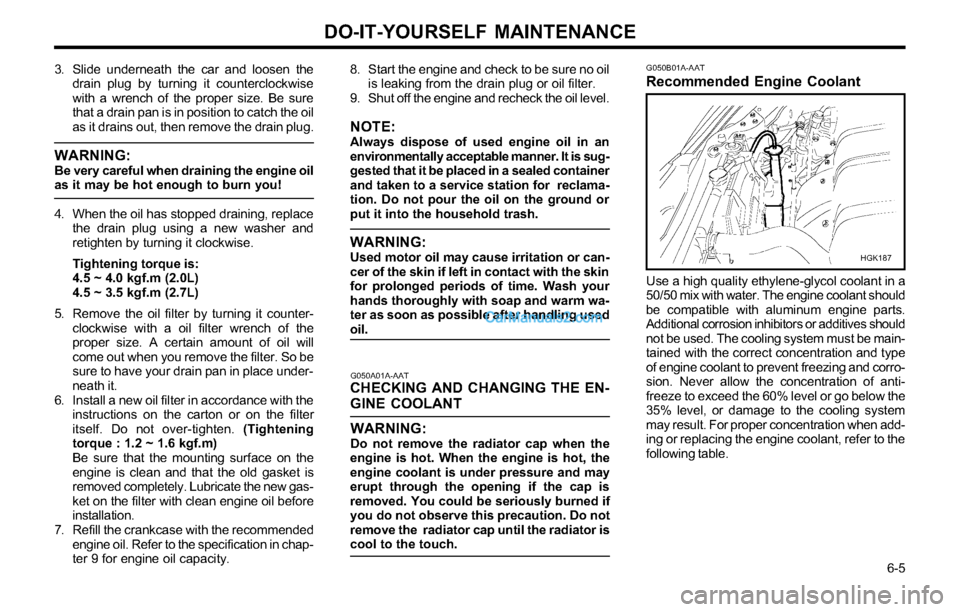
G050B01A-AATRecommended Engine Coolant
Use a high quality ethylene-glycol coolant in a
50/50 mix with water. The engine coolant should
be compatible with aluminum engine parts.
Additional corrosion inhibitors or additives should
not be used. The cooling system must be main-
tained with the correct concentration and type
of engine coolant to prevent freezing and corro-
sion. Never allow the concentration of anti-
freeze to exceed the 60% level or go below the
35% level, or damage to the cooling system
may result. For proper concentration when add-
ing or replacing the engine coolant, refer to the
following table.
HGK187
Page 148 of 169

DO-IT-YOURSELF MAINTENANCE
6-17 manual used by dealership technicians and
while it is highly technical it can be useful in
obtaining a better understanding of your car
and how it works.
G260A02A-AATREPLACING HEADLIGHT BULBS
Before attempting to replace a headlight bulb,
be sure the switch is turned to the "OFF"
position.
The next paragraph shows how to reach head-
light bulbs so they may be changed. Be sure to
replace the burned-out bulb with one of the
same number and wattage rating.
CAUTION:Keep the lamps out of contact with petro-
leum products such as oil, gasoline etc.
NOTE:Grinding noise from the power steering
pump may be heard immediately after the
engine is started in extremely cold condi-
tions (below - 4°F). If the noise stops during
warm up, there is no abnormal function in
the system. It is due to a power steering
fluid characteristic in extremely cold condi-
tions.
Recommended Fluid
Use PSF-3 type fluid
NOTE:Do not start the engine when the power
steering oil reservoir is empty.
G240A01A-AAT
POWER STEERING HOSES
It is suggested that you check the power steer-
ing hose connections for fluid leakage at regular
intervals. The power steering hoses should be
replaced if there is severe surface cracking,
scuffing or worn spots. Deterioration of the
hose could cause premature failure.
G250A01A-AAT
FOR MORE INFORMATION ABOUT
YOUR HYUNDAI
If you desire additional information about main-
taining and servicing your Hyundai, you may
purchase a factory Shop Manual at your Hyundai
dealer's parts department. This is the same
G270A02A-GATHEADLIGHT BULB
Replacement instructions:
HGK225
1. Allow the bulb to cool. Wear eye protection.
2. Always grasp the bulb by its plastic base,
avoid touching the glass.
3. Disconnect the power cord from the bulb
base in the back of the headlight.
4. Remove the dust cover.
5. Push the bulb spring for removing the head-
light bulb.
6. Remove the protective cap from the re-
placement bulb and install the new bulb by
matching the plastic base with the headlight
hole. Install the dust cover after retightening
the bulb spring and reconnect the power
cord.
7. Use the protective cap and carton to dis-
pose of the old bulb.
8. Check for proper headlight aim.
WARNING:The halogen bulb contains gas under pres-
sure and if impacted could shatter, resulting
in flying fragments. Always wear eye pro-
tection when servicing the bulb. Protect the
bulb against abrasions or scratches and
against liquids when lighted. Turn the bulb
on only when installed in a headlight. Re-
place the headlight if damaged or cracked.
Keep the bulb out of the reach of children
and dispose of the used bulb with care.
High BeamLow Beam Turn signal Light
Page 154 of 169

7-2
EMISSION CONTROL SYSTEMS
All Hyundai vehicles are equipped with one or
two monolith type three-way catalytic convert-
ers to reduce the carbon monoxide, hydrocar-
bons and nitrogen oxides contained in the ex-
haust gas. Exhaust gases passing through the
catalytic converter cause it to operate at a very
high temperature. The introduction of large
amounts of unburned gasoline into the exhaust
may cause the catalytic converter to overheat
and create a fire hazard. This risk may be
reduced by observing the following:
WARNING:o Use unleaded fuel only.
o Maintain the engine in good operating
condition. Extremely high catalytic con-
verter temperatures can result from im-
proper operation of the electrical, igni-
tion or multiport electronic fuel injection.
o If your engine stalls, pings, knocks, or is
hard to start, have your Hyundai dealer
inspect and repair the problem as soon
as possible.
o Avoid driving with a very low fuel level.
Running out of gasoline may cause the
engine to misfire and result in damage to
the catalytic converter.
o Avoid idling the engine for periods longer
than 10 minutes.
o The vehicle should not be pushed or
pulled to get started. This may cause the
catalytic converter to overheat and cre-
ate a fire hazard.o Do not touch the catalytic converter or
any other part of the exhaust system
while the catalytic converter is hot. Shut
off the engine, wait for at least one hour
before touching the catalytic converter
or any other part of the exhaust system.
o Remember that your Hyundai dealer is
your best source of assistance.
o Do not stop your Hyundai over any com-
bustible material such as grass, paper,
leaves or rags. These materials might
contact the hot catalytic converter and a
fire might result.
Page 156 of 169

CONSUMER INFORMATION & REPORTING SAFETY DEFECTS
8-2 o Lower-than-recommended tire pressures
cause uneven tread wear and poor han-
dling.
o Higher-than-recommended tire pressures
increase the chance of damage from im-
pacts and cause uneven tread wear.
CAUTION:Always observe the following:
o Check pressures when the tires are cold.
That is, after the car has been parked for
at least three hours and hasn't been driv-
en more than one mile or 1.6 km since
starting up.
o Check the pressure of your spare tire
each time you check the pressure of
other tires.
o Never overload your car. Be especially
careful about overloading if you equip
your car with a luggage rack or car top
carrier.mum pressure shown on the tire sidewall which-
ever is less.
Do not drive faster than 75 mph (120 km/h)
when your car is equipped with snow tires.
I050A02GK-AAT
TIRE CHAINS
Tire chains, if necessary, should be installed on
the front wheels. Be sure that the chains are the
proper size and that they are installed in accor-
dance with the manufacturer's instructions. Refer
to the following information.
To minimize tire and chain wear, do not contin-
ue to use tire chains when they are no longer
needed.
WARNING:o When driving on roads covered with snow
or ice, drive at less than 20 mph (30 km/
h).
o Use tire chains less than 0.39 in. (10mm)
for "16, and "17 tire.
o Avoid sudden stop and turn.
o Tighten firmly to avoid contact with the
vertical body, if you have noise caused
by chaws contacting the body, remove
the chains for damage protection.Tire size
205/55 R 16
215/45 R 17
Snow Chain Thickness
Max. 0.39 in. (10 mm)
Max. 0.39 in. (10 mm)
I060A02GK-AATTIRE ROTATION
Tires should be rotated every 6,000 miles
(10,000 km). If you notice that tires are wearing
unevenly between rotations, have the car
checked by a Hyundai dealer so the cause may
be corrected.
After rotating, adjust the tire pressures and be
sure to check wheel nut tightness.
WARNING:Do not mix bias-ply and radial-ply tires un-
der any circumstances. This may cause dan-
gerous handling characteristics.
I060A01GK
16" Tire17" Tire
I040A01S-AAT
SNOW TIRES
If you equip your car with snow tires, they
should be the same size and have the same
load capacity as the original tires. Snow tires
should be installed on all four wheels; other-
wise, poor handling may result.
Snow tires should carry 4 psi (28 kPa) more air
pressure than the pressure recommended for
the standard tires on the tire label on the driver
side center piller outer panel or up to the maxi-
Page 165 of 169

INDEX
10-2Drive Belts .................................................................................. 6-12, 6-14
Driving
Economical driving .......................................................................... 2-10
Smooth cornering ............................................................................. 2-11
Winter driving ................................................................................... 2-11
E
Emissions Control Systems ................................................................... 7-1
Engine
Before starting the engine ................................................................. 2-2
Compartment ..................................................................................... 6-1
Coolant .............................................................................................. 6-5
Coolant temperature gauge ............................................................. 1-28
If the engine overheats ...................................................................... 3-2
Number .............................................................................................. 8-1
Oil ...................................................................................................... 6-3
Starting .............................................................................................. 2-3
Engine Exhaust Can Be Dangerous .................................................... 2-1
F
Floor mat Anchor .................................................................................. 1-43
Front Fog Light Switch ......................................................................... 1-39
Front Seats
Adjustable front seats .........................................................................1-6
Adjustable headrests ......................................................................... 1-7
Adjusting seatback angle ................................................................... 1-7
Adjusting seat forward and rearward ................................................. 1-7
Lumbar support control ...................................................................... 1-8
Seat cushion height adjustment ......................................................... 1-8
Fuel
Capacity ..............................................................................................9-1
Gauge ............................................................................................... 1-28Recommendations ............................................................................. 1-1
Fuel Filler Lid
Remote release ................................................................................ 1-40
Fuses .................................................................................................... 6-14
Fuse Panel Description .................................................................... 6-20
G
General Everyday Checks .................................................................... 6-3
Glove box ............................................................................................ 1-37
H
Hazard Warning System ...................................................................... 1-33
Headlight Aiming Adjustment .............................................................. 6-18
Headlight Bulb ...................................................................................... 6-17
Heating and Cooling Control
Rotary Type ........................................................................... 1-47 ~ 1-52
Automatic Type ..................................................................... 1-53 ~ 1-58
High-mounted Rear Stop light .............................................................. 1-39
Hood Release ...................................................................................... 1-40
Horn ...................................................................................................... 1-43
I
Ignition Switch ....................................................................................... 2-2
Instrument Cluster and Indicator Lights ................................................ 1-25
Instrument Panel Light Control ............................................................. 1-34
Instruments and Controls .................................................................... 1-24
Intermittent Wiper ................................................................................. 1-32
J
Jump Starting ........................................................................................ 3-1